
selection guide
Phosphate buffers and metal ions
Choose phosphate or PBS only after you name the divalent metals in the mixture. Phosphate precipitates with calcium and is a saline, not every enzyme buffer.
- Author
- EVRINTH Editorial Team
- Published
- 8 October 2026
- Updated
- 8 October 2026
- Reading time
- 8 min
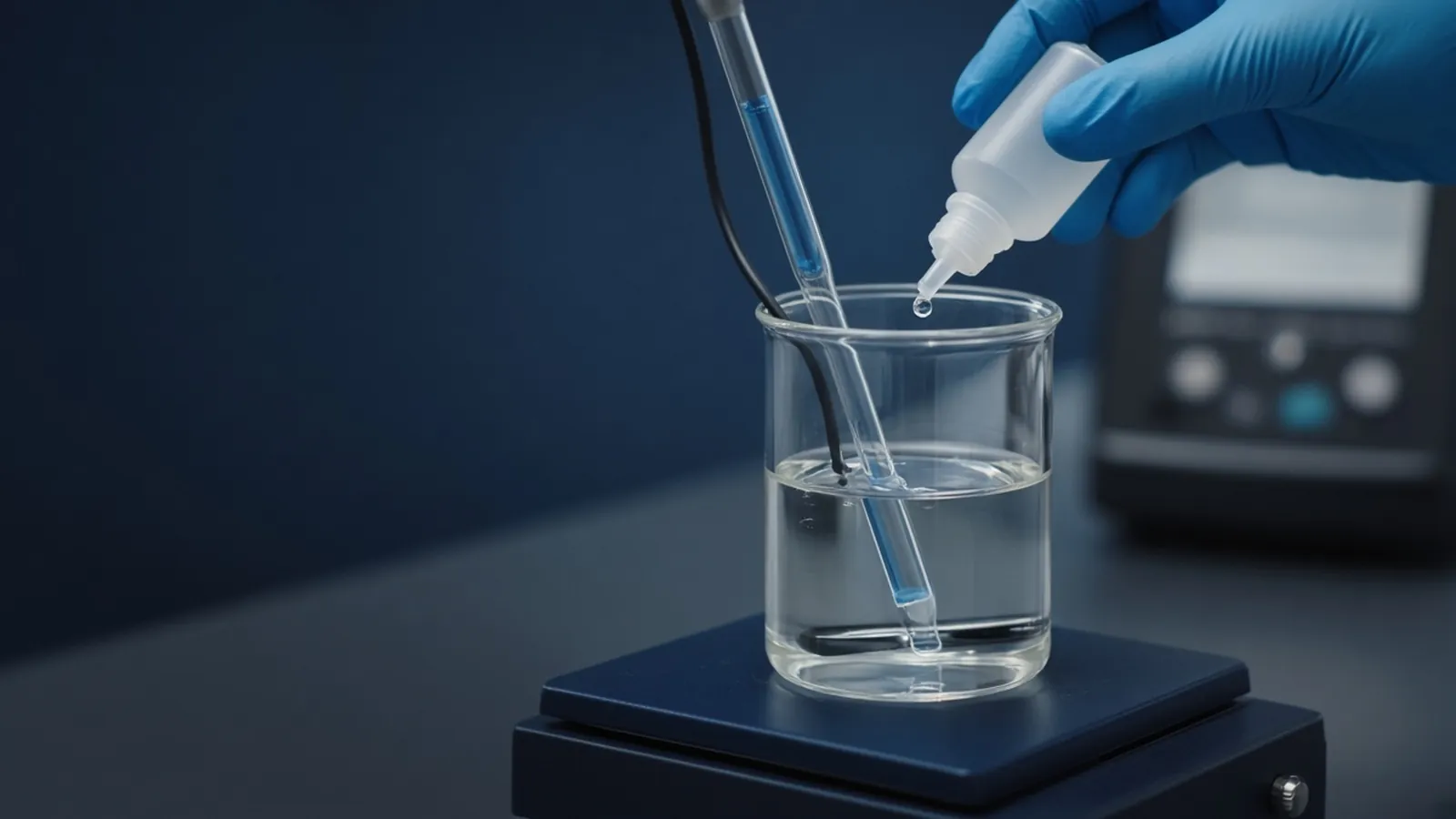
Phosphate is the buffer people reach for because the second pKa sits near 7.2 and the temperature coefficient is quiet beside Tris. That convenience lasts until calcium, magnesium, or another divalent metal has to remain dissolved, or until an enzyme meets a phosphate ion it did not ask for. This selection guide is the criteria for choosing phosphate, choosing PBS, or choosing something else before you buy the salts. Water for the solution is in laboratory water types and where they fail. Making it up and checking the electrode is preparing a buffer and checking pH.
The salts themselves are specified from the reagents and chemicals catalogue. Mixing and the final volume need a real vessel from beakers and flasks. The hydrate, the pH, and the metals that will share the solution go on the quotation request.
The criteria, in the order that avoids a precipitate
Start with the working pH and the temperature. Phosphoric acid's second dissociation, pKa2, is near 7.2 at 25 °C, so the monobasic and dibasic forms buffer best in a window around physiological pH, roughly a unit either side of that pKa. Capacity is poor far from 7.2. If the method wants pH 5.5 or pH 9, phosphate is being asked to work where it is weak. Temperature moves phosphate pH much less than it moves Tris. You still record the temperature. You do not skip the meter.
Next, list every divalent and polyvalent metal that must stay in solution. Calcium is the classic failure: calcium phosphate precipitates, and the solid is more favoured as the pH rises and the phosphate species become more negative. Magnesium can precipitate as well at sufficient concentration and pH. Iron, zinc, and manganese form low-solubility phosphates or tight complexes under conditions that show up as cloudiness, as a missing metal activity, or as both. If the assay needs free calcium or free magnesium, do not select phosphate and plan to "add the metal at the end." The thermodynamics do not wait for your schedule.
Then ask whether phosphate ion itself is a substrate, a product, or an inhibitor in the assay. Phosphatases, some kinases, and a number of metabolic enzymes see phosphate as a participant. A buffer that is invisible to the pH meter can still be visible to the enzyme. PBS adds a further constraint: the chloride and sodium are high, ionic strength is high, and that salt background is its own variable.
PBS is a saline
Phosphate-buffered saline is a wash and dilution solution. A typical research PBS carries sodium chloride near the concentration of physiological saline, a smaller amount of potassium chloride, and phosphate on the order of 10 millimolar, set near pH 7.4. The exact salts differ by recipe. Two bottles called PBS match only when both recipes name the salts and the hydrates. The phosphate is there to hold pH. The chloride salt is there to hold ionic strength. Treating PBS as a universal enzyme buffer imports both, plus any metal binding the phosphate can do.
Use PBS when you are washing cells, diluting a sample that tolerates that salt, or matching a method that was validated in PBS. Do not use it as the default reaction buffer for an enzyme you have not checked. If the protocol says "PBS" and the enzyme supplier says "do not use phosphate," the supplier's buffer identity wins until someone validates the change. Public methods on Addgene show PBS doing wash work and show enzyme buffers named separately. That split is the selection.
Salt form is the purchase decision
Sodium phosphate monobasic and dibasic, potassium salts, and their hydrates are different formulae. The anhydrous dibasic salt and a hydrate with seven waters do not share a mass for one molarity. Write the hydrate that is printed on the bottle you intend to weigh. A buyer who orders "sodium phosphate" will receive a salt the weigher cannot interpret.
The cation matters. Sodium and potassium phosphate buffers are not interchangeable for cells or for enzymes that distinguish those ions. Mixing monobasic potassium with dibasic sodium, which some older recipes do, produces a mixed-cation buffer. That can be legitimate and it must be written down.
Prepare by dissolving below the final volume in water of the grade the assay needs, equilibrating, setting pH with the acid or base that does not import a surprise cation if you can avoid it, and only then making to the mark. If calcium must be present, this is the moment to notice the cloud and switch buffers, before samples are committed. A drop of acid that clears a fresh precipitate has not given you a defined free-calcium activity. It has given you a solid that may redissolve and re-form.
When another buffer is the honest selection
If pH near 7 and a soluble divalent metal are both required, a Good buffer such as HEPES or MOPS is often the class people move to, because those molecules were designed with metal binding as a criterion. They are not inert. You still measure pH, you still watch light and riboflavin for the buffers that form radicals, and you still match the enzyme method. Tris is the other common move, with a larger temperature coefficient and its own metal binding. The selection is a list of constraints, not a ladder of prestige.
If you only needed a wash saline and there is no calcium in the wash, PBS remains a clear choice. If you needed ionic strength without phosphate chemistry, a Tris or HEPES buffer plus a defined sodium chloride or potassium chloride does that job more honestly than PBS. Conductivity can confirm you are in the right gross range against a historical batch. It will not tell you the free calcium.
| Your constraint | A phosphate choice that fits | Walk away from phosphate when |
|---|---|---|
| pH near 7.2 at a stated temperature | Monobasic plus dibasic, hydrate written down | The working pH is far from pKa2 |
| Wash or short dilution, no divalent metal | PBS with the salts named | The enzyme sheet forbids phosphate |
| Calcium or magnesium must stay soluble | Usually a non-phosphate buffer | You see cloudiness or you need a known free metal |
| Low temperature sensitivity | Phosphate is comparatively quiet | You still forgot to record temperature |
| Trace-metal work | Only if phosphate is part of the chemistry | Phosphate is an uncontrolled ligand |
Failure modes after a confident selection
Cloudiness after calcium addition means stop and do not filter the solid away while calling the supernatant the original molarity. You have removed an unknown amount of both ions. A clear solution can still have lowered free metal. If the rate depends on magnesium, compare a non-phosphate buffer under the same pH and a similar ionic strength before you blame the enzyme lot.
A PBS wash that swells or shrinks cells may be a salt error, a wrong hydrate, or a pH that was set at a temperature nobody wrote down. Conductivity against a previous good batch catches the gross salt error. The electrode, calibrated with fresh buffers that bracket pH 7.4, catches the pH error. A tired slope catches neither, because it invents both.
Autoclaving phosphate is usually kinder than autoclaving Tris, and it still does not excuse a recheck if the volume boiled off or if sugars were present to char. Sugars do not belong in the autoclave with the salts when the method can add them later through a filter.
Safety and the limits of a buffer choice
Dry phosphates and the acids and bases used to adjust them are chemical hazards. Wear eye protection. A precipitate is not a waste category by itself; the laboratory's chemical waste rules still apply, and any biological material in the bottle brings the institutional biosafety rules. Choosing PBS for a research wash is not a clinical formulation exercise and not a diagnostic method. This guide does not approve a buffer for use in people.
Specification writing where the room is warm
Heat makes Tris the buffer that drifts fastest, which is why phosphate feels like the safe purchase on a warm afternoon. The purchase is safe only if the metals are compatible. Write the temperature you will measure, even when you expect a small coefficient. Humidity affects the hydrate on the pan: a wet solid is a different mass. Keep the lid on between portions. After a power cut, recalibrate the meter before you release a batch that a cold room or a warm bench will both touch.
What to put on the enquiry
Name the salt, the cation, the hydrate, the grade, and the package size. For a ready solution, name phosphate concentration, any chloride concentration, pH, temperature of that pH, and sterility or nuclease claims as separate lines. Say explicitly whether the solution must tolerate added calcium or magnesium. Ask the certificate to identify the salt form. On receipt, confirm the label, then measure pH on a calibrated meter before the solution meets a metal-dependent assay. The quotation request is where "phosphate" becomes a weighable identity.
Questions from the bench
Why did my phosphate buffer turn cloudy when I added calcium?
Calcium and phosphate form low-solubility salts, and the risk rises as the pH moves toward the more negative phosphate ions. Several other divalent metals do the same class of thing. If the method needs that metal in solution, phosphate is usually the wrong buffer.
Is PBS an enzyme buffer I can use by default?
PBS is a saline: a high sodium chloride background with a modest phosphate, commonly near pH 7.4, used to wash and dilute. Phosphate's second pKa is near 7.2, so the pH window is convenient, and the salt is doing a different job. Many enzymes are inhibited by phosphate or need a metal that phosphate ties up.
What should a phosphate-salt enquiry include?
Name monobasic or dibasic, the cation, and the hydrate. Anhydrous and hydrated sodium phosphates are different masses for the same molarity. State the pH, the temperature, the concentration, and whether calcium or magnesium will share the bottle. Ask for a certificate that identifies the salt you will weigh.
References
Manufacturer names identify published method classes. Trademarks remain with their owners. Catalogue records on this site are independent references for enquiry. They are not a statement of inventory, distribution rights or a supply commitment. This page is educational. It is not medical advice, a diagnostic protocol or a biosafety approval.
Catalogue
Related products and categories
These links follow the subject of the article into published manufacturer references. A listing is a reference for an enquiry, not a statement of stock or distribution rights.
Continue in this cluster
Related reading
 Laboratory water types and where they failResistivity, organic carbon and endotoxin answer different questions. A water grade fails when the assay cares about a contaminant the meter cannot see.Preparing a buffer and checking pHPrepare a buffer at a stated pH and temperature, record the salt form, and treat a drifting electrode or a bad slope as a failed control.A glossary of solution termsDecide which number a recipe means before you weigh a salt: molarity or molality, which percent, normality, buffer capacity, osmolality, or hydrogen-ion