
application
Planning aliquots before the first experiment
Before the first thaw, choose the one-use volume, the freeze-thaw count you will accept, the tube class, and the label.
- Author
- EVRINTH Editorial Team
- Published
- 8 October 2026
- Updated
- 8 October 2026
- Reading time
- 9 min
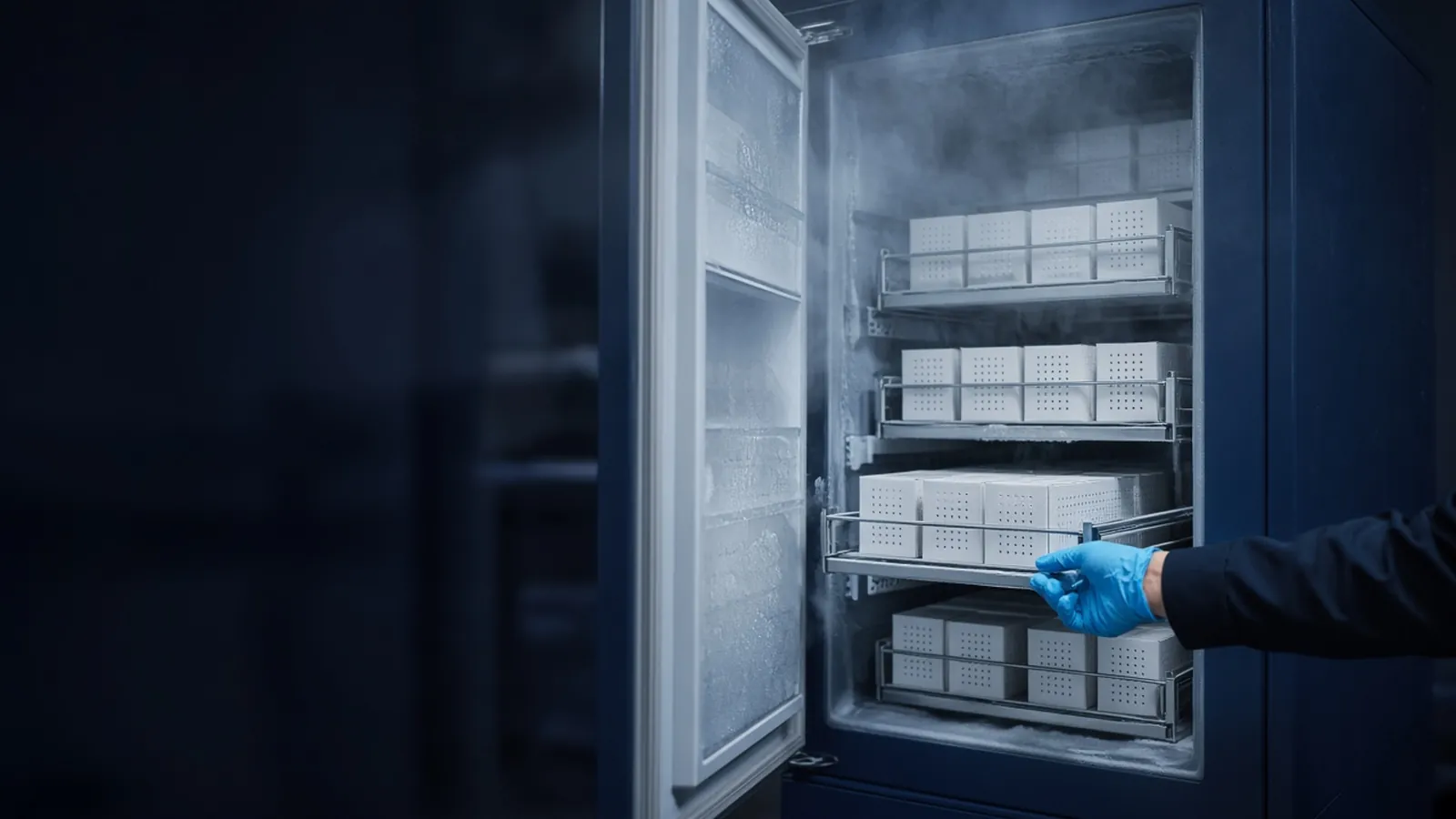
The stock is still frozen. That is the moment to decide how it will be used. Once you thaw it for the first experiment, every later freeze is a cycle you have already begun to spend. This application follows one polymerase stock that a small group will share across a month of PCR, and it notes where a serum control would be planned the same way. The cabinets those aliquots return to are described in storing biological samples from fridge to freezer. The vessel is a plasticware decision in when to use plastic tubes, tips and plates. The dead volume you cannot recover is a pipetting fact from accurate micropipetting technique.
Tubes and cryoboxes come from the laboratory plasticware catalogue. A cabinet that will not frost-cycle the aliquots can be discussed through laboratory procurement and a quotation request.
The experiment you are protecting
Eight PCR runs are planned, on different days, by three people. The polymerase arrives as a single tube, stored at the temperature on its product document, commonly minus 20 for a glycerol stock so the reagent stays liquid or soft. If everyone pipettes from that tube, the stock sees eight thaws plus every accidental warm hour. If you aliquot to the volume of one run before the first of those runs, the stock sees one planned thaw and each run sees its own tube.
The decision has four parts, all made while the parent is still frozen: the volume that matches one use, the number of freeze-thaw cycles you will accept, the tube class, and the label. None of these is a microlitre recipe copied from a vendor. The kit tells you what one reaction consumes. You turn that into a container plan.
Volume that matches one use
One use is the amount one planned experiment consumes, plus the volume the pipette and the tube will not give back. If a run is a set of reactions, one use may be the whole run, not a single well, so that the tube is emptied on the day it is thawed and not refrozen "with a little left". Leftovers that go back to the freezer are an extra cycle you said you would not take.
Write the volume as a laboratory choice: reactions per run, from the protocol you are actually following, times the volume per reaction the protocol states, plus a small excess you have measured with your own pipettes. If you have not measured the excess, do that with water in the same tube class before you touch the enzyme. The pipetting page is why that rehearsal matters. A plan that ignores dead volume produces aliquots that run out mid-plate, and the next move is to thaw a second tube or the parent.
Do not make the aliquots so small that they cannot be labelled and handled with gloves. A volume that looks thrifty and cannot carry an identity is a planning failure. Do not make them so large that each "one use" is secretly three uses and will be refrozen. The size is the experiment, not the smallest tube in the drawer.
Freeze-thaw count as a design choice
You are allowed to decide the number. For this polymerase the group writes: the parent may be thawed once, to aliquot; each daughter may be thawed once, for its run; a daughter is not returned to the freezer after the run starts. That is two cycles in the life of the material that ends up in a reaction, one of them at aliquoting, and it is a choice. Another enzyme, or a cell stock, might be specified for a single thaw total. DNA from the same project might tolerate a more generous number. The SOP says. The product document constrains you when it says the reagent is harmed by cycling. You do not invent a tougher number to save plastic.
Accidental cycles count. A frost-free freezer, a shipper left on a bench, and a tube that thawed in a power cut have spent the budget. Record them against that tube's identity. When the budget is spent, the tube is at the end of its design even if some activity remains. You may run a control the assay already uses. You may not quietly reset the count to zero because the gel looked acceptable once.
Tube class and the label, still before the thaw
Choose the tube for the coldest step the daughter will see. A minus 20 glycerol stock that never travels can live in a tube rated for that cabinet. A daughter that will be sent to a collaborator on dry ice needs a tube and a label rated for that colder journey, and the packing rules are a separate page. Cryovials and microcentrifuge tubes are not interchangeable just because both are plastic. Caps, o-rings, and brittleness are the selection.
Label the daughters before the parent is thawed. Primary identity, link to the parent, date, and concentration if you know it without opening the parent. The label is cryo-rated if the tube will frost. Paper that will fall off in the freezer recreates an unlabelled aliquot, which you will be tempted to replace by thawing the parent again.
Have the rack map ready: which box, which coordinates. Aliquots that go into the freezer unnamed, "to be written up after lunch", are how two people pipette the same daughter and call it two biological replicates.
The afternoon you thaw once
The destination tubes are labelled and open in a cold block if the SOP uses one. You thaw the parent for the minimum time the document allows, mix as it says, dispense the planned volumes, and return only what the design allows. If the design says the parent is now an empty decision, you do not top it up with water and keep it. You record the parent as aliquoted, with the daughter identities listed.
If a dispense fails halfway because a tip blocked, the remaining parent is still in a thaw. Finish the plan or explicitly record a partial aliquot and a parent that has had its one thaw. Do not refreeze the parent and start a new plan tomorrow as if this thaw did not happen.
| Design choice | What you write before the thaw | Failure if you skip it |
|---|---|---|
| One-use volume | Reactions in one run, plus dead volume you measured | Mid-plate shortage, second thaw |
| Freeze-thaw count | A number the SOP will defend for this material | Eight silent cycles of one stock |
| Tube class | Rated for the coldest real step, cap that seals | Brittle tube, leaked glycerol, wrong identity |
| Label and map | Primary code and coordinate, applied before thaw | Unlabelled daughters, parent thawed again to replace them |
The same plan on a serum control
A research serum used as an ELISA control, not as a patient result, follows the same four lines. One use is one plate or one day's plates, from the protocol. The cycle count is whatever the SOP has accepted for that serum. The tube is rated for the freezer you will use, often minus 80 for serum aliquots if that is what you validated, and the label carries a control identity that cannot be confused with a study sample. You plan that before the first plate, not after the parent has already been thawed for a pilot and refrozen unnamed.
If the pilot already happened, the branch is the honest one. Aliquot the remainder now. Mark the parent history. Do not call the daughters unopened controls.
Where the plan fails in ordinary weeks
Three people share one tube because aliquoting felt slower than PCR. The cycle count is whatever the busiest week required. The plan has to be in place before the first person is in a hurry, or it will never win.
Aliquots are made and then left in a dry-ice shipper overnight because the freezer was full. The shipper is not the address in the plan. Either the plan includes a real coordinate with space, or you do not thaw yet.
The volume was copied from a different kit's example table. Your reactions are a different number. Recalculate from the protocol in your hand. A vendor table is not your dead volume.
A power cut spends a cycle on the whole box. The aliquots still help, because you lose one daughter's worth of ambiguity rather than the only stock, but only if you record the excursion against each identity and quarantine as the storage page describes. Planning does not make a warm box fine. It makes the loss smaller and the record clearer.
Safety and the limit of the example
The polymerase example is a research reagent. The serum example is a research control. Neither is a diagnostic storage protocol. Material that is infectious or human-derived keeps the containment and the consent rules the institution already set. The WHO laboratory biosafety manual is the frame. Aliquoting does not declassify a tube.
Glycerol and dimethyl sulfoxide, if the stock uses them, are chemical exposures. Gloves appropriate to the liquid are part of the thaw, not an extra. Do not aliquot on an open bench a material the biosafety office has placed in a cabinet.
What the enquiry needs
State the tube class, the temperature class, and that you need labels which survive that cold. State that the cabinet must not add freeze-thaw cycles of its own if you are storing glycerol stocks at minus 20. Send that as a quotation request. Do not ask anyone to calculate your one-use volume for you. That number comes from the protocol you run and the pipette you hold, before the parent ever leaves the freezer.
Questions from the bench
Why decide the aliquot size before the stock is thawed?
The first thaw is already a freeze-thaw cycle. If you thaw the stock to discover the volume by pipetting and then refreeze the remainder, you have spent a cycle on planning. Decide the one-use volume, the number of cycles you will accept, the tube, and the label while the stock is still frozen. Then thaw once, with the destination tubes ready.
How many freeze-thaw cycles are acceptable?
The number is a design choice written in the SOP for that material, not a universal constant. Some enzymes lose activity faster than some DNA preparations. Some cell stocks are specified for a single thaw. Pick the number you are willing to defend, aliquot so routine use stays inside it, and record a cycle when a warm afternoon or a frost-free cabinet spends one you did not plan.
What tube class belongs in the plan?
A tube rated for the coldest temperature in the real life of the aliquot, including a dry-ice journey if there will be one. Polypropylene microcentrifuge tubes and cryovials are different tools. The plasticware page compares them. A tube that becomes brittle, or a cap that leaks glycerol, is the wrong class even if the volume was calculated perfectly.
The stock was already thawed for a pilot. Is the plan ruined?
The plan is late, not useless. Aliquot now, record that the parent has already had one thaw, and give each daughter its own identity linked to the parent. Do not pretend the daughters have a zero history. Do not refreeze the parent as if it were still the unopened stock.
References
Manufacturer names identify published method classes. Trademarks remain with their owners. Catalogue records on this site are independent references for enquiry. They are not a statement of inventory, distribution rights or a supply commitment. This page is educational. It is not medical advice, a diagnostic protocol or a biosafety approval.
Catalogue
Related products and categories
These links follow the subject of the article into published manufacturer references. A listing is a reference for an enquiry, not a statement of stock or distribution rights.
Continue in this cluster
Related reading
Storing biological samples from fridge to freezerFridge, minus-20, minus-80 and nitrogen storage slow different kinds of damage. A warm box is a quarantine decision, not a hope. When to use plastic tubes tips and platesWhen polypropylene tubes, pipette tips and polystyrene plates are the right vessel, and when solvent or volume still belongs in glass.
 Accurate micropipetting techniqueHow an air-displacement micropipette delivers a volume, how forward pipetting uses the two stops, and why temperature belongs in the result.