
glossary
Plasmid stability in a liquid culture
What segregational stability means in liquid culture, and why a cloudy cloning-strain flask can still give you no plasmid.
- Author
- EVRINTH Editorial Team
- Published
- 8 October 2026
- Updated
- 8 October 2026
- Reading time
- 7 min
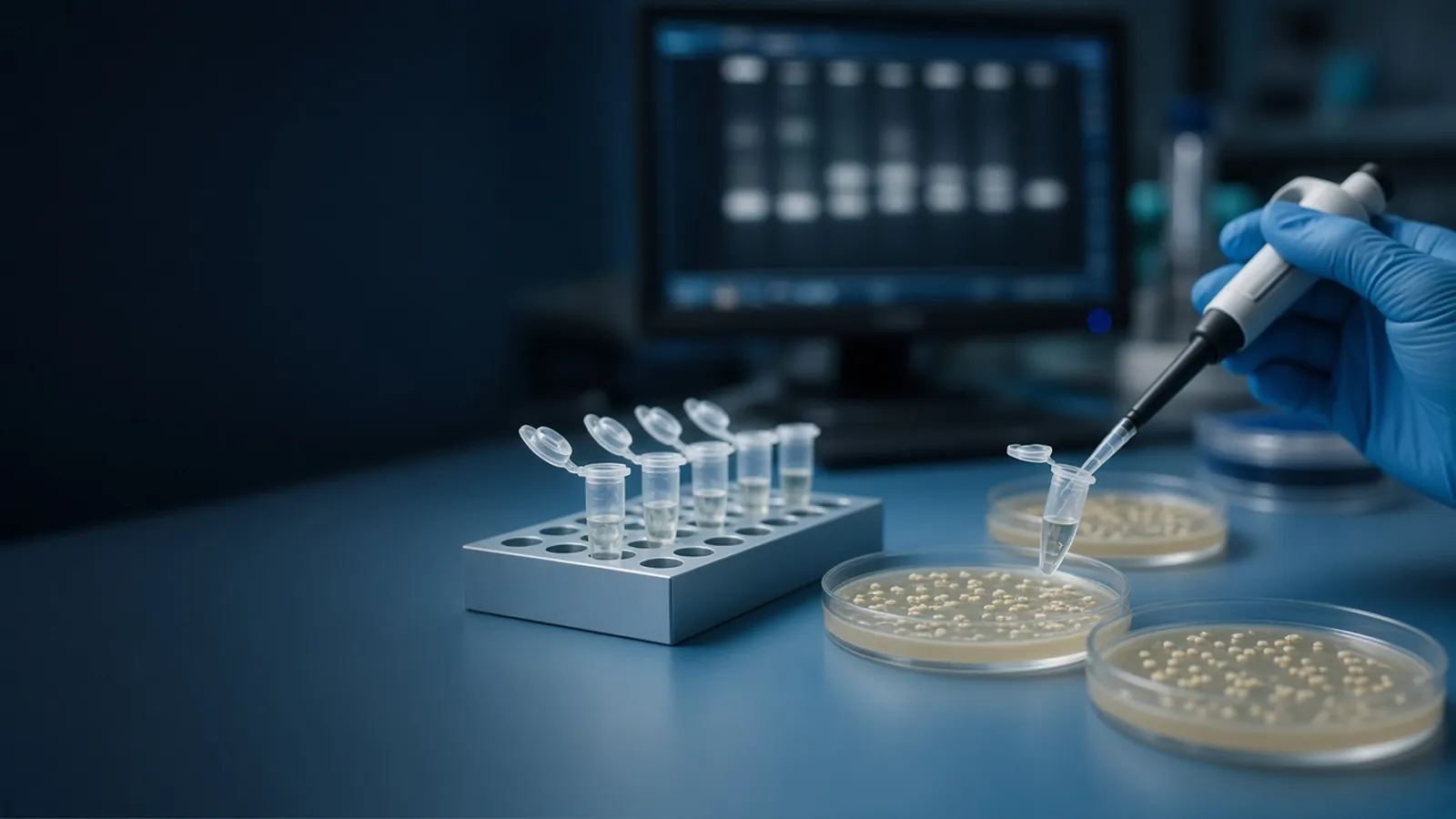
A liquid culture can be gloriously cloudy and still be the wrong cells. The decision this glossary supports is whether the flask you are about to miniprep still holds the plasmid, or only the descendants that threw it away. Growing and transforming the strain is covered in bacterial culture and transformation. How the insert was built and checked is plasmid cloning from insert to colony. The drug you rely on to keep the plasmid is explained in antibiotic selection and blue-white screening.
Medium and antibiotic classes are specified from the reagents and chemicals catalogue, on the molecular biology pathway. A question about the insert sequence can be framed with the custom gene synthesis reference. Use the quote request when you need a host or a marker specified in writing. A method can be discussed.
Cloudy means biomass
Optical density and a thick pellet report how many cells you grew. They do not report how many of those cells carry the circle of DNA you care about. Plasmid DNA is a small fraction of the biomass even when every cell has it. When most cells have lost it, the prep fails quietly: genomic background, no supercoiled band, a nanodrop number that was mostly something else. The vocabulary below is how you talk about that failure without blaming the kit first.
Public cloning language is summarised in the Addgene molecular biology reference. Protein products of marker genes can be looked up as sequences in NCBI Protein, which tells you what the resistance protein is, not whether your flask still contains it.
Segregational stability
Segregational stability is the inheritance of the plasmid at division. A cell with a hundred copies will usually hand some copies to both daughters even without a dedicated partitioning system. A cell with one or two copies will, at a measurable rate, produce a daughter with zero. That daughter is a plasmid-free segregant. It is not a mutant you did anything dramatic to create. It is the arithmetic of low copy number.
Once a plasmid-free segregant exists, its future depends on growth rate. If the plasmid is nearly free to carry, the segregant may stay rare for many generations. If the plasmid is a burden, the segregant doubles faster and takes over the flask. Liquid culture is where that takeover is invisible. On a plate with antibiotic, the segregant would not have formed a colony. In broth without antibiotic, it becomes the pellet.
Plasmid burden
Burden is the extra work the plasmid imposes: DNA to replicate, marker protein to make, and any insert that is expressed when you wish it were quiet. A strong promoter leaking a toxic product is a large burden. A big, high-copy empty vector can be a milder one and still matter over a long culture. Burden is why "it grew fine" is not evidence of stability. The cells that grew finest may be the ones that quit the plasmid.
Lower temperature, a lower-copy origin, or a tighter promoter are structural answers when a construct is known to be hard to keep. They are chosen at the design stage. They are not restored by shaking a lost culture harder.
Antibiotic selection in liquid
Selection in liquid means the drug is in the broth at a level that stops plasmid-free cells, for the whole time you grow them. It only works while three things remain true. The molecule matches the marker. The molecule is still chemically active. The marker is being expressed. A bla plasmid in kanamycin broth is not under selection. An ampicillin broth that sat warm all week may not be either. A culture so dense that a beta-lactam has been destroyed by the enzyme from the resistant cells can also lose selection late in growth: the drug is gone, and any segregant born in that last stretch is free to expand. That is one reason a fresh colony into a fresh selective broth is safer than serial dilution of an old flask into another old flask.
The Addgene protocol for inoculating a culture starts from a colony for this reason. A loop from a mixed liquid is how you preserve the takeover.
A toxic insert
A toxic insert is a sequence the host grows better without. Under antibiotic, cells often cannot afford to lose the whole plasmid, because the marker is on it. They can afford to delete the insert, invert a promoter, or pick a mutation that stops expression. You still have resistance. You no longer have the gene. The gel may show a smaller plasmid. A digest that should have cut out a fragment shows the parental backbone instead. Sequence is the confirmation. Turbidity will not hint at this. The culture looks healthy precisely because the toxin is gone.
Do not keep "the fast flask" and throw away "the slow flask" when the insert is known to be hard on the cell. Speed can be the deletion.
Terms and the result you should expect
| Term | Meaning in the flask | What the gel or the plate shows |
|---|---|---|
| Segregational stability | Both daughters inherit the plasmid | Colonies on selective agar after the broth is plated out |
| Plasmid-free segregant | A daughter that received no plasmid | Grows in plain broth; fails on the antibiotic plate; no plasmid band |
| Plasmid burden | The plasmid slows growth | Plasmid-free cells become a larger share of the culture if the drug is absent |
| Selection in liquid | Active antibiotic matching the marker | Pellet still yields plasmid; a no-antibiotic sister flask may not |
| Structural instability | Insert deleted or silenced; marker kept | A band of the wrong size, or a plasmid that transforms but does not express |
| Copy number | How many plasmids per cell | Low copy is easier to segregate away and gives less DNA per pellet |
How a prep goes empty
Start from a single colony that grew on fresh selective agar. Inoculate selective broth. Do not passage a non-selective overnight "because it was already dense". If the miniprep fails, restreak the glycerol stock or the colony plate onto antibiotic again. Growth there means the stock still has the marker. Failure there means you archived the segregant. A digest of an unexpected size means the marker survived and the insert did not. Sequence before you repeat the expression.
A control plasmid you trust, grown in parallel with the same antibiotic lot, separates a bad drug stock from a bad construct. If the control yields plasmid and yours does not, the broth recipe is innocent. If neither yields plasmid, the antibiotic in that bottle is the prime suspect.
Institutional limits stay where they were
Nothing about plasmid loss changes the organism. These are K-12 cloning strains under the containment already set. A culture that lost its plasmid is still a live culture. Inactivate it. Do not tip it out because the gel was blank. This page is not medical advice and not a method for maintaining a virulence plasmid or any construct outside the approved list. The NCBI Bookshelf is a public molecular-biology reference for the cell biology behind division and growth. It is not an approval to change host.
A flask that sat through a power cut
When the shaker stops, aeration stops and growth becomes a stress. Cells that drop a burden can be the ones that cope. When the power returns, the culture may look recoverable and be enriched for segregants. Do not miniprep it and call the band "the clone" if a band even appears. Go back to a selective plate. In a hot room, ampicillin in a broth that is already dense is particularly easy to exhaust. A sister flask with a more stable marker, where the map allows, is a diagnostic, not a casual swap of drugs.
What to specify
Name the host, the origin of replication if you know it, the marker, the insert's tendency to slow growth, and whether cultures must be started from single colonies on selective agar. Ask for medium and antibiotic specifications that match that marker. The quote request carries that note. A method can be discussed. The custom gene synthesis reference is appropriate when the burden is the sequence you are still designing. Read it as a prompt for the enquiry, not as a claim that the gene is already in production.
Questions from the bench
Why did my overnight look dense and the miniprep gel show no plasmid?
Cloudiness is cells, not plasmids. If the antibiotic was left out, or had already degraded, daughters that lost a burdensome plasmid can outgrow the cells that kept it. You harvest a pellet of plasmid-free bacteria and the gel lane is empty of the band you expected. Restreak the stock on fresh selective agar and start the broth from a colony that still grows there.
What is segregational stability?
It is the chance that both daughter cells inherit the plasmid when the cell divides. High-copy plasmids are often inherited by chance alone. Low-copy plasmids sometimes carry partitioning functions because chance is not enough. Neither kind is a promise once you remove selection and the plasmid slows growth.
Can a toxic insert disappear while the resistance gene stays?
Yes. That is structural instability rather than a total cure. Cells that delete the toxic region, or that silence the promoter, keep the marker and keep growing under the antibiotic. The prep still shows a plasmid, but it is smaller or mutant. A restriction digest or a sequence read catches what the turbidity cannot.
Should every liquid culture of a cloning strain contain antibiotic?
If you need the plasmid at the end of the culture, yes, unless you have a specific reason to omit it and a test that the plasmid is still there. Selection in the plate you streaked yesterday does not protect a broth you inoculated today without the drug. Match the molecule to the marker, and use a stock you still trust.
References
Manufacturer names identify published method classes. Trademarks remain with their owners. Catalogue records on this site are independent references for enquiry. They are not a statement of inventory, distribution rights or a supply commitment. This page is educational. It is not medical advice, a diagnostic protocol or a biosafety approval.
Catalogue
Related products and categories
These links follow the subject of the article into published manufacturer references. A listing is a reference for an enquiry, not a statement of stock or distribution rights.
Continue in this cluster
Related reading
 Bacterial culture and transformationHow non-pathogenic E. coli cloning strains are grown and how plasmid DNA is introduced, with the controls that make a colony meaningful.Plasmid cloning from insert to colonyHow an insert becomes a plasmid, a colony and a verified clone, and which checkpoint fails when the plate is empty or the insert is wrong.A glossary of bench microbiology termsPlain definitions of colony, lawn, streak, pellet, transformant and the other bench words a cloning afternoon depends on.