
troubleshooting
Power cuts and a freezer alarm
A freezer alarm only helps if a written response names who is called, how long the door stays shut, and where the backup sits.
- Author
- EVRINTH Editorial Team
- Published
- 8 October 2026
- Updated
- 8 October 2026
- Reading time
- 9 min
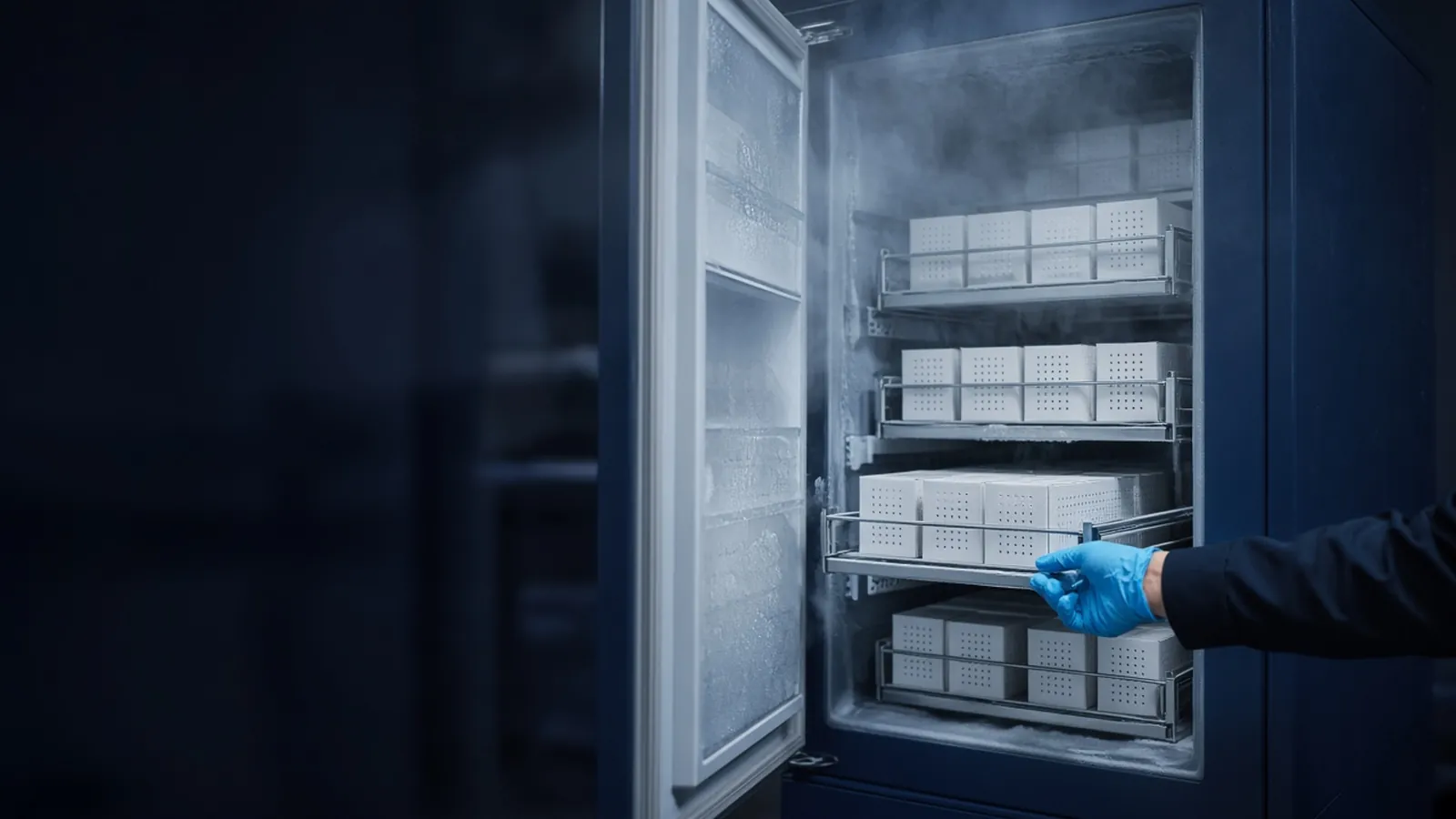
The symptom is the alarm, or a dark display, or a compressor that has gone quiet. The control is not a guess about how long the cabinet can cope. The control is a written response you can carry out while you are half awake: who is called, how long the door stays shut, and where a backup of the same temperature class sits. This troubleshooting page starts from those symptoms. It does not publish survival times for any freezer model. How storage classes differ in ordinary weeks is storing biological samples from fridge to freezer.
Alarm contacts, displays, and the cabinet are instrument questions in scientific instruments. Boxes you would actually move are laboratory plasticware. Labels for a quarantine box are laboratory consumables. Writing the response into a purchase is a laboratory procurement conversation and a quotation request.
Read the symptom before you touch the handle
A local beeper means the cabinet, or its monitor, thinks something left the band you set. A remote message means a nominated phone has the same news. A blank panel can mean a power cut, a tripped breaker, or a failed display on a cabinet that is still cold. Those are different faults. The shared rule is that the door stays shut until the written response tells you otherwise.
Listen and look outside the cabinet. If the room lights are out, you are in a power cut and neighbouring freezers may be failing together. If the lights are on and one compressor is silent, you may have a breaker, a plug, or a failed unit. Resetting a breaker once, if the response allows it and you can do it safely, is a different act from propping the door to "see if the racks look frosty." Frost on the outside of the door tells you little about the core temperature of a full rack.
If the alarm is a high-temperature alarm and the display still works, write down the number and the time. That note is the beginning of the record. Do not wait until morning to recall what it said. If the display is dead, write that down too. Absence of a number is data.
The response that had to exist yesterday
A useful page on the freezer names three things in sentences a new person can follow.
First, who is called. A primary name and a second name, with a way to reach them that does not depend on the laboratory's own server if the outage is wider than the plug. "Tell the group chat" is not a call plan when the building network is down.
Second, the door. It stays shut. The response should say that in plain language, because the natural impulse is to check the samples with your eyes. Eyes require an opening. An opening exchanges the remaining cold air for room air. The longer the search, the more you spend the only buffer you have.
Third, the backup. A named cabinet of the same class, already switched on, with space and a map, or a written alternative such as a vented dry-ice hold for those materials whose documents allow it. A backup that is itself off, full, or two buildings away without a key is not a backup. Walk the route once on a normal day.
If that page does not exist, the incident is a bad time to compose it. Keep the door shut, call the most responsible person you can actually reach, and write what you did. Then write the page before the next cut. Laboratories that face interrupted electricity need this page more, not a more optimistic hold time.
| Symptom | Likely situation | Next check |
|---|---|---|
| Beeper or remote alarm, display still on | Temperature left the band, or the probe did | Record time and reading. Door stays shut. Call the named person |
| Dark display, dark room | Power cut affecting more than one cabinet | Confirm the scope. Do not open each freezer to compare them |
| Dark display, lights on | Breaker, plug, or cabinet fault | Check the breaker if the response allows. Keep the door shut |
| Alarm stops and compressor restarts | Power or cooling returned | Quarantine anything that crossed the action limit. Restart is not a clearance |
| Somebody already opened the door to look | Warm air was added on purpose | Note the duration. Treat the record as worse, not as reassurance |
| Backup cabinet also alarming | The rescue address has failed | Stop moving boxes. Use the dry-ice branch only if the SOP already wrote it |
What not to invent while you wait
Manufacturers sometimes describe how a loaded cabinet behaves with the door closed after power is removed. That description belongs to that model, that load, and that test. It is not a number you may transplant to the freezer in the corridor. This page refuses the transplant. An empty cabinet warms faster than a full one. A cabinet that was opened warms faster than one that was not. A hot room steals cold faster than a cool room. Those are directions, not a timetable.
Your SOP can set an action limit in advance, from the product documents and from advice you trust for that cabinet. During the cut you compare the trace with the limit. You do not derive a new limit from anxiety. If no probe was logging, say so. "It was only off for a bit" is not a trace. NIST's laboratory metrology material is a public reminder that a temperature claim wants a measurement method. A feeling about the door seal is not that method.
After the power returns
Leave the door shut while the cabinet pulls down, unless the response told you to move stock because a limit was already passed. Moving stock into a cabinet that is still warm adds a second injury. If you do move, move to a backup that is already at the right class, in one planned opening, using the map so you are not searching.
Mark every box you cannot clear. Quarantine means those tubes do not re-enter experiments quietly. A functional check on expendable material can support release when the method has one: a transformation with competent cells you can spare, a control digest, a nucleic-acid integrity check you already trust. The product document still outranks a single passed control if the document says to discard after an excursion.
Write the incident where the next user will see it: start time, return time, warmest recorded temperature if you have one, whether the door was opened, and the quarantine decision. A compressor that sounds healthy is the last line in that note, not the first.
Dry ice is a branch with its own failure
Some responses say: if the backup freezer is unavailable and the outage continues, transfer named material onto dry ice in a vented insulated container. That branch is legitimate only when it was written in advance, the material's document tolerates that temperature, and the room can accept the gas. Solid carbon dioxide burns skin and displaces oxygen. A sealed plastic drum is a pressure hazard, not a shipper. The decisions and the injuries are set out in dry ice packing for sample shipments.
Do not add this branch during the emergency because the dry ice happens to be in the building. A person who has not been told about ventilation will put the container in the smallest closed office. That is a second incident.
A worked night call
The remote alarm reaches you at 01:10. The message names freezer B, the minus-80. You do not drive in and open it. You call the second person named on the card because you are off site, and you ask them to confirm the room power, record the display, and leave the door closed. They find the building dark. They confirm two other freezers are also dark and do not open those either. At 06:40 the power returns. Displays show a warm peak on freezer B and a lesser peak on the full minus-20, which was not opened. The SOP action limit for the minus-80 is crossed. Those racks are quarantined. The minus-20 stays in use because its record stayed inside the limit the laboratory had already written. Nobody publishes a moral about "these freezers always last until morning." The full cabinet and the shut door are why there was a record to read.
If freezer B had been opened at 01:30 for a visual check, the trace would be harder to defend and the warm peak would likely have been worse. The troubleshooting step you skip is the visual check.
Safety and biological material
An alarm does not change the biosafety level of what is inside. A leaking tube in a warming cabinet is a spill of that material. Follow the laboratory spill and call-out rules. The WHO laboratory biosafety manual and the CDC BMBL treat facilities and emergency response as part of biological risk management. They are educational references here, not a local permit, and this page is not medical advice for someone who touched a cold rack.
Do not bypass interlocks or climb into a walk-in that has lost ventilation. Oxygen displacement and confined spaces are separate hazards from a small upright freezer. If the alarm is on a walk-in, the response must already say who may enter.
What to specify so the next alarm is usable
Ask for a local alarm and a remote contact that reaches a person, not only a screen inside the building. Ask what happens to the temperature record during a power cut: a logger with its own battery is a different tool from a display that dies with the mains. Ask for the quarantine labels and boxes you will need on the morning after. State, in the enquiry, that you will not accept a verbal hold time in place of a written response. The cabinet can be discussed. The response has to be yours.
On commissioning, run a drill that does not involve unplugging a full precious freezer if the manufacturer forbids it. At least walk through the call, the door rule, and the backup key. A drill that fails on a Tuesday is cheaper than a discovery on the night the compressor stops.
Questions from the bench
How long will a particular ultra-low freezer stay cold after the power fails?
This page will not invent that time. Hold behaviour depends on the model, the load, how full the cabinet is, the room, and whether anyone opened the door. The manufacturer may publish a characteristic. Your control is the alarm plus a written response, not a number remembered from a different cabinet.
Should we open the door to check the samples with a handheld thermometer?
Not as a first move. Opening dumps the cold air you still have. Read the external display or the remote alarm, call the person named in the response, and keep the door shut. A probe that already lives inside the cabinet, logged without opening, is the measurement. A door-open survey is how a short cut becomes a long thaw.
Does a compressor that restarts mean the samples are fine?
No. It means the power returned. Samples that warmed past the action limit your SOP already set stay quarantined until a record or a functional check clears them. If you never set a limit, do not invent one during the incident. Quarantine and decide in daylight from the trace and the product documents.
Where does dry ice fit in a power-cut response?
Only as a temporary coolant the SOP already named, in a vented container, in a ventilated space, for material whose documents allow that temperature. It is not a storage address and it is not safe in a closed room. Packing hazards are explained in the dry-ice shipment page. Do not improvise a sealed box.
References
Manufacturer names identify published method classes. Trademarks remain with their owners. Catalogue records on this site are independent references for enquiry. They are not a statement of inventory, distribution rights or a supply commitment. This page is educational. It is not medical advice, a diagnostic protocol or a biosafety approval.
Catalogue
Related products and categories
These links follow the subject of the article into published manufacturer references. A listing is a reference for an enquiry, not a statement of stock or distribution rights.
Continue in this cluster
Related reading
Storing biological samples from fridge to freezerFridge, minus-20, minus-80 and nitrogen storage slow different kinds of damage. A warm box is a quarantine decision, not a hope. Dry ice packing for sample shipmentsDry ice keeps non-infectious research samples cold and can burn skin or displace air. Carrier rules and infectious-substance law still govern shipping.A glossary of cold-chain termsSetpoint is not air temperature, and a phase-change pack is not every coolant. Compare the cold-chain pairs labs treat as one word.