
guide
Questions before a cold-storage enquiry
Write volume, temperature class, alarm, backup power, footprint, inventory format, and documents before you enquire. Leave price out.
- Author
- EVRINTH Editorial Team
- Published
- 8 October 2026
- Updated
- 8 October 2026
- Reading time
- 10 min
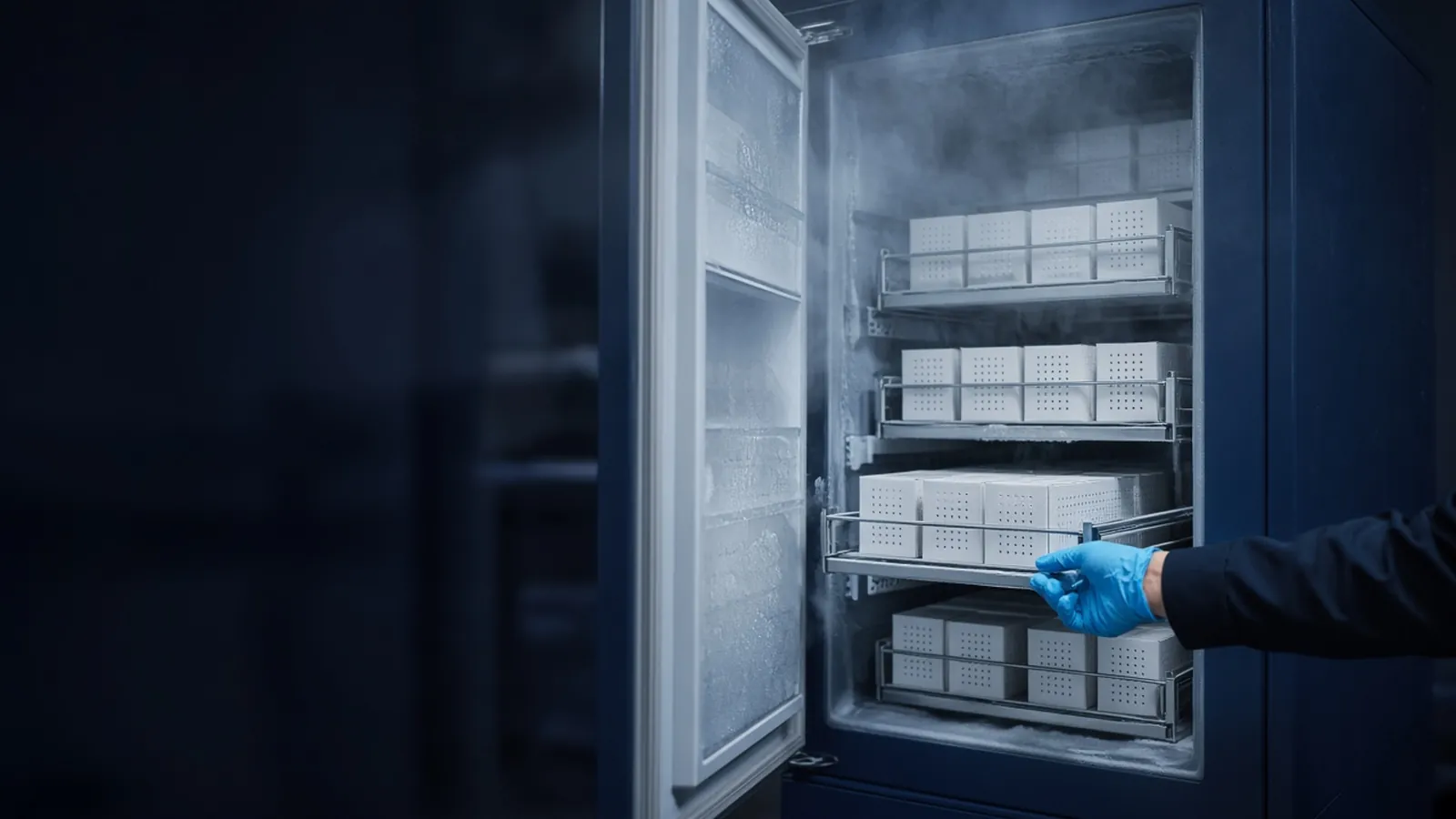
A cold cabinet is specified by the job it must do, written down before anyone asks for a quotation. Volume, temperature class, the alarm you expect, the backup-power behaviour you are willing to rely on, the floor space, the inventory format, and the documents you will actually read are that job. Price is not part of the scientific sentence, and neither is a promise about delivery dates. How the temperature classes differ once the cabinet exists is covered in storing biological samples from fridge to freezer. How a sourcing note is structured in general is in how to write a laboratory sourcing enquiry.
The boxes and racks that fill the cabinet are in the laboratory plasticware catalogue. The discussion of a cabinet as a procurement object sits at laboratory procurement. The place to send the finished lines is a quotation request.
Who the question list is for
Use it when a research group, a core facility, or a procurement colleague is about to ask for a fridge, a minus 20, an ultra-low freezer, or a nitrogen vessel. The decision you are supporting is whether the request describes a machine that can hold your samples under your alarm rules. If you cannot answer one of the questions, the branch is to pause the enquiry, not to send a model name and hope.
This is a research-laboratory specification. It is not a clinical blood-bank qualification and not a biosafety approval.
Volume: what you hold, not a nickname
Write the amount of material as your inventory already counts it. A group that stores eighty-one-place cryoboxes should say how many boxes must be reachable, and on how many racks. Internal litres matter because they are what a cabinet maker can respond to, but litres without a box format hide a rack that does not match your vials.
Include growth only if you can say where it comes from: a study that will add a stated number of boxes, not "we will probably need more". Split volume by temperature class. Eighty boxes at minus 80 and a shelf of enzymes at minus 20 are two machines, or one room with two machines. They are not one adjective, "cold storage".
If the volume includes material that must stay in nitrogen vapour, say vapour, and say that those vials are not part of the ultra-low count. Mixing the counts is how a mechanical freezer is asked to impersonate a dewar.
Temperature class: one primary job
Name the class: controlled room-temperature is a different enquiry; refrigerator near 2 to 8 degrees Celsius; minus 20; minus 80; cryogenic liquid or vapour. If you need a range, say the range the samples are allowed, from their product documents, not a wish that colder is always better.
Say whether the cabinet must avoid frost-free warm cycles. Enzymes and glycerol stocks are a common reason to refuse a domestic cycle. Nucleic acids have their own split between minus 20 and minus 80. Point at the sample types in a phrase, without pasting a vendor's storage table into the enquiry as if you had validated it.
Calibration and mapping come after the class is chosen. NIST's laboratory metrology resources are a reminder that a displayed setpoint still needs a measurement story. You can ask, in the enquiry, whether a mapping summary exists. You cannot ask the summary to replace a test in your room.
Alarm and backup power, written as requirements you own
The alarm requirement is yours. Write who is called, at what hours, by what channel, and what temperature and delay count as a call. A local buzzer that nobody hears from the street is a different requirement from a contact that your building system already knows how to watch. Ask the enquiry to confirm which of those the cabinet provides. Do not write that the seller will staff your nights.
Backup power is also yours to define. One laboratory's requirement is "the cabinet accepts this supply and alarms when the supply fails, and we will move boxes if the outage exceeds the hold we have measured". Another laboratory's requirement is "the building has a supported circuit, and the cabinet must be able to restart without a person on site". Both are honest. A line that says samples are safe through any outage is not a requirement you can check.
Ask what the electrical rating is, in the terms the manual uses, so facilities can say whether the circuit exists. Ask how the compressor behaves when power returns: some cabinets need a person, some restart. That behaviour belongs in your call-out plan.
A second freezer nobody can unlock is not a backup. If your requirement includes a destination for moved boxes, name the destination class and the access rule in the same note. The enquiry for the new cabinet should not pretend a locked spare already solved the night.
Footprint: the room is part of the machine
Write the width, the depth with the door open, the height, and the clearance the maker asks for ventilation. Ultra-low cabinets reject heat into the room. A small equipment room without a plan for that heat will run hot, and the cabinet will work harder. You do not need a regional climate table to say "this room is warm and poorly ventilated; state the heat rejection and the clearance".
Write the floor, the doorway the crate must pass, and whether a nitrogen vessel needs a ventilated bay rather than a cupboard. Asphyxiation is a siting question. The WHO laboratory biosafety manual treats gases and facility design as part of a local programme. Your safety office decides the bay. The enquiry should not site a dewar in a sealed office because the office was free.
Inventory format: the map you already run
Name the rack, the box, and the position system. If positions are barcoded, say what must be readable with gloves and frost. If the map is a spreadsheet with freezer, shelf, rack, box, and coordinate, say that the hardware has to serve that sentence. A cabinet full of baskets you cannot label is a search problem you will pay for in door-open time.
Plasticware belongs here. State the vial class, including whether any vials must tolerate nitrogen liquid or only vapour. Link that class to the plasticware catalogue so the cabinet and the tubes are one specification, not two accidents.
Documents: what you will read before you accept
Ask for the user manual, the alarm and probe description, the electrical information, and any installer guide. Ask whether a temperature mapping was performed on that model and what load it used. Treat the answer as a document you will compare with your acceptance criteria.
Your qualification is still your document: criteria, load, room, and the checks you run. A brochure holding time for a closed door is an input, not a completed performance qualification. Say that explicitly so nobody files the brochure as if the cabinet had been qualified in your building.
| Question | Why it changes the cabinet | What not to write |
|---|---|---|
| Volume | Litres and box count select size and rack pattern | A nickname, or one number for two temperature classes |
| Temperature class | Fridge, minus 20, minus 80, and nitrogen are different machines | Colder is better, with no sample document |
| Alarm | Defines the summons you can actually answer | The seller will watch the freezer |
| Backup power | Defines ride-through or a move, as your rule | Samples are safe through any outage |
| Footprint | Door, heat, ventilation, gas hazards | The empty corner, unmeasured |
| Inventory format | Racks and labels decide search time and fit | Boxes to be chosen later |
| Documents | Manual and mapping summary inform your qualification | The brochure is the qualification |
A request that had to be sent back
A group asks for "an ultra-low, as soon as possible, for the new cohort". The cohort is forty boxes. The room they have in mind is an alcove with no measured width and a domestic socket. They have no alarm plan, because the last freezer has a key that only one postdoctoral researcher holds, and that person travels.
Send it back to the list. Forty boxes is a volume. Ultra-low is a class. The alcove fails footprint until someone measures the door swing and asks facilities about heat and the circuit. The alarm requirement is rewritten as a contact and a deputy who can open the room at night. Backup power is written as "no ride-through in this building; the destination is the core facility cabinet, which we can open". Those sentences can go on a quotation request. "As soon as possible" cannot, not as a scientific line. Availability is a commercial conversation that this page does not decorate with promises.
If facilities cannot support the heat load, the branch is a different room, not a smaller number on the alarm. If the box format is unknown, pause. Buying the cabinet first and the racks second is how the volume you counted never fits.
Safety sits in the specification too
Refrigerants, noise, and nitrogen are hazards the safety office may want to see before the purchase, not after installation. The OSHA laboratory standard is one public statement of employer duties for laboratory chemical safety; your institution maps it, or your local law, onto the room. Do not site a dewar from a catalogue photo. Do not assume a research freezer is approved for clinical products. Say "research samples" in the enquiry so nobody implies a diagnostic chain.
What the quotation request contains
Repeat the seven lines in short form. Attach or link the plasticware class. Ask which documents will be provided with a response. Offer laboratory procurement as the route for the discussion. Omit currencies, omit comparisons of who is cheapest, and omit any request for a guaranteed arrival week. A complete specification is easier to answer than a nickname, and a mismatch is easier to see before a crate is built.
Write the cold-storage requirement before asking for a quotation
- 01State the temperature class and the volume you must holdName fridge, minus 20, minus 80, or nitrogen, and say whether you mean one class or several. Express volume as box count, rack count, or internal litres, using the inventory you actually run. A model nickname is not a volume.
- 02State the alarm and the backup-power expectation as your requirementWrite who must be summoned, what delay you can accept, and whether samples will ride through an outage or be moved. Ask which alarm contact and which electrical supply a cabinet needs. Do not ask a seller to promise your power will stay up.
- 03State footprint, inventory format, and the documents you will readInclude door swing, ventilation clearance, and the heat the room must remove. Name racks, boxes, and whether positions are barcoded. Ask for the manual, the alarm description, and any mapping summary the maker supplies.
- 04Send the enquiry as a specificationUse a quotation request that repeats those lines. Leave prices, currencies, and delivery promises out of the scientific requirement. A cabinet that cannot meet a line is a mismatch, not a discount conversation.
Questions from the bench
Should backup power be written as a hope or as a requirement?
Write it as a requirement the laboratory is stating, then ask what the cabinet can accept electrically and how it alarms. The requirement might be a contact that closes so your building system can see the cabinet, or a plan to move boxes because no ride-through exists. A sentence that says the seller will keep your samples cold through any outage is not a requirement. It is a wish.
Is internal litres better than a box count?
Use both if you can. Litres describe the cavity. Box count describes the inventory you will actually search. A cavity that looks large and uses racks you do not own will not hold the boxes you named. Attach the rack and box family from your map so the two numbers can be checked against each other.
What documents are reasonable to request?
The user manual, the electrical rating, a description of the alarm outputs, and any temperature-mapping summary the manufacturer already publishes. Those documents help you plan qualification. They are not themselves your qualification. Your acceptance criteria, your load, and your room still have to be tested or explicitly adopted under your quality rule.
Where does plasticware belong in a freezer enquiry?
In the inventory-format line. Racks, cryoboxes, and vials decide what fits and what survives the temperature. Name that class from the plasticware catalogue in the same request, or as a linked note. A cabinet specified without a box format is how the first delivery of racks fails to enter the door.
References
Manufacturer names identify published method classes. Trademarks remain with their owners. Catalogue records on this site are independent references for enquiry. They are not a statement of inventory, distribution rights or a supply commitment. This page is educational. It is not medical advice, a diagnostic protocol or a biosafety approval.
Catalogue
Related products and categories
These links follow the subject of the article into published manufacturer references. A listing is a reference for an enquiry, not a statement of stock or distribution rights.
Continue in this cluster
Related reading
Storing biological samples from fridge to freezerFridge, minus-20, minus-80 and nitrogen storage slow different kinds of damage. A warm box is a quarantine decision, not a hope. How to write a laboratory sourcing enquiryWrite a laboratory enquiry as measurable performance, documents and an acceptance check, so a quotation can be compared with the scientific need.A glossary of cold-chain termsSetpoint is not air temperature, and a phase-change pack is not every coolant. Compare the cold-chain pairs labs treat as one word.