
troubleshooting
Racks that survive an autoclave
Why an autoclave rack warps or melts, and how the marking separates polypropylene that can take steam from polystyrene that cannot.
- Author
- EVRINTH Editorial Team
- Published
- 8 October 2026
- Updated
- 8 October 2026
- Reading time
- 7 min
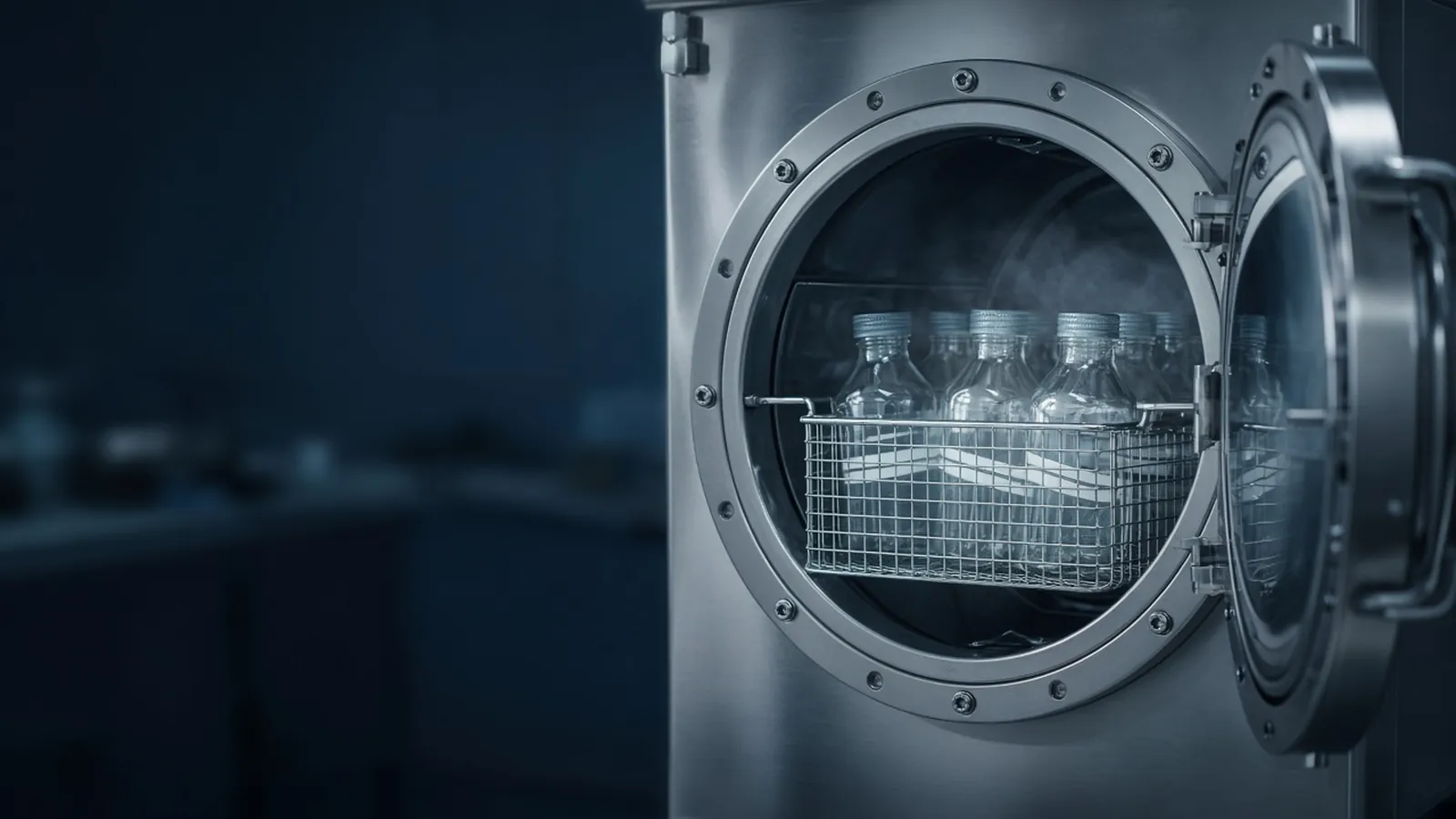
The rack came out of the autoclave bowed, and the tubes no longer sit upright. That is a materials failure with a short list of causes. This troubleshooting note starts from that shape and from racks that fused to the basket. What steam does not do for the load itself is covered in autoclaves and what sterilisation does not do. The glass inside a rack, if it is glass, is still chosen as in choosing laboratory glassware.
Symptom, likely resin, next check
A rack that is wavy, shrunken, or fused to the shelf was almost certainly the wrong polymer, or the right polymer past its drying limit. Polystyrene is clear, rigid and common in tube racks on a bench. It is not an autoclave plastic. It softens and then distorts. If the ruined rack was clear and brittle when cold, polystyrene is the leading suspect. The next check is the moulded mark or the label that should have said what it was. If you cannot find a mark, the replacement needs a mark, and the current rack does not go back in.
Polypropylene is often autoclave-tolerant and is the class to specify when you want a plastic rack to survive steam. Often is not always. The next check is the autoclave symbol or the sentence in the product instruction. Then check how you loaded it. A rack stuffed so the walls were in compression, stacked under a heavy bottle basket, or touching the hot chamber wall, warps even when the resin was eligible. A long dry cycle can be hotter than the steam hold. If the mark allows steam and is silent on the dry cycle, treat the dry cycle as unapproved.
Nylon, polyoxymethylene and other engineering plastics appear as rack components and as hinges. Some survive. Some hydrolyse or creep in steam. The next check is again the mark on that component, not the mark on the frame. A polypropylene frame with polystyrene feet fails at the feet.
Metal wire survives the temperature and fails by corrosion, broken welds, or by being so open that small tubes fall through. The next check for a metal rack that stained the glass is the alloy and any flaking coat. Do not paint a rack with a bench paint and then steam it.
What else looks like a rack failure
Tubes melted into an intact rack mean the tubes were polystyrene or another non-steam plastic. The rack is innocent. Caps melted onto a good rack mean the caps were the weak resin. Bottles cracked in a perfect wire basket are a glass, cap, or thermal-shock problem. Borosilicate bottles, in the sense of ASTM E438, still crack if they are full, sealed, chipped, or set cold-wet while hot. Do not replace the basket because the bottle was soda-lime.
A rack that is geometrically fine and biologically suspicious was overloaded or shadowed so steam did not reach the load. That is a loading and validation question for your autoclave procedure, not a resin question. This page does not set a cycle. Warping and sterility are different failures. A melted rack is not sterile furniture. A straight rack is not proof the load is sterile.
| What came out | Likely cause | Next check |
|---|---|---|
| Clear rack warped or melted | Polystyrene, or an unmarked resin | Do not rerun; specify polypropylene with a mark |
| Polypropylene rack bowed | Overload, chamber wall, or a hot dry cycle | The mark, the load, the dry setting |
| Tubes slumped, rack straight | The tubes were the wrong resin | Tube mark, separately from the rack |
| Rack fused to the shelf | Softening resin plus pressure | Both materials; discard the pair |
| Metal rack, cracked bottles | Bottle glass, fill, cap, or shock | Bottle type and unloading, not the wire |
After a bad cycle
Discard warped plastic. A rack bent back in a vice holds tubes at an angle and can collapse on the next heat. If it fused to a shelf, the autoclave chamber needs inspection under your equipment rules. Do not chip plastic off a heater with a steel tool and continue the day.
If the load was biological, treat distorted closed tubes as a spill risk. Your waste rule, not the rack catalogue, decides decontamination. The WHO laboratory biosafety manual and the CDC BMBL are background. A melted rack does not get a second chance to prove the cycle. Replace it, then rerun a fresh load with a process your institution already uses.
Volumetric glass should not be living in this story as a rack occupant for routine steam. If a flask was in the load, inspect it for new cracks and do not trust its line until it is clean, intact and back at its reference temperature. NIST calibration assumptions do not survive a casual autoclave of a working flask.
A rack can shadow the load it was meant to hold
Even a square, correctly marked polypropylene rack can keep steam off a packed interior if tubes are capped tight and the rack is pressed against its neighbour. Warping is the visible failure. A straight rack with a load that did not heat is the quiet one. Your autoclave procedure, not this note, says how that load is tested. The rack check is whether steam could move. If the design is a solid box with no path through it, it is a storage box that happened to be heat-resistant, not an autoclave rack.
Shared machines and interrupted cycles
A shared autoclave is where polystyrene from a teaching bench meets a media load. The practical control is a mark that is readable after wear, and a habit of refusing unmarked plastic. If a power cut stops a cycle, follow the machine instruction. A rack that cooled under a collapsed load can be warped even if the peak temperature was brief. Inspect before reuse. Humidity and a crowded chamber do not change the resin. They do make people stack racks until the lower one creeps. One layer, with steam space, is the loading picture to return to.
What to ask for next
The resin, an autoclave mark as a requirement, the tube diameter the rack must hold, whether it will see a drying cycle, and the quantity. Ask for polypropylene that is marked for steam, or for stainless wire, and say that polystyrene is unacceptable for this duty. Use the laboratory plasticware catalogue for the plastic racks and the quote request. Bottles that sit in those racks are specified from the laboratory glassware catalogue, not as an accessory the rack happens to fit.
Questions from the bench
Why did the rack come out bowed?
The usual causes are the resin, the temperature, and the load. Polystyrene softens well below an autoclave cycle and will warp or melt. Polypropylene often survives steam if that exact rack is marked for autoclave use, and it can still warp if it was overloaded, pressed against the chamber wall, or run through a drying step hotter than the mark allows. A bowed rack that no longer holds tubes upright has finished its job. Do not bend it back and reload it.
Is every polypropylene rack autoclave-safe?
No. Polypropylene is a class that often tolerates autoclave temperatures, which is why it is the usual candidate. The marking on the rack, or the maker's instruction, is the permission. Fillers, hinges, feet of a different plastic, and a drying cycle you did not read can still deform a rack whose body is polypropylene. If there is no mark, keep it out of the autoclave until you know. Confirm the marking every time you introduce a new colour or a new brand.
What about metal wire racks?
Stainless wire racks are the traditional autoclave furniture and they do not melt. They corrode if the metal is not what you think it is, they conduct heat so the load stays hot at unload, and they can mark soft plastic tubes. They are a good answer for glass bottles if the bottles themselves are borosilicate and capped correctly. They are not a repair for polystyrene. Choose metal when you need the geometry to stay true, and still inspect welds and coating flakes.
Can I autoclave the tubes and the rack as one object?
Only when both are marked for the cycle and the tubes are open or vented as their own instruction requires. A closed tube in a softening rack is a leak and a contamination path. Polystyrene tubes in a polypropylene rack still melt. The rack cannot lend its rating to the tube. Glass bottles in a wire basket follow bottle rules: headspace, loosened ordinary caps, borosilicate. Those rules are about the bottle, not about the basket looking sturdy.
References
Manufacturer names identify published method classes. Trademarks remain with their owners. Catalogue records on this site are independent references for enquiry. They are not a statement of inventory, distribution rights or a supply commitment. This page is educational. It is not medical advice, a diagnostic protocol or a biosafety approval.
Catalogue
Related products and categories
These links follow the subject of the article into published manufacturer references. A listing is a reference for an enquiry, not a statement of stock or distribution rights.
Continue in this cluster
Related reading
 Choosing laboratory glasswareHow to match borosilicate beakers, flasks and volumetric glass to the measurement you need, and when a printed line is only a guide.A glossary of labware termsDefinitions of the labware words that change a result: class marks, to contain and to deliver, joint size, resin, sterile and clean.Beakers are for handling not for accuracyWhy a beaker graduation is only a handling guide, and when a concentration other people will reuse belongs in a volumetric flask.