
glossary
Receiving a warm parcel
A warm parcel stays out of inventory until you have named the shipper, the coolant, any excursion, and the chain of custody.
- Author
- EVRINTH Editorial Team
- Published
- 8 October 2026
- Updated
- 8 October 2026
- Reading time
- 10 min
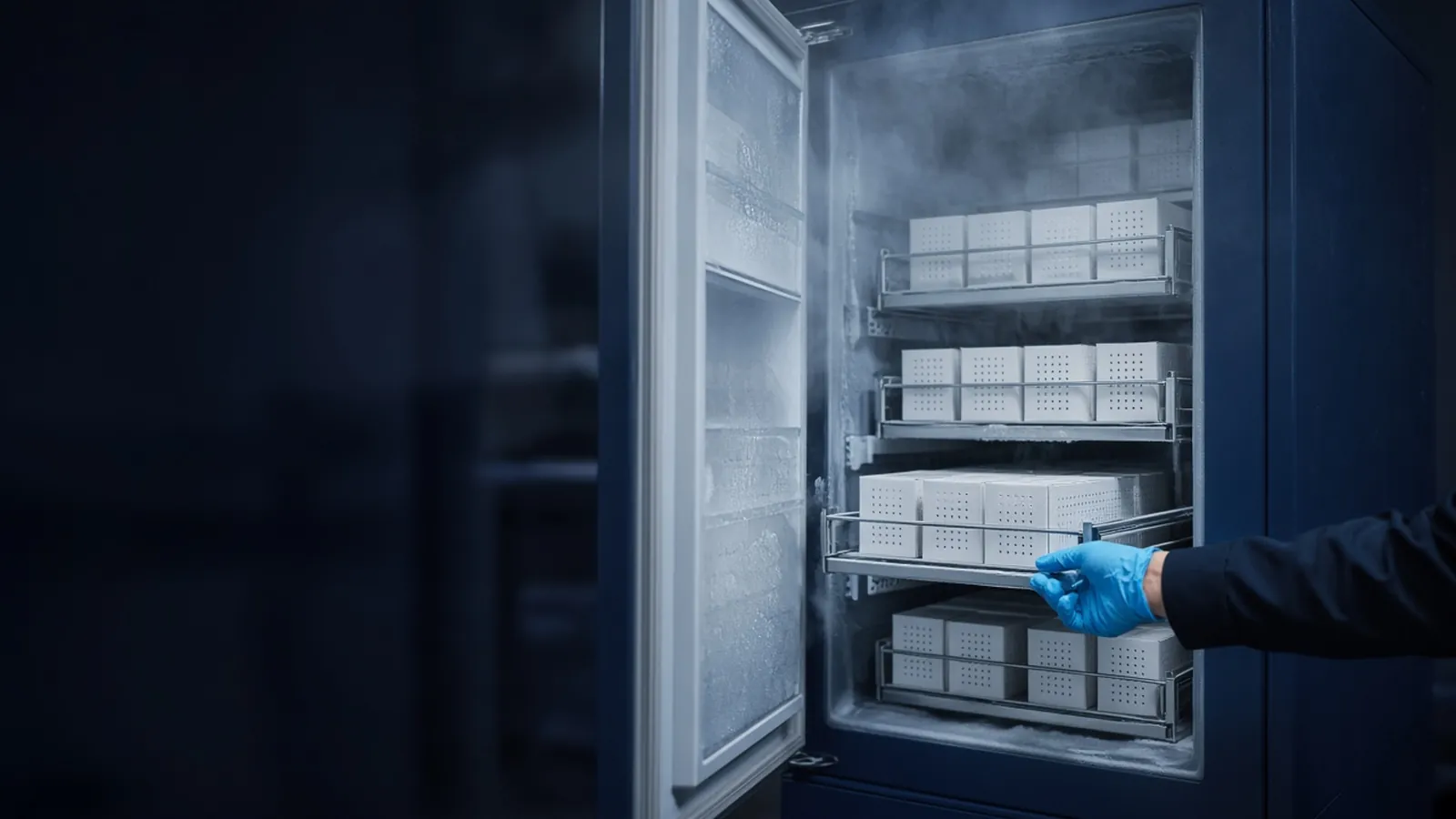
The parcel is on the receiving bench and the outer carton feels warm through a glove. Before anyone slits the inner bag and types the tubes into yesterday's inventory, five words have to mean the same thing to the person who packed the box and the person who opens it. Those words are shipper, coolant, excursion, quarantine, and chain of custody. This page defines them by walking a single receipt. Where the tubes should live after they are accepted is in storing biological samples from fridge to freezer. How dry ice is packed, vented, and respected as a hazard is in dry ice packing for sample shipments.
Tubes and cryoboxes you will transfer into are in the laboratory plasticware catalogue. A standing receiving routine can be discussed through laboratory procurement and written into a quotation request when you need shippers, loggers, or labels. The routine itself is yours.
The scene, before the definitions
A courier has left a carton at 11:40. The receiving room is warm, which is ordinary in a building that is not a cold room, and hotter still if the carton sat in a vehicle or a sunlit lobby before it reached you. You have not opened it. The paperwork is a packing list and a courier slip. You do not yet know whether the coolant has done its job. The decision in front of you is whether these contents may join the laboratory inventory. The answer is not yes merely because the address was correct.
Shipper: the container, and the party who sent it
In the cold chain, a shipper is the insulated container: a foam box, a vacuum panel box, or a reusable case, sometimes sitting inside a plain carton. Its job is to slow heat leak. It is not a freezer, and it is not a storage address. A foam lid left ajar is a different shipper from the same box with the lid seated. Note whether the lid is seated, whether a vent required for dry ice is actually open, and whether the carton is wet, crushed, or re-taped by unknown hands.
The same noun is the legal shipper: the person or organisation that offers the consignment to the carrier. On a dry-ice shipment that party carries duties under dangerous-goods rules. The IATA Dangerous Goods Regulations are the class of rule for air. Your carrier and your institution say how those rules are applied. When you write the receipt, call the box the container and call the sender the sending party, so a later reader does not think the foam box signed the declaration.
Coolant: the cold mass, named in the state you find
Coolant is whatever was packed to absorb heat. Wet ice, gel or phase-change packs, and dry ice are the common research coolants. They are not interchangeable, and a receipt that says "coolant OK" is too vague to use.
Look, and write one of these: dry ice still present as solid; dry ice gone and the cavity empty; gel packs hard; gel packs slush; gel packs fully liquid; wet ice still icy; only meltwater; no coolant where the packing list promised some. A hard pack can still have been the wrong temperature for the product. A soft pack means the plateau, if there was one, has been spent. Neither sentence alone is an excursion. Both belong in the note before the tubes move.
Dry ice that is still present means you are handling a very cold solid that gives off gas. Insulated gloves, eye protection, and a room that is not a closed cupboard are the practical controls. The packing page is the hazard discussion. Do not store the open shipper in a small office while you attend to email.
Excursion: a window, not a feeling
An excursion is a departure from the temperature window that the product document or the laboratory SOP already defined. "The carton felt warm" is a feeling about the outside. The outside is supposed to be warmer than the inside. An excursion is about the contents, for a duration that matters to that material.
You establish it, when you can, from a logger that was packed with the goods and actually started: a trace compared with the window. You suspect it, when you must, from coolant that is in the wrong state for the elapsed time, from a shipper that arrived open, or from a handover time that is longer than the holding condition the sender claimed. Suspicion is not proof of damage. Suspicion is a reason to keep the material out of inventory until the document is read.
Some enzymes and some nucleic-acid preparations are specified to tolerate a short warm interval. Some cell stocks are not. The window is printed, or it is in your SOP. It is not a number you invent on the bench because the freezer has space.
Quarantine: a place and a status, before inventory
Quarantine means the material is identified, physically separated from the working collection, and barred from use until a named person releases it. A shelf, a bag, or a box with a written hold is quarantine. A mental note is not.
The sequence is fixed. Inspect container, coolant, and logger. Record the time. Move the contents to the storage temperature named on the product document if it is safe to do so, into a location that is already marked hold. Only then consider inventory. Mixing the tubes into the general map "so they are not lost" is how they are lost into an experiment. The hold location is on the map too, under a status that a search will not offer as available.
If the logger shows a trace inside the window and the coolant state agrees, release can be the same afternoon, by the person the SOP names. If the logger is absent and the document required one, the hold stays until the owner applies the document's rule for a missing trace.
Chain of custody: who held it, when, and in what condition
Chain of custody is the sequence of holders and the condition at each handoff. For a research parcel it need not look like a forensic form. It does need to answer: who packed it, which carrier moved it, when it was handed to the laboratory, who opened it, and what they saw. Gaps are part of the record. "Courier sometime this morning" is a gap if the slip has a timestamp you could have copied.
The condition line is the coolant state and any logger flag, not the word "received". A later argument about a failed assay will return to that line. Write it where the inventory system, or the notebook, will still have it when the carton has been thrown away.
| Term | The confusion | What to record at the bench |
|---|---|---|
| Shipper | The foam box, or the party who sent the goods | Container condition separate from the sender's name |
| Coolant | Any cold object, treated as success | Solid, slush, liquid, or absent, and which kind |
| Excursion | The carton felt warm | A window from the product document, compared with a trace or a justified suspicion |
| Quarantine | A flag you meant to add later | A physical hold, applied before the working inventory |
| Chain of custody | A signature and nothing else | Holders, times, and the condition at opening |
The same parcel, with the words used properly
You open the carton at 11:55. The foam container lid is on. Two gel packs are slush, not hard. A logger is inside, screen showing a completed run, with a small flag. The packing list says the enzyme ships on conditioned packs and is stored at minus 20 on arrival. You do not stand the foam box on the bench through a seminar.
You copy the courier time, your opening time, the slush, and the flag into the notebook. You move the enzyme to the minus 20 cabinet's hold tray, not to the working enzyme box. That is quarantine. The chain of custody now has a laboratory holder and a condition. Whether the flag is an excursion depends on the window in the product document, which you read before anyone pipettes. If the flag is inside the window the document allows, the owner releases it. If the document is silent and the flag is a high temperature, the enzyme stays on hold and you ask the manufacturer document, not a neighbour's memory of "it is probably fine".
A second inner bag holds plasmid DNA with no logger. The document says ambient shipping is acceptable for that DNA. The warm carton is then expected, the coolant note can say "none packed, by the document", and quarantine is unnecessary if the SOP agrees. The point of the glossary is that the two bags do not share a verdict just because they shared a carton.
When the first reading of a word is wrong
If you called the foam box acceptable because the carton was addressed to you, you skipped the container and the coolant. Reopen the note and add the state before the tubes are used. If they were already used, the experiment record inherits the gap.
If you called every warm carton an excursion, you will quarantine ambient-stable DNA for no reason and train people to ignore holds. Tie the word to a window.
If quarantine lives only in a spreadsheet column while the tube sits in the working rack, the status is fiction. Move the tube.
If the chain of custody names the courier and not the condition, add the condition while you still have the packs in front of you. Packs thrown away are a memory.
Research limits
Receiving is not a biosafety classification. A parcel that might contain infectious material is an institutional question before it is a freezer question. The WHO laboratory biosafety manual and the CDC BMBL are programme documents. Your biosafety office decides whether this parcel may be opened on an open bench at all. This page is not that permission, and it is not a carrier approval to ship.
Heat on the last kilometres of a delivery is a normal operational pressure in a warm climate. You do not need a weather statistic to justify recording the handover time and keeping a warm-climate receiving room from becoming a storage room. Open cold parcels when they arrive, or put the unopened shipper in a planned cold hold if the SOP allows a delay. Do not leave dry ice in a sealed cupboard.
What the enquiry should carry
Ask for insulated containers and loggers as named classes, and for labels that survive condensation when tubes move from shipper to freezer. Point the quotation request at the plasticware you will use for the transfer. State the temperature window you need the pack-out to support, as your requirement. Do not ask anyone to guarantee that a future courier delay will leave the contents unchanged.
Questions from the bench
The outer carton is warm but the inner shipper still has dry ice. Is that an excursion?
Not by itself. The outer carton is allowed to be at room temperature. An excursion is a departure from the temperature window the product document or the SOP defines for the contents. Dry ice still present is one observation. A logger trace, if a logger was packed, is another. Write both before you call the parcel acceptable.
Who is the shipper, the box or the person?
In cold-chain speech the shipper is often the insulated container. In transport law the shipper is the party who offers the goods. Both meanings are real, and they must not be swapped in a record. Write container when you mean the box, and write the sending institution when you mean the party responsible for the paperwork.
Can I log the tubes into inventory and quarantine them in the database later?
No. Once a tube is on the working map, the next person will use it. Quarantine is a physical place and a status, applied before the tubes join the general set. A database flag added the next day is how a warm aliquot becomes someone's control.
What if there is no logger in the parcel?
Then you do not have a temperature history. You still have the coolant state, the clock from handover to opening, and the product document. Some materials are specified to travel without a logger. Others are not. Follow the document that came with the goods, and keep the parcel in quarantine when that document asked for a trace you cannot produce.
References
Manufacturer names identify published method classes. Trademarks remain with their owners. Catalogue records on this site are independent references for enquiry. They are not a statement of inventory, distribution rights or a supply commitment. This page is educational. It is not medical advice, a diagnostic protocol or a biosafety approval.
Catalogue
Related products and categories
These links follow the subject of the article into published manufacturer references. A listing is a reference for an enquiry, not a statement of stock or distribution rights.
Continue in this cluster
Related reading
Storing biological samples from fridge to freezerFridge, minus-20, minus-80 and nitrogen storage slow different kinds of damage. A warm box is a quarantine decision, not a hope.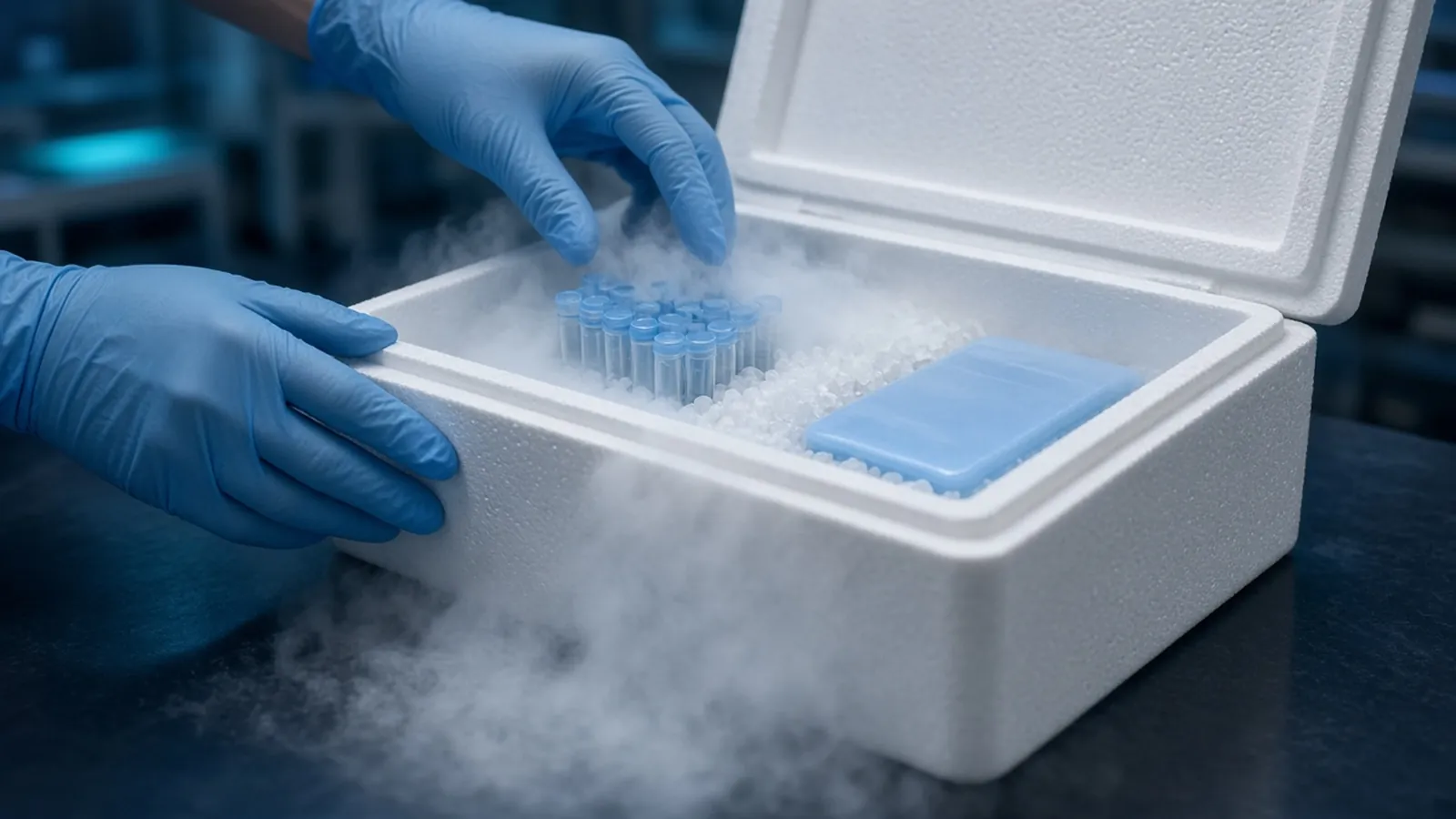 Dry ice packing for sample shipmentsDry ice keeps non-infectious research samples cold and can burn skin or displace air. Carrier rules and infectious-substance law still govern shipping.A glossary of cold-chain termsSetpoint is not air temperature, and a phase-change pack is not every coolant. Compare the cold-chain pairs labs treat as one word.