
comparison
Shipping documentation is a carrier and legal question
A courier slip is not a dangerous-goods declaration. Dry-ice paperwork is a carrier and institutional question, not a brochure approval.
- Author
- EVRINTH Editorial Team
- Published
- 8 October 2026
- Updated
- 8 October 2026
- Reading time
- 8 min
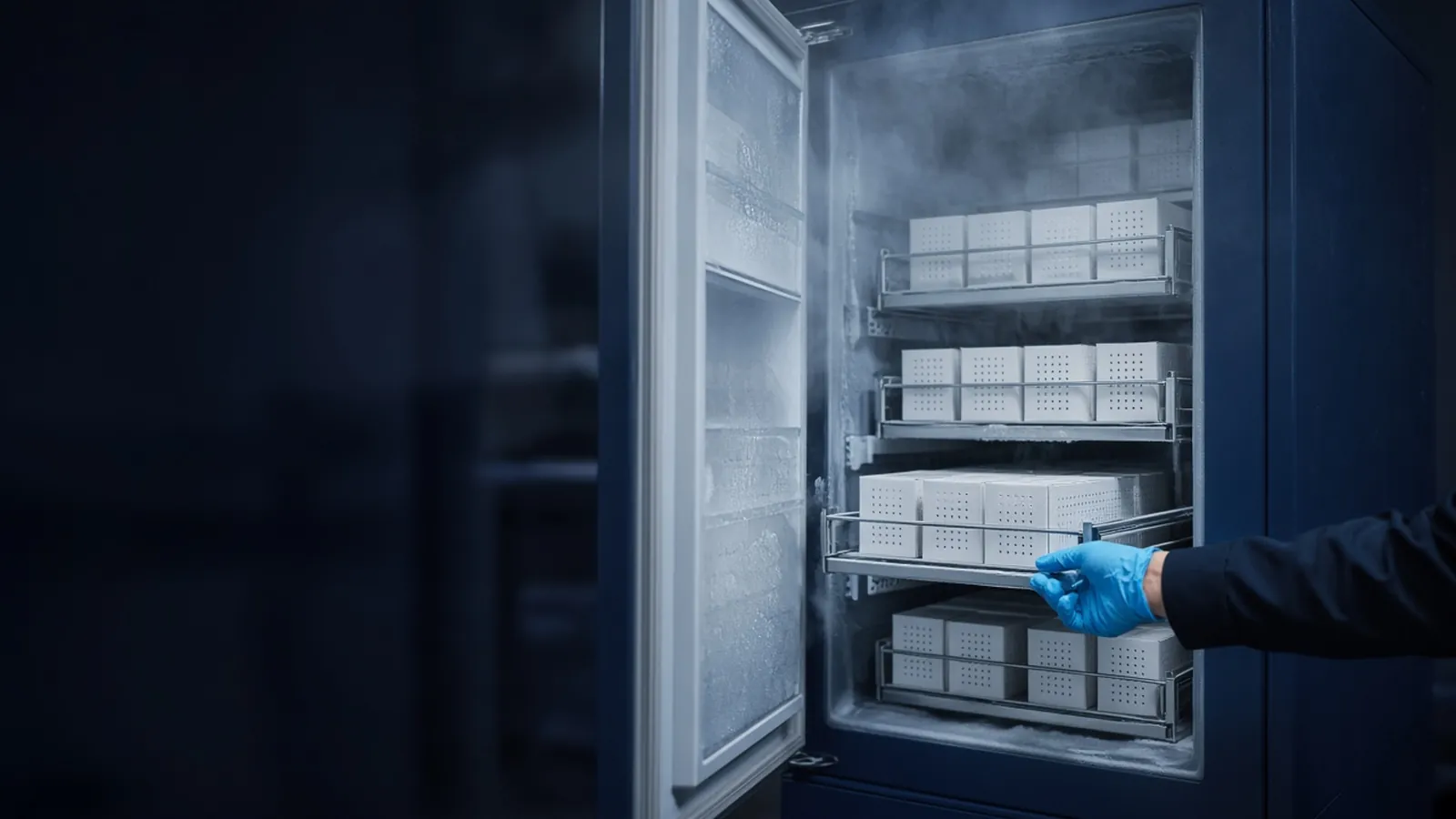
The form that lets a courier collect a box is not the same document as the declaration that lets dry ice fly. Mixing those papers is how a lawful research sample becomes a refused shipment or an undeclared dangerous good. This page compares the kinds of shipping paper a laboratory meets. It is educational. It is not a regulatory approval, and it does not copy a packing instruction. The physical act of packing dry ice, and the burns and the gas, are in dry ice packing for sample shipments. Where the sample should be stored before and after the journey is in storing biological samples from fridge to freezer.
Tubes and outer containers you specify as hardware are in the laboratory plasticware catalogue. A conversation about shippers and labels can go through laboratory procurement and a quotation request. The legal classification of a consignment cannot.
The decision the comparison supports
You are deciding which document answers which question, and which person is allowed to complete it. You are not deciding that a sample may fly because the science is worthwhile. Three authorities sit above this page: the institution's biosafety office and its trained shipper, the carrier that will actually take the box, and the rule set for the mode of transport. For air, that class of rule is the IATA Dangerous Goods Regulations, including the carrier's own variations and the current edition. Road and local movements can sit under different rules. This page will not tell you which edition applies to Tuesday's lane. The trained shipper will.
Four papers that get treated as one
A packing list or a commercial description says what the sender claims is in the package: plasmid DNA, a gel pack, a printed protocol. It helps the receiver and it may help customs classification. It does not, by existing, mean the package was offered correctly as cargo. Anyone can type a packing list. That is why it cannot be the control for a dangerous good.
A courier consignment note or airway bill is the carrier's contract to move a package from address to address. It records weight, account, and service. It is not a scientific stability statement, and it is not automatically a dangerous-goods declaration. A note that says "keep cold" in the remarks line is a wish to the driver. It is not a temperature qualification and not a hazard mark.
A dangerous-goods declaration, in the air rules often called the shipper's declaration, is a specific legal document used when the goods require it. It is signed by a trained person. It identifies the dangerous good in the language the rules require. Dry ice, solid carbon dioxide, is commonly in that world when it is offered for air transport. So are infectious substances, which are a different class of problem and must not be relabelled as ordinary samples to avoid the form. This page does not reproduce the format, the proper shipping name line, or a packing instruction. Those are in the DGR and in your training materials.
Marks and labels on the outside of the package are not paperwork in the folder, but they are part of the same comparison. A diamond, a class mark, a proper shipping name, or a dry-ice mark is how a handler knows the hazard without opening the box. A handwritten "biological samples, fragile" does not do that job. Which marks apply is, again, the trained shipper's application of the current rule. Do not invent a mark from memory, and do not omit one because the box looks scientific.
What each document can and cannot decide
| Document | The question it can answer | The question it cannot answer |
|---|---|---|
| Packing list | What the sender says is inside, for the receiver | Whether the consignment is legal to offer to an airline |
| Courier note or airway bill | That a carrier accepted a contract to move a package | That the contents stayed inside a temperature window |
| Dangerous-goods declaration | That a trained shipper has declared regulated goods in the required form | That the biological material will still work on arrival |
| Hazard marks on the package | That a handler can see the hazard the rule requires | That your institution has classified the biosafety risk |
| Logger file | A temperature history for the receiver's quarantine decision | That the paperwork was complete |
| Biosafety clearance | That the institution allows this material to move, and on what path | The carrier's acceptance on the day |
The logger file is the scientific cousin of this set. It belongs to sample integrity. It does not substitute for a declaration, and a declaration does not substitute for a logger. A box can be legally documented and thermally ruined, or cold and undeclared. Those are different failures, owned by different people.
A comparison you can hold in your hands
Picture two envelopes taped to one shipper.
Envelope A holds a packing list of twelve plasmid tubes and a courier slip. The slip remarks say "refrigerate". There is no dry ice. The biosafety office has already agreed these plasmids are ordinary non-infectious research material and may travel under the institution's routine. The scientific storage page says where they go on arrival. Envelope A may be the whole paper set. You still confirm that conclusion with the trained shipper, because "plasmid" is not a magic exemption if someone has added dry ice or a different organism.
Envelope B holds the same packing list, plus a block of dry ice, plus a colleague's note that the airline "usually allows it". There is no declaration, no mark, and the person holding the tape has never had dangerous-goods training. Envelope B is not a more careful version of envelope A. It is an undeclared coolant that the air rules commonly regulate. The branch is to stop, leave the box unshipped, and hand the problem to the trained shipper and the carrier. You do not add a homemade diamond. You do not copy a packing instruction from a blog, including this one.
A third case is a swab or a culture the biosafety office has not classified. Neither envelope applies. Classification comes first. Infectious-substance rules are not dry-ice rules with a different sticker. The WHO laboratory biosafety manual and the CDC BMBL describe why the institution, not the shipper catalogue, classifies the biological risk.
Where people forge a permission they do not have
They photocopy last year's declaration and change the date. The rules and the carrier variations move. Last year's page is not a current instruction. Go back to training and to the carrier.
They write "non-hazardous" on a box that contains dry ice because the DNA itself is not infectious. The coolant can be the regulated article even when the sample is not. Split those classifications in your mind, then let the trained shipper split them on the form.
They treat a vendor's "ship on dry ice" line as an approval to offer the package to an airline. A product document is a storage and handling statement. It is not a dangerous-goods training certificate. The IATA DGR programme page points at the class of rule. Your carrier applies it.
They hide a small infectious risk inside a dry-ice plasmid shipment to save a form. That is not a documentation shortcut. It is a false declaration. Stop and involve the biosafety office.
Research limits, stated plainly
Nothing here authorises EVRINTH, or you, to ship. Nothing here says a package is excepted, limited, or forbidden. Those are legal conclusions from the current text, the mode of transport, and the material. International journeys add import permits and pathogen controls that a packing list does not mention. Ask the institution's shipping office before you promise a collaborator a date.
Temperature still matters after the paper is perfect. A legally marked shipper can arrive with no coolant left. The receiver quarantines using the storage page and the product document. Paper did not keep it cold. Coolant, insulation, and time did, or did not.
What an equipment enquiry may include
You may ask for insulated shippers, cryovials, and labels as hardware, and you may state that the shipper must be able to vent if it will hold dry ice. Put that in the quotation request. You may not ask a seller to supply a filled-in declaration, a fake training certificate, or a letter that the shipment is approved. Point the reader who needs the rule at the IATA Dangerous Goods Regulations, at their carrier, and at their institution. That is the whole of the legal advice this article is willing to give: those are the doors, and this page is not one of them.
Questions from the bench
Can this page be used as the packing instruction for dry ice?
No. Packing instructions, net quantities, marks, and the current text of the rules live in the IATA Dangerous Goods Regulations, in carrier variations, and in your institution's trained-shipper procedure. This page compares kinds of paper so you know which question to ask. It does not authorise a shipment and it does not reproduce an instruction.
Is a packing list enough when the box contains dry ice?
A packing list says what you believe is inside. It does not do the job of a dangerous-goods declaration, a dry-ice mark, or the carrier's acceptance process. Solid carbon dioxide offered for air transport is commonly regulated as a dangerous good. Whether your consignment needs a particular form is a question for the trained shipper and the carrier, using the current rules.
Who is allowed to sign a dangerous-goods declaration?
Someone the institution has trained and authorised for that class of goods, following the rule set that applies to the journey. A principal investigator's signature on a courier slip is not automatically that authorisation. If you are not that person, you do not sign, and you do not invent the training.
Do research samples that are not infectious skip documentation entirely?
They may skip the infectious-substance path and still meet a dry-ice path, a customs path, or a carrier path. Non-infectious is a classification you earn from the biosafety office, not a mood. The office, the carrier, and the regulations that apply to the route decide which papers remain.
References
Manufacturer names identify published method classes. Trademarks remain with their owners. Catalogue records on this site are independent references for enquiry. They are not a statement of inventory, distribution rights or a supply commitment. This page is educational. It is not medical advice, a diagnostic protocol or a biosafety approval.
Catalogue
Related products and categories
These links follow the subject of the article into published manufacturer references. A listing is a reference for an enquiry, not a statement of stock or distribution rights.
Continue in this cluster
Related reading
Storing biological samples from fridge to freezerFridge, minus-20, minus-80 and nitrogen storage slow different kinds of damage. A warm box is a quarantine decision, not a hope.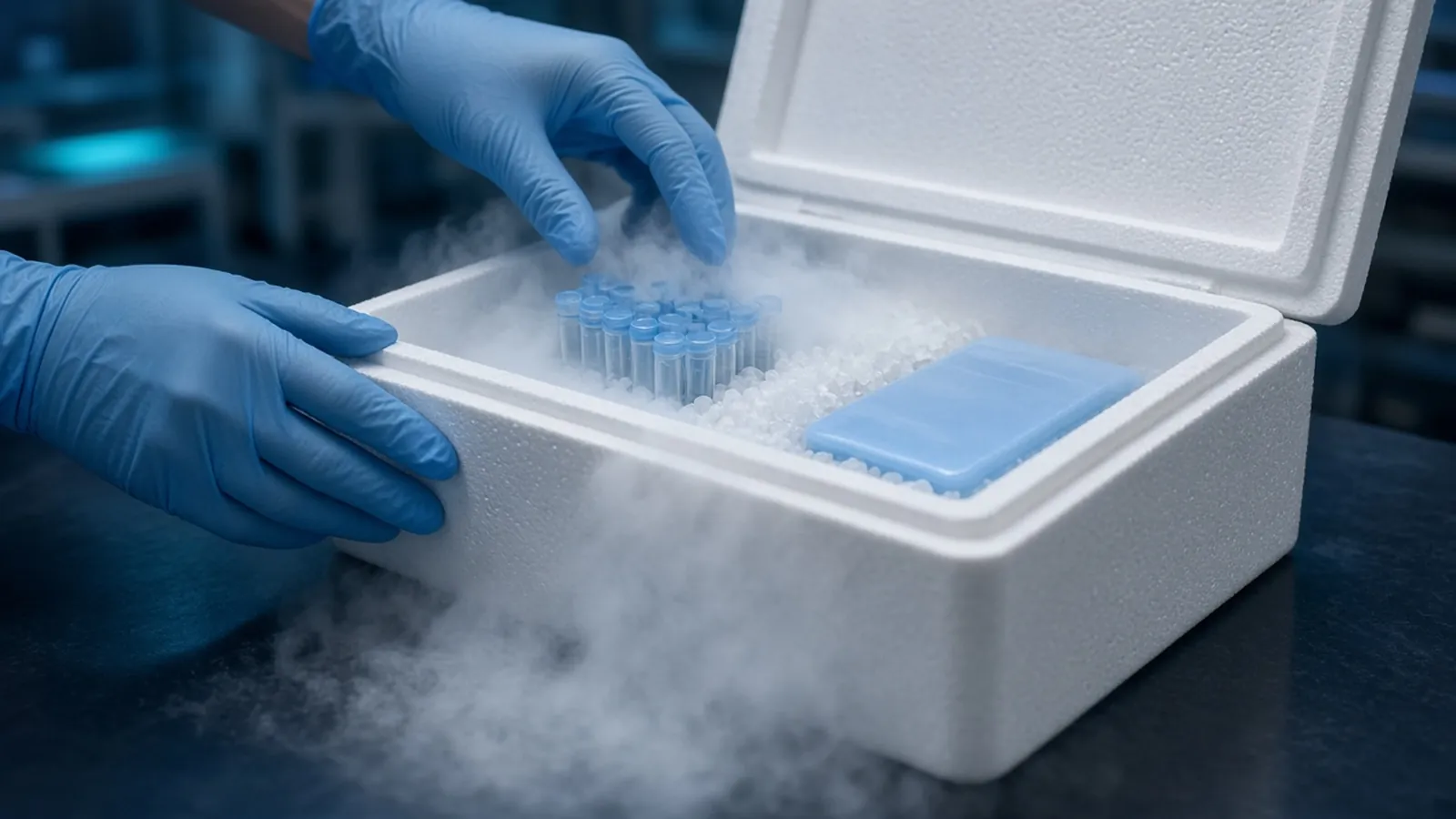 Dry ice packing for sample shipmentsDry ice keeps non-infectious research samples cold and can burn skin or displace air. Carrier rules and infectious-substance law still govern shipping.A glossary of cold-chain termsSetpoint is not air temperature, and a phase-change pack is not every coolant. Compare the cold-chain pairs labs treat as one word.