
explainer
Storing proteins without inventing a stability claim
Store proteins as aliquots, record the conditions you used, and follow the source. There is no universal stability claim that fits every polypeptide.
- Author
- EVRINTH Editorial Team
- Published
- 8 October 2026
- Updated
- 8 October 2026
- Reading time
- 6 min
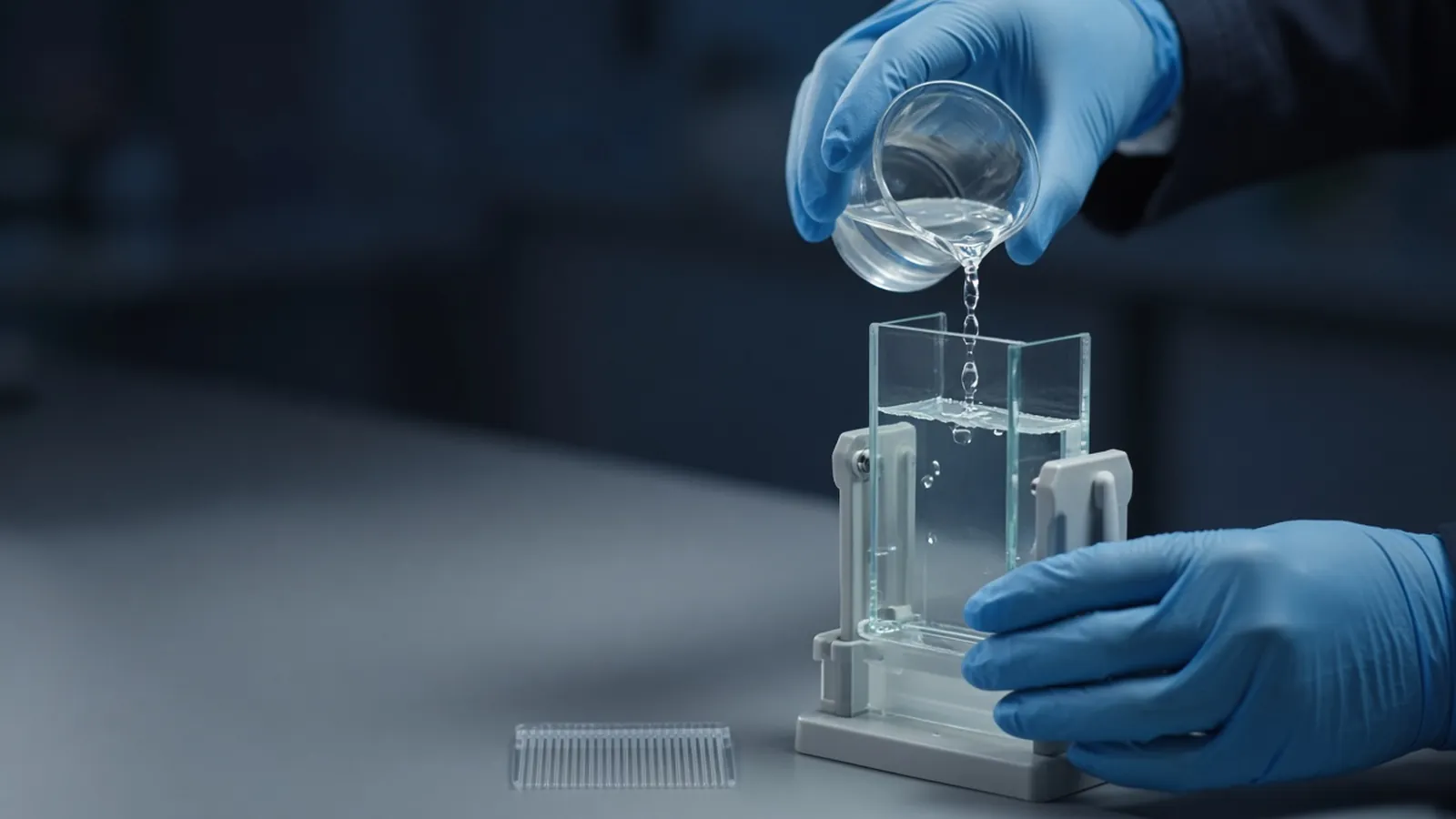
Stability is a property of one protein in one buffer after one history, not a slogan you can attach to every aliquot. The decision this explainer supports is what to write on the tube and what not to promise in a methods sentence. Follow the source of the protein. If that source is your own purification, follow the observations you actually collected: did it cloud on thaw, did the band survive, did the activity survive. Cloudiness is handled in aggregation and cloudy protein samples. A band that survives while catalysis dies is handled in enzymes lose activity before they look degraded. The gel is still reading a protein gel.
What an aliquot is for
Freeze the material in portions sized to one use. Repeated freeze-thaw concentrates solutes in the unfrozen fraction, unfolds some chains, and gives proteases and oxygen more warm minutes. A tube of restriction enzyme that has been dipped into twenty times is a different reagent from the day it was aliquoted. The same is true of a purified kinase. Thaw once, on ice if the protein needs cold, mix gently, and do not re-freeze the leftover unless you have evidence it tolerates that second cycle.
Label the aliquot with the construct, the buffer composition, any glycerol or other additive, the concentration method, and the date. "Pure protein, minus 20" is how a later student applies the wrong extinction coefficient and the wrong assay blank. Concentration can change if the tube loses water in a frost-free cycle. The number on an old label is a historical measurement, not a current one, until you check.
Glycerol, cold cabinets and the source sheet
Glycerol is widely used as a cryoprotectant. Stocks of some enzymes are supplied in a large glycerol fraction so they remain liquid at ordinary freezer temperatures and experience fewer ice events. That is a class of practice. It is not permission to add an invented percentage to every protein. High glycerol changes pipetting, can affect assays, and sometimes reduces solubility of the very protein you hoped to save. If the supplier or the laboratory that made the protein specifies a glycerol condition, follow it. If nobody has tested it, say that storage is untested rather than writing a fake shelf life.
A refrigerator at about 4 Celsius is appropriate for short holds of proteins that tolerate it: a column fraction you will dialyse tomorrow, a sample that precipitates on freezing, a commercial reagent whose label says to stay cold and liquid. It is not a quiet place for a month. Proteolysis, microbial growth and slow aggregation continue. Look at the tube. If activity is the point, assay a small portion rather than assuming the Monday prep matches Friday.
Avoid warm rooms as storage even for "a few hours" when the protein is fragile. Bench temperature in a hot building is not the 22 Celsius a protocol from a temperate city assumed. Ice buckets melt. A protein left in melted ice water overnight has been at a rising temperature, diluted if the lid leaked, and possibly proteolysed. That is a handling event. Record it.
What you must not claim
Do not write that a protein is stable because another protein with the same fold survived. Do not convert a single successful thaw into "stable for six months". Do not omit the buffer. A His-tag elution full of imidazole is not the same sample after desalting, and storage behaviour can change with that swap. Do not report a Bradford number from the day of purification as the concentration after three thaws if the tube has since thrown a pellet. Remeasure the soluble fraction or say that you did not.
Inclusion-body material stored as a frozen pellet is a different object from a refolded solution. The pellet may wait more patiently than the folded enzyme. Say which one you froze. A gel of a stored aliquot tells you about fragments and about whether a band is still there. It does not renew a stability claim by itself.
| Practice | What it is good for | What it does not promise |
|---|---|---|
| Single-use aliquots | Limits repeated freeze-thaw | That one thaw is harmless for every protein |
| Glycerol as specified by the source | Fewer ice events for proteins that tolerate it | A universal percentage or a universal shelf life |
| Short hold at 4 Celsius | Overnight steps for tolerant proteins | Multi-week storage without checks |
| Label with buffer and date | A repeatable description | Current concentration after evaporation or precipitation |
| Activity check after storage | Evidence about function | Purity, identity, or a claim you can paste onto the next construct |
Frost-free freezers, power and records
A frost-free freezer stays frost-free by warming on a cycle. That cycle is a quiet freeze-thaw for every working aliquot inside it. It is a poor home for a small tube you still need to be active. A manual-defrost freezer, or a freezer the manufacturer actually specifies for that enzyme, is a different machine. Know which box you used. Warm rooms make the problem sharper: the set-point may be fine while the door, the power and the defrost cycle are not.
Power cuts turn freezers into refrigerators and refrigerators into warm cupboards. After an outage, do not assume the stock matches its label. Look for cloudiness, consider a gel if proteolysis is likely, and assay activity if the experiment depends on it. Record the outage next to the aliquot. A later reader can then judge the result. Inventing "the freezer held" without a temperature note is how unstable data get a calm voice.
Shipping and handoff add the same honesty. A tube that thawed in transit is a new history. Cold-chain packaging can be discussed as a logistical fact. It is not, by itself, a stability certificate for the protein.
Research limits and the enquiry
Storage notes here are educational. They are not a stability study, not a pharmaceutical shelf-life claim, and not biosafety approval. Infectious or toxic samples follow institutional rules whatever the freezer temperature.
When you ask for a protein or for the reagents around one, request the storage condition the source will actually stand behind, the buffer, and whether glycerol is part of that condition. Ask what was tested, and expect "not tested" to be a valid answer. Reagents and chemicals is the catalogue side for buffer components. Put the storage constraints in a quote. The custom protein expression and purification page can be used as an enquiry reference if storage is part of a larger expression discussion. It is not evidence that a protein is being expressed, purified or stability-tested as an operated service.
Questions from the bench
Is there a standard freezer life for proteins?
No. Stability depends on the protein, the buffer, the concentration, the additives and how many times the tube warms up. A supplier sheet for one enzyme is not a shelf life for your fusion protein. Record what you did and follow the source you actually have.
Why are aliquots better than one stock tube?
Each thaw is a stress. A single tube opened every week spends part of its life half-frozen and warming. Small aliquots let you thaw once, use the tube, and leave the rest untouched. Label them with the buffer and the date, not only with the gene name.
Does glycerol always protect a frozen protein?
Glycerol is a cryoprotectant class, not a universal stabiliser. Many enzymes are stored in a substantial glycerol fraction because their own instructions say so. Some proteins precipitate or become hard to pipette in glycerol. Use it when the source or a real test supports it, and do not invent a percentage for a protein you have never frozen.
When is 4 Celsius reasonable?
For a short hold of a protein known to tolerate it, a cold cabinet can be kinder than a needless freeze. It is a poor default for weeks. Microbes, proteolysis and slow aggregation all continue at 4 Celsius. Check appearance and, if activity matters, activity, before you extend the hold.
References
Manufacturer names identify published method classes. Trademarks remain with their owners. Catalogue records on this site are independent references for enquiry. They are not a statement of inventory, distribution rights or a supply commitment. This page is educational. It is not medical advice, a diagnostic protocol or a biosafety approval.
Catalogue
Related products and categories
These links follow the subject of the article into published manufacturer references. A listing is a reference for an enquiry, not a statement of stock or distribution rights.
Continue in this cluster
Related reading
Reading a protein gelHow to read a protein gel: what SDS-PAGE bands, smears, ladders and loading differences can support, and what they cannot identify.Aggregation and cloudy protein samplesCloudiness, a spin pellet or a void-volume peak means aggregated protein. Do not treat a turbid sample as a concentration or load it onto a column.Enzymes lose activity before they look degradedAn enzyme can lose activity while the Coomassie band remains. Oxidation, carryover, a missing cofactor or partial unfolding need an activity assay.