
troubleshooting
Temperature compensation on a pH meter
If Tris pH still moves while ATC is on, the meter corrected the electrode slope. The buffer's own chemistry is a separate temperature effect.
- Author
- EVRINTH Editorial Team
- Published
- 8 October 2026
- Updated
- 8 October 2026
- Reading time
- 8 min
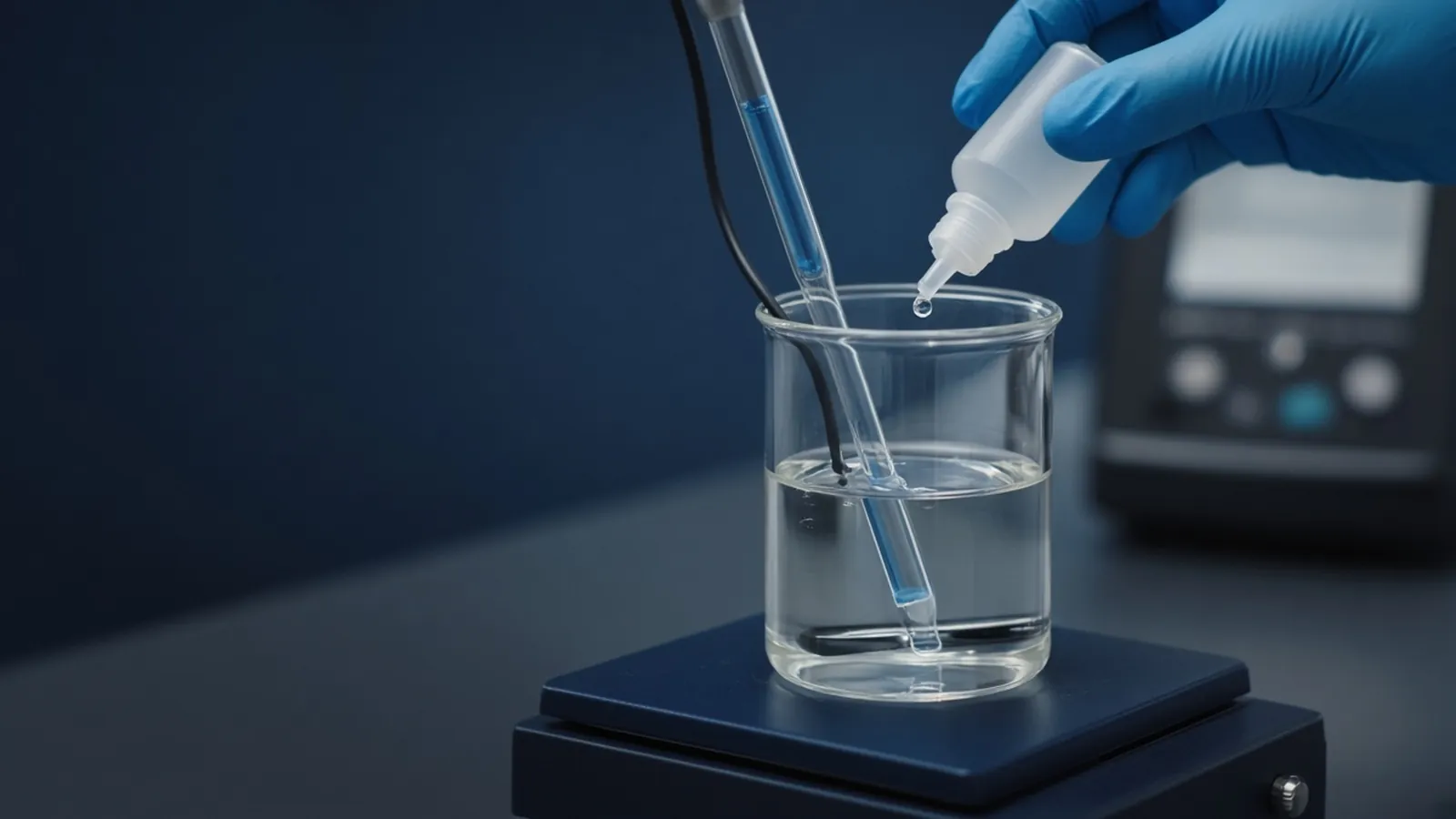
The meter shows a sample temperature and an ATC legend, and the Tris bottle still disagrees with the pH you set yesterday at another temperature. Compensation has done the electrical job. The buffer has done a chemical job the meter is not allowed to undo. This troubleshooting page starts from that symptom and separates the two effects, then catches the case where the temperature probe itself is lying. Electrode storage and the slope window sit in the preparation workflow of preparing a buffer and checking pH. Water you should not be judging by pH at all is in laboratory water types and where they fail.
Standards and buffer salts come from the reagents and chemicals catalogue. The beaker has to hold both the bulb and the temperature probe, which is a practical constraint on the beakers and flasks you use for the measurement. When a meter or a probe is what you are buying, the compensation behaviour belongs on the quotation request.
Symptoms to sort before you touch the offset
Write the symptom as a direction and a condition. Tris set near pH 7.4 or 8 at 25 °C reads lower once it is warm, by a few tenths at 37 °C, and ATC was enabled the whole time. That pattern matches Tris chemistry. A reading that jumps when you move the temperature probe into the liquid, while the buffer itself was already uniform, matches a compensation input that was measuring the wrong place. A slope that fails on fresh standards matches an electrode problem, and ATC will not rehabilitate it. A phosphate buffer that barely moves across the same temperature span, while Tris moves a lot, is the comparison that clears the meter. The instrument is capable of reporting a small shift. The Tris molecule is the large shift.
A symptom in the other direction matters. Tris read in a cold room is higher than the bench value. People call that drift and add acid. If the only change was temperature, they are titrating the coefficient into the recipe as extra chloride or whatever the acid carries. Confirm the temperatures before you add anything.
Two different temperature effects
The electrode effect is the Nernst slope. At 25 °C a glass pH electrode changes by about 59 millivolts per pH unit. The factor contains absolute temperature, so a warmer electrode produces a slightly steeper millivolt response. Automatic temperature compensation uses the measured temperature to apply the matching slope when it converts millivolts to pH. If the temperature input is right, this correction is what you want. Turning ATC off and leaving a 25 °C assumption in place while you measure at 37 °C mis-scales the millivolts. That error is real and much smaller than Tris's chemical swing across the same interval, which is why people who only watch Tris think ATC "does nothing."
The chemical effect is dpH/dT of the solution. Tris has a pKa near 8.1 at 25 °C, and the pH falls as temperature rises, on the order of 0.028 to 0.031 pH units per degree. Twelve degrees of warming, from 25 °C to 37 °C, is a drop of about 0.34 to 0.37 pH units. HEPES moves less, with a coefficient commonly cited near 0.014 per degree. Phosphate moves less again. Compensation does not cancel any of those. A correct meter reports them. The label has to say which temperature the pH refers to. Set the pH at the temperature of use when the assay cares, or record both temperatures and expect the shift.
Calibration standards have a third, smaller story. Their certified pH values also depend on temperature, and many meters contain tables that assign the right standard value at the calibration temperature. That table is about the standard, not about your Tris. Using a meter with ATC during calibration keeps the standards honest. It still does not freeze your buffer's pKa.
Check the temperature the meter believes
Put the temperature probe in the same liquid as the bulb, with both equilibrated. A probe clipped to the stand, sitting in sun, or still wet from a hot rinse will feed ATC a temperature the buffer does not have. The slope correction is then slightly wrong, and you may chase it by editing the sample. If the meter uses manual temperature, the number you type is the entire compensation. Type the measured liquid temperature, not the set point of the room.
Give both probes time. A large bulb and a metal temperature sensor do not equilibrate at the same speed. Reading at the first beep on a cold Tris taken from a refrigerator mixes a thermal lag with the true coefficient. Wait, stir as the method allows, and record the temperature that belongs to the stable pH.
If the displayed temperature is implausible, treat ATC as untrusted until the probe is checked in a water bath or against a second thermometer at two points the laboratory cares about. You do not need a theatrical calibration to notice a probe that reads 40 °C in a beaker that feels cool. You do need to stop releasing numbers while it does.
| Symptom | Likely split between chemistry and the meter | Next check |
|---|---|---|
| Tris lower by a few tenths at 37 °C, ATC on, slope good | Chemical dpH/dT; the meter is reporting it | Compare with HEPES or phosphate across the same span |
| Small error that grows when the temperature probe is moved | ATC is using the wrong temperature | Probe in the liquid, equilibrated, beside the bulb |
| Slope outside the laboratory window | Electrode or standards, not the coefficient | Fresh bracketing buffers; storage solution |
| Phosphate stable, Tris moving, same meter | The difference is chemistry | Label Tris with the temperature of measurement |
| Meter woke at a default temperature after a power cut | Compensation input is a reset, not a measurement | Recalibrate and confirm the probe reading |
| Ultrapure water pH wanders at any temperature | Almost no buffer capacity; pH is the wrong test | Resistivity at 25 °C, not a finer ATC setting |
What to change once the split is clear
If the slope passes, the temperature probe is in the liquid, and Tris moved by about the coefficient you expect, stop editing the meter. Change the label. Either equilibrate at the temperature of use and set the pH there, or keep the bench pH and write the expected warm value as a planning note you will confirm with the meter. Adding base at 37 °C to recover a 25 °C number is allowed only when 37 °C is the pH you actually wanted. Do it with the solution at 37 °C, with ATC on and the probe immersed, and record that this is a different composition from the bottle that was set at 25 °C.
If the slope fails, ATC is irrelevant. A tired electrode is a failed control at every temperature. Return to storage solution, commonly concentrated potassium chloride, fresh bracketing standards, and a slope near 59 millivolts per pH unit at 25 °C before you interpret any coefficient.
If two buffers disagree with each other and with their coefficients, look at carbon dioxide in an open alkaline beaker. That drift is acid from the air, and it stacks with the Tris coefficient on a warm afternoon. Cap the comparison aliquot.
Conductivity compensation, if you are also watching a conductivity meter, is yet another correction, about ionic mobility, not about pH. Do not import its temperature setting as the pH story. Ionic strength is still a sum over charges. None of these meters convert one into the other.
Safety and the limits of a displayed legend
The ATC legend is not a validation sticker. It does not make a buffer sterile, nuclease-free, or suitable for a diagnostic claim. Hot buffers and water baths need the ordinary burn precautions. Infectious samples follow institutional biosafety rules, including whether the temperature probe is allowed in the vessel and how it is cleaned. This page does not authorise a clinical reading of a compensated pH.
Warm rooms and meters that reboot
A laboratory that swings several degrees during the day will see Tris move even when nobody carries the bottle to an incubator. ATC will track the slope. The chemistry will track the room. Write the temperature on each release, not a single morning value reused at dusk. After a power cut, assume the calibration and the temperature input are both untrusted until you check them. Recalibrate with fresh standards. A default of 25 °C left in a manual-compensation field is a silent error on a 32 °C bench, small beside Tris chemistry and large enough to matter for a tight phosphate specification you were treating as temperature-quiet.
What to specify when the meter is the purchase
Ask whether compensation is automatic from a probe, manual, or both, and whether calibration uses a temperature table for the standard buffers. Ask which probe belongs to the meter and how it is cleaned. State that you will measure Tris at a named temperature and that you need the slope displayed so a tired electrode can be rejected. On receipt, check the temperature probe at two points and run a bracket calibration before the meter touches a batch. A quotation request that says "pH meter with ATC" can then be checked against a Tris reading you already know how to interpret: the number may move, and the move is not, by itself, a defect.
Questions from the bench
What does automatic temperature compensation actually correct?
It corrects the electrode slope. The Nernst factor is about 59 millivolts per pH unit at 25 °C and changes with temperature, so the meter needs the sample temperature to convert millivolts into pH. The chemical pKa of the buffer is outside that correction.
Why does my Tris buffer still read lower at 37 °C with ATC on?
Because Tris itself changes. Its pKa is about 8.1 at 25 °C, and the pH falls on the order of 0.028 to 0.031 units per degree as the solution warms. A faithful meter with working compensation will show that lower pH. That is a chemical result, not an ATC fault.
The display temperature looks wrong. What should I check?
See whether the temperature probe is in the buffer or lying on the bench. Compensation for the slope uses the temperature it is given. A probe in warm air and a bulb in a cooler beaker apply the wrong slope. Manual temperature entry has the same trap if the number is a guess.
References
Manufacturer names identify published method classes. Trademarks remain with their owners. Catalogue records on this site are independent references for enquiry. They are not a statement of inventory, distribution rights or a supply commitment. This page is educational. It is not medical advice, a diagnostic protocol or a biosafety approval.
Catalogue
Related products and categories
These links follow the subject of the article into published manufacturer references. A listing is a reference for an enquiry, not a statement of stock or distribution rights.
Continue in this cluster
Related reading
 Laboratory water types and where they failResistivity, organic carbon and endotoxin answer different questions. A water grade fails when the assay cares about a contaminant the meter cannot see.Preparing a buffer and checking pHPrepare a buffer at a stated pH and temperature, record the salt form, and treat a drifting electrode or a bad slope as a failed control.A glossary of solution termsDecide which number a recipe means before you weigh a salt: molarity or molality, which percent, normality, buffer capacity, osmolality, or hydrogen-ion