
guide
Temperature of the liquid changes the volume
Equilibrate cold liquids and warm pipettes before you trust an air-displacement volume, and separate that error from a weighing drift.
- Author
- EVRINTH Editorial Team
- Published
- 8 October 2026
- Updated
- 8 October 2026
- Reading time
- 8 min
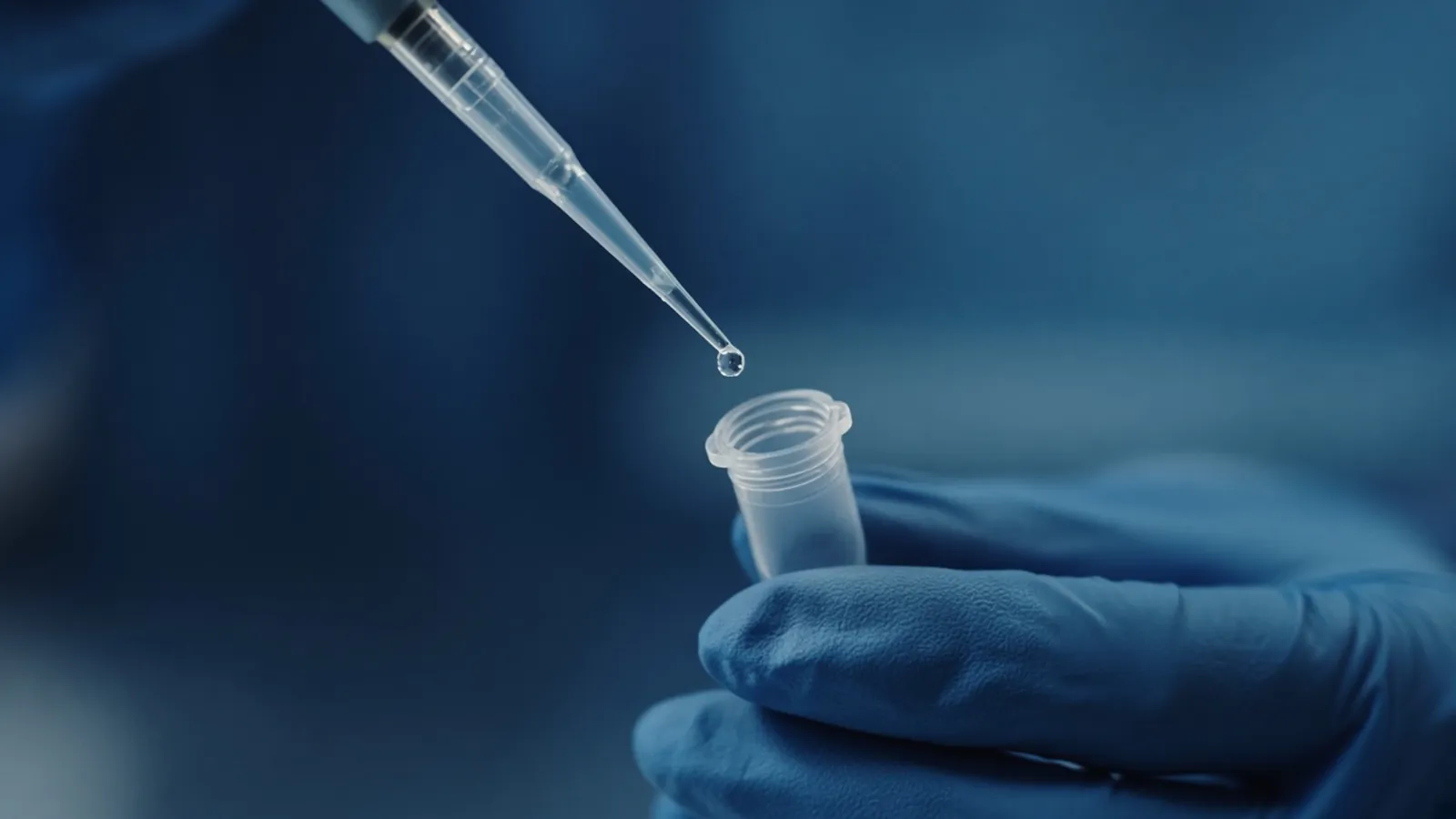
Temperature of the liquid changes the volume an air-displacement pipette delivers, even when the thumb repeats a perfect forward stroke. The decision is when to equilibrate, when to accept that a reagent must stay cold and change the way you interpret the dial, and when a warm weighing room has fooled the balance rather than the piston. The stroke itself is taught in accurate micropipetting technique.
The cushion expands and contracts
The piston sets a geometric air volume. The liquid moves because that air moved. Air's volume depends on temperature and pressure. A warm barrel around a cold plug of liquid, or a cold pipette dipped into a warm buffer, puts a temperature gradient inside the cushion during the stroke. The amount of liquid that ends in the tip is then not the amount a calibration at one temperature predicted. Hand heat on a small pipette during a long series is the same mechanism in miniature.
The liquid's own density moves too. That shows up twice: once in the volume that left the bottle, and again when you weigh the delivery and convert mass to volume. Near room temperature, water is about 0.998 grams per millilitre. Use a table for the temperature you measured. A Z-factor copied from a cooler calibration day will make a warm series look biased when the water was simply less dense.
ISO 8655-1:2022 includes user recommendations for these influences. It is a terminology and recommendation standard, not a certificate that your pipette is accurate on a hot afternoon. Numerical tolerances remain in ISO 8655-2:2022 and in the manufacturer specification. Compare a check done at a stated temperature with the specification you claim.
What to equilibrate, and what must stay cold
Equilibrate the pipette, the tip box, and any liquid whose volume is a result and whose chemistry allows it to sit at the bench temperature. Water for a gravimetric check belongs in this group. Buffers for a standard curve usually do too. Tips stored in a sunny window or against a cold wall should come to the same place as the pipette before a quantitative plate.
Some liquids must stay cold: enzyme stocks, ligations, certain competent-cell steps. Taking them from ice and pipetting them slowly with a warm tip lets the cushion change while you work through the rack. The practical controls are a pre-wet at the start of that cold series, a short contact time, a tip that is not huge relative to the aliquot, and a refusal to mix those tubes into a calibration story that was collected at room temperature. If the assay can use a master mix that has been brought to a stated temperature, do that, and keep only the enzyme cold. Follow the manufacturer's protocol for the enzyme. This page does not replace it.
Humidity is the decoy. It changes evaporation from open plates and from weigh boats, and it changes static on plastic. It is a weaker direct driver of the air cushion than temperature. If replicates scatter only on the balance, suspect the weighing. If they scatter in the assay while the balance is calm, suspect the liquid temperature and the stroke. The interim check pattern in checking a pipette between calibrations is how you separate those.
A decision path when morning and afternoon disagree
Yesterday's check passed in an air-conditioned room. This afternoon the room is warmer and the standard curve has shifted. Do not turn the pipette's adjustment screw to chase the weather. First, repeat a short water series with equilibrated water and record its temperature. Convert with the matching density. If that series meets the specification, the pipette is behaving and the assay liquids need the same patience. If it fails, the instrument or the tip is out of quantitative service until a fuller check says otherwise.
Branch for cold reagents separately. A water series can pass at the bench while an ice-bucket enzyme is still being delivered by a changing cushion. Watch the first and the last tube of a practice row into a tared cold-compatible vessel if the volume justifies it, using that liquid's density. If they diverge, standardise a faster rhythm or a smaller number of tubes per tip, and write it down. Do not publish the dial and the ice as if they were the equilibrated calibration.
Hand warmth and sunlight on a barrel are the same branch. Move the instrument, let it sit, then measure.
| Mismatch | What the cushion does | What you equilibrate or record |
|---|---|---|
| Cold liquid, warm pipette | Air changes temperature during the stroke | Pre-wet, shorten contact, or warm the buffer if the protocol allows |
| Warm water weighed with a cool-room factor | Mass-to-volume uses the wrong density | A table at the measured water temperature |
| Humid room, drifting balance | Evaporation and static, more than the piston | Shield, vessel, and a note that humidity is a weighing problem |
| Hill laboratory versus a coastal certificate | Air pressure around the cushion differs | A check at the place of use |
| Series that walks from tube one to tube twelve | Tip and barrel warming as you go | Pause and re-equilibrate, or shorten the run per tip |
Failure modes
A standard curve prepared in a cool morning and samples pipetted in a hot afternoon are not the same volume scale. A certificate from a controlled room remains a true report of that day. Check again on the warm bench. Stopping short of the first stop to chase the difference hides the thermal error inside a new systematic error.
Safety
Cold racks sweat. Condensation on a lid is water you did not pipette. Wipe without contaminating a sterile tube mouth. Follow the institutional assessment. This guide is research technique.
In a warm laboratory the working room may sit well above the temperature printed on a temperate calibration. Record that condition. Keep the balance out of direct sun, let it warm up after cooling returns, and repeat a water check when the room you care about is back. A hill station adds altitude to heat. Check the pipette where it works.
What an enquiry should include
State the volume range, the liquid temperature you must work at, and whether the calibration document should say the temperature of the test. Name air displacement or positive displacement, the tip family, and any solvent exposure. Use the scientific instruments catalogue and the laboratory consumables catalogue, and send the thermal condition with the quotation request.
Equilibrate liquid, tip, and pipette before a volume you will trust
- 01Measure the liquid, not the set-point on a distant thermostatRead the temperature of the liquid you will pipette and the temperature of the room where the pipette has been resting. A label that says keep cold is a storage rule, not a volume.
- 02Bring the apparatus to one thermal conditionLeave tips, the pipette, and the water or buffer you will measure together long enough that the first stroke and the last stroke see the same cushion. Do not alternate an ice-cold tube and a warm one in one series.
- 03Pre-wet at that condition, then use one forward habitPre-wet with the equilibrated liquid so the cushion's vapour matches it. Aspirate to the first stop and dispense with the blow-out only at the end, unless the method has already chosen reverse mode.
- 04Repeat the check when the room or the liquid movesIf a gravimetric series was weighed at one water temperature and you now work much warmer, convert with the new density and do not reuse the old mean. A failing comparison takes the pipette out of quantitative use until you separate technique from the instrument.
Questions from the bench
Why does a cold enzyme mix under- or over-deliver on a warm pipette?
The air cushion sits between a warm piston and a cold liquid. As you aspirate, that air changes temperature, expands or contracts, and the liquid column moves by a different amount than it did in an equilibrated practice stroke. The effect can walk along a set of tubes as the tip and the barrel warm the next aliquot. Equilibrate what you can. Where a reagent must stay cold, keep the contact short, pre-wet at the working condition, and do not treat a room-temperature calibration as a description of the ice-bucket series.
Does humidity change the pipette the way temperature does?
Humidity mainly changes the weighing and the static, not the piston stroke itself. Moist air slows evaporation from an open weigh boat, so a slow gravimetric series loses less mass. Dry air does the reverse and can add electrostatic drift. The delivered volume of an air-displacement pipette is much more sensitive to the temperature of the liquid and the barrel. Record humidity if the balance is misbehaving, and do not invent a pipette correction factor from a humid afternoon.
What water density should a warm-room check use?
Use a density table at the water temperature you measured in the vessel. Near room temperature the density is about 0.998 grams per millilitre, and it falls as the water gets warmer. Assuming 1.000 grams per millilitre builds a systematic tilt into the volume. A Z-factor from the procedure you claim already includes density and usually air buoyancy. Write the temperature next to the factor. A factor copied from a 20 Celsius sheet is the wrong factor on a 30 Celsius bench.
Should a tropical laboratory aim to recreate a 20 Celsius calibration room?
It should know the difference, and it should check the pipette in the conditions where the results are produced, or in a controlled corner that it can actually maintain. Many manufacturer specifications and metrology comparisons are stated near 20 Celsius. A warm working room is a real influence, not a moral failing. Equilibrate liquids, keep balances out of sun and draughts, and send the working temperature with any calibration document you ask for. The document does not become false because the city is hot. It becomes incomplete if nobody records the gap.
References
Manufacturer names identify published method classes. Trademarks remain with their owners. Catalogue records on this site are independent references for enquiry. They are not a statement of inventory, distribution rights or a supply commitment. This page is educational. It is not medical advice, a diagnostic protocol or a biosafety approval.
Catalogue
Related products and categories
These links follow the subject of the article into published manufacturer references. A listing is a reference for an enquiry, not a statement of stock or distribution rights.
Continue in this cluster
Related reading
Accurate micropipetting techniqueHow an air-displacement micropipette delivers a volume, how forward pipetting uses the two stops, and why temperature belongs in the result.A glossary of liquid-handling termsSeparate the liquid-handling terms people mix up, from blow-out and pre-wetting to systematic error, tip fit, and the Z-factor.Air displacement versus positive displacementTrace under-delivery and dripping to the air cushion or the piston, and choose the pipette class that matches the liquid.