
selection guide
Troubleshooting a thawed freezer box
Ice and a label tell you only part of a warm box. Quarantine first, then use the product document and the assay control.
- Author
- EVRINTH Editorial Team
- Published
- 8 October 2026
- Updated
- 8 October 2026
- Reading time
- 10 min
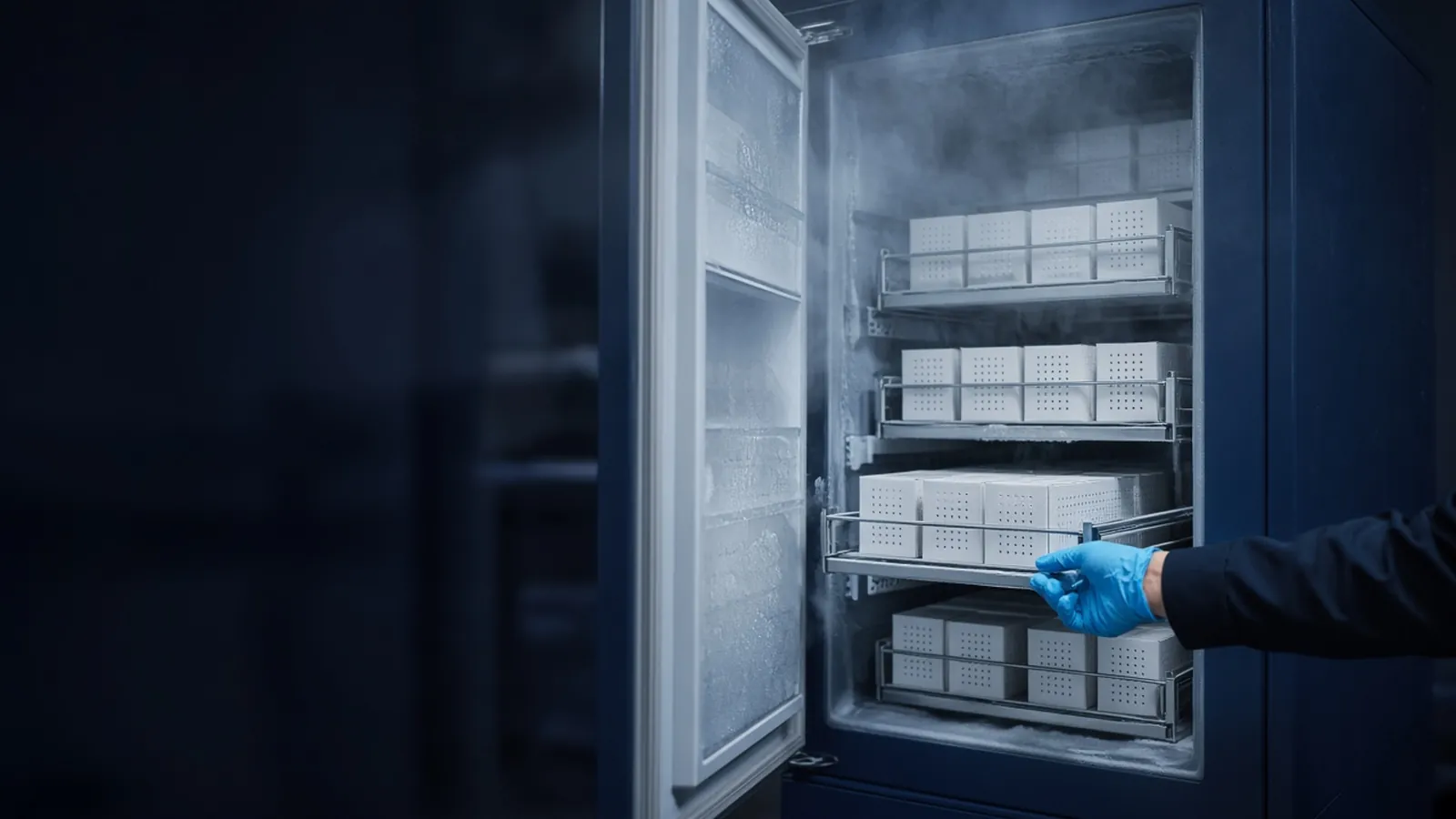
The box is heavier than it was on Friday, or the tubes sit in a clear sheet of ice that was not there when you last pulled the rack. That observation starts a selection. It does not finish one. A warm box is not automatically destroyed, and it is not automatically fine. You choose a holding state first, then you choose what evidence is allowed to release it. Temperature classes and the reason a warm box stays quarantined are the backbone of storing biological samples from fridge to freezer. If the box was on dry ice rather than in a cabinet, the coolant hazards are in dry ice packing for sample shipments.
Replacement tubes, cryoboxes, and labels are plasticware in the laboratory plasticware catalogue. A spare cabinet or a logger is a procurement conversation at laboratory procurement, sent as a quotation request. Neither link tells you whether this particular box is still usable.
What you are selecting
You are selecting one of three next homes for the box, and you are not selecting a viability percentage. This page will not invent one.
The first home is quarantine: a marked shelf or a marked bag, physically away from the in-use rack, with a note of the date, the freezer, and what you saw. The second is a controlled check: a test aliquot, a reference sample, or the control the assay already uses, applied only if the product document or the laboratory SOP says that check can clear the material. The third is discard or return to the owner, when the document says the excursion is outside what the material tolerates, or when the identity is gone.
Going straight back to the working rack is not on the list. A compressor that is running again is not a release.
What the ice can tell you
Ice is water that changed phase. The pattern is a clue to whether liquid water existed inside the box, not a thermometer and not an assay.
Heavy frost on the outside of a box that just left a cold cabinet is ordinary. Moist room air hits a cold surface and freezes. In a humid laboratory that frost grows quickly. It does not mean the tubes thawed. Wipe nothing into the labels while you look, and do not read outside frost as an interior history.
A sheet of clear ice across the bottom of the box, tubes frozen into it, or a glazed crust that looks like a puddle caught mid-freeze, means water was liquid in the box and then froze. The interior reached a temperature where frost and ice already in the box could melt. That is evidence of a warm interval. It is not a measurement of the peak, and it is not a clock. A box can look like that after a long slow warm-up or after a shorter one that went far enough to melt. You cannot see which.
Tubes that are loose, cold, and merely frosty, in a box with no refrozen puddle, are compatible with a cabinet that stayed cold. They are also compatible with a box that warmed, dried a little, and was refrozen so fast that meltwater did not pool. Ambiguous patterns stay ambiguous. Do not promote them to "never thawed".
A box that is uniformly at room temperature, with liquid contents and no ice at all, is warm now. You still do not know when it left the setpoint, unless an alarm or a logger tells you. Dry ice that has vanished from a shipper is the same kind of fact: the coolant is gone, the history of the tubes is not fully known from the empty space alone.
Cracked tubes are a different observation. Cracks come from overfilling, from liquid nitrogen that entered a poor seal on an earlier day, or from mechanical damage. A crack is a contamination and a labelling problem as well as a temperature problem. Isolate cracked tubes. Do not pour them back into the study.
What the label can tell you
A label that is still stuck, still legible, and still matched to the box map preserves identity. Identity is independent of whether the contents tolerated the warm interval. You can quarantine a perfectly named tube.
A label that has fallen off, smeared, or dyed the tube with running ink tells you that moisture and warmth attacked the adhesive or the ink. That supports the idea that the box was wet, which supports a melt, but it also destroys the name. A position in a 9 by 9 box is an identity only while nobody has lifted the tubes out of the ice and put them back by eye. If people have already "sorted" the loose tubes, position is gone.
Two labels on one tube, or a lid labelled differently from the wall of the tube, are an inventory problem that the warm event did not create and does not solve. Hold the tube and reconcile the names before any assay sees it. A cohort analysed under both names is a false result even if the freezer never warmed.
What neither ice nor label can tell you
They cannot tell you the number of degrees above the limit, or the number of minutes. They cannot tell you whether an enzyme still has its activity, whether a cell will form a colony, or whether an RNA preparation is still intact. Those answers live in the product document, the culture-collection guidance, or a control you run on purpose.
They cannot tell you that neighbouring boxes are fine. Heat enters from the door and from the walls. An outer box can have a puddle while a box against the back wall is still hard. Inspect the boxes the alarm or the map marks as exposed. Do not condemn the whole freezer from one box, and do not clear the front row because a box at the back still has loose frost.
They cannot replace a logger trace. If a trace exists, read it. If it does not, write "no trace" in the quarantine note. Absence of an alarm bell is not a trace. The bell may have been silenced, delayed, or pointed at a probe that never saw this shelf.
Choose the next home
| What you see | What it supports | What it does not support | Next home |
|---|---|---|---|
| Outside frost only, tubes loose and hard, labels intact | The box has been in humid air while cold | A full temperature history | Return only if the cabinet record shows no excursion; otherwise quarantine |
| Refrozen sheet or tubes locked in clear ice | The interior melted and froze again | How hot, how long, or whether the analyte survived | Quarantine, then product document and assay control |
| Box warm now, no ice, contents liquid | The box is above freezing now | When the warm interval started | Quarantine. Do not refreeze and forget |
| Label missing or smeared after tubes were moved | Identity is broken | A guess from a neighbour's code | Hold out of the assay until the map rebuilds the name |
| Cracked tube | Possible nitrogen ingress, overfill, or impact | A routine thaw story | Isolate. Treat contents as a spill risk under the local rule |
A box from a power cut, worked without a survival number
The ultra-low freezer alarms during a hot night. In the morning the display is near the setpoint again because power returned before dawn. You pull one front-shelf box of serum aliquots used as research controls, not as a clinical panel. The bottom of the box is a clear ice sheet. Three labels have slid but are still readable in the lid. One lid is blank because the label is stuck to the ice.
You do not scrape the loose label onto the nearest tube. You photograph the box, lift tubes only as far as you must to keep the blank one separate, and move the whole set to a quarantine bag in a freezer that is actually cold, with a note: refrozen puddle, one identity detached, no vial-level logger, cabinet trace to be exported. Then you export the trace. If the trace shows a long interval above the limit written in the serum SOP, the SOP's own rule fires: discard, or run the control the method already names, on one aliquot, and keep the rest quarantined until that control is read. If the SOP has no rule, you write one with the person who owns the study before anyone publishes a figure from those tubes. You still do not estimate a percent remaining.
A second box on the rear shelf is hard, labels dry, no puddle. It does not get a free pass from the front box, and it does not get condemned by it. It gets the same trace. If the trace never left the band, the ice you did not find agrees with the trace, and the box can return under the SOP. If there is no trace, the rear box is quarantined too, because "it looked colder" is a comparison of your hands, not a measurement.
Branches when the first check fails
If the product document says the material tolerates a stated warm interval and your trace is inside that interval, release is a document decision. File the trace with the box name.
If the document says the material does not tolerate a thaw, discard or return under that sentence. Refreezing "in case" creates a box everyone is afraid to use and nobody will throw away.
If the document is silent, the assay control is the only experimental voice you have. Run it on a sacrificial aliquot if the owner agrees. A single failed control supports keeping the quarantine. A single passed control supports release only to the extent the SOP allows one control to speak for the box. Do not widen it into a general claim about cells or enzymes.
If the owner cannot be found and the label is incomplete, the tube is unlabelled material. The laboratory's unlabelled-sample rule applies. A guessed code is not a rescue.
Safety and the limits of this page
Cold boxes still burn skin. Dry ice, if you used it as a bridge overnight, still displaces air and belongs in a ventilated space, as the packing page describes. A cracked tube of cultured cells, blood-derived research material, or any agent the biosafety office has classified is a spill, not a housekeeping wipe. The WHO laboratory biosafety manual and the CDC BMBL describe programme-level controls. Your institution decides which of them apply. This page does not clear material for diagnosis or for clinical use.
What to ask for before the next warm morning
Specify cryoboxes and labels that survive frost, from the plasticware catalogue, so the next puddle does not take the names with it. Specify a logger and an alarm contact whose delay and probe location you understand. Say, in the quotation request, that you need the temperature record a person on call can actually open. Do not ask a seller to declare your thawed box viable. That sentence is yours, and only after quarantine.
Questions from the bench
Does a refrozen sheet of ice in the box mean the samples are ruined?
It means water was liquid inside the box and then froze again, so the interior warmed through a melt. It does not measure how long that lasted, how warm the liquid in each tube became, or whether the analyte is still fit. Quarantine the box and decide from the product document and a control the assay already trusts.
The tubes look frozen and the frost on the outside is heavy. Is that a thaw?
Frost on the outside of a cold box in humid room air is what cold surfaces do. It can appear in a minute and says little about the history inside. Look for melt that refroze around the tubes, wet labels, or a box that is uniformly warm. Outside frost alone is a weak reason to discard and a weak reason to relax.
Can I put the box straight back once the freezer is cold again?
Not if it passed through a temperature you cannot defend. Returning it to the working rack hides the event from the next person. Park it in a marked quarantine location, record the alarm or the lack of a log, and release it only when the stability statement or a test aliquot says you may.
The label fell off one tube. Do I still run it?
Identity and temperature are separate failures. A readable neighbour and a box map may rebuild the identity. A guess from position, after tubes were lifted out of ice, is not an identity. Hold that tube out of the experiment until the map and a second person agree, or discard it under the laboratory rule for unlabelled material.
References
Manufacturer names identify published method classes. Trademarks remain with their owners. Catalogue records on this site are independent references for enquiry. They are not a statement of inventory, distribution rights or a supply commitment. This page is educational. It is not medical advice, a diagnostic protocol or a biosafety approval.
Catalogue
Related products and categories
These links follow the subject of the article into published manufacturer references. A listing is a reference for an enquiry, not a statement of stock or distribution rights.
Continue in this cluster
Related reading
Storing biological samples from fridge to freezerFridge, minus-20, minus-80 and nitrogen storage slow different kinds of damage. A warm box is a quarantine decision, not a hope.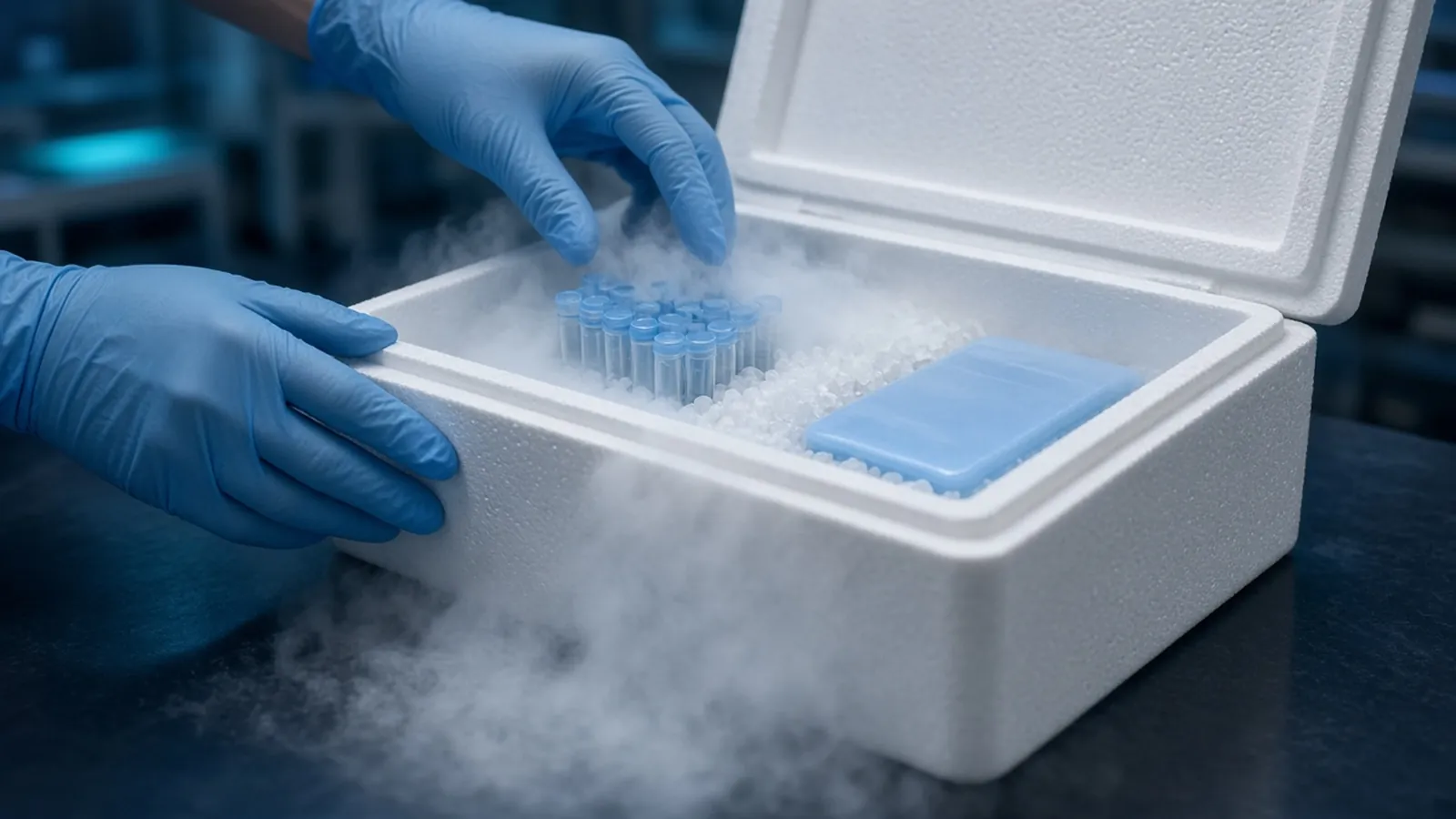 Dry ice packing for sample shipmentsDry ice keeps non-infectious research samples cold and can burn skin or displace air. Carrier rules and infectious-substance law still govern shipping.A glossary of cold-chain termsSetpoint is not air temperature, and a phase-change pack is not every coolant. Compare the cold-chain pairs labs treat as one word.