
guide
Ventilation when dry ice is in a small room
Dry ice in a small room releases carbon dioxide that pools low. Ventilate. This page is not a clearance to keep dry ice in an office.
- Author
- EVRINTH Editorial Team
- Published
- 8 October 2026
- Updated
- 8 October 2026
- Reading time
- 9 min
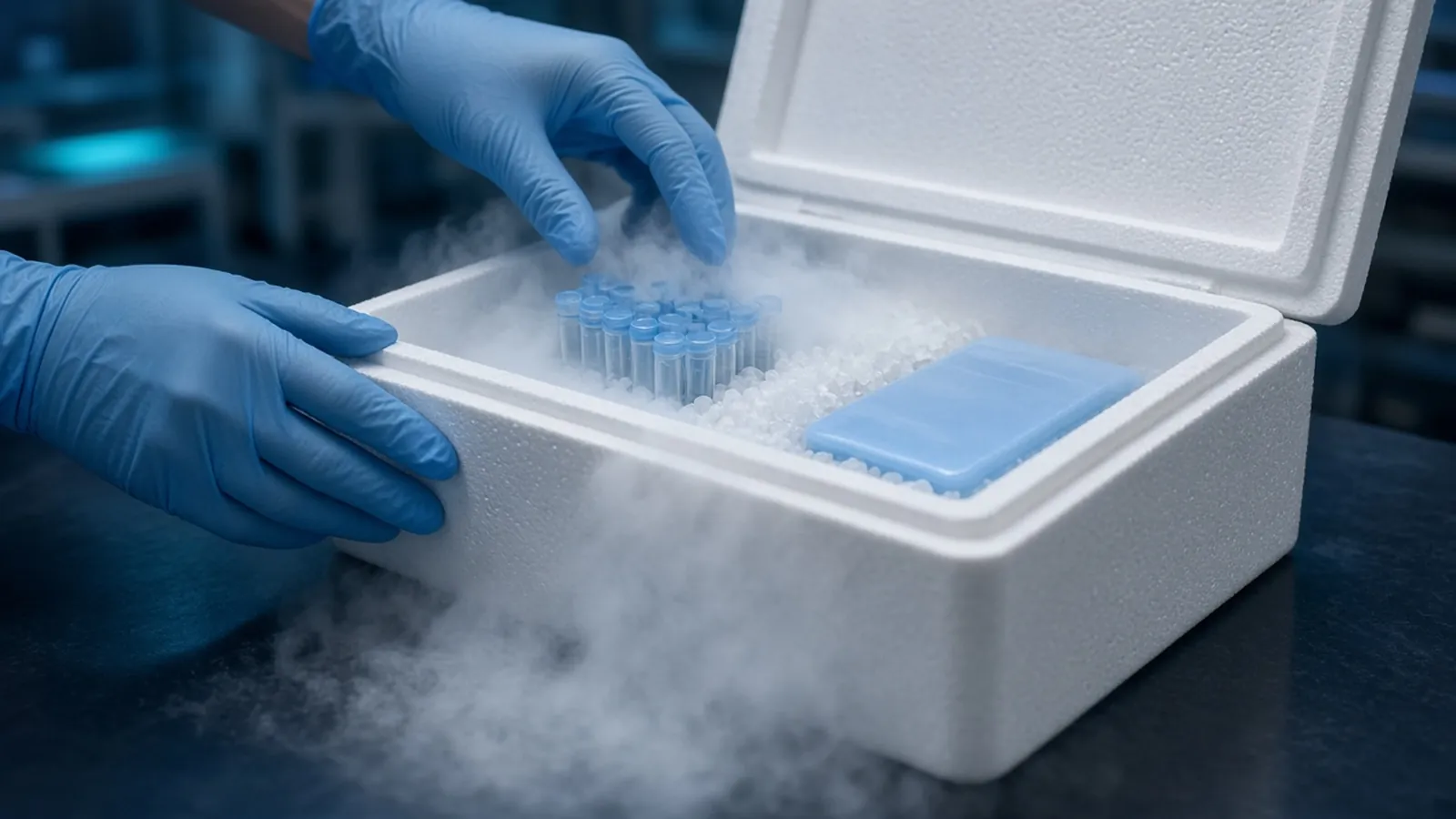
A small room with dry ice in it is a gas problem that looks like a storage problem. Solid carbon dioxide sublimes, the gas is heavier than air, and a closed office does not dilute it. This guide is the decision to ventilate or to move the solid. It is explicitly not a clearance to keep dry ice in an office, a locked cold room, a car, or a cupboard. How shipments are packed, and why the shipper must vent, is dry ice packing for sample shipments. Where samples belong after the coolant has done its job is storing biological samples from fridge to freezer.
Shippers and tubes are laboratory plasticware. Insulated gloves are laboratory consumables. The hardware can be discussed through laboratory procurement and a quotation request. The room itself is an institutional decision.
The decision
You are deciding whether this room may contain subliming dry ice for the time the solid will actually last. The answer is yes only when the institution has already named that room, the air exchange is real, people know the gas hazard, and nobody will close the door and go home. In every other case the decision is to move the solid. Educational text does not convert a spare office into an approved store. If you need a sentence for the door, use the SOP. Do not use this article.
The same decision covers a shipper that arrives at a receiving desk, a block left over after packing, and a "temporary" hold during a freezer failure. Temporary is how weekend exposures begin. Name the allowed place before the dry ice arrives, not after the corridor smells faintly of nothing, which is the usual smell of this hazard.
Why the gas sits low
At atmospheric pressure, dry ice passes directly from solid to carbon dioxide gas at about minus 78.5 °C. The shipper is designed to let that gas out, because a sealed vessel can burst. Once the gas is in the room it does not vanish at the lid. Carbon dioxide is denser than air. It flows downward, pools at floor level, and finds sumps, the space under a bench, and the bottom of a lift. Mixing upward is slow if the air is still.
A small room has little volume, so the same mass of gas produces a higher concentration than it would in a hall. A closed door stops replacement with corridor air. A recirculating air conditioner continues to feel like ventilation because it makes a breeze and may cool the room. It is not ventilation unless it brings in outside air and sends room air out. If the unit's manual says recirculation, believe it.
This guide will not calculate a safe mass of dry ice for a stated floor area. That calculation depends on release rate, mixing, and the exposure limit your institution uses. Inventing it here would be the clearance the title refuses. Workplaces that regulate carbon dioxide do so under occupational rules. The OSHA laboratory standard is a chemical-hygiene framework that points you back to the employer’s programme. It is not a number you paste on an office door.
You also cannot manage this by symptoms alone. People do not have a reliable internal meter for a rising carbon dioxide fraction. Waiting until someone feels unwell is how the control fails. The control is not to be in the small closed room with the source.
What to do when the shipper is already there
If you open a door and find a venting shipper or loose pellets in a small closed room, do not step in and sort the parcels. Call people out. Leave the door open on your way if that is what the emergency procedure says, and tell the person the procedure names. Do not spend the next ten minutes labelling tubes at floor level, which is where the gas collects. Tubes can wait. Lungs should not.
If the procedure says a trained person may move the shipper, they do it with insulated gloves, without hugging the box, and they take it to the named ventilated place. They do not put it in another small room that happens to be empty. They do not put it in a cold room and shut the latch. Cold rooms are small, they are often poorly refreshed, and people enter them without thinking about last week's coolant.
If pellets have spilled, do not sweep them into a closed bin. That bin holds both pressure and a dense gas at floor level. Move them in a venting container to the allowed space, or leave them only if the room is already that space.
| Situation | Why it is a problem | The move |
|---|---|---|
| Shipper in a closed office | Small volume, no assured fresh air, gas pools low | People out. Relocate to the SOP address. Do not store it there |
| Dry ice under a bench overnight | A low, still pocket | Move it now. A cracked lid is not a control |
| Cold room used as a convenient hold | Often small and weakly ventilated, door seals | Forbid it in the SOP. Use the named space |
| Recirculating cooler running | Feels like airflow, may not replace air | Do not count it as ventilation unless you know it exchanges air |
| Sealed bin of "waste" pellets | Gas has nowhere to go | Use an open, ventilated disposal the institution allows |
| Car or van cabin with a large load | A small volume that travels | Keep the cabin supplied with fresh air as the packing page requires. Do not nap in it |
Ventilation that counts
Exchange means a path in and a path out. A window and a door on a still day may or may not be enough. This guide will not bless a window. The institution's safety people, who can see the room, own that judgment. What you can see yourself is the failure mode: a single closed door, a comfort cooler, and a mass of subliming solid.
A monitor with nobody assigned to the alarm does not make a small office an approved store. A fan pointed at the ceiling only stirs a closed room. Stirring distributes carbon dioxide. It does not remove it. Exchange, accepted by the people responsible for the room, is the control.
A worked afternoon
A courier leaves a dry-ice shipper at a receiving window that closes at five. The duty person wheels it into a side office so the corridor stays clear, cracks the lid because they remember that dry ice must vent, and locks the office because the tubes are valuable. The crack is the correct idea applied to the wrong room. Overnight the solid sublimes into a few cubic metres of still air, much of it near the floor.
The morning repair is to follow the emergency procedure, air the room as that procedure directs, and only then recover the samples into the cabinet named in the storage guide. The office does not become a store because nothing obviously went wrong.
The branch you write afterwards: parcels that arrive after the receiving desk closes go to a named ventilated hold, or they wait with the courier under the carrier's rules. They do not go to the side office. Valuable tubes are protected by locking a cabinet, not by locking the gas in with them.
Heat and a shut door
In a hot building, people close doors and run recirculating coolers. That comfort breeze does not cancel the gas. Heat can also finish the solid sooner, so a box left "until after lunch" may be gone while the carbon dioxide it released is still in the room. Do not treat a warm climate as a reason to keep dry ice in a small office. The need for air exchange is the same, and this page states no outdoor temperature.
Safety limits
Cold burns happen while you are trying to be helpful. Gloves or tongs for the solid, eye protection, and no bare-handed heroics. This page is not a medical protocol for someone who has collapsed, and it is not a respirator selection guide. If a person is down, the emergency procedure comes first, which includes not rushing into the same atmosphere unprotected. Practice that distinction before you need it.
Biological hazards of the samples are unchanged by the gas. A venting shipper of infectious material is a biosafety incident plus a gas incident. Stop and use the institutional rule. Biosafety basics for research benches is the introductory page, not an approval. Carrier rules for dry ice as a dangerous good live with the IATA dangerous goods programme. Ventilating a room is not a shipping certification.
What an enquiry can and cannot do
Ask for vented shippers, secondary containers, and insulated gloves. Describe the receiving task and the coolant class. State plainly that you are not seeking approval to store dry ice in an office, and that room safety stays with your institution. A seller who replies with a storage promise for a closed room has not answered the question you asked. Compare quotations on the vent, the outer size the carrier will accept, and the glove class. Then put the SOP sentence on the receiving door: the allowed place, the person to call, and the fact that a side office is not on the list.
Decide whether a room may hold subliming dry ice, and move it if the room cannot
- 01Treat solid carbon dioxide as a gas source, not as a cold brickDry ice sublimes to carbon dioxide at atmospheric pressure. In a small closed room that gas has little volume to dilute into, and it accumulates low because it is heavier than air.
- 02Do not use the room as a storeAn office, a cold room people lock, or any space without a real air exchange is the wrong address. This guide does not authorise storage there. Move the solid to a place the institution has already allowed.
- 03Ventilate by exchanging air, not by stirring itOpen a path to a larger volume or to outside air if the emergency rule says you may. A recirculating cooler that never replaces room air does not remove carbon dioxide. It only moves the cloud.
- 04Leave if the room is wrong and tell someoneIf a shipper is already venting in a closed small room, get people out and follow the laboratory emergency procedure. Do not stay to tidy. Cold burn is a separate injury. Do not handle pellets with bare hands while you exit.
Questions from the bench
Why does carbon dioxide from dry ice collect near the floor?
The gas is denser than air, so it sinks and spreads along the floor, into pits, and into any low cupboard that is open. A small room gives it less air to mix with, and a closed door stops replacement. You cannot rely on smell. The hazard can be present before anyone feels short of breath. That is why the control is ventilation and a decision not to store the solid there.
Is a split air conditioner ventilation?
Not if it only recirculates the room. Comfort cooling can make a closed office feel manageable while carbon dioxide still accumulates. Ventilation means air leaves and fresh air arrives. If you do not know which kind the room has, assume it is not adequate and move the dry ice. This page will not certify a particular room.
Can we keep a shipper under the bench until Monday if the lid is cracked?
No. A cracked lid is the shipper venting, which is correct for the box and incorrect for a small room over a weekend. The solid will continue to sublime. Move it to the location your SOP names, or dispose of leftover solid in a ventilated place the institution allows. A bench well is a low space, which is the wrong geometry.
What should an enquiry say about the receiving room?
Describe the receiving task and ask for a vented shipper sized to the coolant class. State that storage of dry ice in offices is outside the purchase. Ask for insulated gloves as a consumable class. Do not ask a seller to approve your room. Send the hardware specification as a quotation request.
References
Manufacturer names identify published method classes. Trademarks remain with their owners. Catalogue records on this site are independent references for enquiry. They are not a statement of inventory, distribution rights or a supply commitment. This page is educational. It is not medical advice, a diagnostic protocol or a biosafety approval.
Catalogue
Related products and categories
These links follow the subject of the article into published manufacturer references. A listing is a reference for an enquiry, not a statement of stock or distribution rights.
Continue in this cluster
Related reading
Dry ice packing for sample shipmentsDry ice keeps non-infectious research samples cold and can burn skin or displace air. Carrier rules and infectious-substance law still govern shipping. Storing biological samples from fridge to freezerFridge, minus-20, minus-80 and nitrogen storage slow different kinds of damage. A warm box is a quarantine decision, not a hope.
 Biosafety basics for research benchesResearch-bench biosafety is a stack of barriers chosen by a risk assessment. This page explains the stack. It does not approve the work.