
protocol overview
Viscous liquids and slow plunger work
Slow the plunger for viscous liquids, choose reverse or positive displacement, and decide what to do when a film stays in the tip.
- Author
- EVRINTH Editorial Team
- Published
- 8 October 2026
- Updated
- 8 October 2026
- Reading time
- 8 min
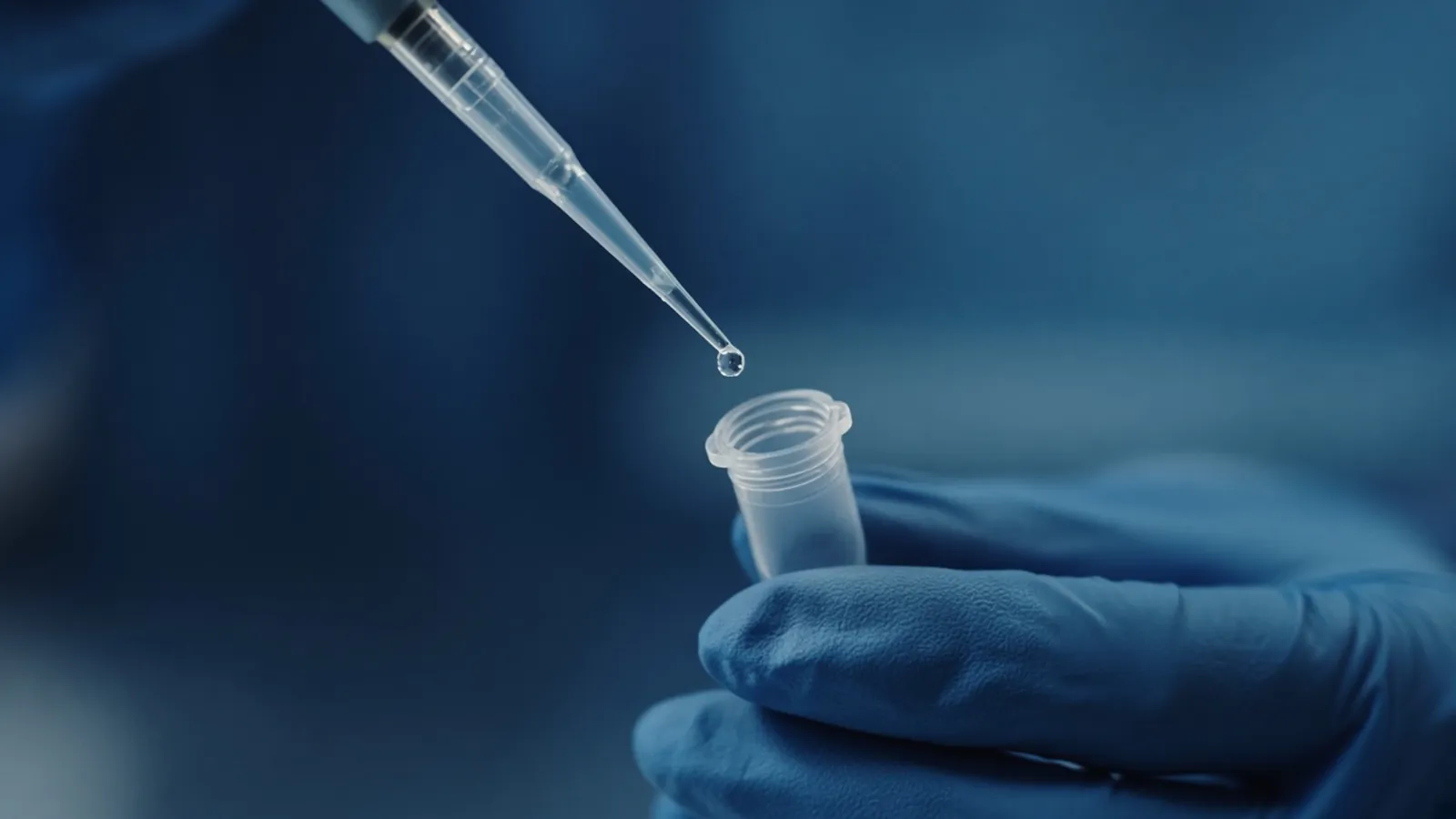
A viscous aliquot that looks complete in the tip is often still arriving. Glycerol, glycerol-rich enzyme stabilisers, concentrated protein, oils, and detergent-heavy lysis buffers lag behind the piston. The decision this workflow supports is how to move that liquid so the tube receives a repeatable volume, and when to stop and change tool. The aqueous forward habit, including the two stops, is set out in accurate micropipetting technique. Use it as the contrast, not as the default, once the liquid clings.
Why speed becomes a volume error
An air-displacement micropipette couples the piston to the liquid through air. With water, the liquid accelerates quickly and the pause you already use is short. With a viscous liquid the pressure difference has to drag a thicker fluid through the orifice. If your thumb is faster than that drag, the cushion stretches, a bubble appears, and the mass in the tip is less than the dial. On the way out, the same lag leaves a film and a slow final bead. Snapping the plunger does not defeat viscosity. It adds splash and a random film.
Reverse pipetting is the air-displacement mode built for this. You aspirate past the first stop so the tip holds the set volume plus the blow-out volume, then you dispense only to the first stop. The film and the extra stay behind as a discarded remainder. The delivered portion repeats more closely from tube to tube. You still move slowly in both directions. Reverse mode with a snapped thumb is only a faster way to be wrong.
Positive displacement is the other branch. A capillary-piston tip puts a solid piston against the liquid. There is no air spring to stretch. Very viscous and very volatile liquids are why that class exists. It uses its own tips and its own calibration. Do not apply a water certificate for an air pipette to a glycerol series done on a piston tip, or the reverse.
Equipment classes, not a single product ritual
You need a pipette whose range covers the volume without living at the extreme bottom of the scale, a tip that seals on that cone, and a reservoir wide enough that a slow aspirate does not suck air when the level falls. Wide-orifice tips are a class for thick liquids and for samples that should not be sheared. They change the flow. If you switch to them mid-experiment, you have changed the measurement. Filter tips are for aerosol control. They are not a treatment for viscosity, and the filter can make the air path slightly less willing. Match the tip to the reason you picked it.
Low-retention surfaces can reduce cling for some aqueous protein solutions. The claim belongs to the tip and the pipette it was tested on. ISO 8655-2:2022 treats a pipette as complete with the selected tip. ISO 8655-1:2022 is the terminology and user-recommendation part, not a statement that your unit is accurate this afternoon. Numerical error limits live in the pipette part of the series and in the manufacturer specification. Compare a check with the specification you claim.
A mix that is honey-like when cool can flow more freely after it sits in a warm room. Equilibrate the liquid you intend to measure. Density for any mass check must be the density of that liquid at that temperature, not the density of water.
The ordered workflow and its branches
Read the liquid. If it is water-like, leave this page and use forward pipetting. If it foams or clings, plan reverse pipetting. If it barely moves, or it is an oil, plan positive displacement. Write the choice in the method before the first real sample.
Seat the tip with a firm press. Set the volume. For reverse mode, press past the first stop before immersion. Enter only a few millimetres. Let the plunger rise slowly, slowly enough that the liquid column keeps moving with it. Pause at the top until the meniscus in the tip is still. If you see a bubble, expel into waste and repeat more slowly. Do not tap the tip to knock the bubble out and then keep the volume.
Move to the destination. Touch the inner wall in a way you can repeat, or dispense into the liquid if the method is a mix and you have standardised that contact. Press slowly to the first stop. Pause. In reverse mode, withdraw and discard the remainder into waste. In a forward method that you have evidence still works for this liquid, use the second stop as blow-out and withdraw while holding the plunger down. Do not snap.
Branch on what you see. A bead that will not leave after a patient reverse stroke means the air pipette is the wrong class. Switch to positive displacement or a wider orifice, and re-check mass. A drip that appears before you dispense is a seal, a damaged shaft, or unexpected volatility, not "just thickness". Reseat once. If it continues, remove the pipette from service. A series that was fine for the first tubes and short for the last often means the reservoir level fell and some channels or the single tip sucked air. Refill or tilt the reservoir with a written habit, not an improvised deeper plunge that coats the outside of the tip.
An interim check with water, described in checking a pipette between calibrations, tells you the piston and seal still behave with water. Pass it, then weigh the real liquid if that volume decides the experiment. A passing water mean does not license glycerol.
| What you see in the tip | Likely mechanism | Branch |
|---|---|---|
| Bubble after a fast upstroke | Liquid lagged the piston | Repeat slowly and pause |
| Film after a forward blow-out | Retention on a water-style stroke | Change to reverse mode |
| Bead remains after slow reverse | Air cushion cannot finish the job | Positive displacement or wide orifice |
| Drip before dispensing | Seal, shaft, or vapour | Reseat once, then remove from service |
| Early tubes good, late tubes short | Reservoir air intake | Refill and keep immersion shallow |
Failure modes that look like biology or chemistry
A restriction digest that sometimes fails because the glycerol-stabilised enzyme was short is a pipetting story wearing a biochemistry costume. A protein assay that drifts because each reverse stroke was a different speed is a rhythm story. Watch one dispense into a tared vessel and convert mass with the liquid's own density. If the mass walks around while the gesture looks identical, slow down further or change class. If the mass is stable and wrong, you have a systematic mode error, such as blowing out a reverse aliquot.
A certificate for water in forward mode does not absorb a viscous method. Record the mode beside the pipette identity.
Safety
Viscous reagents include corrosives and concentrated detergents. Thickness is not a reduction in hazard. Use the containment the assessment names. Do not mouth-pipette. This workflow is for research measurement.
What to send with an enquiry
State the liquid class in plain words, the volume, the temperature you work at, and whether you need air displacement with reverse mode or a positive-displacement system. Name the tip family, including any wide-orifice requirement, and whether a calibration document must cover the volumes you use. Pipette families are browsed from the scientific instruments catalogue, tips from the laboratory consumables catalogue, and the written need goes with the quotation request.
Dispense a viscous liquid without snapping the plunger
- 01Match the tool to the liquid before the first aliquotDecide whether the liquid is only thick or also foaming or volatile. Choose reverse pipetting on an air-displacement pipette, or move to a positive-displacement tip, before you build a dilution series.
- 02Aspirate slowly and pause at the topPress to the stop the mode requires, immerse only a few millimetres, and let the plunger rise over a second or more. Wait until the liquid in the tip has stopped moving before you leave the reservoir.
- 03Dispense slowly and do not chase a film by snappingDeliver with the same unhurried pressure. In reverse mode, stop at the first stop and discard the remainder. In forward mode, use the blow-out only if the method still expects it for that liquid.
- 04Branch when the tip keeps a visible filmIf a bead remains after a slow reverse stroke, change to positive displacement or widen the tip class. Do not spin the destination tube and record the dial volume as delivered.
Questions from the bench
Why does a snapped plunger leave bubbles in glycerol?
The piston can move faster than a viscous liquid can follow through a narrow orifice. The air cushion expands, the liquid lags, and a bubble or a void opens in the tip. That void is unmeasured air sitting where volume should be. A slow aspirate and a pause at the end of the upstroke let drag catch up. Snapping the plunger on the way out sprays the receiving tube and still leaves a film on the wall that the blow-out never quite clears.
Is reverse pipetting enough for every viscous liquid?
Reverse pipetting helps when the problem is a repeatable film: you aspirate extra and dispense only to the first stop, so the clingy remainder stays in the tip instead of varying the delivery. Very thick liquids, oils, and some lysis mixes still move too slowly for an air cushion. Positive displacement, with a piston in the tip, is the class that removes that cushion. A water calibration does not become a glycerol calibration because you reversed the stroke.
Should a viscous aliquot be pre-wet?
Pre-wetting wets the inner wall so the first stroke is not the one that paints a dry tip. It does not replace a slow rhythm. Use the same tip family you will measure with, because a poor seal adds a leak on top of the film. If the liquid is also volatile, pre-wet for vapour as well and keep the pace short. Discard preparatory strokes. They are not part of the sample volume.
How does tip fit change a viscous measurement?
A tip that does not seal lets air enter around the cone while the thick liquid is still moving. The delivered mass then depends on how hard you happened to seat that tip. Low-retention claims are real only for the surface and the pipette they were tested on. Write the tip family into the method next to the mode, and check a few dispenses by mass, using the density of that liquid at the temperature you measured, before you trust a long series.
References
Manufacturer names identify published method classes. Trademarks remain with their owners. Catalogue records on this site are independent references for enquiry. They are not a statement of inventory, distribution rights or a supply commitment. This page is educational. It is not medical advice, a diagnostic protocol or a biosafety approval.
Catalogue
Related products and categories
These links follow the subject of the article into published manufacturer references. A listing is a reference for an enquiry, not a statement of stock or distribution rights.
Continue in this cluster
Related reading
Accurate micropipetting techniqueHow an air-displacement micropipette delivers a volume, how forward pipetting uses the two stops, and why temperature belongs in the result.A glossary of liquid-handling termsSeparate the liquid-handling terms people mix up, from blow-out and pre-wetting to systematic error, tip fit, and the Z-factor.Air displacement versus positive displacementTrace under-delivery and dripping to the air cushion or the piston, and choose the pipette class that matches the liquid.