
selection guide
What an autoclave indicator does not prove
Tape, a chemical integrator, and a biological indicator answer different questions. Choose the class that matches the claim you need about a cycle.
- Author
- EVRINTH Editorial Team
- Published
- 8 October 2026
- Updated
- 8 October 2026
- Reading time
- 10 min
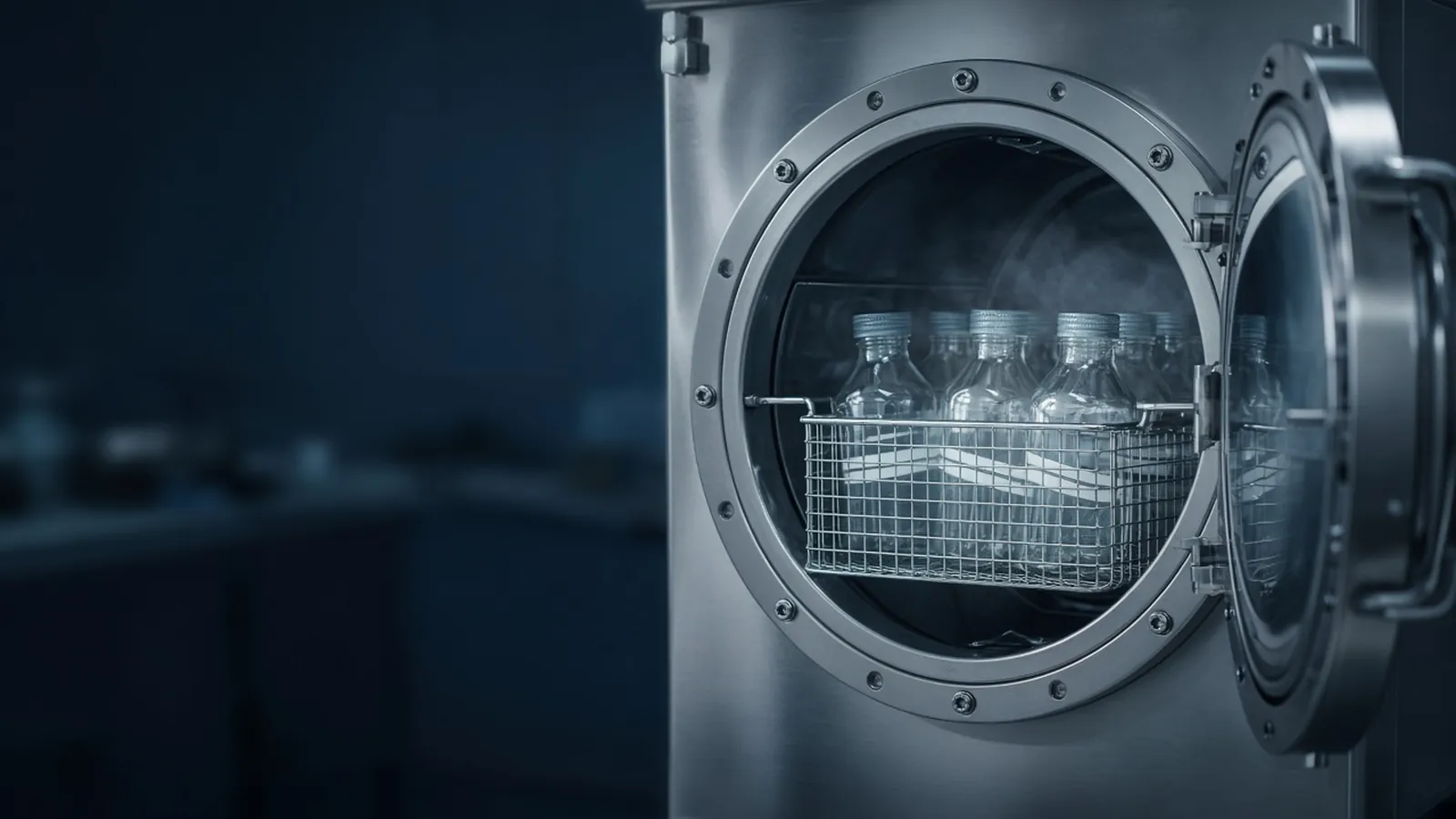
A brown stripe on a bag is a useful mark and a poor verdict. Before the next box of indicators is specified, decide which question the mark is allowed to answer, and which questions it must leave closed. What steam sterilisation itself does not do, including cleaning, endotoxin, and chemical waste, is already set out in autoclaves and what sterilisation does not do. This page is the selection guide for the indicator class. Bags, tape, integrators, and biological indicators are consumable classes in the laboratory consumables catalogue. The reason a load is autoclaved at all sits in biosafety basics for research benches. Send the specification with a quotation request. A seller cannot release your load.
The claim you are buying
You are choosing a piece of evidence, not a decoration. Three families get ordered as if they were sizes of the same product. They are not. An external process indicator, of which autoclave tape is the everyday example, changes when conditions at that spot reach a trigger the dye was built for. A chemical integrator or other in-pack chemical indicator is built to respond to a combination of time, temperature, and steam, and it is placed where you want that claim. A biological indicator carries resistant spores, commonly Geobacillus stearothermophilus for steam, and asks whether those spores were killed where the indicator sat. The biological result is the class of evidence that challenges the process. The other two can support process control. They do not stand in for the spore.
Public practice is framed by the WHO laboratory biosafety manual and the CDC BMBL. A healthcare-oriented discussion of sterilisation monitoring is also published by the CDC. None of these is your cycle recipe. The autoclave manufacturer, the indicator manufacturer, and your laboratory's release rule decide what a pass looks like for each load type.
What tape is allowed to say
Tape on the outside of a pack often only shows that temperature, or a steam condition the dye needs, was reached at the tape. It does not show that the centre of a liquid, the middle of a tied bag, or a crowded basket was held at temperature. It does not show that air was removed. It does not show that the hold lasted for the time the load required. It does not show that a resistant spore would have died. It is still worth having, because a pack with unchanged tape is a pack that should not be mistaken for one that entered a cycle. The selection rule is: buy tape when you need to stop the "was this bag processed at all" error. Do not buy tape when the sentence you need is "this load is sterilised."
A chart or a digital record sits beside tape, not above a biological indicator. It says what the sensor saw. If the sensor is in the drain or the chamber, it is not automatically the coldest point in a dense load. Select a recorder when you need a history. Read it as the sensor's history.
What a chemical integrator is allowed to say
An integrator placed inside a pack is a stronger process check than tape on the outside, because it saw the inside. It is built so that its change reflects exposure to the variables its design integrates, rather than a single glimpse of heat. It still is not a living challenge. A chemical change can be produced by conditions that would not have killed the spores you care about, or it can sit in an easy part of the load while a tight corner never saw steam. Select an integrator when your procedure wants a rapid, in-pack process mark and you already know it is not the biological release test. Place it where the procedure says, not where the tape was. If the integrator has not changed, do not release the pack on the strength of the outside tape. That branch is the reason you bought the integrator.
There is a further chemical check people fold into the same sentence: an air-removal test, such as a Bowie-Dick type test, used on a pre-vacuum machine. That test asks whether the empty-chamber air-removal function worked on that test pack. It does not sterilise the afternoon's waste, and it does not belong in the middle of a liquid load as a substitute indicator. Select it only if you run the cycle type it was made for, at the frequency your validation states, and keep its result in the machine log rather than on the waste bag.
What a biological indicator is allowed to say
A biological indicator is the class of evidence for the sterilisation process at the point where it was placed. If the spores grow after the incubation the instructions name, the cycle did not do what a sterilisation claim requires at that point. If they do not grow, and a non-autoclaved control from the same lot does grow, you have evidence about that placement and that cycle. You do not have evidence about a different packing density, a sealed bottle, or a load that ran after a power cut. You do not have evidence that chemical contamination was removed. You do not have evidence the items were clean before they went in.
Select a biological indicator when the release rule, or the validation, asks for a biological challenge. Match it to steam if the cycle is steam. Read the stated organism and the incubation temperature and time on the instructions, and do not invent a shorter incubation because the incubator is busy. Store the lot as the maker says. Heat and a humid shelf can kill the challenge before the autoclave does, which makes a "pass" meaningless. The unexposed control is part of the selection, not an optional extra. A control that does not grow tells you the test failed open.
Criteria, in the order that keeps the claim honest
Write the sentence the indicator must support. If the sentence is "this pack entered a hot cycle," an external process indicator can be enough. If the sentence is "the inside of this pack saw a defined steam exposure," look at an in-pack chemical indicator and still do not call it a spore result. If the sentence is "a resistant spore at the hardest location was killed," you are selecting a biological indicator, a placement, a control, and an incubation you can actually perform.
Then write the cycle family. A steam indicator is not automatically honest in a dry-heat oven or in a vapour process you do not run. Then write the placement. Outside, in-pack, and worst-case are three specifications. Then write who reads the result and what they do on a fail. An indicator nobody is allowed to fail is not a control. Then write the documents you will ask to see: the organism for a biological product, the cycle it is intended for, storage, shelf life, and the incubation method. You are not asking the seller to validate your autoclave.
| Class you might specify | Select it when the question is | Do not let it prove | A failed result means |
|---|---|---|---|
| Tape or other external dye | Did the outside see a triggering condition? | That the load centre was sterilised | Do not treat the pack as processed |
| In-pack chemical integrator | Did this interior spot see the integrated exposure? | That spores at a harder spot died | Do not release on the outside tape |
| Air-removal test pack | Did this pre-vacuum machine remove air in the test? | Anything about today's waste or media | Hold the machine for the laboratory's rule |
| Biological indicator, with a live control | Could this cycle kill the challenge where it sat? | Other loads, dirty soil, or a chemical hazard | The load stays unsterilised |
| Chamber chart | What did the named sensor record? | The temperature in a trapped air pocket | An incomplete record is not a pass |
The branch when the result and the load disagree
If tape has changed and the biological indicator grows, believe the biological indicator for that placement. Do not split the difference. Quarantine the load as the rule requires, and look at packing and the cycle before you look at the brand of tape.
If the power fails during the hold, an indicator that had already begun to change is not a finished cycle. The load is incomplete. Restart only the cycle your written rule names, or hold the load and ask the person responsible. Do not invent the remaining minutes. If the chart stops and the tape is striped, you have a stripe and an incomplete record. That is not a quiet pass.
If the control vial does not grow, you did not run a biological test. Repeat with a lot that can still grow, and do not release on chemistry alone if biology was required. If every indicator passes and the load was a sealed, overfilled bottle, the indicators were not in the liquid. The mechanism failed even though the dyes behaved. Packing limits are the manufacturer's and your procedure's, not the indicator's job to repair.
Heat, humidity, and a purchasing habit
In a humid season, indicator stocks left open take up moisture, and packs that leave the chamber wet are not a sterile barrier just because a dye moved. Specify storage on the enquiry: dry, within the temperature the maker states, away from the autoclave's own heat. In a building where power drops in the afternoon, specify that your release rule treats an interrupted cycle as failed, and do not ask an indicator to paper over the gap. A smaller validated load you can finish is a better specification than a pallet of tape.
Safety and the limit of a catalogue line
Unloading is a burn hazard. Indicators do not change the personal protective equipment the assessment names for that job. This page does not validate your autoclave, does not approve infectious waste, and does not tell you to treat a burn. Report injuries through the laboratory's process. Choosing an indicator class is not permission to run a load the chemical or biological rule forbids.
What to put in an enquiry
State steam as the process, the indicator family, and the claim it must support. For a biological indicator, ask for the organism, the incubation the instructions require, and the storage conditions. Ask whether a control is part of the pack. For tape and integrators, state external or in-pack. Say that your institution owns the release decision. Use the quote form and the consumables catalogue. Compare documents, not adjectives such as medical grade. Then write the placement into the local procedure, because an indicator in the easy corner will pass a load the steam never reached.
Questions from the bench
Can I release a load because the tape striped and the chart looks normal?
Only if your laboratory's release rule says those two items are enough for that load class. Tape reports a condition at the tape. A chart reports the sensor the machine trusts. Neither is a spore challenge in the hardest part of the pack. If the rule requires a biological indicator, a stripe does not substitute for it.
Where should a biological indicator sit if I am allowed to place one?
In the location your validation treats as hardest for steam to reach, not in the place that is easiest to retrieve. A indicator taped to the outside of a bag answers a different question from one inside a dense load. Follow the indicator maker's instructions for the cycle type, and follow the autoclave maker for where a challenge is meaningful.
What does a positive biological indicator mean the next morning?
Treat that load as not sterilised. A growth result means the challenge spores were able to grow after the cycle, so you do not average it into a pass. Review packing, air removal, the cycle that was actually selected, and the machine. A control from the same lot that fails to grow means the test itself is uninformative, because you have not shown the spores were alive.
Which indicator class belongs on a purchasing note?
State the process you need evidence for: steam, not a dry-heat or chemical-vapour claim you do not run. Name whether you need an external process mark, an in-pack chemical integrator, or a biological indicator, and name the organism the biological product uses if that is the class. Ask for storage conditions and the incubation the instructions require. Do not ask a seller to decide that your waste is sterile.
References
Manufacturer names identify published method classes. Trademarks remain with their owners. Catalogue records on this site are independent references for enquiry. They are not a statement of inventory, distribution rights or a supply commitment. This page is educational. It is not medical advice, a diagnostic protocol or a biosafety approval.
Catalogue
Related products and categories
These links follow the subject of the article into published manufacturer references. A listing is a reference for an enquiry, not a statement of stock or distribution rights.
Continue in this cluster
Related reading
 Biosafety basics for research benchesResearch-bench biosafety is a stack of barriers chosen by a risk assessment. This page explains the stack. It does not approve the work.Autoclaves and what sterilisation does not doSteam sterilisation holds a cleaned load at temperature. It does not wash, remove endotoxin, or prove sterility because the tape changed colour.A glossary of biosafety termsPairs that share a bench still do different jobs. Use this comparison to choose the right word for a cabinet, a chemical, a level, or a control.