
selection guide
A glossary of immunoassay terms
Analyte, capture, conjugate, blank, matrix, spike recovery and lot, defined so a datasheet can be shortlisted before a reagent is ordered.
- Author
- EVRINTH Editorial Team
- Published
- 8 October 2026
- Updated
- 8 October 2026
- Reading time
- 11 min
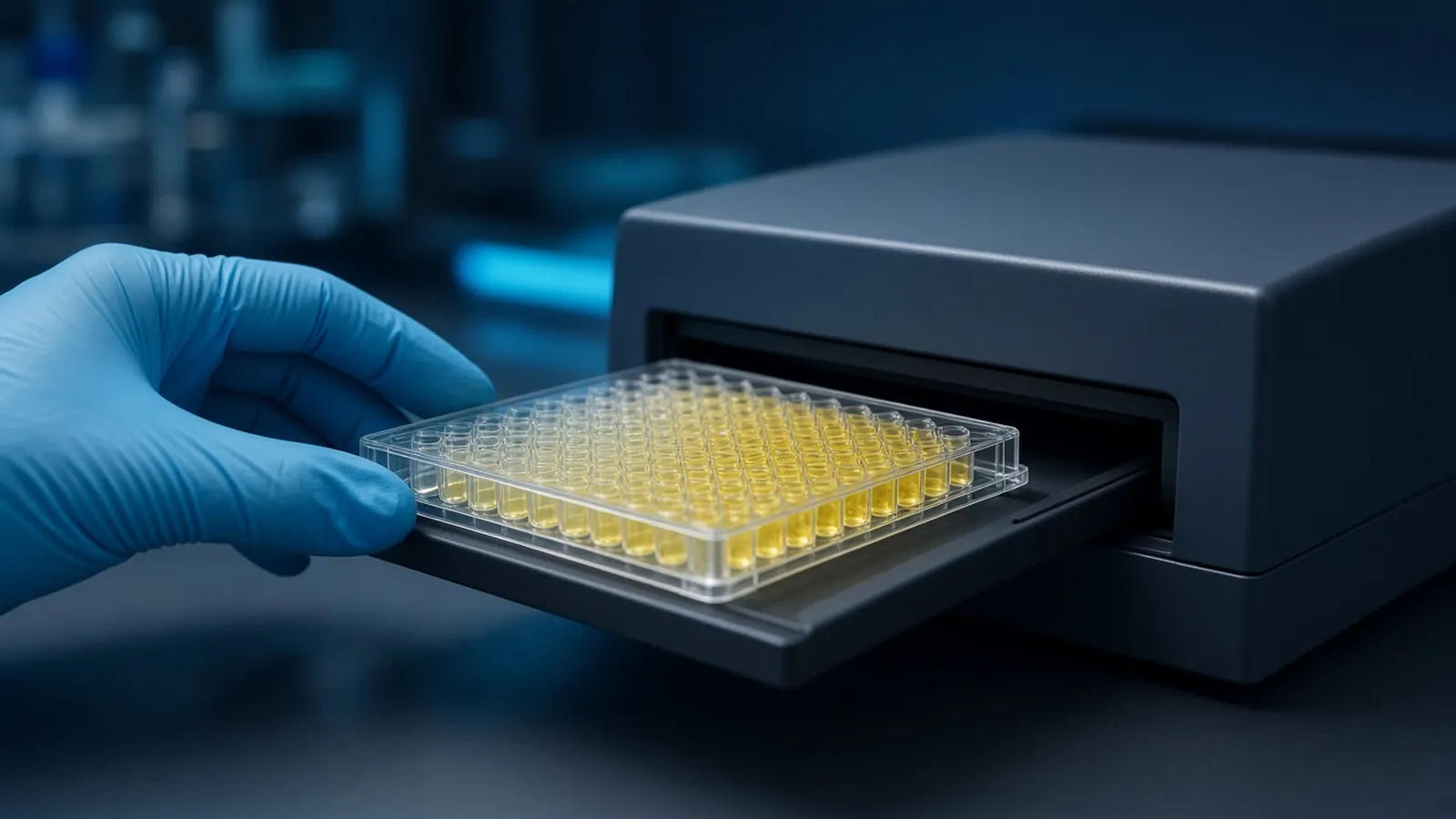
A glossary of immunoassay terms is a purchasing tool dressed as a vocabulary list. The words below decide whether a reagent class even belongs on a shortlist. If a datasheet cannot say what the analyte is, what captures it, what detects it, what the blank contains and what unit the calibrator uses, you are not comparing products yet. You are comparing adjectives. The formats those words sit inside are explained in ELISA formats, controls and readout. How to test a primary antibody once it arrives is the companion page choosing and checking a primary antibody. Nothing here is a price comparison, and nothing here is a clinical claim.
Analyte, the thing the well is supposed to report
The analyte is the molecule you intend to measure: a protein, a peptide, sometimes a small hormone or a drug. Name it with a species. Human serum albumin and bovine serum albumin are both albumins and they are not interchangeable calibrators. If the target is a protein with isoforms, say which isoform, or say that the assay does not distinguish them. Sequence databases such as UniProt and NCBI Protein are where you check that the name on the vial matches a real entry, including domains a peptide immunogen might have covered or missed.
On a shortlist, the analyte name has to appear as a specific target, not as a family. Ask which species were actually tested. Cross-reactivity you have not asked about will be discovered by your samples.
Capture and detection, and why the pair matters
Capture is the reagent fixed to the solid phase, usually an antibody coated on the plastic, that pulls the analyte out of the mixture. Detection is the reagent that binds the captured analyte and carries the signal, either because it is itself labelled or because a further reagent labels it. In a sandwich, capture and detection must be able to bind at the same time, which means their epitopes should not collide. A single antibody cannot be both partners unless the assay is a different format.
Write down whether you are buying a matched pair or two vials you will combine yourself. A pair tested only as a blot primary is not automatically a capture reagent. The datasheet should say which antibody coats and which detects. If it does not, pause the shortlist.
Blocking sits beside these words. Blocking is the solution, often a protein such as albumin or casein, that covers plastic the capture antibody did not cover. It is not the analyte and it is not a control by itself. You select a blocker by the detection chemistry: milk is a problem for some biotin systems and for some phospho-specific reagents. A datasheet that specifies the blocker class has done you a favour. A datasheet that says block as usual has left the failure to you.
Conjugate, chromogen and substrate
A conjugate is a detection reagent covalently joined to something that makes a signal. Common enzyme conjugates use horseradish peroxidase or alkaline phosphatase. A fluorescent conjugate carries a fluorophore instead. The word conjugate on a label should tell you the enzyme or the dye, the host the antibody was raised in, and the species it recognises. Anti-rabbit peroxidase is not anti-mouse peroxidase. Selecting the wrong species gives a quiet plate that looks like a failed coating.
Chromogen and substrate are the chemicals the enzyme converts into something you can see or measure. People use the words loosely. Strictly, the substrate is what the enzyme acts on, and the chromogen is the compound that becomes coloured. In many colour kits the bottle is simply called substrate and contains both roles in one solution. Select the bottle that matches the enzyme. A peroxidase substrate on an alkaline phosphatase conjugate stays colourless. That is a selection error, not a low sample.
Read the stop condition on the same sheet. Some colour reactions are read while they are still developing. Others are stopped with acid and change hue. The wavelength belongs to that stopped or unstopped state. Put the wavelength next to the substrate name in your specification so a later reader setting cannot drift away from the chemistry you bought.
Optical density, and the blank underneath it
Optical density, often shortened to OD, is a way of reporting absorbance. A higher number means the well transmitted less of the light the reader sent. It is not a mass, and it is not unitless in any deep sense: it depends on wavelength, path length and the instrument's blanking. When you select a reader or a kit, ask which wavelength the colour is meant to be read at, and whether the report should store raw optical density as well as a calculated concentration.
The blank is the well that estimates signal without the specific event you care about. Laboratories use the word for slightly different wells: substrate only, or the full protocol without analyte, or a well without capture antibody. The selection point is that the datasheet or your protocol must define the blank in one sentence. If you subtract an undefined blank, another laboratory cannot audit the number. A loud blank means the reagents are sticking somewhere. It is a reason to change blocking, washing or antibody dilution. It is not a number to subtract until the remainder looks plausible.
Matrix, the liquid the analyte actually lives in
Matrix means everything in the sample that is not the analyte: serum proteins, lysate detergents, culture medium, bile salts, biotin from a supplement, the buffer you diluted with. The matrix changes binding and it changes background. A calibrator diluted in a clean buffer can draw a beautiful curve that the serum samples do not lie on.
When you shortlist a kit or a standard, ask which matrix the calibrator is supplied in, and which sample types were used when the method was demonstrated. Demonstrated is not the same as validated for a clinical decision. For a research plate it still matters, because a lysate and a serum are different arguments. If your matrix is unusual, say so in the enquiry. A method can be discussed against that matrix. Do not assume a general ELISA reagent has already seen it.
Spike recovery and parallelism
Spike recovery asks a direct question. You add a known amount of analyte into the real sample matrix and measure what fraction you get back. Poor recovery means something in the matrix hides the analyte or inflates the signal. The plate can still rank samples. It should not be asked to report a true mass until recovery is acceptable by a criterion you set before looking.
Parallelism, sometimes called dilutional linearity in everyday speech, asks whether a diluted sample traces the same shape as the calibrator curve. If doubling the dilution does not move the calculated concentration the way the curve predicts, you may be measuring a different mixture at different doses, or you may be outside the working range. Select assays where you can run this check. A kit that forbids dilution and also saturates on your samples has not given you a working range. It has given you a single point.
Set the acceptance criterion in the protocol and keep the raw optical densities. The words exist so a specification can demand the experiment.
Precision, as a concept rather than a badge
Precision is how tightly repeated measurements agree. Repeatability is agreement under the same conditions, close together in time. Reproducibility is agreement when something important changes: a day, an operator, a lot. A datasheet that quotes a single precision figure without saying which of those it means is hard to use. Ask what was repeated. Wells pipetted from one dilution are a pipetting check. Samples from independent cultures are a biological check. They are both useful and they are not the same purchase.
A small precision number is not accuracy. A method can be tightly wrong if the calibrator is the wrong protein. Accuracy needs identity and recovery. Precision needs the kind of repeat you actually ran.
Lot, the only identity a vial keeps over time
A lot, or batch, is the manufacturer's grouping of material made and tested together. Polyclonal bleeds change between animals and even between bleeds of one animal. Hybridoma supernatants change if the culture drifts. Recombinant reagents change if the production run changes, even when the sequence is intended to stay constant. The lot code is how you notice. Your specification should require the lot to be printed on the vial and on the documents, and your plate record should copy it down.
A control sample stored with the cold-chain habit in storing biological samples from fridge to freezer lets the next lot be compared on one plate. Apply the antibody sheet's own temperature. A shortlist without a bridging control hides a quiet lot change.
Cell-line controls used to check that an antibody still sees the intended target have their own identity problems. ICLAC records misidentified lines. If your negative control is a named line, its identity is part of the reagent specification, not a footnote.
Terms that must appear before you continue a shortlist
Read each candidate against the decisions in the table. If the cell is empty, the next step is a question, not an order.
| Term | Decision it controls |
|---|---|
| Analyte and species | Whether the vial is even aimed at your target |
| Capture and detection | Whether you have a pair that can bind together, and which vial coats |
| Conjugate | Whether the enzyme or dye matches the substrate and the host |
| Chromogen or substrate | Wavelength, stop acid, and timing, all taken from that bottle |
| Optical density | What the reader must store so a later audit can see raw signal |
| Blank | Which well is allowed to define background, written in one sentence |
| Matrix | Whether calibrators and samples are the same kind of liquid |
| Spike recovery | Whether a mass claim is allowed, or only a rank |
| Parallelism | Whether dilutions are measuring the same thing |
| Precision | Which kind of repeat the number refers to |
| Lot | How you will notice that the next delivery is not the last one |
When a missing word should stop the order
If the conjugate species is absent, stop. Guessing anti-mouse versus anti-rabbit wastes the plate and can look like no antigen. If the unit of the standard is absent, stop before you promise a supervisor a concentration in mass. Arbitrary units are allowed when you say they are arbitrary. Hidden units are not. If the application list does not include the method you will run, treat a western blot photograph as evidence about blots, and ask whether ELISA was ever tried.
protocols.io is a reasonable place to see how working groups name these controls in full write-ups. Use it to compare completeness, not to replace the sheet in the box you received.
Safety and the boundary of the vocabulary
Learning the words does not authorise diagnostic use. A research immunoassay supports the comparison you designed. Preservatives, stop acids and human specimens are handled under institutional rules and the safety sheet for each bottle. Blocking proteins are still proteins: they can spoil, and a spoiled blocker raises background that the glossary would call a failed blank. Discard on the signs the sheet describes. Do not taste, sniff as a test, or repackage into an unlabelled tube and hope the word conjugate is remembered.
Specification files in a humid office
Purchase files travel badly when they are only a product nickname on a shared drive. Write the glossary words into the specification itself: analyte, species, capture, detection, conjugate, substrate class, matrix, unit, lot-bridging plan, and the storage temperature the vial will need on arrival. In a hot receiving room, a vial that must stay frozen is a logistics sentence, not a hope. Print or export the datasheet into the same folder as the enquiry, because a web page can change while your experiment cannot. Humidity that curls a paper plate map is a small version of the same problem. The map and the definitions belong where the optical densities will be stored.
What to ask for when the words are still thin
Name the analyte, the species, the matrix, the format, and which of the terms above you need the reply to define. Say whether you need a matched pair or a detection conjugate for an antibody you already have. The reagents and chemicals catalogue is where reagent classes can be browsed. The molecular biology pathway is the methods context around the plate. Send the specification through the quote request and ask whether a quotation is possible. A method can be discussed from those words. Ask the reply to state conjugate identity, calibrator unit and lot documentation. Do not fill a gap in the datasheet with a guess and then treat the guess as a specification.
Questions from the bench
Which words have to be on the datasheet before a shortlist?
Analyte or target, application, host, clonality, conjugate if one is already attached, calibrator identity and unit, recommended matrix, and lot definition. A page that only says sensitive ELISA is not yet a candidate. You can ask for the missing words, and you should not guess them.
Is optical density the same thing as a concentration?
Optical density is the reader output. Concentration is what you infer when a calibrator curve, a quiet blank and a stated curve model all hold. Reporting optical density as if it were a mass hides the unit. Keep both numbers in the file.
What is the difference between a blank and a zero standard?
A blank is the well that shows the signal of reagents without the specific binding you claim, and laboratories define it in the protocol. A zero standard is usually the calibrator diluent with no added analyte, carried through the full assay. They answer neighbouring questions and should not be collapsed into one well without a sentence that says so.
Does a published lot number prove the next vial will match?
A lot number lets you notice a change. It does not promise that the next lot will give the same optical density at the same dilution. Keep a control sample and compare lots on the same plate before you pool data across a delivery.
References
Manufacturer names identify published method classes. Trademarks remain with their owners. Catalogue records on this site are independent references for enquiry. They are not a statement of inventory, distribution rights or a supply commitment. This page is educational. It is not medical advice, a diagnostic protocol or a biosafety approval.
Continue in this cluster
Related reading
ELISA formats controls and readoutELISA formats, controls and readout: how direct, sandwich and competitive assays turn a binding event into a number that stays inside the curve. Choosing and checking a primary antibodyHow to choose and check a primary antibody: host, clonality, application claims, and controls that show the signal is the intended target.Questions before an antibody enquiryTarget, species, application, immunogen, host, conjugate and storage on arrival. Each question stops a different wrong reagent from being quoted.