
explainer
Questions before an antibody enquiry
Target, species, application, immunogen, host, conjugate and storage on arrival. Each question stops a different wrong reagent from being quoted.
- Author
- EVRINTH Editorial Team
- Published
- 8 October 2026
- Updated
- 8 October 2026
- Reading time
- 10 min
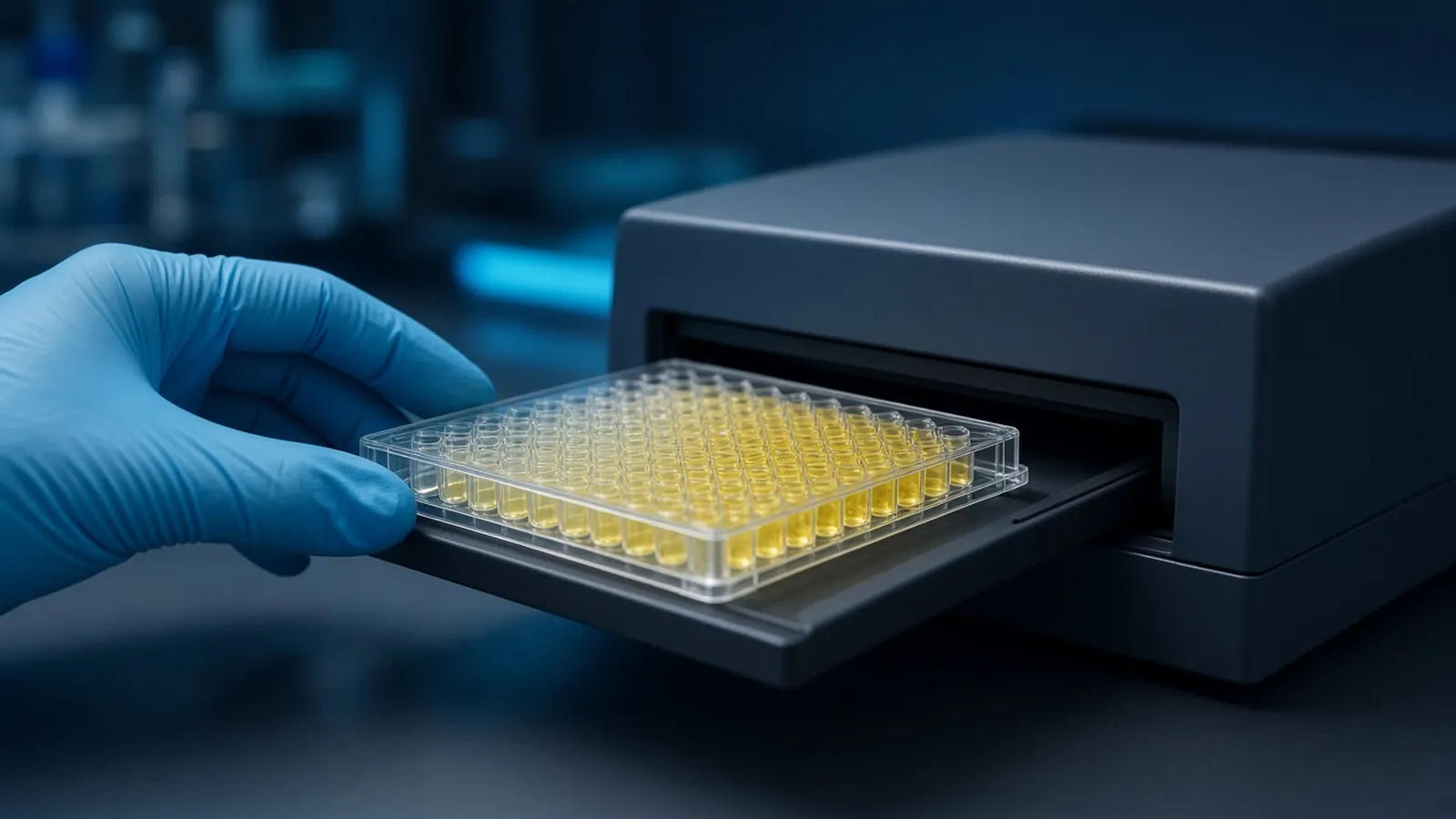
Questions before an antibody enquiry exist because a product name is not a specification. Each question below blocks a different wrong vial: the right protein in the wrong species, the right species in a method the antibody was never shown to survive, a peptide epitope your samples do not display, a host that does not match the secondary you already own, a conjugate you did not want, or a shipment that thaws on a hot dock because nobody mentioned storage. How to shape any laboratory enquiry as measurable requirements is set out in how to write a laboratory sourcing enquiry. How to test the vial after it arrives is in choosing and checking a primary antibody. Plate context, if the method is an ELISA, is in ELISA formats, controls and readout. This page explains why the questions are on the list. It does not set a price and it does not promise that a particular vial will pass your samples.
Target protein and species, including the isoform
Write the protein name, the species of the sample, and the species the reagent must recognise. A mouse monoclonal raised against human protein may or may not bind the mouse orthologue. If you need both, say both, and expect that the answer may be two reagents. If the gene has isoforms, name the isoform or say that you need a reagent that does not distinguish them. UniProt and NCBI Protein are the places to copy an accession so the name is not only a nickname. Put the accession in the enquiry. Two laboratories can mean different proteins by the same short name.
This question prevents a vial aimed at a related protein that shares a marketing family and not your epitope. It also prevents a species mismatch that looks, on the plate, like no signal. You will troubleshoot chemistry for a week when the biology was never the antibody's target.
Application, because epitopes are method-shaped
State the method: ELISA, western blot, immunohistochemistry, flow cytometry, or another use you can describe. Add the sample treatment that method implies. A blot that reduces and boils the lysate destroys many folded epitopes. Formalin-fixed tissue hides others and may need retrieval. A live-cell stain must not include a preservative that kills the cells. An ELISA capture antibody must still bind after it is adsorbed to plastic.
An application claim on a datasheet is evidence only for the applications listed. Asking for ELISA suitability when you will cut sections is how nonspecific binding in tissue gets blamed on a blocker that was never the problem. The antibody may be sticking to the matrix you did not mention. Say the matrix. Serum, lysate, culture supernatant and fixed tissue are different liquids and solids.
If you need a pair for a sandwich, say so here, not later. Two antibodies that each work as blot primaries can still collide on one epitope and never form a sandwich. Ask for non-overlapping epitopes if you know you need them.
Immunogen sequence or residue range
The immunogen is what the animal or the display library actually saw. It may be a full-length protein, a domain, or a short peptide coupled to a carrier. Peptide antibodies can be excellent when the peptide is present and accessible, and useless when the isoform lacks those residues or a modification covers them. Ask for the residue range or the sequence if it can be shared. If it is proprietary, ask for the domain and for evidence that your species was tested.
This question prevents a C-terminal peptide antibody being used on a truncated protein that has lost that tail, and it prevents a native-only immunogen being put on a denaturing blot. If you already know a post-translational modification is the real target, say the modification. An antibody against the unmodified peptide will happily ignore the biology you care about, and the blank will look clean while the science is wrong.
Clonality class
Say whether you need a polyclonal serum, a monoclonal hybridoma antibody, or a recombinant sequence-defined antibody, or whether you are open to more than one class. Polyclonals recognise several epitopes and can be more tolerant of a partly masked target, and they vary by animal and bleed. Monoclonals recognise one epitope and can fail entirely if that epitope is lost. Recombinants are monoclonals you can define by sequence if the supplier keeps the sequence. None of these is always the right class. The question forces the choice into the open so a quotation is not a random class that happened to share the protein name.
If you are bridging an old lot, say which class you already use. Switching from a polyclonal to a single epitope in the middle of a study changes the analyte you measure. That is allowed when you plan it. It is not allowed as a surprise in a delivery note.
Host species, and the secondary you already have
The host is the species the immunoglobulin comes from: rabbit, mouse, goat, and so on. Your secondary antibody has to recognise that host. If you already own an anti-rabbit conjugate, a mouse primary is a new secondary purchase, not a drop-in. State the host you prefer and the secondary you already use. If the primary must be used without a secondary, say unconjugated is not acceptable and name the label.
Host also matters inside the sample. A mouse primary on mouse tissue, detected with anti-mouse secondary, stains endogenous immunoglobulin. That nonspecific binding is a design error made at the enquiry stage. Mention the sample species and the host together so the clash is visible on paper.
Conjugate already on the antibody, or not
Some vials are bare immunoglobulin. Some are labelled with biotin, a fluorophore, horseradish peroxidase or alkaline phosphatase. A label changes the storage, the detection chemistry and whether a further secondary is possible. Ask for the conjugate status explicitly. If the enzyme is peroxidase, remember that sodium azide in a diluent can inhibit it. If the experiment is live cells, a preservative that is acceptable in a blot buffer may be unacceptable in the stain. Say the downstream use so the preservative can be discussed. Do not assume bare and labelled are the same product with a sticker.
Validation already in hand
Say what evidence you already trust, and what evidence you still need. A blot in your own lysates, a knockout or knockdown that removes the band, a recombinant protein spike, or only the supplier's picture: these are different starting points. ICLAC is a reminder that a cell line used as a negative control must itself be identified. Name the line if the enquiry depends on it. If you have no local evidence, say that the first experiment will be a check, and do not ask a quotation to stand in for that check.
Supplier images are a reason to shortlist, not a reason to skip the local control. Ask whether a knockout, a negative cell, or a peptide competition was part of the supplier's evidence, and for which application. Evidence on a blot does not travel to immunohistochemistry by implication.
Amount class and storage on arrival
State an amount class rather than a wish. A few micrograms for a checkerboard is a different request from a quantity meant to carry a project. You do not need to invent a pack size that is not published. Say trial versus campaign, and say how you will store it. Many antibody stocks are kept frozen, often around minus 20 degrees Celsius or colder, and the vial sheet is the authority. If your freezer situation means you need the material shipped and held in a particular way, write that constraint. A vial that arrives warm has to be quarantined and judged against the sheet, not assumed unchanged.
This question prevents a large volume arriving with no aliquoting plan, and it prevents a courier instruction that leaves a frozen vial on a receiving bench. Tie the storage sentence to the same enquiry. Splitting it into a later message is how it gets lost.
| Question | Wrong reagent it prevents |
|---|---|
| Protein, species, accession | A related protein, or the right protein from the wrong species |
| Application and matrix | A blot antibody used as if it were an ELISA pair or a tissue stain |
| Immunogen or residue range | A peptide that your isoform or your truncation does not contain |
| Clonality class | A silent switch from many epitopes to one, mid-study |
| Host species | A primary that your secondary does not see, or a host that matches endogenous immunoglobulin |
| Conjugate status | A labelled vial when you needed bare immunoglobulin, or the reverse |
| Validation already in hand | Treating a supplier image as a knockout you never ran |
| Amount class and arrival storage | A volume you cannot aliquot, or a warm vial treated as intact |
A thin enquiry buys a class, not a result
If the message says only the protein name, the reply can only offer a class of vials that share that name. You will then discover the mismatch at the bench, where nonspecific binding, no signal, or a band at the wrong mass appears. Those failures feel like assay trouble. Many of them were unspecified requirements. protocols.io shows how complete method write-ups name antibody identity, dilution and application together. Your enquiry should be able to support a write-up at that level of clarity, even though you do not yet have the lot number.
Do not pad the enquiry with claims you cannot check. Do not ask for a guarantee of a biological result. Ask for identity, application evidence, conjugate, storage conditions and documents that travel with the lot.
Safety sentences that belong in the same note
Say whether the downstream work is a live culture, a lysate, or fixed material, because preservatives and toxins in antibody stocks are part of the hazard. Say whether samples are human or otherwise need a biosafety review. The enquiry is not the biosafety approval. It is where you avoid ordering a reagent that contradicts an approval you already have. Stop solutions, enzyme substrates and azide-containing buffers stay on their safety sheets after the vial arrives.
Heat at the dock
In a hot season, the storage line is an operational control. Write whether the material may warm, for how the sheet defines a temperature excursion, and who may receive it. A frozen antibody left on a loading bench until the afternoon is a different reagent from the one that went into the shipper, and you may not have a test that proves it is unchanged. Ask for the arrival condition to be visible: a temperature indicator if that is part of the shipment plan you are specifying, or a simple instruction that a warm parcel is quarantined. Put a named person on the receiving side in your own laboratory book, not as a demand that a courier invent a quality system. The point of the question is that storage is part of the scientific specification.
Where the questions go
Assemble the answers into one note and send it with the quote request, asking whether a quotation is possible. Browse reagent classes in the reagents and chemicals catalogue only to see what kinds of materials exist, not to replace the questions. The molecular biology pathway is the methods context. A method can be discussed from the specification card. Ask the reply to restate target, application, host, conjugate and storage. Compare that restatement with your card before you accept a quotation as matching the experiment.
Questions from the bench
Why ask the application if the protein name is already correct?
An antibody that works on a denaturing blot can fail in an ELISA, in tissue, or in flow cytometry, because the epitope is not presented the same way. Naming the protein without the method invites a vial that is aimed at a different experiment. Put the application in the first lines of the enquiry.
What if I do not know the immunogen sequence?
Say so, and say what you do know, such as a residue range, a domain, or that any epitope in the native protein is acceptable. Hiding the gap leads to a peptide antibody that misses the isoform you study. A supplier can only match a sequence you actually send.
Should the enquiry name a conjugate even when I plan to use a secondary?
Yes. Say that you need an unconjugated primary and name the host so the secondary can match. If you need the enzyme already on the primary, say the enzyme. Silence on this point is how a peroxidase-labelled vial arrives for an experiment that expected a bare immunoglobulin.
Is amount a scientific question or only a purchasing one?
It is both. A trial aliquot and a year of plates are different preparations, and the storage plan changes with the volume. State an amount class, such as a trial size or a multi-plate campaign, without inventing a catalogue number you have not been given.
References
Manufacturer names identify published method classes. Trademarks remain with their owners. Catalogue records on this site are independent references for enquiry. They are not a statement of inventory, distribution rights or a supply commitment. This page is educational. It is not medical advice, a diagnostic protocol or a biosafety approval.
Catalogue
Related products and categories
These links follow the subject of the article into published manufacturer references. A listing is a reference for an enquiry, not a statement of stock or distribution rights.
Continue in this cluster
Related reading
ELISA formats controls and readoutELISA formats, controls and readout: how direct, sandwich and competitive assays turn a binding event into a number that stays inside the curve. How to write a laboratory sourcing enquiryWrite a laboratory enquiry as measurable performance, documents and an acceptance check, so a quotation can be compared with the scientific need.
 Choosing and checking a primary antibodyHow to choose and check a primary antibody: host, clonality, application claims, and controls that show the signal is the intended target.