
explainer
Biosafety levels are not a slogan
Biosafety levels name a bundle of practices, equipment, and facilities. They are not a slogan, and this page will not assign one to your organism.
- Author
- EVRINTH Editorial Team
- Published
- 8 October 2026
- Updated
- 8 October 2026
- Reading time
- 9 min
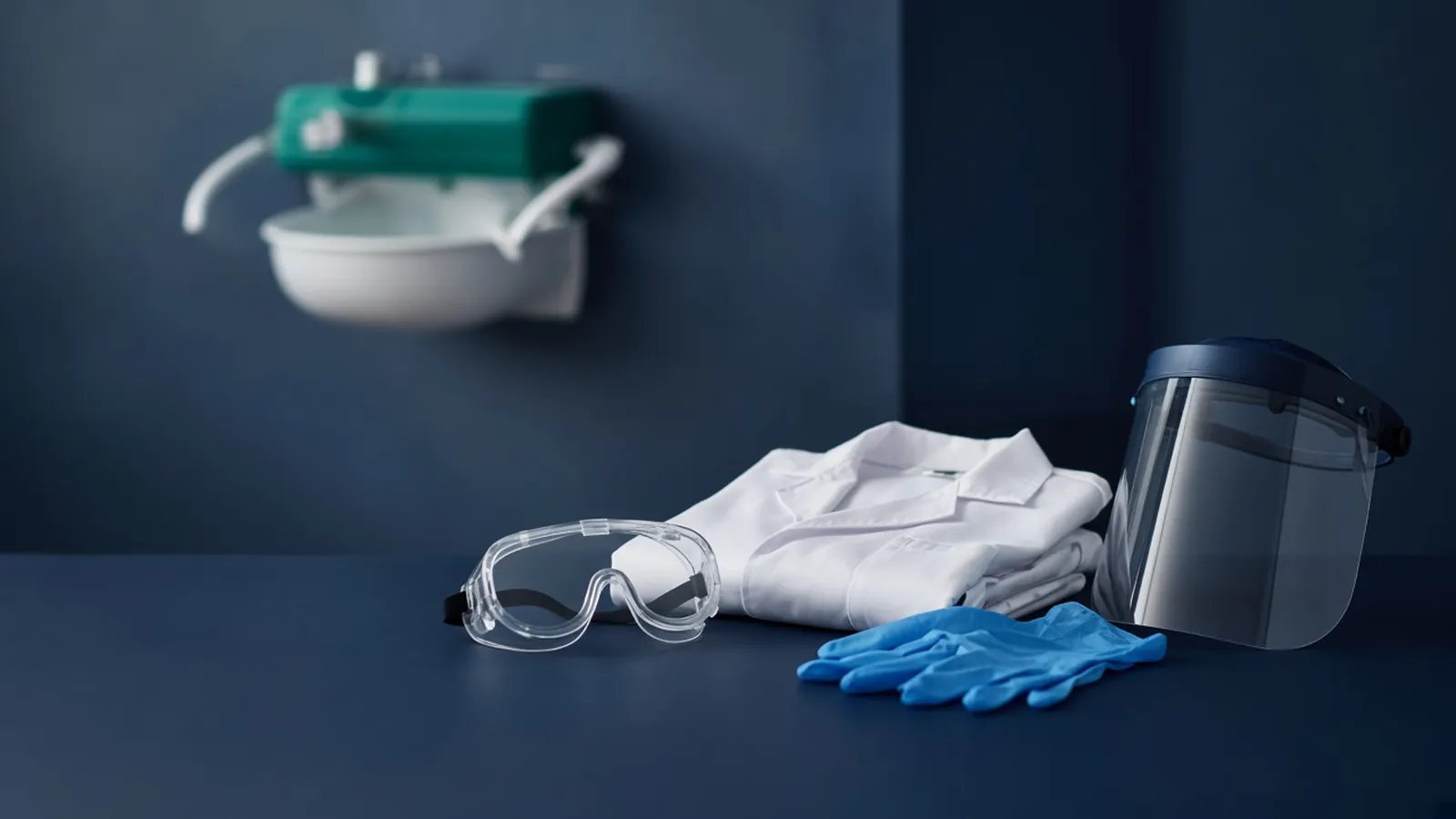
People say "BSL-2" the way they say the buffer is fine: as a short way to end the conversation. A biosafety level is a bundle. In the sources laboratories cite, it joins practices, safety equipment, and facility features for a defined kind of work. Using the phrase as a slogan skips the bundle. This page will not tell you which level your organism belongs in. That assignment is local, and it is not something a reader can collect from an article.
The bench-level picture of barriers sits in biosafety basics for research benches. How a Class II cabinet is actually used, once an assessment has named one, is in working inside a biosafety cabinet. Consumables that show up inside those practices are listed under laboratory consumables. A group writing a teaching specification can use academic research and a quotation request to describe equipment. Neither link assigns a containment level.
What the manuals are actually describing
The WHO laboratory biosafety manual, fourth edition, asks laboratories to assess the agent, the procedure, and the people, and to add controls when that assessment requires them. It treats a level number as too thin to be the whole decision. Many national systems still speak in biosafety levels, and the manual is written so those systems can map their rules onto a risk-based argument. The CDC Biosafety in Microbiological and Biomedical Laboratories keeps the familiar four levels and defines each one as a combination of practices, safety equipment, and facilities. Read together, the two sources agree on the part that matters at the bench: the number is a label for a bundle, and the bundle is chosen after the work is described.
This page stays at that altitude. It does not set out how to build or operate higher-containment facilities, and it does not list organisms against levels. If your institution uses different words, such as core requirements and heightened control measures, follow those words. The principle is the same. Controls are justified by the assessment, then installed, then used.
Practices, equipment, and the room
Practices are what people do with their hands. They include how you enter and leave, what you wear for which step, how you open tubes, how you label waste, and when you stop because a spill plan has been triggered. Standard microbiological practice is the floor under every serious biological laboratory: no food, no mouth pipetting, hands washed, work surfaces cared for, sharps controlled. Higher bundles add restrictions on access, on which procedures may be done on the open bench, and on how waste is treated before it leaves.
Equipment is the device that does a job the hands cannot. A certified biosafety cabinet is the usual example when the assessment says an aerosol must be contained. A centrifuge with sealed buckets is equipment. A face shield is equipment of a different, closer kind. The device counts only while it is the right class, in certification or in test, and used as the SOP describes. A fan that is merely running is not the equipment the level language was pointing at.
Facilities are the building. Directional airflow, restricted access, handwashing sinks, and surfaces that can be cleaned show up early. Higher containment adds more of the building: specialised ventilation, sealed surfaces, and waste treatment that is part of the room rather than a habit. You cannot adopt those features by writing them into a notebook. Either the room has them, under an engineer's record, or it does not.
Spill response sits across all three. The practice is knowing when to stop and whom to call. The equipment is whatever kit the plan named for that substance family. The facility is the path out, the eyewash, and the ventilation that is still running. A slogan has no spill response. An assessment does, and it differs for biological material, acid, solvent, and cryogen.
Why a risk group is a different word
Risk groups classify agents. A group used for an agent that is not associated with disease in healthy adults is not a promise about a clinical specimen, a large-volume culture, or a procedure that makes aerosols. A higher risk group flags a more serious agent hazard. It still does not design your room. The procedure can demand containment equipment even when the agent is familiar, and a carefully controlled procedure is part of why an institution might accept work that a bare organism name would make you nervous about.
Recombinant work adds a committee question the organism name does not answer. A gene insert, a host strain, and a volume can change the assessment even when the parent species looks ordinary on a teaching slide. The committee, not the slide, decides. If you do not know whether the construct has been seen locally, that ignorance is a reason to pause, not a reason to borrow a level from the paper where the plasmid was published.
Chemical hazards ride along. A lysis buffer with a volatile solvent is a chemical hygiene problem inside a biological procedure. The OSHA laboratory standard, where it applies, is about hazardous chemicals in laboratories. A biosafety level does not absorb that duty. The chemical still needs its safety data sheet, its hood or other control, and its waste stream.
What goes wrong when the number is doing all the work
The first failure is self-assignment. A student reads that a strain is "commonly handled at BSL-1" and treats the sentence as a permit. The manuals describe typical practice for defined work. Your sample may be a mixed culture, a clinical specimen, or a strain the committee has not reviewed. Typical practice in a manual is background. The local document is the decision, and how to write that document is covered in risk assessment is a local document.
The second failure is under-reading the procedure. Two laboratories can hold the same species and need different controls because one plates colonies and the other sonicates litres. Quoting a single level for both hides the aerosol. The cabinet, the sealed rotor, or the decision not to do the step are the real controls. The number was only the index.
The third failure is costume compliance. People put on a coat because the corridor poster shows a coat, while the assessment's actual demand was a certified cabinet and a restricted door. The coat can still be required. It does not substitute for the facility half of the bundle. The mirror failure is over-costume: so many layers that the person cannot see the work or change gloves cleanly. More equipment is safer only when it matches the route and still lets the person work in control.
The fourth failure is a stale facility claim. A sign on the door can outlive the certification of the cabinet, the test of the hood, or the training of the people now in the room. Read the sign against the current records. If the records and the sign disagree, the records win, and the work waits.
| Term | What it names | What it leaves open |
|---|---|---|
| Risk group | A classification of an agent in a stated scheme | The procedure, the volume, and your room |
| Biosafety level | Practices, equipment, and facilities as a bundle | Which bundle your institution assigned to this work |
| Core practice | The habits every biological bench is expected to keep | Whether this procedure needs more than the core |
| Heightened control | An added barrier justified by the assessment | A licence to invent the barrier yourself |
| Door sign | A local communication of rules for that room | Proof that the cabinet, the people, and the waste path are current |
A label that arrives with a parcel
Strains, plasmids, and kits sometimes ship with paperwork that mentions the containment language of the sending institution. That sentence describes their decision under their rules. It is useful context for your biosafety officer. It is not your assignment. The receiving laboratory repeats the assessment with its own procedure, people, and place. Until that is done, the parcel stays unopened under whatever holding rule the institution already uses.
The same boundary applies to a collaborator's method section. "Performed at BSL-2" tells you what they claim about their laboratory. It does not inspect your cabinet, your training record, or your waste contractor. Ask for the procedural details that change risk: volume, aerosol steps, and whether animals or clinical material were involved. Then hand that description to the person who is allowed to assign controls.
Authority stays with the institution
Reading this explainer does not authorise work at any level. It is not medical advice, not a diagnosis of an exposure, and not permission to proceed. Risk assessment and authorisation sit with the institution. If you do not know who that is in your building, finding that person is the next step, ahead of ordering equipment or opening a tube. Higher-containment work, where it exists, is a specialised facility with its own training. Nothing here is an invitation to attempt it, or a checklist for constructing it.
When the work also uses hazardous chemicals, the chemical hygiene arrangements stay in force beside the biological ones. A level number does not retire the safety data sheet.
What to specify, and what not to ask a seller
An enquiry can describe equipment the assessment has already required: a cabinet class, a sealed centrifuge rotor, a coat, a glove material, an eye-protection type. Put the task and the route in the quotation request. Do not ask a supplier to declare that your organism "is BSL-2" or that a room becomes a containment laboratory because a piece of equipment arrived. Sellers can describe product class. They cannot see your agent, your procedure, or your building, and they are not the authority that assigns the bundle.
Questions from the bench
Can this article tell me whether my organism is BSL-1 or BSL-2?
No. A level is assigned by the institution for a defined piece of work, using the agent, the procedure, and the facility. This page explains what the public manuals mean by a level. It does not classify your strain, your sample, or your room.
Is a risk group the same thing as a biosafety level?
No. A risk group is a classification of an agent based on the hazard it poses, in the scheme your country uses. A biosafety level, where that term is still the local language, describes the practices, equipment, and facilities for a procedure. The same agent can sit in different containment arrangements when the procedure changes.
If a paper says the work was done at BSL-2, may we copy that phrase onto our protocol?
You may cite the paper as a description of what those authors reported. You may not treat their phrase as your assignment. Your building, your aerosol steps, and your waste rules are local. The phrase becomes meaningful only inside an assessment your institution has accepted.
Does a higher number always mean a safer laboratory?
A higher number, in the BMBL sense, means a tighter bundle of controls for work that the assessment judged to need them. Wearing the phrase without the practices, the equipment, and the facility does not add protection. Using a higher bundle than the work needs can also get in the way of clean technique if people treat equipment as a costume.
References
Manufacturer names identify published method classes. Trademarks remain with their owners. Catalogue records on this site are independent references for enquiry. They are not a statement of inventory, distribution rights or a supply commitment. This page is educational. It is not medical advice, a diagnostic protocol or a biosafety approval.
Catalogue
Related products and categories
These links follow the subject of the article into published manufacturer references. A listing is a reference for an enquiry, not a statement of stock or distribution rights.
Continue in this cluster
Related reading
Biosafety basics for research benchesResearch-bench biosafety is a stack of barriers chosen by a risk assessment. This page explains the stack. It does not approve the work. Working inside a biosafety cabinetHow a Class II biosafety cabinet moves air, how that differs from a chemical fume hood, and which habits keep cultures and workers protected.A glossary of biosafety termsPairs that share a bench still do different jobs. Use this comparison to choose the right word for a cabinet, a chemical, a level, or a control.