
selection guide
Calibrators and what they are traceable to
A calibrator defines the ELISA x-axis. Traceability is a documented chain to a stated reference. Many research standards are assay units only.
- Author
- EVRINTH Editorial Team
- Published
- 8 October 2026
- Updated
- 8 October 2026
- Reading time
- 9 min
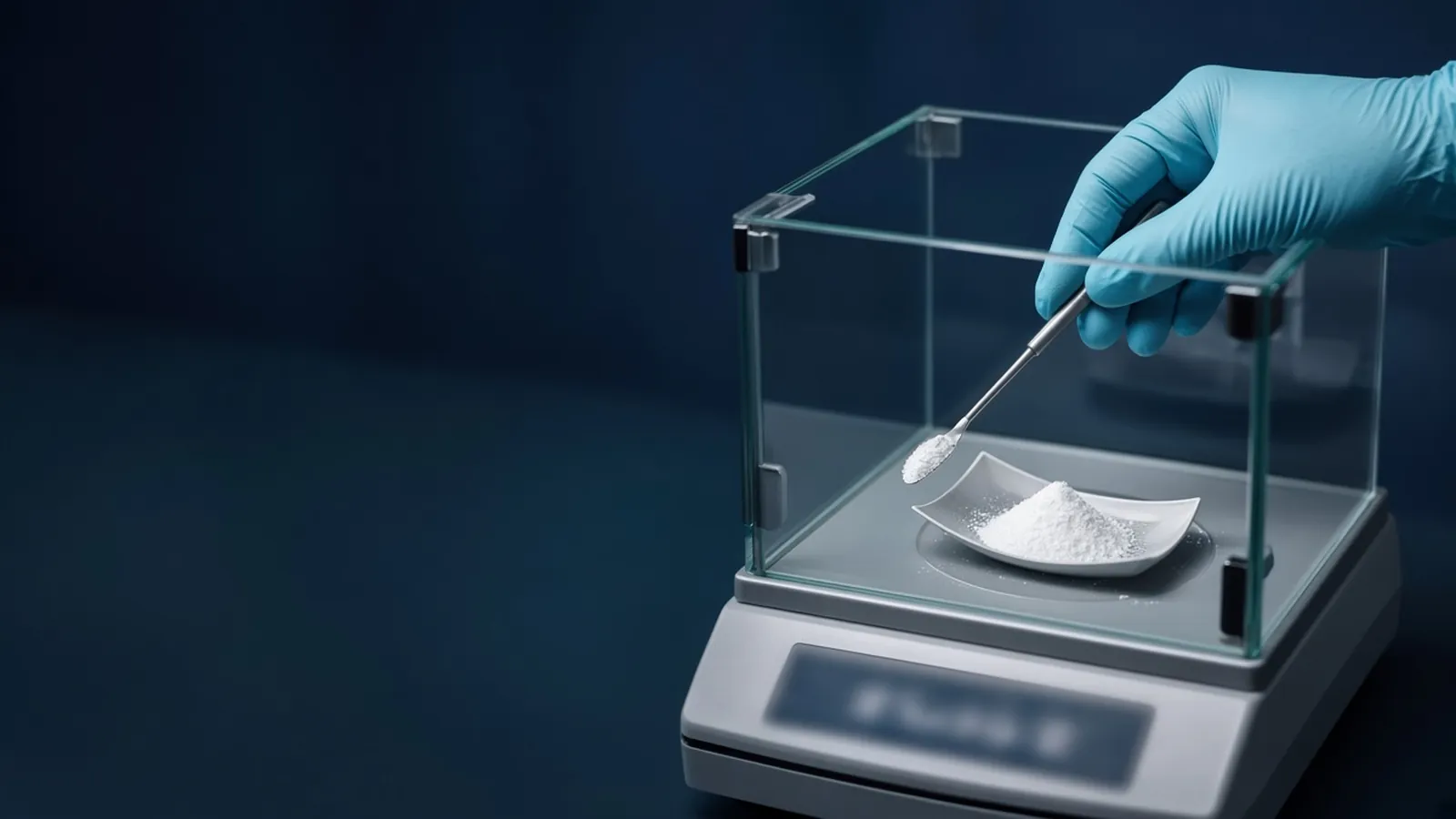
Calibrators and what they are traceable to is the question that decides whether a standard curve has an x-axis or only a shape. The calibrator is the material you dilute to known assigned values and run beside the samples. Traceability means a documented chain from your vial back to a stated reference, not a feeling that the number looks official. Many research ELISA standards are recombinant proteins that are not traceable to a clinical reference. Their numbers are assay units. Selecting a kit or a loose standard starts by asking what the material is, what liquid it is supplied in, and whether the unit is a mass, an arbitrary unit, or an international unit. How curves, blanks and formats behave is in ELISA formats, controls and readout. How a weighed or dyed protein becomes a concentration estimate is in how laboratories estimate protein concentration. The photograph on this page is an analytical balance. A spatula of white powder becomes a calibrator only after identity and purity are known. Until then it is a powder.
The x-axis is a material
Every optical density you trust is plotted against something you claim to know. That something is not the software's curve fit. It is the contents of the top standard and the dilutions you made from it. If the top standard is a recombinant cytokine assigned a mass by immunoassay against a previous lot, your x-axis is that assignment. If it is a purified native protein with a stated purity, the x-axis is that purity statement. If it is a reference preparation with a unit defined by a recognised authority, the x-axis can carry that unit, and only then.
Selection starts with the material, not with the slope. Two kits that both say they measure the same protein can sit on different materials. Their numbers will not match, and averaging them is not a meta-analysis. It is a unit error. Put the calibrator identity in the specification in the same sentence as the analyte.
Identity, purity and the balance
The balance in the draft shield reports mass. It does not report species, sequence, or the fraction of the powder that is the analyte rather than salt, moisture, detergent or a purification tag. A lyophilised vial labelled with a protein name can contain stabilisers that dominate the mass. If you reweigh a portion and call the entire mass analyte, you have invented a concentration. The protein estimation article walks through why dye-binding and absorbance assays also depend on the standard you compare with. Use that thinking here. A calibrator assigned by absorbance at 280 nanometres is only as good as the extinction coefficient and the purity assumption.
Check the sequence name against UniProt or NCBI Protein. A tag, a mutation, or a truncated construct is a different molecule from the serum protein you think you are matching. Antibodies may see the tag or miss the isoform. The curve is then in units of the construct. Say so in the report. Do not relabel it as the native protein because the gene name matches.
NIST publishes measurement science and reference materials in many fields. Citing that institution is a reminder of what a real reference chain looks like. It is not a claim that your cytokine vial is a NIST material. If a certificate of analysis exists, read what property it certifies. A certificate of concentration without a method is a sentence, not a chain.
What traceability is, and what it is not
A traceable assignment can be followed from your working dilution to a stated reference, through documents that name each comparison. International units for some biological materials exist because a particular reference preparation was established and later preparations were calibrated against it. That is a chain. A manufacturer assigning a round arbitrary number because the optical density was convenient is not a chain. It can still be a perfectly usable assay unit inside one method.
Research work is allowed to use assay units. The failure is to speak about them as if they were a clinical concentration or a mole of pure native protein. When you select, ask whether any link to a named reference preparation is documented. If the answer is no, write arbitrary assay unit, or mass of the stated recombinant, and keep the lot in the file. The next lot may be assigned the same way and still differ. Bridge lots with samples, not with faith.
There is no universal conversion in this page between mass, arbitrary units and international units. Anyone who offers you a single factor for all assays of a protein is guessing. Conversions are assay-specific and material-specific, and they belong in a document you can file.
Matrix of the calibrator
The calibrator is supplied in a matrix: buffer, a protein buffer, a stripped serum, a lyophilised cake you reconstitute. Samples live in their own matrix. If those liquids differ, the curve and the samples can diverge even when the analyte mass is what you think. Spike recovery and parallelism, described with the ELISA formats, are how you notice. When you shortlist, ask for the reconstituting liquid and for any warning about matrices that do not read back the spike.
A calibrator that already contains the analyte as a contaminant, or a zero diluent that does, destroys the bottom of the curve. Nonspecific binding then becomes hard to separate from a dirty zero. Ask how the zero is defined. A kit that cannot describe its zero matrix is a weak candidate, whatever the pictures of curves look like.
Mass, arbitrary unit, international unit
Use the table as a selection filter. Do not fill the empty cells with a conversion you hoped for.
| Unit you might see | What it can mean | What you still must not assume |
|---|---|---|
| Mass of a named protein | Someone assigned a mass to a stated material, by a stated method | That the powder was pure, dry, and the same molecule as the native analyte |
| Arbitrary assay unit | A scale internal to a method or a manufacturer lot | That another kit's unit, or a paper's unit, is the same scale |
| International unit | A chain to a named international reference, when the documents say so | That every commercial vial using the protein's name carries that chain |
If the documents say mass and do not say the method, treat the mass as provisional until you see the method. If they say international unit and do not name the reference preparation, ask for the name before you repeat the phrase in a report.
A broken chain still draws a smooth curve
Software will fit a curve through any dilutions you type in. Smoothness is not traceability. A mislabelled stock, a reconstitution with the wrong volume, and a pipette that was systematically short all produce tidy curves on a shifted axis. The samples will be precise and wrong together. That is why accuracy and precision are different words. Your control sample, stored carefully and run on every plate, detects a shift from the previous axis. It does not prove the axis was true in the first place. Truth of the axis is the calibrator document. Stability of the axis is the control sample.
When identity is unknown, draw the break on purpose in your notes: powder, assignment missing, curve fitted anyway, results reported only as ranks. Ranks can be the right scientific product. They should not be dressed as nanomoles.
Selecting among kits and loose standards
Prefer the candidate that states material, matrix, unit and lot assignment in language you can copy into a report. Prefer a lot-bridging recommendation you can actually run. A steeper brochure curve is not a selection criterion, because you do not know the axes. If you need to compare results with another laboratory, select the calibrator they can also obtain, or agree a shared control sample and report that, rather than forcing two arbitrary units into one table.
Home-made calibrators from a purified prep are legitimate when you document identity, purity method, and assignment method, and when you accept that the unit is yours. They are a poor surprise for a collaborator who thought they were buying a named reference. Say which one you are doing in the methods sentence.
Safety and research limits
Calibrators can be bioactive proteins, toxins, or materials derived from human specimens. Handle them under the safety sheet and under institutional biosafety rules. The WHO Laboratory Biosafety Manual is a public reference for the biological side of that decision. A traceable unit does not make a research plate a diagnostic result. Report the unit you earned. Do not add a clinical reference range you did not validate.
Weighing in humid air
The balance photograph is also a humidity problem. Hygroscopic powders gain water while you weigh them, especially in a humid season or when a draft shield is left open. A mass that climbs as you watch is not a stable assignment. Weigh as the balance procedure requires, record the appearance of the powder, and do not assign a protein mass from a wet cake. Air conditioning that dries the room changes static and also changes evaporation of reconstituting liquid in open tubes. Cap calibrators. In a power cut, a refrigerated standard left out is an excursion, like any other protein. Quarantine it from the working set and bridge before you reuse it. Do not reassign its concentration from memory of the original label if the volume has visibly fallen.
What to ask before you shortlist
Ask what the calibrator is, the matrix, the unit and the reference it is traceable to if any, the assignment method, and the lot. State the sample matrix you will actually run. The reagents and chemicals catalogue is a place to browse reagent classes, not a certificate of traceability. The molecular biology pathway is the methods context. Use the quote request to ask whether a quotation is possible. A method can be discussed when the unit is part of the question. Ask the reply to restate material, matrix and unit in words you can put in a report. Do not ask for a conversion factor to a clinical unit the documents do not contain.
Questions from the bench
Is a recombinant protein in the kit a clinical standard?
Usually it is not. Many research ELISA calibrators are recombinant proteins assigned a mass or an arbitrary unit by the manufacturer. They support comparisons inside that assay. They are not automatically traceable to a clinical reference preparation. Say assay units unless the documents show a chain to a named reference.
We weighed 1 milligram of powder. Is that the calibrator value?
Only if you know the identity and the purity of what the balance saw, and the moisture and salt the powder contained. A number on a balance is a mass of powder, not a mass of analyte. The photograph of a draft shield is that distinction. Without identity and purity, the curve is anchored to an unknown.
Can I convert an arbitrary unit into a mass with a factor from another paper?
Not honestly, unless the factor was established for the same calibrator and the same assay, and you show that work. Different recombinants of the same name can carry different specific activities and different impurities. Report the unit you actually calibrated.
What should the specification ask a supplier to state?
What the calibrator material is, which matrix it is dissolved in, whether the unit is mass, an arbitrary assay unit, or an international unit tied to a named reference, and which lot the assignment belongs to. A curve drawn without those four answers is not yet a shortlist.
References
Manufacturer names identify published method classes. Trademarks remain with their owners. Catalogue records on this site are independent references for enquiry. They are not a statement of inventory, distribution rights or a supply commitment. This page is educational. It is not medical advice, a diagnostic protocol or a biosafety approval.
Catalogue
Related products and categories
These links follow the subject of the article into published manufacturer references. A listing is a reference for an enquiry, not a statement of stock or distribution rights.
Continue in this cluster
Related reading
 ELISA formats controls and readoutELISA formats, controls and readout: how direct, sandwich and competitive assays turn a binding event into a number that stays inside the curve.
 How laboratories estimate protein concentrationHow laboratories estimate protein concentration with absorbance, dye-binding and copper assays, and why the number depends on the standard.Reporting an immunoassay so another lab can audit itAn auditable immunoassay file holds lots, the unit, the curve model, raw blanks and excluded wells. A bar on a slide does not replace them.