
application
Reporting an immunoassay so another lab can audit it
An auditable immunoassay file holds lots, the unit, the curve model, raw blanks and excluded wells. A bar on a slide does not replace them.
- Author
- EVRINTH Editorial Team
- Published
- 8 October 2026
- Updated
- 8 October 2026
- Reading time
- 9 min
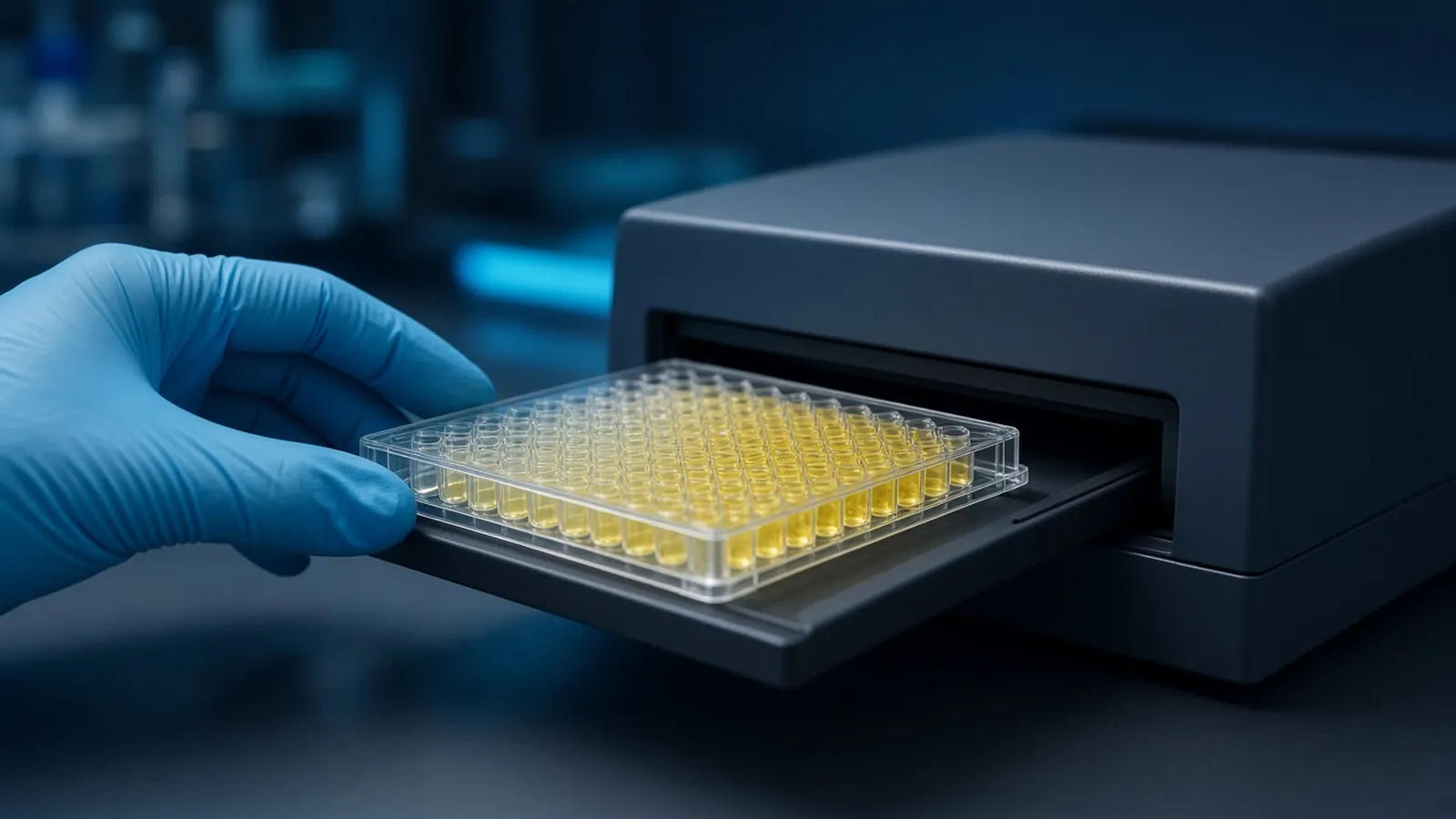
Reporting an immunoassay so another lab can audit it is an application of the plate, not a second experiment. You are handing a result to people who were not in the room when the washer misaligned. They should be able to rebuild the claim from the file: what format you ran, which antibodies and lots, what the standard was and in which unit, what matrix and dilutions you used, which curve model you locked, what the blanks and the control sample did, which wells you excluded and why, which wavelength the reader used, and the one sentence you are willing to stand behind. A subtracted blank with no raw values is not that file. The meanings of format, blank and curve are in ELISA formats, controls and readout. How to write the surrounding specification, if the work later becomes an enquiry, is in how to write a laboratory sourcing enquiry. This is a research record. It is not a diagnostic report and it does not become one by using a tidy template.
What the other laboratory is trying to do
They are trying to decide whether your sentence follows from the wells. They will ask whether the blank was quiet, whether the samples sat inside the standards, whether a control sample landed where it usually does, and whether a well disappeared from the figure. If those answers are in a slide as a bar with stars, they cannot audit. They can only admire or doubt. Give them the plate. The reader photograph is a reminder that the primary record is the file the instrument wrote, plus the map you used to load it, plus the reagent identities. Everything else is a view.
Put the claim sentence at the top of the record in plain language, and make it smaller than the temptation. A useful sentence names the analyte, the direction of the comparison, the unit and the limit. An example of the shape, not a result you should copy, is: the measured analyte was higher in condition B than in condition A, in assay units, inside the curve, on two independent runs. It does not say the pathway is proven. It does not say a patient is anything. If you cannot write the sentence without a number that is not in the file, the file is unfinished.
Identity of the reagents and the calibrator
Record the capture antibody, the detection antibody, the conjugate and the substrate by name and lot. Host species and clonality belong here because the next laboratory cannot order the same class from a nickname. If a secondary was used, name it. Blocking buffer composition belongs here, because milk versus albumin changes what nonspecific binding means for the next person.
The standard needs its own lines: what the material is, the lot, the unit, the matrix it was diluted in, and the assigned values of each point. If the unit is an arbitrary assay unit, say arbitrary. If it is a mass of a stated recombinant, say that, and do not upgrade it to an international unit. The calibrator discussion is the long form of this paragraph. UniProt accessions help when the analyte name is ambiguous. Put the accession next to the name so the other laboratory does not chase a different isoform.
A control sample that you ran on the plate, with the value you obtained and the value you expected from earlier plates, is the bridge. Without it, a shift in level might be biology or a new antibody lot. The auditor cannot tell. You will not remember.
Matrix, dilutions and the model
State the sample matrix and every dilution that was applied before the well. A 1 in 10 dilution that is missing from the table makes every concentration tenfold wrong in a way no curve fit will reveal. Say whether dilutions were in buffer or in the sample matrix.
Name the curve model: a straight line over a short range, a four-parameter logistic, or whatever you actually used. Say that you chose it before inspecting the sample ranks, or admit that you did not. Points outside the lowest and highest standard are outside the model. Report them as below or above the working range. Do not print a concentration the software extrapolated and then forget the flag. If the software dropped a standard point, say which point and why.
NIST is a public face of measurement traceability. You do not need a national calibration certificate to be auditable. You need the chain you actually have, described without decoration. If there is no chain beyond the kit lot, write that. An auditor can use an honest assay unit. They cannot use a pretended one.
Blanks, exclusions and the wavelength
Define the blank in one sentence. Substrate only, zero standard, or a well without capture: pick the definition you used and stick to it. Publish the raw optical densities and the blanked values side by side. If the blank is large relative to the samples, the claim sentence should not proceed. Say the plate failed the blank criterion you set. Do not bury the failure in a corrected column.
Excluded wells need a plate map coordinate and a reason: bubble, dry well, known pipetting error, reader flag. Pre-specified exclusion rules belong in the protocol. Post-hoc exclusions belong in a confession, still in the file. Keep the raw number.
Wavelength or filter pair, gain if it was fluorescence, integration time if it was luminescence, and the reader identity if you have more than one instrument: these are one line and they save a week. A file exported without the wavelength in the header should have the wavelength typed in by the operator before anyone plots. The instrument will not add it later.
Plate maps on protocols.io are a model of how much context a method file can carry. Match that spirit. Do not paste an unrelated group's times into your record.
The slide is a view, not the record
A bar chart can be shown in a meeting. It is not the audit object. The minimum record and the slide answer different questions. Use the table when you decide what to archive. Archive the record. You may still show the bar.
| Item | Minimum record for another laboratory | A slide that only shows a bar |
|---|---|---|
| Format | Sandwich, competitive or direct, named | Often omitted |
| Antibodies | Names, hosts, lots, dilutions | A nickname, if anything |
| Calibrator | Material, unit, lot, point values | An axis title |
| Matrix and dilutions | Written for every sample | Hidden inside a concentration |
| Curve model | Named, with out-of-range rules | A mean and an error bar |
| Blanks | Raw and defined | Already subtracted, raw gone |
| Control sample | Value on this plate | Absent |
| Exclusions | Well identity and reason | The point is simply missing |
| Reader | Wavelength or filters | Absent |
| Claim | One sentence matched to the above | A title broader than the wells |
How to write the sentence you will defend
Draft the sentence before you export the figure, then check it against the table. If the blanks were loud, the sentence is that the plate was not interpretable. If the samples were below the curve, the sentence is below the working range, not zero biology. If two methods disagreed, the sentence says they disagreed and names the branch you investigated. If only one biological replicate exists, the sentence does not say the effect was reproduced.
Independent runs mean independent samples or independent days in the way you pre-defined, not three wells from one dilution. The report should use the word replicate in that stricter sense or not use it. Another laboratory will assume the stricter sense.
Version the file. A spreadsheet that is overwritten each time a well is dropped cannot be audited, because the auditor sees only the last state. Save the instrument export untouched and do the analysis beside it. Date both.
Safety, specimens and the boundary of the report
The record may contain human or animal sample identifiers. Follow the data rules of your institution. Do not put identifying clinical detail into a research plate map that will be emailed casually. Chemical hazards of the assay, including stop acid and preservatives, stay in the method, not in the claim. The WHO Laboratory Biosafety Manual is a public reference for the biosafety decision around specimens. The audit file does not authorise diagnosis. If a collaborator asks for a clinical interpretation, the honest reply is that this record is a research immunoassay with the limits written in the claim sentence.
Files that survive the laboratory you actually have
Humidity curls paper notebooks and smears ink. Copy the plate map into the same digital folder as the instrument file on the day, not at the end of the season. A shared drive with a name like final-final is not an audit trail. Name the folder with the date, the analyte and the lot. If a power cut interrupts an export, keep the partial file and note the interruption rather than reconstructing numbers from a photograph of the screen. Photographs of the screen are a backup for the map in your head. They are a weak backup for optical densities. In a group that shares a reader, the wavelength in the file name prevents you from archiving another group's programme under your experiment title.
When a second site will repeat the work, send the record, not the slide. Offer the control sample's identity if it can be shared under your material rules. They still need their own reagents and their own curve. Your file tells them what to aim at. It does not transfer your optical densities into their wells.
What to include if you later enquire about repeating the plate
If you ask for reagents so another run can match this one, send the audit lines: antibody identities and lots if you need the same class, calibrator unit, matrix, readout wavelength and the claim you are trying to repeat. The reagents and chemicals catalogue is a starting list of classes. The molecular biology pathway is the methods context. Use the quote request to ask whether a quotation is possible. A method can be discussed from the audit file. Ask the reply to restate unit, conjugate and storage. Do not send only the bar and ask for the same result. The bar does not contain the experiment.
Questions from the bench
Is a subtracted blank enough if I keep the formula?
A formula without the raw optical densities cannot be audited. The other laboratory needs the blank values, the sample values and the sentence that defines which well was the blank. A corrected column alone hides whether the blank was quiet or almost as high as the samples.
What if a well was excluded because of a bubble?
Say which well, on the plate map, and why. An exclusion written before you looked at the group means is different from an exclusion chosen because the point weakened a figure. Keep the raw value in the file even when the figure omits it.
Do I have to report a failed plate?
You have to be able to show it if someone audits the series. A failed curve, a loud blank or a mis-set wavelength is part of the method's history. The claim sentence simply does not use that plate. Hiding it makes the remaining plates look cleaner than the work was.
Can the claim sentence say the treatment changed expression?
Only if the assay, the curve and the controls support that wording, and only as a research statement. The plate measured antibody-detected analyte in a matrix, in a unit you named. It did not, by itself, prove a mechanism or a clinical state. Write the narrower sentence you can defend from the file.
References
Manufacturer names identify published method classes. Trademarks remain with their owners. Catalogue records on this site are independent references for enquiry. They are not a statement of inventory, distribution rights or a supply commitment. This page is educational. It is not medical advice, a diagnostic protocol or a biosafety approval.
Catalogue
Related products and categories
These links follow the subject of the article into published manufacturer references. A listing is a reference for an enquiry, not a statement of stock or distribution rights.
Continue in this cluster
Related reading
ELISA formats controls and readoutELISA formats, controls and readout: how direct, sandwich and competitive assays turn a binding event into a number that stays inside the curve. How to write a laboratory sourcing enquiryWrite a laboratory enquiry as measurable performance, documents and an acceptance check, so a quotation can be compared with the scientific need.
 Calibrators and what they are traceable toA calibrator defines the ELISA x-axis. Traceability is a documented chain to a stated reference. Many research standards are assay units only.