
troubleshooting
CO2 and why pH drifts in a carboy
When carboy pH falls overnight, follow dissolved carbon dioxide and buffer capacity first, then decide whether the electrode is the failed control.
- Author
- EVRINTH Editorial Team
- Published
- 8 October 2026
- Updated
- 8 October 2026
- Reading time
- 8 min
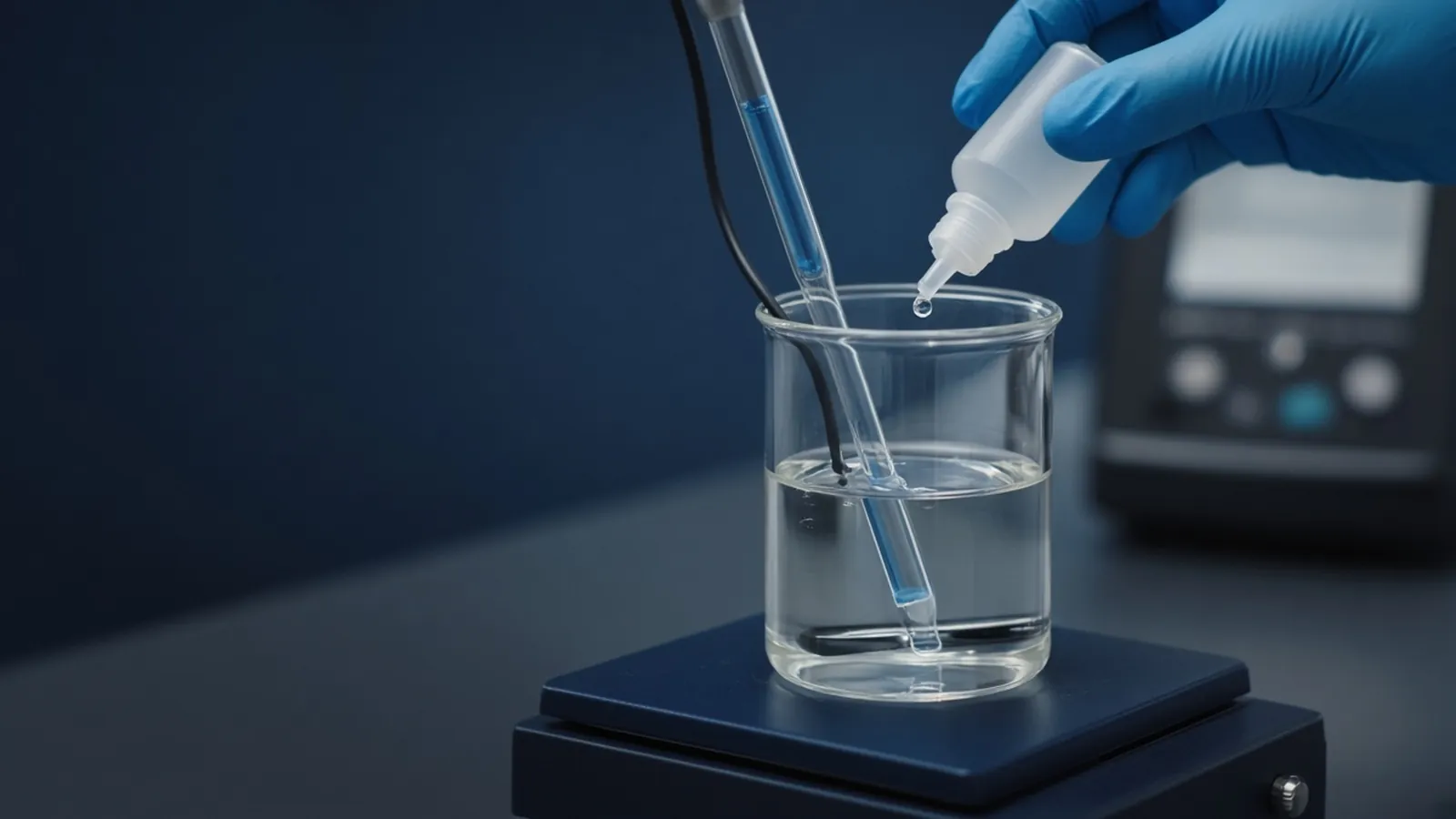
The symptom is usually quiet. A carboy that matched its label yesterday reads lower this morning. A freshly polished water will not settle on the pH meter and wanders downward as it sits. An alkaline buffer in an open neck drifts while you are still adjusting it. Dissolved carbon dioxide is the first mechanism to test, because it is ordinary air doing acid-base chemistry. The electrode is the second mechanism, and it has to be ruled in with a slope, not with a hope. Water grades and the contaminants they miss are in laboratory water types and where they fail. The calibration habit that makes the slope meaningful is in preparing a buffer and checking pH.
Standards and salts come from the reagents and chemicals catalogue. The open vessel is often a convenient jug from beakers and flasks, which is also the object you may need to cap or replace. If you are buying buffer salts or calibration standards because drift has become the weekly argument, put the pH, the temperature, and the container on the quotation request.
Read the symptom before you change the recipe
Write down what moved, and in which direction. Carbon dioxide drift of a poorly buffered or alkaline solution is a fall in pH. A rise in pH wants a different story: a loss of carbon dioxide from a bicarbonate system that had been equilibrated with a higher carbon dioxide level, a temperature change in Tris, or an electrode that has not been calibrated. Do not average "the pH drifted" into one corrective squirt of acid or base.
Note the vessel. An open carboy, a beaker under the electrode, and a capped bottle are three headspaces. Note the starting chemistry: ultrapure water, a dilute buffer, a carbonate or high-pH Tris, or a concentrated phosphate. Note whether the meter was calibrated this session and whether the slope met the laboratory window. Those four notes usually pick the branch without a new hypothesis.
Carbonic acid is the chemistry
Carbon dioxide from air dissolves, hydrates to carbonic acid, and that acid dissociates to hydrogen ion and bicarbonate. In a solution with real buffer capacity, the conjugate pair consumes the added acid and the pH moves only a little. In a solution with almost no conjugate pair, the same carbon dioxide moves the pH a lot. Ultrapure water is the extreme. Its only "buffer" is water itself, which is a very weak arrangement near neutrality, so the reading is unstable and tends toward the acidic side once the water has met air. That is why a pH specification on ultrapure water is not a useful release test. Resistivity or a dedicated contaminant test belongs there instead.
Alkaline buffers have capacity, and they also have a driving force. Hydroxide and the basic form of the buffer react with incoming carbonic acid, so the pH falls as alkalinity is consumed. Carbonate buffers are built from this same system, which is why an open carbonate solution is a moving target. A high-pH Tris left stirring in a wide beaker can walk downward while you are trying to set it. A well-chosen phosphate at a modest concentration near pH 7.2 moves more slowly for the same exposure, because you are nearer a strong conjugate pair and you are not offering a large reservoir of free hydroxide.
The amount of carbon dioxide that enters depends on surface, agitation, time, and the partial pressure in the room. A carboy with the neck open all afternoon is an exchanger. A full, capped bottle with little headspace exchanges much less. Stirring under the electrode, which you need for a fair pH reading, is also a gas-exchange step. Cover what you can without blocking the junction.
Separate a changing solution from a changing electrode
Calibrate with fresh standard buffers that bracket the pH you care about, and read the slope. A glass electrode's theoretical slope is about 59 millivolts per pH unit at 25 °C. The laboratory sets the window. A slope outside that window is a failed control: the display is not a solution pH, and titrating the carboy to a pretty number bakes the electrode error into the batch. Storage in the manufacturer's solution, commonly a concentrated potassium chloride, is what keeps the next slope possible. Storage in ultrapure water is a known way to ruin the glass and the junction. If the slope has died, fix that before you interpret carbon dioxide.
If the slope passes and an open alkaline carboy still falls over an hour, believe the chemistry. Repeat the reading on an aliquot that has been kept capped, and on an aliquot you deliberately leave open. The capped aliquot should move less. That comparison is the control. A standard buffer left open for a week is itself a carbon dioxide experiment, especially an alkaline standard. Fresh standards are part of the electrode check for that reason. NIST's calibration resources are a public reminder that pH standards are a metrology procedure, not a beaker that lives beside the sink.
Temperature sits in the background. Tris also changes pH when it warms, on the order of a few hundredths of a pH unit per degree, in the same direction as a casual glance might blame on carbon dioxide if the room heated overnight. Record the temperature. A warm afternoon and an open neck can both push Tris downward. You need both notes to avoid "correcting" a temperature effect by adding base, and then watching carbon dioxide remove the base you just added.
| What you see | Likely mechanism | Next check |
|---|---|---|
| Ultrapure water pH wanders and will not settle | Almost no buffer capacity, plus CO2 and a low-ionic sample | Stop using pH as the water specification; read resistivity |
| Alkaline buffer falls in an open neck | Carbonic acid consuming alkalinity | Compare a capped aliquot with an open one; slope first |
| Alkaline calibration buffer reads low | The standard has aged in air | Open a fresh standard and recalibrate |
| pH falls after a warm night, slope is fine, cap was on | Temperature coefficient, especially Tris | Repeat at the temperature written on the label |
| Slope outside the laboratory window | The electrode is the failed control | Storage solution, filling solution, or a replacement electrode |
| pH rises in a bicarbonate solution taken out of a CO2 incubator | CO2 leaving a system that had been equilibrated richer in CO2 | This is the opposite direction; do not chase it as carboy acidification |
What to change, and what to leave alone
Cap the vessel, reduce the headspace, and avoid leaving alkaline buffers stirring in a wide beaker longer than the measurement needs. For a buffer you must hold, set the pH, bring it to volume, and close it. Recheck at the temperature of use if the method is sensitive. Adding base every morning to chase a falling pH adds sodium or whatever cation is in the base, changes ionic strength, and feeds the next day's carbon dioxide reaction. If the assay can tolerate the drift, write the tolerance. If it cannot, change the container habit or move to a buffer system the method actually validated.
Do not specify ultrapure water by pH. Use the ionic measurement at 25 °C, and use TOC, endotoxin, or a nuclease control when those are the risks. A noisy pH on the polish dispense is expected chemistry and expected electrochemistry. Chasing it with a drop of acid is how pure water stops being pure.
If the capped solution still drifts and the slope is healthy, look past carbon dioxide. A continuing precipitation, a microbial bloom in a nutrient-rich buffer, or a Tris temperature change will all move pH. Cloudiness, a smell, or a carboy that has sat warm for days belongs to contamination and expiry, not to a tighter cap alone. Discard by the laboratory's chemical and biological waste rules.
Safety and research-use limits
Adjusting a drifted buffer with concentrated acid or base is a splash hazard. Use a dilute titrant near the target, wear eye protection, and add acid to water when you are diluting a concentrate. Carbon dioxide itself is not the hazard in an open carboy at room air. The hazard is the chemistry you add in response, and any biological material already in the vessel. A pH drift does not disinfect anything. Institutional biosafety rules still govern infectious work. This troubleshooting guide is not a diagnostic procedure and not a medical instruction.
Warm rooms and open necks
A warm laboratory increases the chance that two effects stack: gas exchange at an open neck, and a real temperature coefficient if the buffer is Tris. Power cuts matter when they stop a CO2 incubator and everyone "rescues" bicarbonate media into an open bottle on the bench. That rescue changes the gas the buffer was equilibrated with. For ordinary reagent carboys, the practical note is smaller. Close the cap, keep alkaline standards in small bottles you can finish, and do not leave the week's water sitting uncapped because the dispense was convenient. Measure the carboy you have. There is no regional constant for how far it will drift.
What to put in the enquiry
If drift is why you are buying salts or ready buffers, specify the buffer identity, the pH, the temperature of that pH, the concentration, and whether the container should be filled with minimal headspace. Ask for calibration standards as a separate line, with the nominal pH values you need in order to bracket the target, and ask how the supplier recommends they be kept once opened. On receipt, calibrate, read the slope, then read the bottle. A certificate that says "pH adjusted" without a temperature is not enough to explain a morning drift. The quotation request should make those fields explicit so the argument happens before the carboy is open.
Questions from the bench
Why does ultrapure water refuse to give a stable pH?
It has essentially no buffer capacity, so a little dissolved carbon dioxide moves the hydrogen-ion activity a long way. The electrode is also working in a solution with almost no ionic strength, so the display wanders. pH is not a useful specification for that water.
Which buffers drift fastest in an open carboy?
Poorly buffered dilutions and alkaline buffers drift first, because incoming carbon dioxide becomes carbonic acid and consumes alkalinity. A concentrated phosphate near its pKa moves less for the same carbon dioxide load. The cap, the headspace, and the starting pH decide the rate.
How do I tell carbon dioxide drift from a tired electrode?
Check the slope on fresh standard buffers that bracket the target. A slope inside the laboratory window means the electrode can still read standards. If the standards pass and the open carboy keeps falling, the solution is changing. If the slope has failed, you do not have a pH yet.
References
Manufacturer names identify published method classes. Trademarks remain with their owners. Catalogue records on this site are independent references for enquiry. They are not a statement of inventory, distribution rights or a supply commitment. This page is educational. It is not medical advice, a diagnostic protocol or a biosafety approval.
Catalogue
Related products and categories
These links follow the subject of the article into published manufacturer references. A listing is a reference for an enquiry, not a statement of stock or distribution rights.
Continue in this cluster
Related reading
 Laboratory water types and where they failResistivity, organic carbon and endotoxin answer different questions. A water grade fails when the assay cares about a contaminant the meter cannot see.Preparing a buffer and checking pHPrepare a buffer at a stated pH and temperature, record the salt form, and treat a drifting electrode or a bad slope as a failed control.A glossary of solution termsDecide which number a recipe means before you weigh a salt: molarity or molality, which percent, normality, buffer capacity, osmolality, or hydrogen-ion