
selection guide
Concentrating a dilute protein
How to choose ultrafiltration, precipitation or polymer dialysis when a protein is dilute, and why the smaller volume is not yet a concentration.
- Author
- EVRINTH Editorial Team
- Published
- 8 October 2026
- Updated
- 8 October 2026
- Reading time
- 8 min
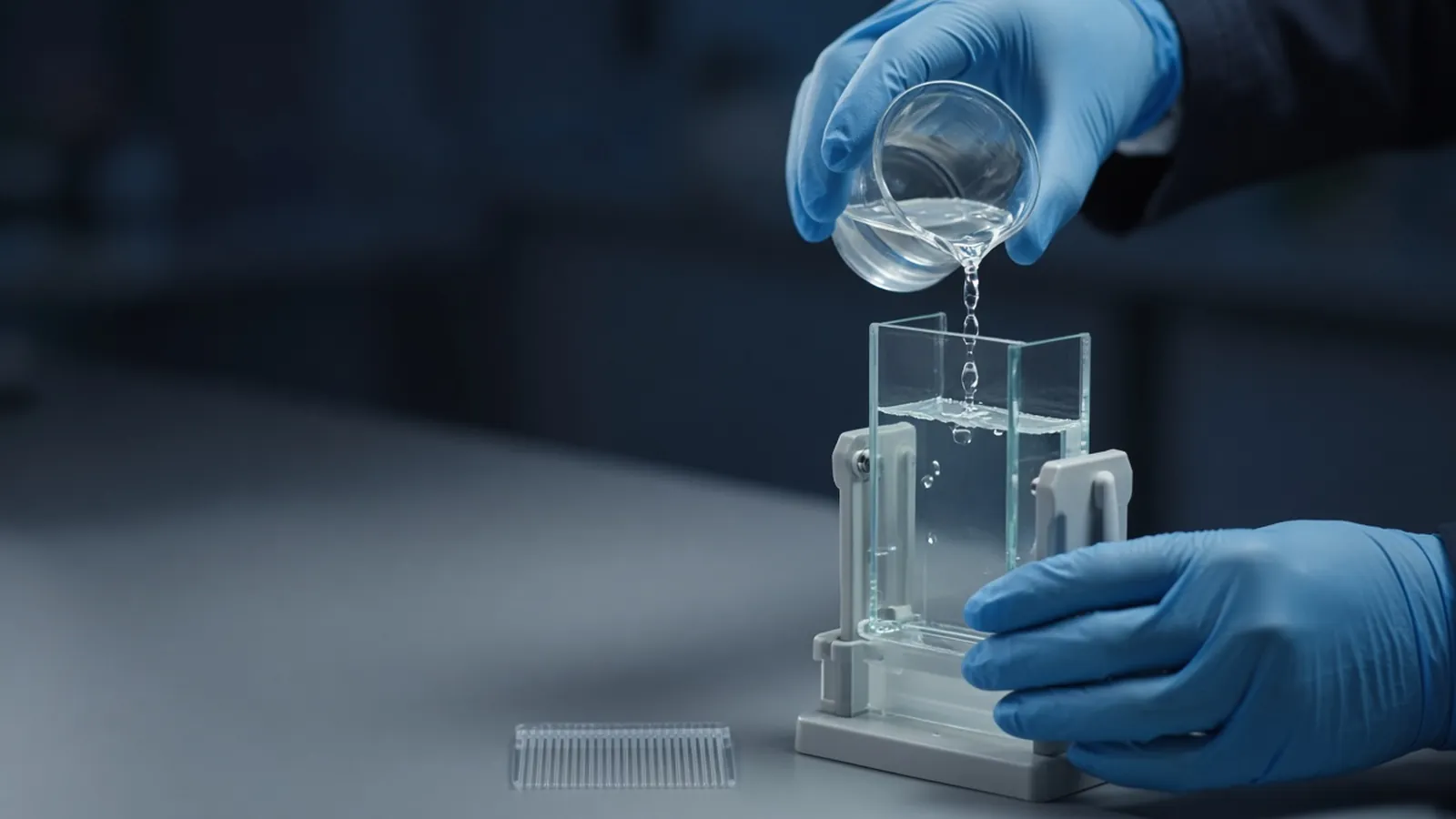
A dilute column pool becomes useful only if the molecules you care about survive the step that removes the water. Centrifugal ultrafiltration, precipitation, and dialysis against a high-molecular-weight polymer are three different ways to reduce volume. They lose protein for different reasons. Dividing the starting mass by the new volume is arithmetic, not a measurement. This selection guide is for research preps. Follow the device insert for speeds and volumes. Nothing here is a microlitre recipe.
Where the dilute pool came from is in affinity and ion-exchange protein purification. Whether the band survived is in reading a protein gel. The buffer you concentrate into is written as in preparing a buffer and checking pH.
Three physical ideas
Centrifugal ultrafiltration pushes solvent and small solutes through a membrane while protein above the cut-off stays in the retentate. The force is centrifugal. The selectivity is the membrane. Small buffer ions leave, so this step can concentrate and, if you refill with a new buffer, exchange. It does not distinguish your protein from other proteins of similar size. A dirty pool becomes a smaller dirty pool.
Precipitation lowers solubility until the protein falls out of a large volume. Ammonium sulfate and polyethylene glycol are familiar classes. You spin the solid down and dissolve it in a small volume of the buffer you actually want. Precipitation can also purify a little, because not every protein crashes at the same cut. It can also irreversibly aggregate the one protein you wanted. The pellet is an intermediate, not a product, until it redissolves and the activity or the gel says the fold survived.
Dialysis against a high-molecular-weight polymer uses a bag or a device whose outside is a concentrated polymer, often polyethylene glycol, sometimes dry polymer. Water leaves the bag to dilute the polymer. Protein that cannot cross the dialysis membrane stays inside and gets more concentrated. The method is gentle and slow. It fails if the bag leaks, if the protein sticks to the membrane, or if you overshoot and the contents crystallise or gel. It is a different operation from dialysis against a buffer, which exchanges salts and does not, by itself, shrink the volume much.
Choose from the constraint you actually have
If the protein is reasonably soluble, the volume is tens of millilitres, and you need it in a defined buffer this afternoon, centrifugal ultrafiltration is the usual class. Pick a nominal MWCO well below the protein mass. A planning figure many laboratories use is a cut-off no higher than about one third of the mass, then they adjust to the device table in front of them. A 30 kDa membrane for a 28 kDa protein is a leak waiting for a long spin. A very low cut-off on a large protein is slow and can raise shear as you chase the last millilitre.
If the protein is extremely dilute in a huge volume, precipitation can be the practical class, because spinning litres through a small centrifugal device is a poor use of membrane and time. You must know a precipitation cut that the protein survives. Try it at small scale. If the redissolved pellet is cloudy, the method concentrated an aggregate.
If the protein dislikes the shear and the surface of a spin concentrator, polymer dialysis is the gentler class, provided you can wait and you can judge the endpoint. Watch the bag. A collapsed bag can mean success or a leak. Weighing or measuring the recovered volume, then checking protein, is the only way to tell.
Membrane binding dominates when the protein is hydrophobic, dilute, or present in micrograms. The first milligram can vanish onto a device rated for many milligrams. Pre-rinsing, choosing a low-bind membrane class, and avoiding a device that is vastly larger than the sample are decision-level responses. The insert will say whether the membrane needs equilibration. A dry membrane and a hopeful spin is how yields disappear.
Shear and local concentration at the membrane surface also matter. Proteins gel on the face of the filter, which looks like a slow spin and a loss. Stop, mix gently, and continue. Foaming is not a sign of a healthy concentrate.
Solubility is the ceiling. Concentrating above the point where the protein stays in solution produces a precipitate that the volume math still counts as "in the tube". Work near the pI with extra care, because solubility is often worst there. Glycerol, salt, or a known stabiliser belong in the buffer before you reduce the volume, if you already know the protein needs them. Adding them after a cloudy crash is late.
Check the concentrate, then stop
Measure something that sees the protein. An activity assay, if you have one, tells you the functional molecules survived. A gel of equal volumes before and after, or of equal estimated mass, tells you the band is still there and whether new aggregates appear in the well. A dye assay tells you mass equivalents if the buffer is compatible. Use at least one measurement that is not the pipette's volume marks.
Compare recovered mass with starting mass. A concentrate that is tenfold smaller in volume and twofold higher in concentration lost most of the protein. Look in the filtrate. Protein in the filtrate means the cut-off was too high, the membrane failed, or the protein was cleaved to pieces small enough to pass. Look on the membrane if the filtrate is empty and the retentate is poor.
Over-concentration is its own failure. Aggregates scatter light, clog the next column, and can show as a band that will not enter a gel. Aliquot a soluble concentrate and store it as in storing biological samples from fridge to freezer. One tube at a very high concentration is a single point of loss if it crashes overnight.
| Constraint | Class to consider | What you measure afterward |
|---|---|---|
| Moderate volume, soluble protein | Centrifugal ultrafiltration, MWCO well below the mass | Retentate and filtrate on a gel or by activity |
| Very large volume | Precipitation, then redissolve | Pellet that actually dissolves, activity |
| Protein that sticks to or shears on spin devices | Dialysis against a high-MW polymer | Bag volume plus a protein assay |
| Microgram amounts | Smallest suitable low-bind device | Spike recovery, not volume math |
| Already near the solubility limit | Stop, or change buffer before you shrink volume | Clarity, gel wells, activity |
| Need a new buffer as well as less volume | Ultrafiltration with buffer refill, or dialyse then concentrate | pH and conductivity, plus protein |
Failure modes
Calculating a tenfold concentration from a tenfold volume drop, then discovering the filtrate holds the protein, means the MWCO choice or the device failed. Calculating the same fold and finding neither fraction holds the protein means the membrane adsorbed it or the protein precipitated on the plastic. A cloudy retentate that will not filter any further is over-concentration or a gel layer. Dilute it back into a buffer it likes rather than forcing the spin.
Precipitation that works in a 200 microlitre trial can heat differently in a large beaker. Mix and hold at the temperature the trial used. A pellet dissolved in the wrong pH will look like a failed precipitation when it was a failed redissolution.
Polymer dialysis left unattended can go to dryness. Dry protein film inside a bag is a loss. Set a time to look, especially in a warm room where water leaves faster.
Safety and research limits
Concentrated ammonium sulfate, polymer dust, and centrifuge rotors are ordinary laboratory hazards. Balance the rotor. Do not claim a concentrated research sample is a formulated product. Aggregation can change immunogenicity and activity. Report the condition you actually achieved: buffer, estimated concentration, method, and whether the sample was clear.
Heat, power, and a spin that stopped
In a hot laboratory, a long spin warms a rotor that started cold, and a protein that was stable at 4 °C spends the concentration step warmer than the notebook says. Use a refrigerated centrifuge when the protein needs it, and record the temperature you actually had. A power cut mid-spin stops the force and can let a tipped device leak when it restarts. Discard a leaked device's "retentate" unless you can still identify it, and do not pool it silently with a finished concentrate.
Humidity matters for dry polymer used outside a dialysis bag. Damp polymer is already partly hydrated and will pull water more weakly than the method assumes. Close the container.
What to ask for
State the protein mass, the starting volume, the buffer, the MWCO you think is fair, and whether activity must survive. If precipitation is unacceptable because the protein never redissolves, say so. Membrane and buffer classes are in the reagents and chemicals catalogue. A purification that includes a concentration endpoint can be discussed through the custom protein expression and purification reference. Put the method class and the assay you will trust in the quote request. Volume math can travel in the same note as a warning, not as the result.
Questions from the bench
How far below the protein mass should the MWCO sit?
Choose a nominal cut-off substantially below the protein mass so the chain stays in the retentate. A common planning habit is to keep the cut-off at or under about a third of the protein mass, and then follow the membrane maker's own guidance. Proteins near the cut-off leak, and the printed number is not a sharp pore.
Why did the volume fall and the assay stay flat?
Protein bound to the membrane, precipitated and was left behind, or passed through a damaged device. Volume ratios assume every molecule stayed in the liquid you recovered. Measure the concentrate by activity or by a gel, and if the yield is poor, rinse the membrane as the device instructions allow and count that rinse.
Is precipitation a concentration method?
Yes, as a class. Salt or polymer precipitation takes protein out of a large volume, and you redissolve the pellet in a small one. It concentrates only the protein that redissolves in the buffer you need. A pellet that will not go back is a loss, not a stock.
Can I keep spinning until the volume is tiny?
Past a point you are concentrating toward insolubility. Aggregates, skin on the membrane, and a cloudy retentate are the signs. Stop at a concentration your solubility trials support, and aliquot before the protein spends the afternoon at that density.
References
Manufacturer names identify published method classes. Trademarks remain with their owners. Catalogue records on this site are independent references for enquiry. They are not a statement of inventory, distribution rights or a supply commitment. This page is educational. It is not medical advice, a diagnostic protocol or a biosafety approval.
Catalogue
Related products and categories
These links follow the subject of the article into published manufacturer references. A listing is a reference for an enquiry, not a statement of stock or distribution rights.
Continue in this cluster
Related reading
Reading a protein gelHow to read a protein gel: what SDS-PAGE bands, smears, ladders and loading differences can support, and what they cannot identify. Affinity and ion-exchange protein purificationHow affinity capture and ion exchange pull a protein from a lysate, and why each collected fraction still needs an identity check.
 Preparing a buffer and checking pHPrepare a buffer at a stated pH and temperature, record the salt form, and treat a drifting electrode or a bad slope as a failed control.