
comparison
Cryovials in liquid nitrogen and the explosion risk
A leaking cryovial can fill with liquid nitrogen and burst on warming. Compare that immersion risk with vapour-phase storage before you specify tubes.
- Author
- EVRINTH Editorial Team
- Published
- 8 October 2026
- Updated
- 8 October 2026
- Reading time
- 9 min
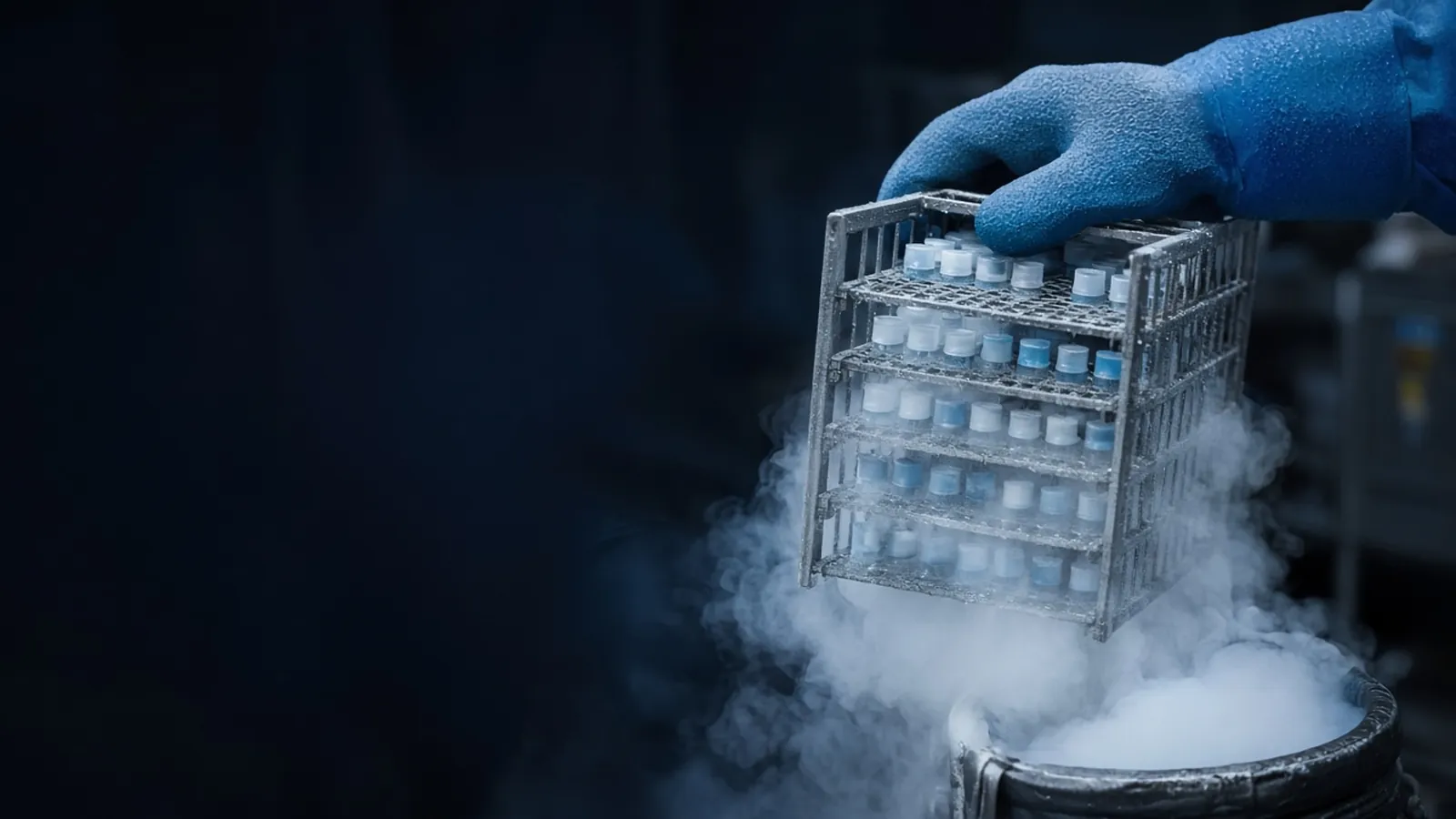
A cryovial that has spent time under liquid nitrogen can come back to the bench as a small bomb. The mechanism is physical. Liquid nitrogen enters through a seal that does not hold, and when the tube warms, that liquid boils and the tube can burst. Vapour-phase storage reduces immersion. It does not turn nitrogen into a mild reagent. This comparison is for someone specifying tubes and a storage phase before an enquiry. It is not a sales page, and it is not a licence to ignore your institutional SOP. The wider temperature ladder sits in storing biological samples from fridge to freezer.
Cryovials and racks are chosen from the laboratory plasticware catalogue. Cryogenic gloves and labels are laboratory consumables. The specification can be discussed through laboratory procurement and sent as a quotation request. Which plastics belong in the cold at all is also a question in when to use plastic tubes, tips, and plates.
Two encounters with the same liquid
Liquid nitrogen boils near minus 196 °C. In the liquid phase of a dewar, vials sit in that bath. The temperature is very low and, below the surface, comparatively steady. The cost is submersion. Any path past the cap — a poor seal, a crack, a cap not designed for immersion — lets liquid creep in. The tube looks normal when you lift it. The liquid inside is the part you cannot see.
In the vapour phase, racks are held above the liquid. The gas is still extremely cold, but it is warmer than the liquid and it is not a bath. A leaky cap is less likely to fill. That is the safety difference this comparison is about. The thermal difference, including height gradients and lid openings, is a selection problem of its own. Here the question is what happens to the tube.
Warming is the moment of failure. Liquid nitrogen does not stay liquid at room temperature. It becomes gas, and the gas needs several hundred times the volume the liquid occupied. Inside a closed tube the pressure rises until the plastic yields. People call it an explosion because that is how it behaves: a burst, fragments, and a spray of the contents. The driving force is expanding nitrogen, not a reaction in the sample. Those fragments are cold enough to injure, and the contents may be a biological hazard as well as a projectile.
What else nitrogen does in the same room
The burst is the dramatic failure. Two quieter hazards sit beside it and do not depend on a bad seal.
Cold burn is contact injury. Liquid, cold gas, a rack, or a tube fresh from the dewar can freeze tissue. Wet gloves make it worse because they freeze to the rack. Cryogenic gloves and a face shield are the class of protection the SOP should name. Ordinary examination gloves are not that class. This page is not a first-aid manual. If someone is injured, you follow the institutional emergency procedure.
Oxygen displacement is the gas itself. Nitrogen boiling off a dewar, or off a spilled charge of liquid, mixes into the room and lowers the oxygen fraction. The gas is not a sharp smell you can use as a warning. A small, closed room is the dangerous geometry. An oxygen monitor and ventilation are institutional controls, not optional accessories you add after a scare. The CDC BMBL discusses cryogenic storage among laboratory biosafety practices. Read it as education. Your safety office decides what the room requires.
Dry ice is a different cold hazard, carbon dioxide rather than nitrogen, and it belongs to shipment practice in dry ice packing for sample shipments. Do not "top up" a nitrogen dewar with dry ice, and do not store cryovials loose on dry ice as if that were a phase of the dewar.
| Question | Liquid-phase immersion | Vapour phase above the liquid | A snap-cap microtube |
|---|---|---|---|
| Can liquid nitrogen enter the tube? | Yes, if the seal leaks or the vial is not rated for immersion | Much less likely, because the tube is not submerged | Easily. This tube is the wrong class |
| What warming does | Trapped liquid boils and the tube can burst | Burst from trapped liquid is less likely. Cold injury remains | High burst risk if it was dipped |
| Thermal character | Colder, steadier below the surface | Warmer, and variable with height and lid openings | Not a storage condition |
| What you specify | A vial the manufacturer rates for liquid immersion, plus the SOP | A vial rated at least for vapour, and a rack that keeps tubes above the liquid | Do not specify it for nitrogen |
| Hazards that remain either way | Cold burn, oxygen displacement, biological content | Cold burn, oxygen displacement, biological content | All of those, plus a predictable seal failure |
A worked retrieval that goes wrong
A rack has been stored in the liquid because that is where space remained, in vials the manufacturer marks as vapour-only. The caps were done up firmly by hand. Firm is not the same as a rated seal. On retrieval, one tube sits on the bench for a minute while a label is checked. It bursts. Nobody stirred a reactive mixture. The nitrogen that had entered through the threads boiled.
The comparison that would have prevented it is on the product page, not in the firmness of the wrist. Vapour-only means do not submerge. A vial rated for liquid immersion is the other class, and even that class can leak if the cap is damaged, cross-threaded, or past the use the manufacturer describes. Inspect the O-ring or gasket if the design has one. Discard cracked vials. Do not refill a burst tube's neighbours with a story that "these batches are usually fine."
The branch after a burst: treat fragments and droplets as a cryogenic spill and as a biological spill of whatever organism or sample was inside. Clear people, follow the spill SOP, and do not collect shards with bare hands. Quarantine the rest of that rack until someone confirms the vials are the rated class and the seals are intact. Then change the storage phase or the vial specification so the rack is not returned to the liquid by habit.
Tube classes side by side
A cryovial rated for liquid nitrogen is a thick-walled tube with a cap and seal the manufacturer is willing to describe for that duty. Read the phase. "Cryogenic" in a brochure can mean vapour only. Internal-thread and external-thread designs both exist. Neither thread style is a universal seal. The gasket, the rating, and the condition of the cap decide. Specify the rating in the enquiry so the answer has to name a phase.
A cryovial rated only for vapour is the correct tube for a vapour SOP and the wrong tube for a liquid SOP. Buying it because it was the format on the shelf, then submerging it, is the worked example above.
A microcentrifuge tube, a skirted PCR tube, or a glass ampoule you have not qualified are not interchangeable with either cryovial. Glass in liquid nitrogen is its own fragmentation hazard. If a method truly requires a glass ampoule, that method needs the institutional procedure, not a paragraph of encouragement.
Do not overfill. A tube packed with aqueous sample and then immersed has less free volume and more ice. Follow the fill guidance the vial manufacturer prints. This page will not replace that line with a homemade millilitre limit.
Sample integrity is the other column
Cells and other stocks go into nitrogen because the method needs that cold, not because the dewar is dramatic. A burst tube is a total loss of that aliquot and a contamination risk to the bench. A tube that took in liquid nitrogen and did not burst may still have a compromised seal and a contaminated exterior. Liquid nitrogen is not sterile in the way a freshly opened medium is sterile. Wipe-down and containment follow the SOP. The ATCC culture guides show that viable material arrives with storage conditions. Match the tube class to those conditions before you drop the rack.
Minus-80 storage avoids this particular burst mechanism because there is no liquid nitrogen to enter the tube. It is the right comparison when the method does not actually require nitrogen. Moving a nitrogen stock to minus 80 for convenience can start the biological damage nitrogen was preventing. The tube hazard and the biological hazard point in different directions. Write down which one your method is solving.
Safety limits
Face shield, cryogenic gloves, closed shoes, and tongs or a rack handle are the ordinary personal equipment for retrieval. Work so that a bursting tube is aimed away from faces, which means you do not hover over a freshly lifted rack in a warm room. Let the institutional procedure decide whether vials are vented in a hood or a designated bench. This page will not invent that choreography.
The OSHA laboratory standard is a framework for chemical hygiene in laboratories. Nitrogen is a chemical asphyxiant as well as a cold liquid. Local rules decide monitors, training, and filling procedures. Filling a dewar from a storage vessel is a separate task with its own splashes and pressure hazards. Do not learn it from an article.
Biological content keeps its own rules at cryogenic temperature. A burst vial of a risk-group organism is an incident for the biosafety office. Biosafety basics for research benches is the cluster introduction. It is not an approval of nitrogen storage for any organism.
What the enquiry is actually choosing
You are choosing a vial rating, a cap and seal, a rack geometry that keeps vapour-phase tubes out of the liquid, and labels that survive the cold. Ask the supplier to state liquid-phase, vapour-phase, or both, in writing. Ask what the seal material is and how the cap is meant to be closed. State that your SOP, not the seller, assigns the dewar phase. Ask for the glove and face-shield class only as catalogue categories you will match to that SOP.
Compare two replies by the rating sentence, not by adjectives. A tube described as suitable for "ultra-low temperatures" has not answered the immersion question. Ultra-low freezers and liquid nitrogen are different tools. The quotation should keep them apart.
Questions from the bench
Why can a cryovial burst after it comes out of liquid nitrogen?
If the seal leaks, liquid nitrogen can enter the tube while it is submerged. At the bench that liquid boils. Nitrogen gas occupies several hundred times the volume of the liquid, and the pressure can shatter the tube. The explosion is mechanical. It throws cold plastic and whatever was stored inside. It is not a chemical reaction inside the cells.
Does vapour-phase storage remove the burst risk?
It reduces immersion, which is how liquid usually gets in. Tubes held in the vapour above the liquid are not bathing in nitrogen, so a leaky seal has less opportunity to fill. It does not remove cold burn, and it does not remove the oxygen-displacement hazard of nitrogen gas in the room. A vial that was previously dipped in liquid can still contain some. Follow the vial rating and the institutional SOP.
Can I use an ordinary microcentrifuge tube if I am careful?
No. A snap-cap microtube is the wrong class. It is not sealed or built for this duty, and it is a common way liquid nitrogen gets inside a tube that then bursts on the bench. Specify a cryovial the manufacturer rates for the phase you will use. Some vials are rated for vapour only. The rating is the comparison that matters.
What belongs in a cryovial enquiry if we are choosing a storage phase?
Ask the manufacturer rating for liquid immersion versus vapour only, the cap and seal type, the rack that fits your dewar, and whether the vial is sterile and nuclease-controlled if your method needs that. State that your institution chooses the phase in an SOP. Ask for documents, not for a slogan that the tube is cryo-safe. Send it as a quotation request.
References
Manufacturer names identify published method classes. Trademarks remain with their owners. Catalogue records on this site are independent references for enquiry. They are not a statement of inventory, distribution rights or a supply commitment. This page is educational. It is not medical advice, a diagnostic protocol or a biosafety approval.
Catalogue
Related products and categories
These links follow the subject of the article into published manufacturer references. A listing is a reference for an enquiry, not a statement of stock or distribution rights.
Continue in this cluster
Related reading
 Storing biological samples from fridge to freezerFridge, minus-20, minus-80 and nitrogen storage slow different kinds of damage. A warm box is a quarantine decision, not a hope.
 When to use plastic tubes tips and platesWhen polypropylene tubes, pipette tips and polystyrene plates are the right vessel, and when solvent or volume still belongs in glass.
 Biosafety basics for research benchesResearch-bench biosafety is a stack of barriers chosen by a risk assessment. This page explains the stack. It does not approve the work.