
application
Documenting a purification so it can be repeated
Which buffer pH, resin lot, gradient, gel, yield assay and tube location another person needs before a purification can be repeated.
- Author
- EVRINTH Editorial Team
- Published
- 8 October 2026
- Updated
- 8 October 2026
- Reading time
- 7 min
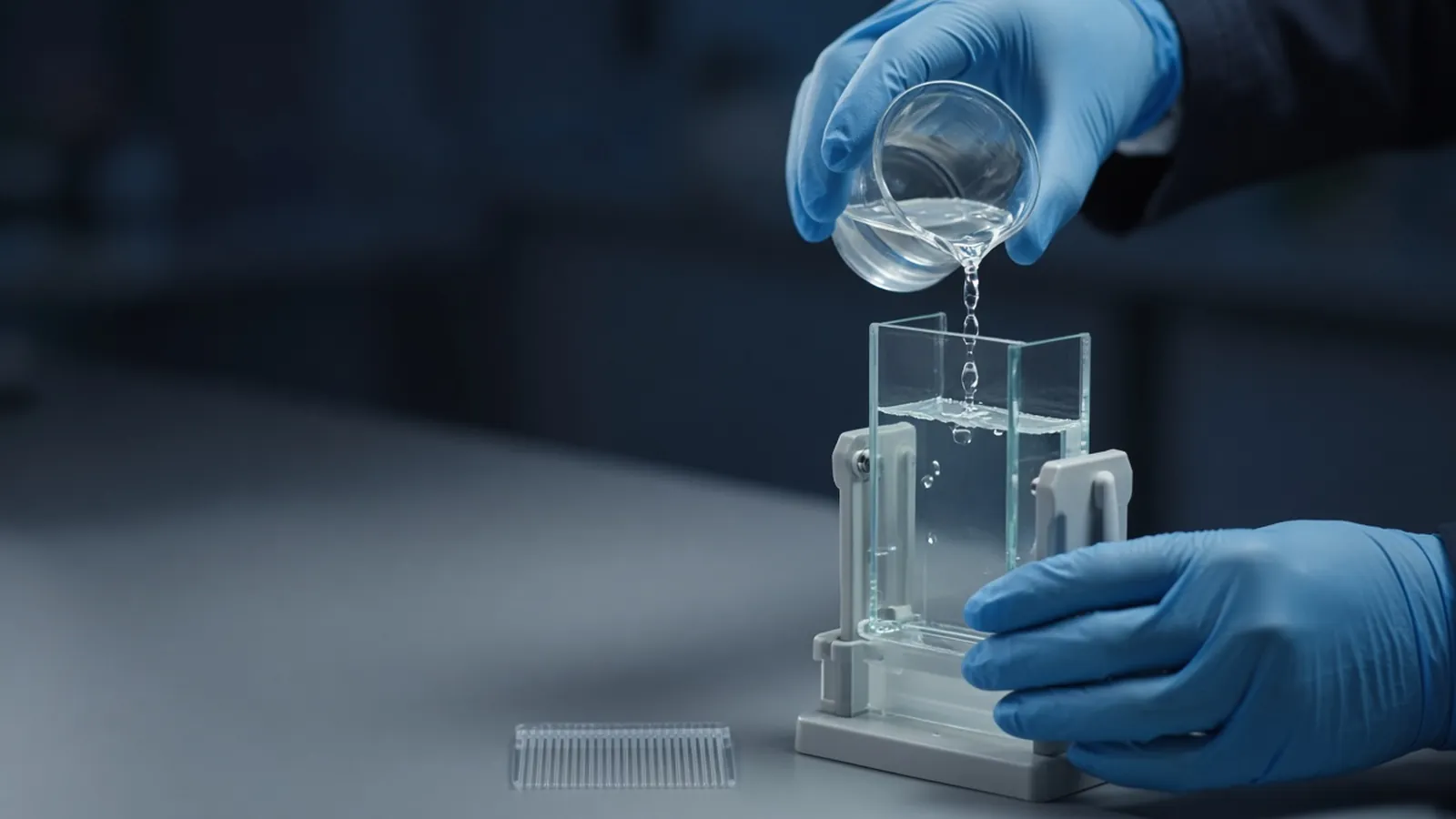
A purification is repeatable when another person can rebuild the buffer, the gradient and the pool without asking what you meant. Memory of a successful afternoon is not that document. The record has to carry the chemistry, the resin identity, the fractions you kept, the gel that justified the pool, the assay behind the yield, and the place the tube went. This page is the application of that list to ordinary research chromatography. It is not a quality-management certificate.
Reading the gel you file is covered in reading a protein gel. Writing buffer recipes so the pH means something is in preparing a buffer and checking pH. Naming the concentration assay is in how laboratories estimate protein concentration.
The buffer recipe has to include the measurement
Write every component and its concentration, including additives you consider obvious: imidazole, salt, glycerol, detergent, reductant, inhibitors. Write the pH and the temperature at which you measured it. A Tris buffer adjusted at a warm bench and used in a cold room is not the pH on the sticker unless you say which condition you adjusted. If you titrated with a specific acid or base, name it. "To pH 7.5" without the temperature trains the next person to hit a different ionic state.
Record water quality only as far as you know it. If the buffer was made with a particular laboratory water type, say so, because a later mass-spec or endotoxin-sensitive use will care. Lot numbers of unusual additives belong here too. A change of imidazole lot is a small thing until the absorbance background of the elution changes and nobody can explain the new chromatogram.
If you inherited a bottle labelled only with a nickname, do not copy the nickname into the permanent record. Find the recipe or remake the buffer and write it in full. Nicknames die when their author leaves.
Resin, column, and gradient
Name the resin class and, when you have it, the product lot. A nickel resin and a cobalt resin are both IMAC and they do not behave identically. Agarose and magnetic beads of the same ligand family differ in capacity and in how you wash them. The lot explains a failure that appears after a reorder. The column volume explains the gradient. A 20-column-volume wash on a 1 millilitre column is a different experiment from the same sentence on a 5 millilitre column.
Write the gradient as start and end composition, volume or time, and flow. "Imidazole gradient" is the shape. The numbers are the method. Note whether the column was run in the cold room or on the bench, and whether a stop divided the run. Fractions should have numbers that match the collector or the hand-labelled tubes. "Peak fractions" is the conclusion. "Fractions 14 to 18, pooled, 12 to 18 discarded after the gel" is the method.
Equilibration and wash volumes belong in the same note. A target that leaked into the flow-through because the resin was not equilibrated into the binding buffer will look like a mysterious expression failure next time if the wash was never written down.
The gel is part of the method
File the image with the marker visible and the lanes named: load, flow-through, wash, fractions you pooled, fractions you rejected, and the final pool. Say whether samples were reduced and how much protein or what volume went in the well. A pool that looked like one band because the gel was overloaded in the lysate lane and underloaded in the pool lane is a documentation trap. State the load honestly.
If you cropped the image for a slide, keep the uncropped file. The crop is a figure. The uncropped gel is the record. Date it so it cannot be paired with a different week's fractions by filename accident.
When the gel shows a second band you accepted, write why. A documented contaminant is a decision. An undocumented one becomes a surprise in the collaborator's assay.
Yield is an assay plus a place
Report yield with the assay and the standard: for example, BCA against BSA, or A280 using the coefficient you calculated for the sequence, blanked against the elution buffer. Include the pool volume. Specific activity, if the protein is an enzyme, needs the activity definition as well as the mass. A yield that changed because you switched from Bradford to A280 is a methods change. Label it that way.
Then write where the tube went. Freezer name or temperature class, box, position, date, and the person who put it there. Aliquots should say what each vial is, because the parent tube and a diluted working aliquot are different concentrations. If the sample was handed to another group, name the handoff: who received it, in what buffer, on what date. A purification that cannot be found has not been repeated. It has been narrated.
Storage conditions that the protein actually experienced, including a thaw, belong in this line. The storage overview in storing biological samples from fridge to freezer is the companion habit.
| Record field | Repeatable content | Too thin to rebuild |
|---|---|---|
| Buffer | Components, concentrations, pH, temperature of the reading | A nickname on the bottle |
| Resin | Chemistry, lot if known, bed volume | "The nickel column" |
| Gradient | Start, end, length, flow, room or cold | "An imidazole gradient" |
| Fractions | Numbers kept, numbers rejected, pool volume | "The peak" |
| Gel | Image, marker, named lanes, reduced or not | A cropped band with no label |
| Yield | Number, assay, standard, volume | A bare mass |
| Location | Freezer, box, date, handoff | "In the freezer" |
Branch when the record and the tube disagree
If the gel file shows two bands and the yield line says pure, correct the words. The gel is the evidence. If the location line points at an empty slot, the purification is not available, whatever the chromatogram says. If two preps share a filename, stop and split them before you average the yields. If a resin lot change coincides with a shift in elution conductivity or imidazole, write the coincidence down. It is a hypothesis for the next run, not a complaint.
A missing pH temperature is worth a comment in the margin the day you notice it. Reconstructing it months later from memory is how Tris buffers drift between operators.
Research records, not a release dossier
This level of detail serves repetition and honest troubleshooting. It does not by itself satisfy a clinical quality system, a patent deposit, or a biosafety approval. Those frameworks ask for their own documents. Do not describe a research note as a certificate of analysis. Hazards of the buffers and the host remain subject to the laboratory rules. A well-labelled tube of a toxin is still a toxin.
Sequences you cite should match a public record or the file you actually cloned. An accession in the header of the note keeps the protein identity attached when the short name is ambiguous.
Notes that have to travel
Humidity and heat ruin paper labels and warm freezers. A record that exists only as a slip under the box fails when the slip falls off. Keep the same fields in a file the group can open, and keep the vial label short and identical to the file's sample code. When power cuts scramble a freezer, the box map is how you decide which thawed tubes are still the documented pool and which must be marked as thawed.
If the next purification will be done by someone who was not in the room, the note is the handoff. Read it once as a stranger. Any step that says "as usual" is a step the stranger cannot run.
Sourcing from the record
When you need more resin or a replacement buffer component, the record is the specification. Ask for the resin class, the ligand, and the bead form you actually ran, and attach the gradient that has to work with it. Those classes live in the reagents and chemicals catalogue. A purification someone else will repeat can be discussed through the custom protein expression and purification reference, which is an enquiry path for that scope. Send the written method with the quote request: buffer with pH and temperature, resin lot or class, gradient, the gel you will accept, the yield assay, and where the delivered tube must be labelled so it can be found.
Questions from the bench
Is a chromatogram enough to repeat the prep?
A trace shows that absorbance moved. It does not show the buffer recipe, the pH temperature, the resin lot, or which fractions were pooled. Those lines are what another person mixes and loads. Keep the trace, and keep the recipe beside it.
What should the yield line contain?
The number, the assay, and the standard. A Bradford BSA-equivalent is a different claim from A280 with a named coefficient. Add the volume of the pool so mass and concentration can be rebuilt. A bare milligram figure cannot be repeated or challenged.
How detailed does the gel record need to be?
Enough to see the marker, the lane order, and which fraction numbers match the tubes. A photograph with unlabelled lanes forces the next person to trust your memory of which shoulder you discarded. Name the lanes in the file name or on the image.
Where does the tube location belong?
In the same record as the pool. Box, slot, freezer, and date are how the purification stays attached to a physical sample. A perfect methods paragraph that points at an unlabelled vial in a shared freezer cannot be repeated, because the material is already lost.
References
Manufacturer names identify published method classes. Trademarks remain with their owners. Catalogue records on this site are independent references for enquiry. They are not a statement of inventory, distribution rights or a supply commitment. This page is educational. It is not medical advice, a diagnostic protocol or a biosafety approval.
Catalogue
Related products and categories
These links follow the subject of the article into published manufacturer references. A listing is a reference for an enquiry, not a statement of stock or distribution rights.
Continue in this cluster
Related reading
Reading a protein gelHow to read a protein gel: what SDS-PAGE bands, smears, ladders and loading differences can support, and what they cannot identify. Preparing a buffer and checking pHPrepare a buffer at a stated pH and temperature, record the salt form, and treat a drifting electrode or a bad slope as a failed control.
 How laboratories estimate protein concentrationHow laboratories estimate protein concentration with absorbance, dye-binding and copper assays, and why the number depends on the standard.