
guide
Extraction controls and blank samples
A reagent blank and a known positive decide whether an extraction batch is interpretable. A contaminated blank stops the whole set.
- Author
- EVRINTH Editorial Team
- Published
- 8 October 2026
- Updated
- 8 October 2026
- Reading time
- 7 min
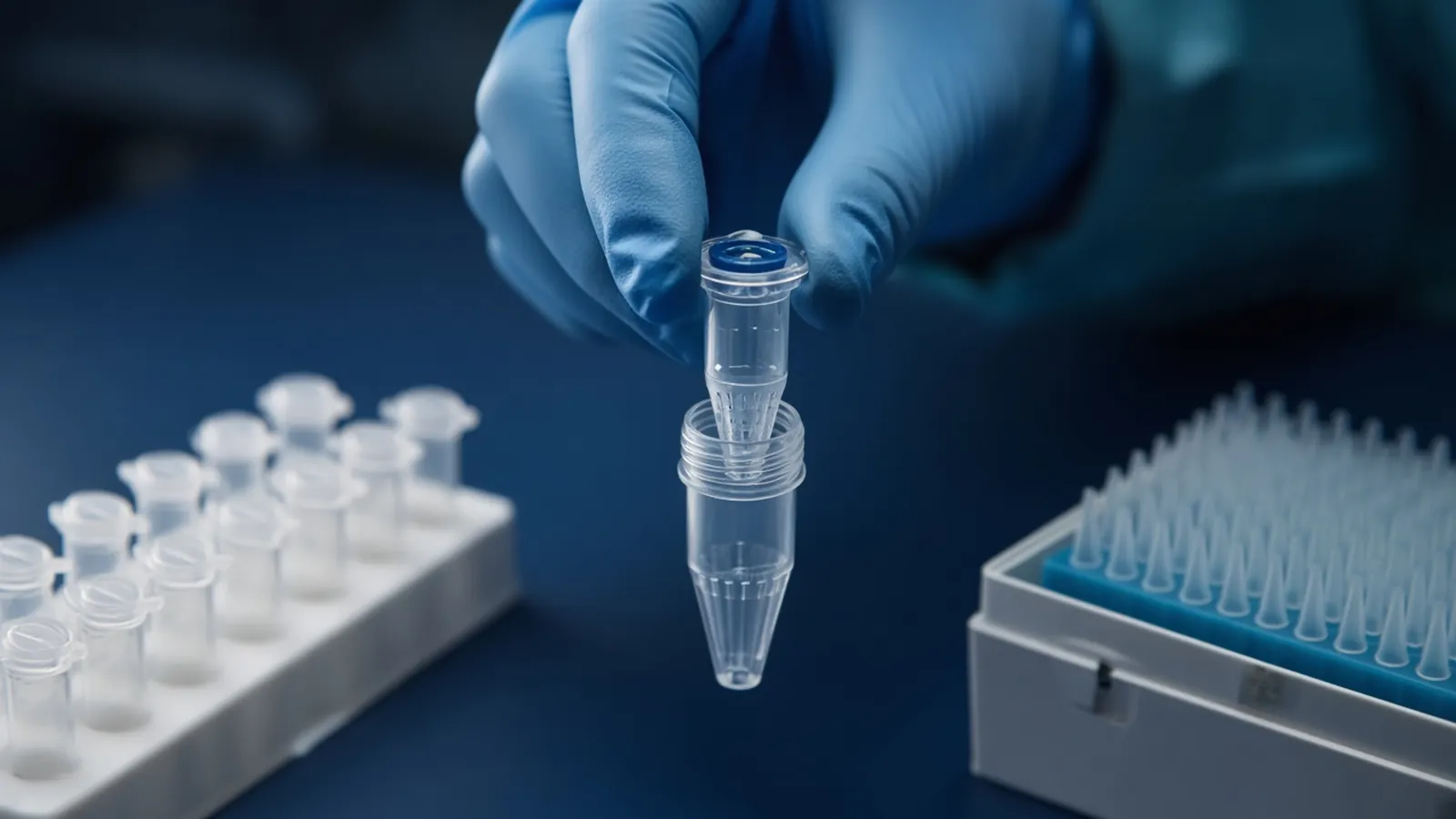
Extraction controls and blank samples answer one question: is this batch interpretable at all? A reagent blank goes through lysis, bind, wash, and elution with the samples. A known positive, when you truly have one, shows that those same steps can recover nucleic acid. If the blank comes up contaminated, you stop the whole batch. You do not pick out the pretty sample tubes and continue. This is a research decision guide. It is not a clinical validation plan and not a kit insert.
The extraction classes these controls sit inside are compared in how DNA extraction methods differ. When the readout is a PCR band, the same logic continues in PCR controls and contamination control. An extraction blank and a no-template control are not duplicates. One watches the prep. The other watches the amplification.
What a reagent blank is
A reagent blank is everything in the method except the specimen. Use the water or elution buffer you would trust as clean, at the volume the sample would have occupied, and take it through sample lysis, binding, washing, and elution with the same reagent lots. Measure it at the end with the assay you care about.
An unused tube of water on the spectrophotometer is not that blank. It never saw the column, the pipette, or the wash buffer. It cannot tell you that the kit introduced DNA. It also cannot tell you that your gloves did.
The blank's job is to catch nucleic acid that the method itself added: contaminated reagents, a reused tip, aerosol from a neighbouring high-copy tube, or a column loaded on a dirty rack. A little ultraviolet absorbance from the elution buffer can be a true buffer baseline. A band at the same size as the samples, or a dye reading comparable to them, is contamination.
The known positive, if you have one
A known positive is a specimen or a nucleic acid this method has already recovered, processed today beside the unknowns. It answers a different question from the blank. The blank asks whether the method invented a signal. The positive asks whether the method can still find a real one.
Use a matrix as close as you honestly can. A plasmid spike into water proves the column can bind that plasmid. It does not prove the column recovered DNA from the tissue sitting next to it. If your only positive is a spike, write "spike" on the sheet so nobody later calls it a matrix control.
If you have no positive, do not pretend. A batch with a clean blank and no positive can show that signals are not pure contamination. It cannot show that a negative sample failed because the target was absent rather than because lysis failed. Keep those sentences distinct in the notebook.
How to decide the batch is interpretable
Read the blank first, with the assay that will carry the claim.
If the blank shows the product you are about to call real, stop. Quarantine every tube from that batch, including the ones with strong signals. Those signals may be the same contaminant. Find the source before the next run: a new kit lot, a clean rack, fresh tips, and a repeat of the blank alone if you need to see whether the reagents were enough. Subtracting the blank from the samples hides the event. It does not restore independence.
If the blank is clean and the positive recovered, sample results can be discussed one by one. A sample failure is then allowed to be a sample story: no target, inhibition, or a lysis that did not open that matrix. Confirm inhibition with a spike into that eluate if the answer matters.
If the blank is clean and the positive failed, the method failed today. Sample negatives are not evidence of absence. Sample positives are surprising and should be treated as suspicious until you know why the positive died. Do not average your way past a dead positive.
If the blank is contaminated and the positive failed, you have learned little about the specimens. Change the suspected reagents and the handling, then repeat blank and positive before any more unknowns are committed.
| Pattern | Blank | Known positive | What you may say |
|---|---|---|---|
| Interpretable set | Clean | Recovered | Sample results can be compared with the assay's own limits |
| Method down | Clean | Failed | Do not call sample negatives true negatives |
| Batch stopped | Contaminated | Any result | The whole set is quarantined, including strong samples |
| Incomplete control | Clean | Not run | Contamination is less likely. Method success was not shown |
A260/A280 on the blank is optional context. A ratio without a real absorbance is noise. A blank that looks like DNA by absorbance has already failed as a blank, even if you never run PCR.
Where blanks fail in practice
A blank opened after the samples, with a pipette that just dispensed a high-copy plasmid, measures that pipette. Process the blank as a peer. Change tips. Do not wave the blank tube through a cloud of eluate "just to label it."
A blank that uses a different wash lot from the samples is a different method. Shared lots are the point.
A positive that is far richer than any sample can succeed while the samples are overloaded or inhibited, and you will wrongly trust the method. Match the positive's input to the range you claim, or run a modest spike and say so.
PCR can make a tiny blank contamination look like a full sample. If the extraction blank amplifies and the no-template control does not, the nucleic acid entered during extraction. If both amplify, you have not located the step. If only the no-template control amplifies, look at the PCR setup. Do not clean the columns for a problem that started in the master mix.
Safety
Controls contain whatever the specimens contain once you process them together. A blank that became contaminated with an infectious extract is no longer "just water" for disposal purposes. Follow institutional waste and biosafety rules. The WHO laboratory biosafety manual is background, not an approval of containment. Nothing here validates a diagnostic or forensic interpretation of a blank.
A spin that the power cut short
A batch interrupted by a power cut during the bind or wash spin is not the batch the protocol describes. Columns left half-processed are not rescued by a clean-looking blank that you spin later under different conditions. Record the interruption, discard or quarantine as your risk rules require, and repeat blank and samples as a new batch. Do not stitch two half-runs into one interpretable set because the tubes are already labelled.
What to send with an enquiry
State the specimen, whether you need a blank-friendly kit class, and how you will judge the blank (dye, gel, or PCR). Say if a matrix positive is available. That tells a sourcing conversation whether you need a method for a dirty specimen or simply columns and buffers. Use the sample preparation catalogue and the sample preparation pathway, and send the notes with the quote request. The nucleic acid isolation enquiry reference is an enquiry reference. Ask whether a quotation is possible.
Decide whether an extraction batch is interpretable
- 01Take a reagent blank through every stepStart water or the elution buffer you trust in parallel with the samples, using the same lysis, bind, wash, and elution lots. The blank is a sample of the method, not a tube of unused water measured at the end.
- 02Add a known positive only when one existsInclude a specimen or control nucleic acid this method has recovered before, and record its matrix. If no such control exists, write that down rather than borrowing an unrelated tube in silence.
- 03Read the blank before the samplesJudge the blank with the same assay you will trust on the samples, whether that is a dye, a gel, or a PCR. A product in the blank that matches the samples means the batch cannot be interpreted.
- 04Stop or continue from that resultQuarantine the whole batch when the blank is contaminated, including tubes that look perfect. Discuss sample-level failures only after the blank is clean and, if you included one, the positive has been recovered.
Questions from the bench
Can I subtract the blank absorbance and keep the batch?
Subtraction is reasonable for a small, stable buffer background at 260 nm when you are estimating mass and the blank has no target. It is not reasonable when the blank produces the same PCR band, the same clone, or a dye signal in the range of the samples. That pattern means nucleic acid entered the method. The samples are no longer interpretable as independent specimens.
What if I have no known positive?
Say so in the record and lean on the blank plus a downstream control that the assay itself requires. A missing positive means you cannot prove the method worked today. You can still prove it was contaminated if the blank lights up. Do not invent a positive by spiking a neighbour's plasmid without writing the source and the amount.
Where should the blank sit in the rack?
Place it where a splash or a reused tip would reach it, not only in a corner the pipette never crosses. Many groups put a blank early and another late in a large run. A single blank that never shared a pipette is a weaker test of the handling you actually did.
Does a clean A260/A280 on the blank mean the PCR blank will be clean?
Not always. Absorbance may miss a few copies that a PCR will amplify, and a PCR blank can be clean while absorbance still sees leftover wash chemistry. Match the control readout to the claim. Sample lysis and nucleic acid extraction controls are interpreted with the assay you will publish, not with a more convenient instrument.
References
Manufacturer names identify published method classes. Trademarks remain with their owners. Catalogue records on this site are independent references for enquiry. They are not a statement of inventory, distribution rights or a supply commitment. This page is educational. It is not medical advice, a diagnostic protocol or a biosafety approval.
Catalogue
Related products and categories
These links follow the subject of the article into published manufacturer references. A listing is a reference for an enquiry, not a statement of stock or distribution rights.
Continue in this cluster
Related reading
How DNA extraction methods differHow silica columns, beads, precipitation and organic extraction change DNA yield, length and inhibitors, and which class fits the assay you actually plan toA glossary of purification termsDefine chaotrope, bind-wash-elute, yield, purity ratios and RIN, then walk a purification so those words describe one real workflow.Blood saliva and tissue as starting materialExplain how EDTA blood, heparin blood, saliva and solid tissue behave as extraction inputs, and why a serum tube is not whole blood.