
explainer
Filter sterilising a buffer
Explain what a 0.22 micrometre filter removes from a buffer, which membrane polymer fits the solution, and why a bubble-point value belongs to one device.
- Author
- EVRINTH Editorial Team
- Published
- 8 October 2026
- Updated
- 8 October 2026
- Reading time
- 8 min
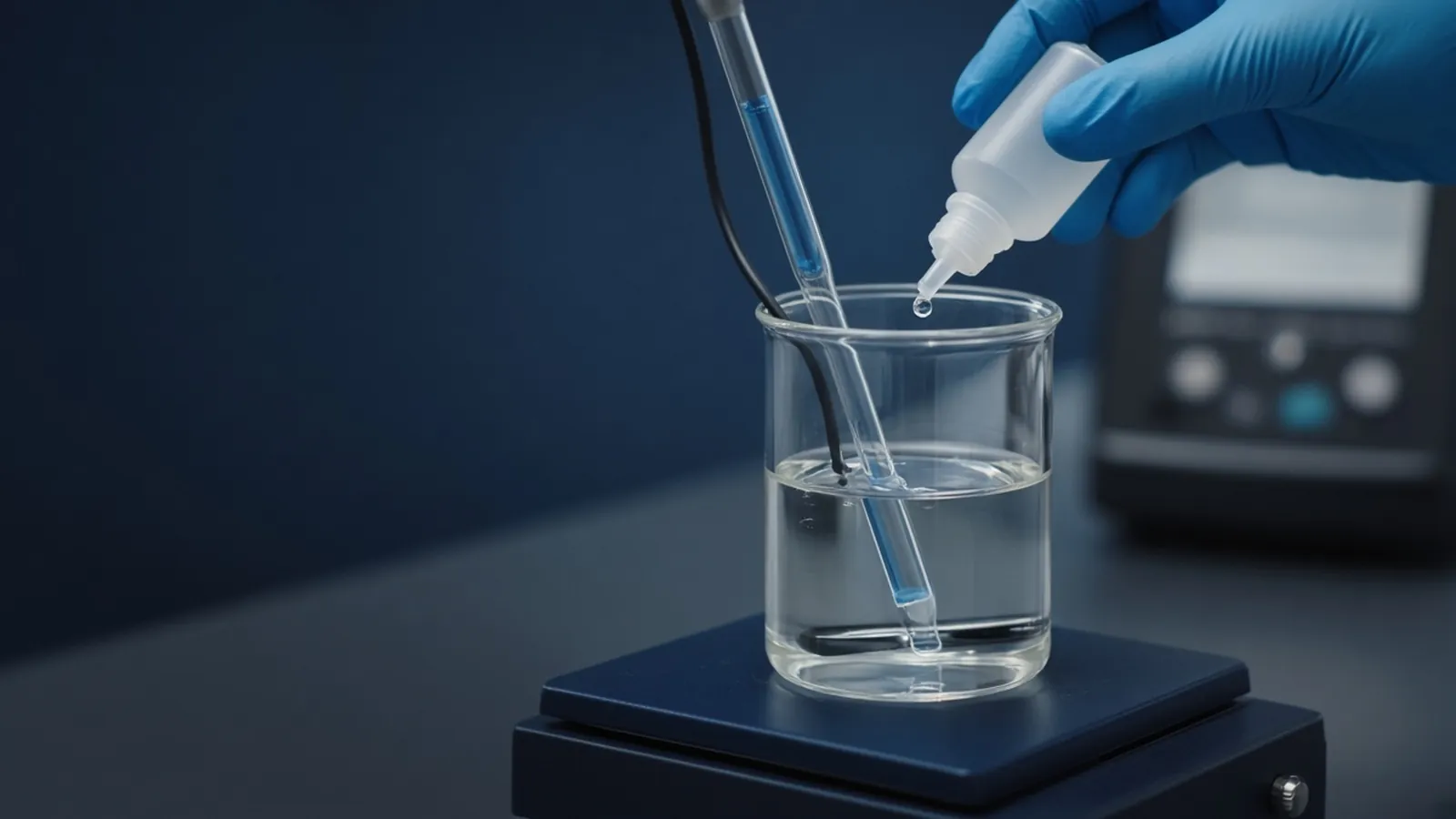
A buffer that cannot be autoclaved is often pushed through a membrane and then called sterile. The pore size does some of that work. It does not do all of the work the sentence suggests. This explainer is for deciding what a 0.22 micrometre filtration step can mean for a heat-sensitive buffer, which membrane class belongs in the funnel, and which claims you must not borrow from the word sterile.
Filtration does not improve the water you started with. Ions, organic carbon, and endotoxin already in that water are discussed in laboratory water types and where they fail. The pH you measured before you filtered still has to be a real pH, which is preparing a buffer and checking pH. What steam does and does not do, if you were choosing between heat and a filter, is in autoclaves and what sterilisation does not do. Buffer salts are specified from the reagents and chemicals catalogue. Receiving bottles and flasks are in beakers and flasks. Device ratings belong on the quotation request.
What the pore is being asked to hold
A membrane rated at 0.22 micrometres, sometimes labelled 0.2, is used because most bacteria are larger than that rating and a sterilising-grade device is built and tested to retain them under defined conditions. "Most bacteria" is the honest summary for a teaching bench. It is not a promise about every organism, and the rating on a disc is not the same document as a validation pack for a sterilising-grade capsule. Use the claim the device actually carries.
Mycoplasma sit in a size range that overlaps and undercuts that pore, and they are deformable. A buffer passed at 0.22 micrometres can still carry them. Viruses pass. Free endotoxin, which is lipopolysaccharide rather than a cell, passes. If your reason for filtering was a fear of endotoxin, a bacterial filter is the wrong tool. If your reason was a heat-labile vitamin, a sugar you do not want caramelised, or an antibiotic the method says to add after heat, a bacterial filter may be exactly the tool. Write the reason in the batch record so the next person does not upgrade the claim.
Prefilters and depth filters are a different class again. They take out particles that would clog the membrane. They are not a sterilising step by virtue of sitting upstream. A cloudy buffer needs that help, or it needs to be dissolved properly before anyone calls the cloud contamination.
Polymer class is a compatibility choice
Polyethersulfone is a common default for aqueous buffers and for media because flow is high and protein binding is low. It is not universally resistant to every solvent. A buffer that is mostly water with a little acetonitrile is already a compatibility question for the sheet, not a place for habit.
Polyvinylidene fluoride comes hydrophobic or hydrophilic. The hydrophilic grades are used for protein solutions because binding is low. The hydrophobic grades repel water until they are wetted with an alcohol the device allows, and they are a poor surprise if you needed an aqueous buffer to pass without that step. Specify the grade. "PVDF" alone hides it.
Nylon is tough and appears in a lot of solvent filtration. It also binds protein and can bind nucleic acids. A dilute enzyme buffer pushed through nylon can come out clearer and weaker. That is a concentration change, not purification you wanted. Use nylon when the solution matches it and the analyte is not something the polymer eats.
Cellulose acetate binds very little protein and is used for some sensitive aqueous biologicals. Its solvent and pH window is narrower. An acidic or solvent-rich buffer that is kind to polyethersulfone can still be unkind to cellulose acetate. Again the sheet governs, not a memory of which plastic looked pale.
Extractables are the quiet fourth column. The first liquid through a device is the liquid most likely to carry manufacturing residues. Some methods discard an initial rinse. The volume of that rinse is a device instruction, not a number to invent here. If the assay can see ultraviolet-absorbing leachate, the rinse and the polymer both matter, and so does the water you rinse with.
Bubble point is a concept with a local number
An integrity test asks whether the membrane you just used is the membrane you think you used: unwetted pores, a crack, or a bad seal show up as gas passing too easily. The bubble point is the pressure at which a wetted pore releases a bulk stream of gas. Smaller pores and higher liquid surface tension push that pressure up. Wetting with the wrong liquid changes the number. A capsule and a small syringe filter with the same nominal pore do not share a pass-fail pressure.
So you do not memorise one bubble point for "0.22 micrometre filters". You read the integrity specification for that catalogue device, wetted as it says, and you compare your test with that sheet. If you do not have the sheet, you do not have a number. A passing visual "it looked hard to push" is not a bubble-point test. A failed test means you do not use the filtrate for a step that required integrity. You set the batch aside and find out whether the wetting, the gauge, or the device is at fault.
Where this step sits in the workflow
Prepare the buffer in a volume short of the mark if you still need to adjust pH, equilibrate, set the pH at the temperature the recipe names, then make up to volume. Filtering before the pH is finished means you may contaminate the sterile filtrate with the adjusting acid. Filtering a solution that still has undissolved salt means the concentration changes when the rest dissolves in the receiving bottle.
Choose pressure or vacuum as the device allows. A vacuum flask that was not cleaned is a sterilisation of the membrane followed by immediate contamination. The receiving vessel has to be as sterile as the claim you want, which for many buffers means a vessel fresh from a qualified autoclave cycle or a purchased sterile bottle. Touching the outlet to a bench edge ends the claim.
Label the filtrate with the pore rating, the polymer, the date, and the integrity result if you performed one. "Filter sterilised" without those words cannot be audited. If the downstream method is a culture, BMBL and the WHO laboratory biosafety manual still govern how you handle the medium afterwards. Filtration is not a biosafety approval.
| Question | A 0.22 micrometre step | What it does not decide |
|---|---|---|
| Most bacteria | Retained when the device is a sterilising-grade filter used as rated | Mycoplasma, viruses |
| Endotoxin already free in the buffer | Left in the filtrate | Whether a later autoclave will destroy it |
| Protein concentration | Preserved better on low-binding polymers | Binding loss on nylon |
| Device intact | Bubble point against that device's own sheet | A single pressure reused from another model |
| Heat-labile additive | Can be introduced after the salts are sterilised | A substitute for a dirty receiving bottle |
Failure modes that look like a bad buffer recipe
A filtrate that is weaker than the feed in a protein assay often met a binding polymer. Repeat on a low-binding device before you remake the chemistry. A filtrate that foams and filters slowly may be a detergent solution; surfactants wet pores differently and can defeat a casual integrity impression. Follow the device guidance for solutions that lower surface tension, because bubble point shifts when the liquid changes.
A buffer that precipitates on the membrane was not fully dissolved, or it was filtered cold and will redissolve warm, or calcium met phosphate. The membrane is not the cause. Fix the order of addition, then filter a solution that stays dissolved at the temperature of use. A hot laboratory makes that temperature check more important, not less. A vacuum filter that boils under an aggressive vacuum has been concentrated by evaporation. Ease the vacuum. The molarity you calculated is no longer the molarity in the flask.
If the receiving bottle was only "clean" and not sterile, you filtered into a new contamination. The branch is to autoclave or purchase the vessel properly and repeat. Do not try to rescue the bottle by filtering it twice through the same contaminated outlet.
What to put in an enquiry
Ask for the pore rating, the polymer and whether it is hydrophilic, the format you need, the wetting liquid and bubble-point specification for integrity, and any extractables or protein-binding statement the assay requires. Say that you are filtering an aqueous buffer, a solvent mixture, or a protein solution. Ask for the sterilising claim in the words the manufacturer is willing to print, and do not ask them to add mycoplasma, virus, or endotoxin language the device does not have. On receipt, match the sheet to the catalogue identity before the first valuable batch goes through.
Questions from the bench
Does a 0.22 micrometre filter stop mycoplasma and viruses?
It is not a reliable mycoplasma barrier, and it is not a virus barrier. Mycoplasma are small and lack a rigid wall, so a pore size that retains most bacteria does not retain them as a class. Viruses are smaller still. If the method needs a mycoplasma claim, it will name a tighter device or a different control. Do not infer that claim from a bacterial rating.
Will the same filter remove endotoxin?
Free endotoxin passes a bacterial-retentive membrane because lipopolysaccharide is far smaller than a bacterial cell. Filtering a hazy solution can remove cells and leave the endotoxin those cells already shed. Endotoxin reduction is a different device and a different documented claim. Autoclaving the filtrate later does not finish the job either.
Can I use one bubble-point pressure for every 0.22 micrometre unit?
No. Bubble point is the gas pressure at which a wetted membrane lets a bulk gas path open. The pass value depends on the pore rating, the polymer, the wetting liquid, and the device geometry. Use the number on that device's integrity sheet. A value remembered from a teaching practical does not transfer.
Which polymer should a protein buffer use?
Often a low-binding hydrophilic membrane such as polyethersulfone or a hydrophilic polyvinylidene fluoride, because nylon and some other polymers bind protein and can change the concentration you just prepared. The choice is still compatibility with the solvent, the pH, and the extractables the assay can see. Read the device sheet rather than a nickname.
References
Manufacturer names identify published method classes. Trademarks remain with their owners. Catalogue records on this site are independent references for enquiry. They are not a statement of inventory, distribution rights or a supply commitment. This page is educational. It is not medical advice, a diagnostic protocol or a biosafety approval.
Catalogue
Related products and categories
These links follow the subject of the article into published manufacturer references. A listing is a reference for an enquiry, not a statement of stock or distribution rights.
Continue in this cluster
Related reading
 Laboratory water types and where they failResistivity, organic carbon and endotoxin answer different questions. A water grade fails when the assay cares about a contaminant the meter cannot see.Preparing a buffer and checking pHPrepare a buffer at a stated pH and temperature, record the salt form, and treat a drifting electrode or a bad slope as a failed control.
 Autoclaves and what sterilisation does not doSteam sterilisation holds a cleaned load at temperature. It does not wash, remove endotoxin, or prove sterility because the tape changed colour.