
troubleshooting
Gloves are not a substitute for handwashing
Dirty gloves, a rash at the cuff, and solvent wetting the skin are symptoms to reason about. Handwashing still belongs after the gloves come off.
- Author
- EVRINTH Editorial Team
- Published
- 8 October 2026
- Updated
- 8 October 2026
- Reading time
- 9 min
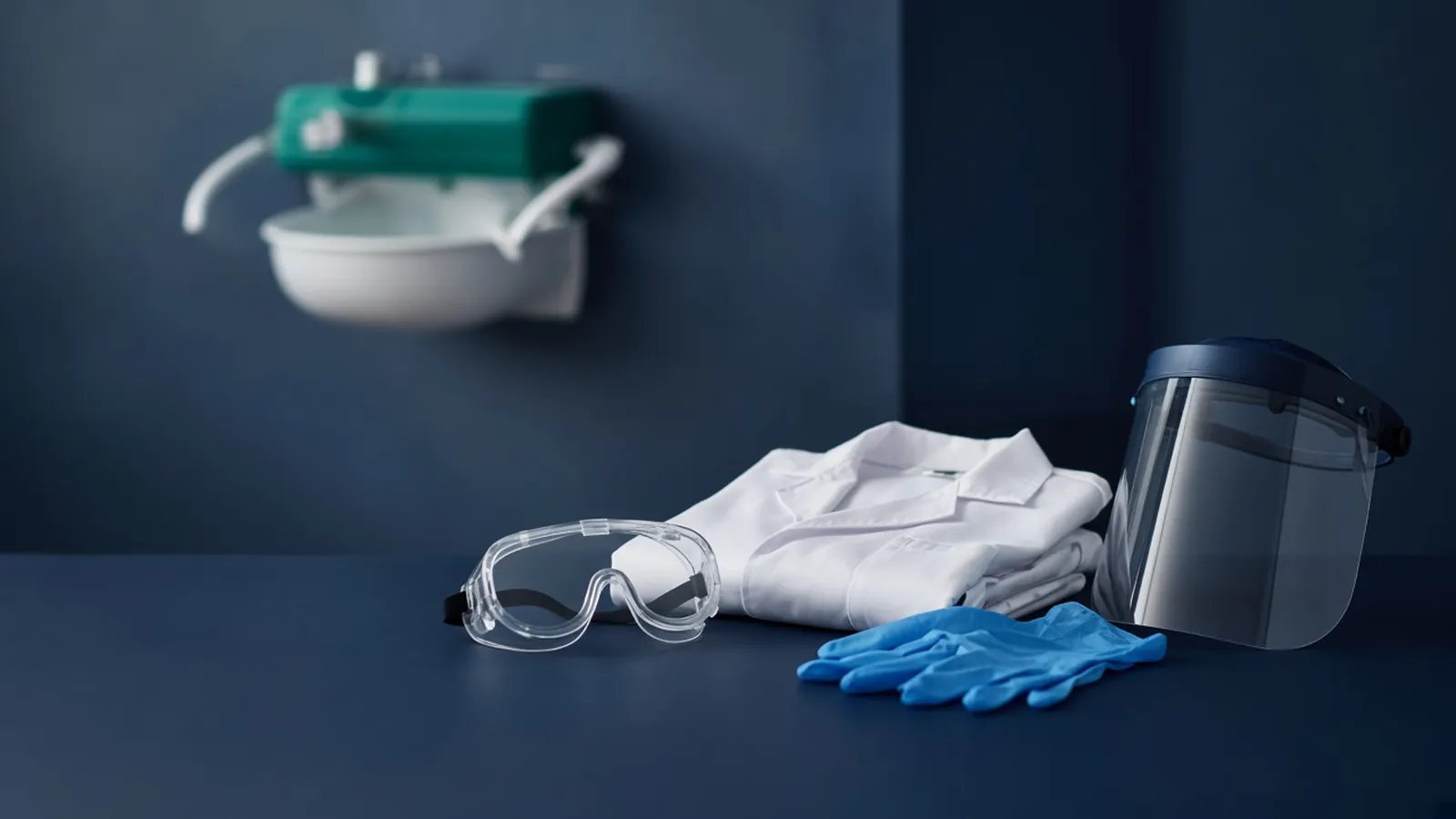
The glove looks intact, and the phone is already contaminated. That pairing is the usual failure, and you notice it late. A cuff soaked through. Nitrile went slick in a solvent. A rash appeared after a week of latex. Someone left the bench, still gloved, to answer a door. None of these symptoms means the glove replaced handwashing. The glove is a temporary barrier. The wash is what you do to the hand after the barrier is finished.
How coats, gloves, and eyewear share a task is set out in PPE that matches the task and in biosafety basics for research benches. Glove classes sit in laboratory consumables. A laboratory specifying them for a teaching bench can use academic research and a quotation request.
Symptoms, before the theory
Start with what you can see, because this is a troubleshooting page.
The outside of the glove is wet, sticky, or powdered with the material you were handling, and you are about to touch a pen. The glove has done its job of keeping that material off the skin so far, and it is now a contaminated tool. The next check is whether you are still inside the dirty step. If you are moving to a clean step, to a notebook, or out of the room, the glove comes off. Then you wash. Wiping the glove on the coat and carrying on spreads the material onto the coat.
Your skin is wet when the glove comes off, and you were using a solvent. Sweat and breakthrough can look alike. The next check is the chemical, the glove polymer, and how long you wore it. Do not guess a breakthrough time. Look up the glove manufacturer's chart for that named chemical and thickness. If the chart says the material is a poor choice, stop using that pairing. Wash, report the contact the way the laboratory requires, and change the specification. If the liquid is only sweat and the chart supports the glove, the wash is still required, and you look at whether the task needs a glove change more often so technique survives the heat.
A rash, itching, or cracked skin shows up at the wrist or the back of the hand. Split the possibilities without diagnosing yourself. Natural-rubber latex is a classic allergen. Sweat under an occlusive glove causes irritant dermatitis. A chemical can do both a burn and an allergy. This page is not a medical assessment. Report skin reactions as the institution directs, and do not keep wearing the suspected material while you wait to see if it gets worse. Powdered latex, where it is still in a drawer, is a particularly poor default.
You washed, and the soap never met the wrists because the coat cuffs were down and the tap was operated with a dirty glove. The wash did not happen. The next check is the order: gloves off, coat cuff out of the way, soap on the whole hand including the wrists, then a tap you can operate without recontaminating the clean hand. A knee-operated or elbow-operated tap is a facility feature. If you only have a hand tap, the technique is to close it with a paper towel on the way out, as your SOP describes.
What the glove is for
A glove interrupts contact between a substance and the skin for a limited time, if the polymer resists that substance and the film is intact. It does not filter air. It does not make the bench clean. It does not authorise you to touch your face. The WHO laboratory biosafety manual and the CDC BMBL treat gloves as one practice inside a larger biosafety arrangement, removed before you leave the work area, with handwashing afterwards. The OSHA laboratory standard, where it applies, similarly refuses to let protective equipment stand in for a proper chemical control.
Removal is part of the hazard. People peel a glove off by pinching a contaminated palm with a bare hand, or they snap the cuff so droplets flick onto the wrist. A cleaner pattern is the one your training already teaches: glove-to-glove for the first removal, skin-to-skin for the second, so the bare hand touches the inside only. Then wash. If your training names a different order, follow that order. The invariant is that the wash comes after, not instead.
Double gloving is a control some assessments specify for particular tasks, so the outer glove can be changed without baring the hand in the middle of a dirty step. It is not a universal upgrade, and it does not cancel the wash when both layers finally come off. If double gloves destroy your grip on a small tube, tell the person who owns the assessment. A dropped tube is its own exposure.
Nitrile, latex, and the chart you must not invent
Nitrile is a synthetic polymer widely used for biological buffers and for better resistance than latex to many organic solvents. Latex, from natural rubber, is flexible and still appears in some laboratories, with a known allergy risk. Vinyl is sometimes used for tasks the assessment regards as low hazard, and it is generally a weaker barrier. None of these sentences is a compatibility approval for your bottle.
Resistance depends on the chemical, the thickness, the temperature, and the time. Manufacturers publish charts. Those charts are the data. A blog that printed a minute value for "solvents" would be inventing a number for an unnamed chemical. If the chart shows poor resistance, choose another material or change the task so the hand is not in that chemical. If the chart is silent, do not assume safety. Ask the supplier for the data on the specific glove, and keep the chemical hygiene officer in the conversation.
Change gloves when they are contaminated, when they tear, when you have touched a surface that must stay clean, and when you leave the cabinet or the bench zone. A glove that has touched a culture does not then touch the centrifuge keypad, the phone, or the eyewash handle. Those surfaces become the next person's exposure.
The sink is the control you skip
Handwashing removes material the glove leaked or the removal smeared. It uses soap and water, covers the wrists, and takes long enough that the soap actually met the skin. Alcohol gel, where the SOP allows it, is an addition for some biological hand hygiene steps. It is a poor answer to a chemical on the skin, and it is not a reason to skip the sink when the hands are soiled. Follow the institutional hand-hygiene rule for the agent you had. Do not build a personal hybrid.
Then look at where the gloves went. Disposable gloves are waste on the stream the assessment named. They are not "cleaned" by a wish to autoclave them. Some loads of biological waste are candidates for steam, and many glove-and-chemical mixtures are not. Read autoclaves and what sterilisation does not do before you treat the autoclave as a glove laundry. If the waste path is unclear, bag the gloves as the spill and waste plan says and ask. Do not rinse contaminated gloves in the sink as a disposal method.
| Symptom | Likely cause | Next check |
|---|---|---|
| Phone, pen, or door was touched while gloved | The glove was treated as skin | Remove gloves, wash, and disinfect the object as the plan allows |
| Skin wet after a solvent step | Sweat, or breakthrough of that chemical | Manufacturer chart for that glove and chemical. No guessed time |
| Rash at the cuff after latex use | Latex allergy or irritant dermatitis | Stop the suspected glove. Report it. This page does not diagnose |
| Ethanol "disinfection" of gloves between samples | Contact time lost to evaporation | SOP: is a glove change required instead? |
| Hands still dirty at the wrists after a wash | Cuffs down, or the tap recontaminated the hands | Wash sequence and how the tap is closed |
| Plan to autoclave the gloves | Waste stream confused with hand hygiene | Assessment and the autoclave limits. Wash anyway |
Failure modes that look like discipline
Touching your face to move goggles, with gloves still on, paints the face with the bench. Park the eyewear before you glove, or deglove and wash before you adjust it. Holding a phone "for a second" is the same error with a witness. If the phone was touched, it is now part of the contamination, and the plan for equipment disinfection applies. Then wash.
Cuffs are a second route. A long coat cuff that covers the glove cuff can stay clean, or it can wick liquid onto the wrist if it dips into a tray. The assessment should say which arrangement you use. A wet wrist at the end of a stain or a lysate step is a signal to wash further up the arm than you planned and to change the cuff habit.
Solvent slickness is a stop signal. When nitrile swells, softens, or feels slippery, the barrier is telling you the chemical and the polymer are interacting. Finish the immediate safe stop the SOP allows, remove the gloves, wash, and do not put a fresh pair of the same glove back into the same solvent while you "just finish." Change the material or the engineering control.
What this does not decide
Glove choice and handwashing sit inside the institutional assessment. This page does not approve your organism, your chemical, or your room. It does not diagnose a rash or an exposure, and it does not tell you to continue working. Authorisation and any clinical follow-up sit with the institution. If a chemical reached the skin, the safety data sheet and the local emergency plan govern the first response, not a troubleshooting table.
Warm weather and long wear
In a hot, humid laboratory, hands sweat and people delay the wash because removing gloves feels like a chore they will do once at the end. That delay is how door handles accumulate a day's work. Plan glove changes at the real breaks in the method, and wash at each removal, even when the only liquid you can see is sweat. Specify gloves that people can don with damp hands if that is the climate you actually have. A glove that cannot be put on correctly will be worn half-on, with the wrist exposed.
What to ask for
On a quotation request, name the polymer, the task, and the chemicals the institution has cleared you to mention. Ask for the resistance chart for those chemicals rather than a single word such as "chemical resistant." Say whether latex is forbidden in the room because of allergy. Ask for unpowdered gloves unless the assessment has a reason for powder. State that the gloves are for the bench task, and that handwashing facilities are a separate requirement you are not asking a supplier to replace.
Questions from the bench
Why wash if the gloves never tore?
Removal contaminates the skin even when the palm looks clean. The cuff, the wrist, and the technique of peeling the glove off move material onto the hand. Microscopic holes are also possible. Handwashing is the step that addresses the hand after the barrier comes off.
Which is better, nitrile or latex?
It depends on the chemical and on allergy. Nitrile is often chosen for aqueous biological work and resists many solvents better than latex, but some solvent families still attack it. Latex proteins cause allergy in some people. The manufacturer's resistance chart for the named chemical, and the institution's allergy rule, are the decision. This page does not give breakthrough times.
Can I disinfect the gloves and keep them on for the next sample?
Only if the SOP says that a defined disinfectant, with a real contact time, is acceptable between samples of that kind. A quick rinse of ethanol that flashes off is not that step. Gross contamination, a tear, or a change of chemical means the gloves come off. Then you wash.
Should used gloves be autoclaved?
Only if the waste assessment names that load as suitable for steam. Many glove materials and many mixed wastes are a poor autoclave load, and steam does not replace handwashing or turn a dirty removal into a clean one. The limits of steam are in the autoclave article. The waste stream is the institution's, not a technique you invent at the sink.
References
Manufacturer names identify published method classes. Trademarks remain with their owners. Catalogue records on this site are independent references for enquiry. They are not a statement of inventory, distribution rights or a supply commitment. This page is educational. It is not medical advice, a diagnostic protocol or a biosafety approval.
Catalogue
Related products and categories
These links follow the subject of the article into published manufacturer references. A listing is a reference for an enquiry, not a statement of stock or distribution rights.
Continue in this cluster
Related reading
Biosafety basics for research benchesResearch-bench biosafety is a stack of barriers chosen by a risk assessment. This page explains the stack. It does not approve the work. Autoclaves and what sterilisation does not doSteam sterilisation holds a cleaned load at temperature. It does not wash, remove endotoxin, or prove sterility because the tape changed colour.A glossary of biosafety termsPairs that share a bench still do different jobs. Use this comparison to choose the right word for a cabinet, a chemical, a level, or a control.