
application
Ionic strength is not the same as pH
During a hybridisation wash, compute ionic strength from the ions you added. A matched pH can still hide a salt change that moves stringency.
- Author
- EVRINTH Editorial Team
- Published
- 8 October 2026
- Updated
- 8 October 2026
- Reading time
- 7 min
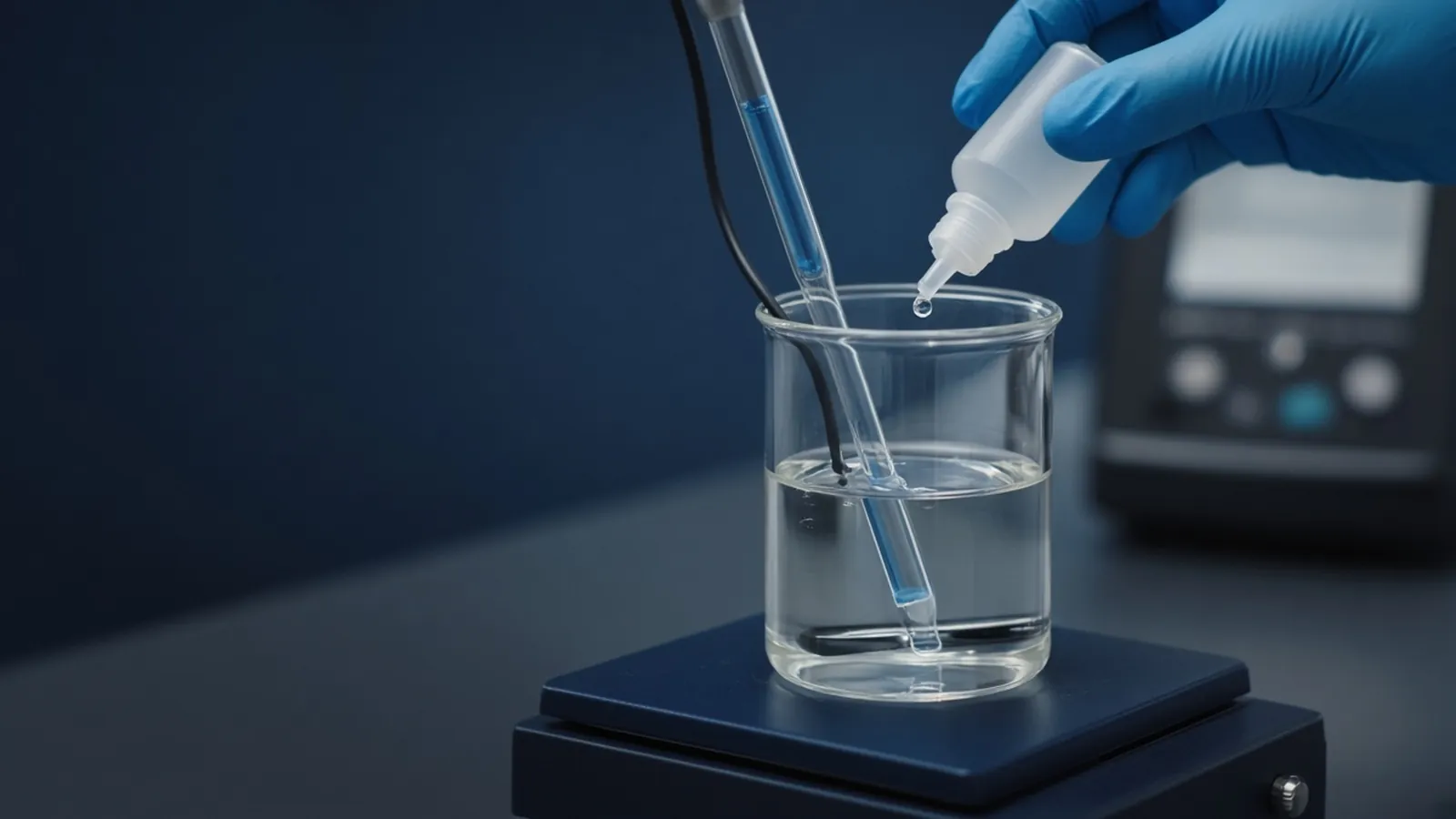
A hybridisation wash can read pH 7.0 on two benches and still be two different chemical environments. Stringency moves with salt, temperature, and the probe. pH is only one of those terms. This application follows one wash buffer from the formula for ionic strength through the mistake that keeps the pH and loses the salt. The water in the wash is laboratory water types and where they fail. Setting the pH without wrecking the concentration is preparing a buffer and checking pH.
Sodium chloride, the buffer acid and base, and any magnesium the hybridisation itself requires are specified from the reagents and chemicals catalogue. The volumetric step needs beakers and flasks and a flask that was actually calibrated. Put the salt identity and the concentration on the quotation request when you order, so the bottle matches the formula you are about to compute.
The task this page stays inside
You are preparing a wash for a nucleic-acid hybridisation. The method says 150 millimolar sodium chloride, a low concentration of a buffer at pH 7.0, and a temperature for the wash. A colleague suggests swapping the sodium chloride for "the same molarity" of another salt that happens to be open, or dropping the salt because the pH meter still reads 7.0. Your decision is whether those washes are the same wash. They are not, and ionic strength is the language that shows why.
The same arithmetic applies to protein solubility and to many enzymatic rates. The hybridisation wash is the example because the salt effect is the point of the method, not a side note. Public cloning and blotting protocols on Addgene treat salt, temperature, and buffer as separate words. Keep them separate in the notebook too.
The definition you can calculate
Ionic strength I is one half the sum, over every ion, of its concentration times the square of its charge. In symbols, I = 1/2 Σ ci zi². Concentration is in moles per litre for the usual laboratory number. Charge is the ionic charge, so a divalent ion is counted four times before the one-half, because two squared is four. pH does not appear in the sum. A hydrogen ion at 10⁻⁷ moles per litre, which is what pH 7 points at in the ideal case, contributes almost nothing to I beside 150 millimolar salt. Matching pH and matching ionic strength are different successes.
Work the wash salt. Sodium chloride at 0.150 moles per litre gives sodium at 0.150 with z² = 1 and chloride at 0.150 with z² = 1. The sum inside is 0.300. Half of that is 0.150. So I is 0.150 moles per litre. If someone prepares 50 millimolar sodium chloride and calls it "still saline, and the pH is the same," I from the salt falls to 0.050. That is a large stringency change. The meter will not object.
Now suppose the hybridisation buffer, not the wash, contains 10 millimolar magnesium chloride, and someone computes it as if it were sodium chloride. Ideal full dissociation: magnesium at 0.010 with z² = 4 contributes 0.040, and chloride at 0.020 contributes 0.020. The sum is 0.060. Half is 0.030. Ten millimolar magnesium chloride is three times the ionic strength of ten millimolar sodium chloride, before you allow for ion pairing that reduces the free-ion ideal. Use the ideal figure to see the scale of the mistake, then follow the method's stated concentration rather than inventing a pairing correction you did not measure.
A buffer ion belongs in the sum too. Near a pKa, phosphate is a mixture of charges, and the sodium that arrived with the phosphate salts counts. Tris adjusted with hydrochloric acid contributes chloride. If you ignore those and only add up the sodium chloride line, you are slightly low, which is often acceptable for a wash. If you replace the sodium chloride with the buffer and assume "50 millimolar buffer equals 50 millimolar salt," you are not slightly low. You are in a different experiment. The pH can be perfect throughout.
Where you put the numbers in the workflow
Write the ions on the recipe before you weigh anything. Include the hydrate so the mass matches the moles you just used. Magnesium chloride hexahydrate and the anhydrous salt are different masses for the same nominal molarity; weighing the wrong one corrupts I and the magnesium activity together. Dissolve in water short of the final volume. The water's own ions are negligible beside 150 millimolar salt if the water is a normal analytical grade. They are not negligible in an ultrapure-water conductivity specification, which is a different question.
Set the pH at the wash temperature if the buffer's coefficient is large. For a small phosphate or for HEPES, record the temperature anyway. Bringing the pH into range by adding a lot of acid or base adds ions. Those ions belong in the ionic-strength sum if the addition is more than a trim. Then make to volume. Topping a beaker by eye changes the concentration you just calculated, which changes I in proportion.
Branch when the control fails. If the electrode slope is outside the laboratory window, you do not know the pH, and you also do not yet know whether you over-titrated. Fix the meter and prepare again if the titrant volume was wild. If the pH is right and the hybridisation background is wrong, compare the salt concentration with the method before you change the probe. Conductivity against a retained aliquot of a wash that worked is a gross check: a threefold salt error usually shows. Conductivity is not I, and it is not pH. It is a screen.
| Wash in front of you | Ionic strength from the named salt | What the pH meter adds |
|---|---|---|
| 150 mmol/L NaCl, pH 7.0 | 0.15 mol/L | Confirms pH only |
| 50 mmol/L NaCl, pH 7.0 | 0.05 mol/L | Can still read 7.0 |
| 10 mmol/L MgCl2, ideal ions | 0.030 mol/L | Says nothing about magnesium charge |
| 10 mmol/L NaCl | 0.010 mol/L | Easy to confuse with the row above |
| Salt omitted, buffer only | Whatever the buffer ions contribute | A pretty pH and a different stringency |
Failure modes that look like a bad probe
A hygroscopic salt weighed slowly adds water mass and lowers the true molarity, which lowers I. The pH can still be adjusted to 7.0. Record the hydrate and weigh with the lid discipline the salt requires. A volumetric flask made up well above its calibration temperature changes how much solution the mark represents. The direction is that warmer water occupies more volume, so the mark captures less mass of solution than it would at the calibration temperature. That scales every concentration, including I. It does not show up as a pH error.
Protein work has the twin failure. Salting in and salting out follow ionic strength and the specific ions, not the pH label. An enzyme rate that changes after "we kept pH 7.4 and used PBS instead of the low-salt HEPES" is often an ionic-strength and phosphate story together. PBS is a saline. Substituting it is a method change.
Temperature of the wash changes hybridisation directly, through melting behaviour, and also changes the pH of Tris if Tris was the buffer. Those are additional levers. Do not fold them into I. Report them beside it.
Safety and research limits
Concentrated salts are still chemicals: eye protection when you handle acids and bases for the pH trim, and the laboratory waste rules for the ethidium or other probe chemistry that may be in a real hybridisation. This page is not a diagnostic protocol and not a biosafety approval. If the nucleic acid came from an infectious source, institutional rules decide the containment. The arithmetic does not.
Writing the wash so the next hot afternoon matches
In a warm room, measure pH at the temperature you will claim, and do not let an open bottle of a hygroscopic magnesium salt sit in the draft shield while you answer a question. After a power cut, the meter is uncalibrated until you show a fresh slope, even if the sodium chloride mass was perfect. The ionic strength did not forget itself. The pH record might have.
What the salt enquiry needs
Ask for the salt, the hydrate, and the grade. Sodium chloride for a wash does not need the same certificate as a trace-metal acid, and it does need to be the salt you named. If magnesium chloride is on the method, write hexahydrate or anhydrous explicitly. State that you will prepare the solution at a stated concentration and pH, so a ready-made "hybridisation buffer" is acceptable only when its salt concentrations and pH temperature are printed. Check the received label against the formula before you compute I from memory of a different bottle.
Questions from the bench
What is the ionic strength of 150 millimolar sodium chloride?
Sodium and chloride are each 0.15 moles per litre with charge 1. Ionic strength is one half of the sum of concentration times charge squared, so I equals 0.15 moles per litre. The pH of that salt in water is a separate measurement and is a poor description of the salt.
Why is 10 millimolar magnesium chloride not the same ionic strength as 10 millimolar sodium chloride?
Magnesium carries charge 2, and the formula releases two chlorides. Fully dissociated, I is 0.030 moles per litre for 10 millimolar magnesium chloride, three times the ionic strength of 10 millimolar sodium chloride. Ion pairing in real water trims that ideal number. The direction of the difference remains.
Can I hold stringency constant by holding only the pH?
Hybridisation and the wash that follows depend strongly on salt as well as on temperature and on any formamide or other additive the method names. Two washes at pH 7.0 can have different stringency when the sodium chloride changes. Write the salt, then check pH as its own control.
References
Manufacturer names identify published method classes. Trademarks remain with their owners. Catalogue records on this site are independent references for enquiry. They are not a statement of inventory, distribution rights or a supply commitment. This page is educational. It is not medical advice, a diagnostic protocol or a biosafety approval.
Catalogue
Related products and categories
These links follow the subject of the article into published manufacturer references. A listing is a reference for an enquiry, not a statement of stock or distribution rights.
Continue in this cluster
Related reading
 Laboratory water types and where they failResistivity, organic carbon and endotoxin answer different questions. A water grade fails when the assay cares about a contaminant the meter cannot see.Preparing a buffer and checking pHPrepare a buffer at a stated pH and temperature, record the salt form, and treat a drifting electrode or a bad slope as a failed control.A glossary of solution termsDecide which number a recipe means before you weigh a salt: molarity or molality, which percent, normality, buffer capacity, osmolality, or hydrogen-ion