
application
Labeling tubes so an extraction stays traceable
A perfect ratio on an unlabeled tube cannot be used. Record identity, date, method, elution buffer and operator so the extraction stays traceable.
- Author
- EVRINTH Editorial Team
- Published
- 8 October 2026
- Updated
- 8 October 2026
- Reading time
- 8 min
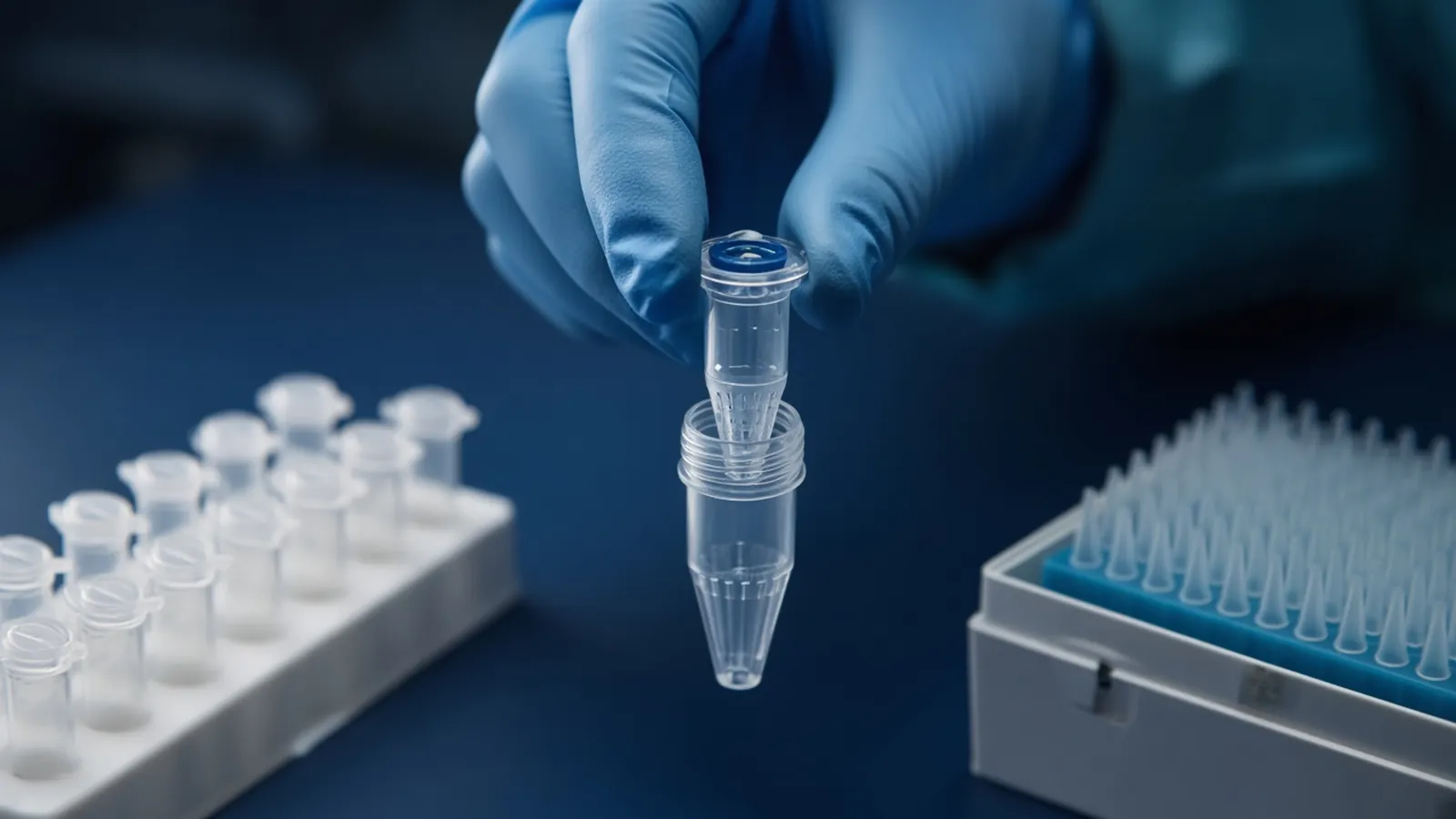
Labeling tubes so an extraction stays traceable is the step that makes every later number usable. Identity, date, method, elution buffer, operator, and a sample sheet are the minimum. A perfect A260/A280 on an unlabeled tube cannot be used, because you no longer know which specimen, which lysis, or which molecule produced it. This is a research habit for purification benches. It does not replace your institutional record system, and it does not make a prep clinically valid.
The chemistry those labels must point at is compared in how DNA extraction methods differ. Where the tube goes after elution, including frost and thaw, is in storing biological samples from fridge to freezer.
When the label is part of the method
Choose a full label when the eluate will be used by someone else, stored, or compared with another prep. Choose it also when more than one sample is open on the rack. Stop and relabel, or quarantine, when you notice a clash before the downstream assay. Running a PCR to "see which tube it was" spends the sample to answer a question the pen should have answered.
A label is doing traceability work, not decoration. The person who quantifies the tube next week, and the person who reviews the notebook in a year, both have to recover the same story without asking you.
What to write, and where
Write on the tube wall, not only on the cap. Caps are swapped when two tubes are open and the lids are placed back by position rather than by reading. A swapped cap carries a droplet of the other sample and a false name. If you mark the cap for convenience, the wall still needs the identity.
Six items close the record.
Identity is the specimen name or code that matches the sheet and the original container. A date without a code is a day, not a sample. If you process two aliquots of one specimen, add a suffix the sheet explains.
Date is the day of elution. Add a time when more than one batch of the same specimen happens that day. A lysis started yesterday and eluted today should say which event the date refers to. Pick elution, and note the lysis time on the sheet if the delay matters for RNA.
Method is the protocol or column class and the version or insert you actually followed. "Kit" is not a method. Two silica kits on one bench are two methods. Sample lysis that included an extra proteinase step belongs in this line or on the sheet, because the yield will be blamed on the wrong variable later.
Elution buffer is water, Tris-EDTA, or the named kit buffer, plus the volume you added. The next enzyme cares. A tube marked only "DNA" can be full of EDTA that will chelate magnesium, or full of water that will not buffer the pH. The buffer is part of the identity of the liquid.
Operator is the person who eluted, by initials the group can still resolve. A shared login or a bench nickname that three people use is not an operator.
The sample sheet is the row that holds what will not fit on the plastic: input mass or cell count, specimen type, any deviation, the freezer box and position, and where the quantification and the gel were filed. The tube and the sheet must point at each other. A sheet without tube positions, and a tube without a code on the sheet, are two half records.
| On the tube wall | On the sample sheet | Why it cannot live in memory |
|---|---|---|
| Identity code | Specimen description and source container | Nicknames collide |
| Elution date | Lysis time if it differed | Delay matters for RNA |
| Method short name | Insert or protocol version, and lysis notes | Two kits share a family name |
| Buffer and volume | Enzyme limits you already know | EDTA and water are different liquids |
| Operator initials | Who checks the sheet | The eluter may leave the group |
A workflow that survives the rack
Label the tubes before lysis, when your hands are dry and the samples are still in their source containers. Pre-label a blank tube the same way, with BLANK in the identity field, so an empty-looking tube is not mistaken for a spare. As you transfer, match code to code. Do not rely on rack position once people reach across the centrifuge.
At elution, confirm the wall label is still readable and add buffer and volume if they were not known earlier. Enter the row on the sheet before you leave the bench. A tube in a box without a row is already drifting.
If a label smears because wash buffer splashed it, replace the mark before the ethanol dries the ink into a blur. Alcohol-soluble marker ink is a known failure on this bench. Use a pen or a printed label the group has already seen survive ethanol and a freezer. Test one label on a spare tube if you are unsure. Do not discover the failure on the only clinical-looking research specimen you have. This article still does not make that specimen a diagnostic sample.
Swapped caps and faded ink
The ordinary disasters are mechanical. Two caps rest on the bench and return to the wrong tubes. From then on, every careful ratio belongs to the wrong identity. The sheet cannot detect the swap if you only labelled caps. Wall labels make the swap visible: the cap and the wall disagree, and you stop.
The slower disaster is a frost-lined freezer. Moisture cycles across the tube, ink that was dark in a warm room fades or flakes, and a box that was organised becomes a set of anonymous plastics. Position still helps if the sheet recorded box, rack, and slot, and if nobody resorted the box without updating the sheet. Position does not help if the box was tipped. Cold storage practice, including what a warm excursion means, is the companion problem in the storage article linked above.
RNA integrity added months later depends on this. A faded tube that might be either the RNA prep or the DNA prep from the same tissue cannot be given an integrity score that means anything. Store the molecule you named, in the buffer you named.
When to stop
Stop using the tube when identity is a guess. That includes a label you can almost read, a cap that might have been swapped, and a sheet row that matches two tubes. Quarantine the tube. Repeat the extraction from a retained specimen whose container is still readable, or from a source vessel that never entered the confused rack. Do not pipette a precious downstream assay on the better-looking guess.
Stop a batch, not just one tube, when several labels smeared in the same wash and you cannot reconstruct the order from wall marks. One heroic reconstruction is how misidentified results enter a paper.
Safety and records
Labels do not inactivate a specimen. A well-marked tube of infectious material is still infectious, and an unmarked one is infectious and anonymous. Follow institutional biosafety rules for what may be stored in which freezer. The WHO laboratory biosafety manual is background for that decision, not a label design.
Keep the sheet where the group’s record rules say it lives. A photograph of a rack is a backup for positions. It is not a substitute for codes written before the frost arrives.
Freezers, humidity, and ink
In a humid building, tubes taken from a freezer sweat immediately. Water beads on the wall and crawls under a loosely stuck label. Write or print labels that tolerate moisture, and let a freshly labelled cold tube be read before you put it back. Power cuts that thaw a box and refreeze it also thaw the adhesive. After an excursion, check that labels still match the sheet before you trust the box. The storage article treats the temperature side of that event. The label side is whether you can still prove which tube thawed.
What to ask for
If you are sourcing columns, tubes, or labels for this work, state that marks must survive ethanol wash and freezer storage, and that caps are not the only writing surface. Name DNA versus RNA and the elution buffer so the plastics match the chemistry. Use the sample preparation catalogue and the sample preparation pathway, and send the requirement with the quote request. The nucleic acid isolation enquiry reference is an enquiry reference when the question is the prep itself. Ask whether a quotation is possible.
Questions from the bench
Is a cap label enough if the sample sheet has the details?
No. Caps come off and go back onto the wrong tubes, and the sheet cannot tell you which cap moved. Write identity on the tube wall, and keep the sheet as the place for method, elution buffer, operator, and input. A cap colour can help you spot a set. It is not an identity.
What if two tubes share a short name?
Short names collide as soon as a second person uses the same nickname. Use the identifier that already exists on the specimen record, plus the date, and put the nickname only as a note on the sheet. If two tubes can be read as the same sample, neither result is traceable.
Can I still use a tube whose writing faded in the freezer?
Only if a second durable mark, or a position recorded on the sheet, still identifies it without guesswork. Frost and moisture lift ordinary ink. If you are choosing between two faded tubes, stop and repeat from a specimen that is still identified. A remembered identity is not a label.
Does a good A260/A280 rescue a missing label?
A ratio describes a liquid. It does not name the specimen, the lysis, or whether the tube is DNA or RNA. RNA integrity checked later is meaningless if the tube might be the DNA prep from the same tissue. File the ratio only against a label and a sheet row that agree.
References
Manufacturer names identify published method classes. Trademarks remain with their owners. Catalogue records on this site are independent references for enquiry. They are not a statement of inventory, distribution rights or a supply commitment. This page is educational. It is not medical advice, a diagnostic protocol or a biosafety approval.
Catalogue
Related products and categories
These links follow the subject of the article into published manufacturer references. A listing is a reference for an enquiry, not a statement of stock or distribution rights.
Continue in this cluster
Related reading
How DNA extraction methods differHow silica columns, beads, precipitation and organic extraction change DNA yield, length and inhibitors, and which class fits the assay you actually plan toA glossary of purification termsDefine chaotrope, bind-wash-elute, yield, purity ratios and RIN, then walk a purification so those words describe one real workflow.Blood saliva and tissue as starting materialExplain how EDTA blood, heparin blood, saliva and solid tissue behave as extraction inputs, and why a serum tube is not whole blood.