
selection guide
Lot changes and why a control sample matters
How a frozen control sample shows that an antibody or kit lot has shifted, and what to ask when you bridge an old lot to a new one.
- Author
- EVRINTH Editorial Team
- Published
- 8 October 2026
- Updated
- 8 October 2026
- Reading time
- 9 min
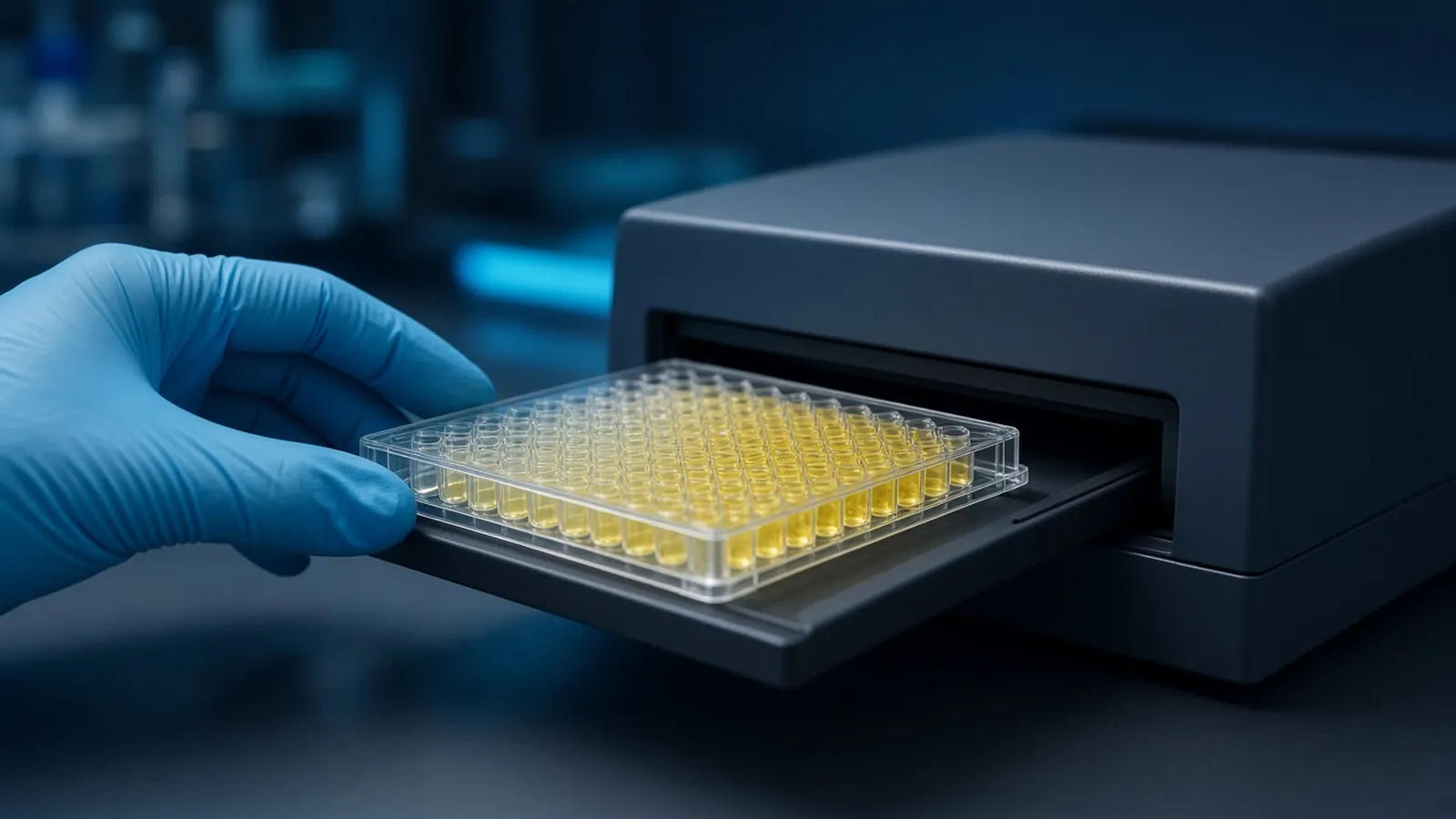
Antibodies and ELISA kits are biological reagents. A new lot can shift titre, background or the position of the curve even when the name on the box is unchanged. A standard curve on the new lot will often look fine, because the calibrator shifted with the antibodies. The well that tells you the plate moved is a control sample you aliquoted yourself, from a material the kit vendor does not get to redefine, and that you run every time. Formats and curves are introduced in ELISA formats, controls and readout. This page is how to select that control and how to bridge a lot. It is a research practice, not a claim that any particular product arrives with a certificate you have not read.
What you are deciding when the lot number changes
You are deciding whether results from the new lot may sit in the same table as results from the old one. If the control sample lands where it landed before, within a spread you wrote down in advance, you have a reason to continue. If it moves, you either apply a bridge factor you can defend from the paired plate, or you stop and treat the new lot as a new assay. Quietly appending the new numbers to the old spreadsheet is how a reagent change becomes a biological story.
This decision sits with the person who will sign the figure. A purchasing note that a replacement lot was obtained is not that decision.
What actually drifts
Polyclonal antibodies change when a new animal, or a new pool of animals, is bled. Monoclonal and recombinant reagents change less at the binding-site sequence and can still change in concentration, aggregation, conjugation ratio and residual host protein. A conjugated enzyme lot can lose activity. A kit calibrator can be reassigned. Blocking protein sold as the same grade can carry a different trace of immunoglobulin. Any of those moves the signal from a real sample without an obvious tear in the curve's shape.
Background can rise while the top of the curve stays put, which compresses the window and makes low samples look higher after a blank subtraction that is no longer honest. Titre can fall, so the whole curve stretches and a mid sample reads lower. A specificity change is the least visible from a single control: the control may be the target, and a new cross-reaction appears only in samples that contain the relative. One control concentration cannot see that. It can see the common shifts. Pair it, when a lot changes, with one sample you know is negative.
The analyte name should still be checked against a stable accession on UniProt so a lot bridge is not comparing two different proteins that shared a colloquial name. How other groups record reagent identity shows up in public protocols on protocols.io. A metrology laboratory such as NIST is a reference for the idea that a measurement procedure must state its materials. It does not assign a value to your frozen aliquot.
What makes a control sample worth its well
Select it before the study, not from the first surprising plate.
The matrix should be the matrix of the samples. A buffer spike of pure calibrator is a useful extra well, and it is a poor control, because it misses the matrix effects a new blocker or a new antibody will express only in serum, lysate or medium. If the real matrix is scarce, a pool of leftover research samples of that matrix, screened once so you know it contains the analyte, is the usual class of solution.
The concentration should sit on the steep part of the curve, in the same region as the samples you care about. If the study spans high and low samples, two controls beat one. A single control at the plateau will reassure you while the assay moves.
Stability has to match the storage you actually have. Aliquot so that each plate thaws a volume it will finish. Repeated freeze-thaw of one tube is a second experiment. Do not invent a shelf life in months. Watch the control on the old lot for several plates and see whether it is already drifting in your freezer, your frost cycle and your thaw habit. If it drifts before any lot change, it cannot witness a lot change. The physical side of that storage is discussed in storing biological samples from fridge to freezer.
Volume has to cover the study plus the bridge. When the control runs out, the new pool is a new material and needs its own overlap against the old pool, on one plate, or the thread breaks.
Write the acceptance spread before you look at the new lot. A verbal "it looks similar" is how slow drift passes. The spread can be a percentage of the mean or a range in concentration units. Pick it from the historical plates of the same control, not from a wish.
Bridging on one plate
Thaw one aliquot of the control. Run the old lot and the new lot side by side if you still have the old lot. Same dilutions of the same samples, same buffer batch where you can, same reader, same development logic. Read the control on both halves.
If the control agrees and a small panel of real samples agrees, you may proceed, and you keep running the control so the new lot does not walk away later. If the control shifts by more than the spread, do not "correct" it with a single heroic factor unless the shift is proportional across the curve. Check at least a high and a low sample. A lot change that rotates the curve needs a new validation, not a multiplier. If the old lot is already finished, you cannot bridge. You can only mark a break in the series and start the control's history again. Say that in the figure legend rather than smoothing it.
| Question | What the standard curve detects | What a stored control sample detects |
|---|---|---|
| Did the calibrator and the antibody of this lot produce a shape? | Yes. That is what the curve is for | Only indirectly, if the control misses the shape |
| Did today's plate develop at all? | Yes, if the top standard climbed | Yes, if the control missed its usual signal |
| Did sample-like matrix move relative to last month? | No. The calibrator may have moved too | Yes, because the aliquot is the same material |
| Did background in the real matrix rise? | Only if the zero standard is the real matrix | Yes, when a low control or a negative aliquot climbs |
| Did a new cross-reaction appear against a protein the control lacks? | No | No. You need a sample that contains the relative |
When the curve looks perfect and the samples have moved
Believe the paired samples. A beautiful logistic on the new calibrator means the new reagents bind the new calibrator. Your control is the question that matters for the study. If samples that were mid-curve on the old lot pile up at the top on the new lot, the titre or the development has changed. Dilute and re-read before you describe a biological increase.
A second failure is a control that was chosen once from a pool and then "topped up" with a later experiment's leftovers. That is a new control wearing an old name. Keep the tube identity in the plate map.
A third failure is using the kit's own high control as the only witness. It catches a dead enzyme. It does not catch a reassigned calibrator, because the vendor may have adjusted that control to match. Your aliquot, prepared outside the kit, is the independent material.
Do not set the acceptance spread after you have seen the new lot fail it. Widening the gate to let a bridge pass is a different study, and it should be labelled as a break in comparability.
Human-origin controls and the freezer
A control made from human or animal material is still that material after it is aliquoted. The biosafety level is an institutional assignment. Freezer storage does not reclassify it. Azide in the assay reagents must not be assumed to have sterilised the control. Read the WHO Laboratory Biosafety Manual as a public framework your safety officer may already use, and follow the local rule. A stable control sample is not a diagnostic calibrator, and agreement across lots is not a clinical validation.
Receiving docks, power cuts and the aliquot you actually have
In a hot season the vulnerable moment is the handoff. A parcel sits on a dock, a cold pack finishes melting, and the new lot is already different from the lot that was packed. Note the condition on arrival before you mix the vial into the study. If you still hold the previous lot, the bridge plate will show whether the journey mattered.
Power cuts thaw freezers in a pattern that is rarely uniform. A control box in the door is not the control box in the body of the cabinet. After an outage, do not assume every aliquot survived because one tube still felt cold. Run the control on the old reagents if you still have them, and treat a shift as a storage event rather than as a discovery. Label aliquots with the date they were frozen and the lot of assay they were first measured on. Future you will not remember which tube was the witness.
What to ask in an enquiry about lot changes
Ask how a lot change is documented: what is compared, whether a previous lot is retained for overlap, and which fields identify the antibody and the calibrator. Ask that as a question. Do not state that a certificate is already in hand, and do not invent one. Name the matrix of your control sample, the concentration region you need, and the instrument readout. The reagents and chemicals catalogue is a place to look at reagent classes. The molecular biology pathway is the methods context. A lot-bridging approach can be discussed through the quote request. The reply should say what is held constant when a lot number changes. Your control sample is still the well that proves the constant held.
Questions from the bench
Why is a standard curve not enough to catch a lot change?
The curve is built from calibrator supplied with, or assigned to, that lot. A new lot can bring a new calibrator and a new antibody, and the curve can look perfectly shaped while every research sample has shifted relative to last month. A control sample that is not part of the kit is what sits outside that closed loop.
Where on the curve should the control sample sit?
On the steep middle, where a small change in assay behaviour moves the signal enough to notice. A control parked on the flat top reads the same absorbance across a wide concentration range, so a real shift hides. A control near the blank is mostly noise. Pick a material whose concentration lands in the limb you use for real samples.
How should an old lot and a new lot be compared?
On one plate, in the same run, with the same control sample and the same dilutions. Plate-to-plate comparison across a week mixes the lot change with ordinary drift. If both lots will not fit on one plate, a shared control still has to travel on every plate of the bridge.
Does a quiet control sample prove the new lot is specific?
No. It proves the assay has not moved, within your limits, on that material. A new lot can keep the control steady and still change cross-reactivity against a protein the control does not contain. Specificity is a separate experiment. The control is a drift detector.
References
Manufacturer names identify published method classes. Trademarks remain with their owners. Catalogue records on this site are independent references for enquiry. They are not a statement of inventory, distribution rights or a supply commitment. This page is educational. It is not medical advice, a diagnostic protocol or a biosafety approval.
Catalogue
Related products and categories
These links follow the subject of the article into published manufacturer references. A listing is a reference for an enquiry, not a statement of stock or distribution rights.
Continue in this cluster
Related reading
ELISA formats controls and readoutELISA formats, controls and readout: how direct, sandwich and competitive assays turn a binding event into a number that stays inside the curve. Storing biological samples from fridge to freezerFridge, minus-20, minus-80 and nitrogen storage slow different kinds of damage. A warm box is a quarantine decision, not a hope.Standard curves that bendWhy immunoassay standard curves are sigmoid, where the usable window sits, and what an early bend or a forced straight line does to a reported value.