
application
Low yield troubleshooting for DNA preps
A low spectrophotometer reading can mean incomplete lysis, overload, excess elution volume, leftover ethanol, nuclease or input that was never there.
- Author
- EVRINTH Editorial Team
- Published
- 8 October 2026
- Updated
- 8 October 2026
- Reading time
- 7 min
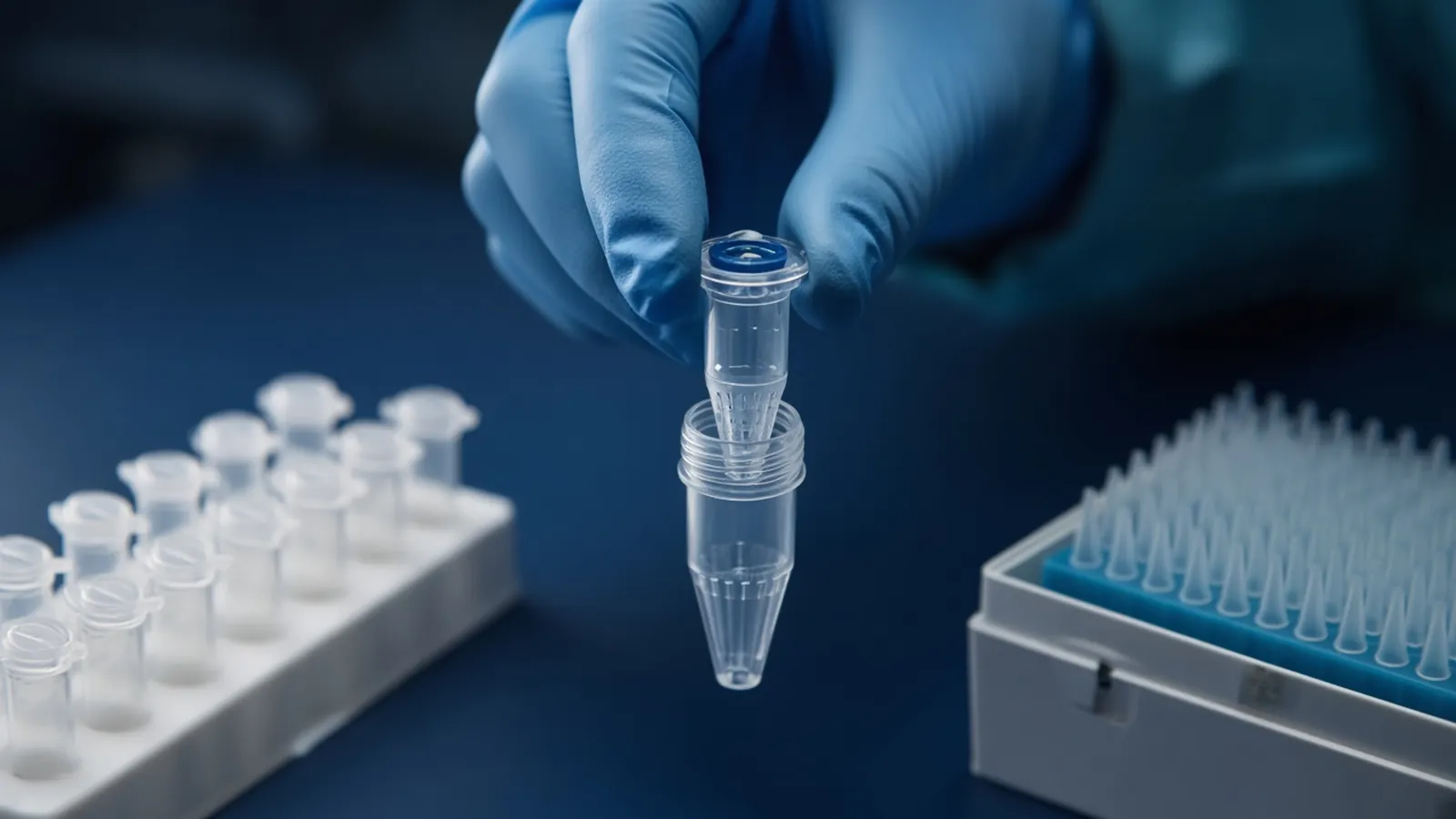
Low yield troubleshooting for DNA preps starts when someone says the nanodrop is low and reaches for another kit. The number is a symptom. The cause is one of a short list: the reading is not real, the input was never there, lysis did not finish, the column was overloaded, the DNA was eluted into too much volume, ethanol left from the wash is being confused with a loss, or nuclease destroyed the DNA after it was released. This application note is a decision path among those causes. It does not promise a yield for any specimen or any silica column.
The method classes you might be troubleshooting are in how DNA extraction methods differ.
Confirm the reading before you confirm a failure
A microvolume spectrophotometer can report a low concentration because the droplet missed the pedestal, the blank was dirtier than the sample, or the factor and the pathlength were not the pair you think. Reblank with the elution buffer. Confirm you are using the double-stranded factor, about 50 ng per microlitre per absorbance unit at a 1 cm path, only if the instrument has already scaled to that path. Read a second droplet. If the second reading is healthy, the prep was never low. If both are low, you have a real concentration to explain. You still need the elution volume before you call it a yield. Mass is concentration times volume. Input is what you put in. Yield is the comparison.
Input that was never there
A column cannot bind DNA that sample lysis was never given. An empty bacterial pellet, a swab that did not touch the culture, a tissue piece that is mostly connective matrix, or a tube mislabelled from an empty well all produce a faithful low number. Check the source container and the sheet before you change buffers. If the input was absent, stop. Repeating the extraction on nothing consumes a column and teaches nothing. Record the empty input and take a new specimen if the question still matters.
Incomplete lysis
If the input was real and the lysate still shows a chunk, a viscous clot, or a turbid mass that was not cleared, DNA is trapped in debris. It left in the pellet or never entered the silica. The next action is to finish lysis on a retained piece: the enzyme class the insert names for that wall or that tissue, the time and temperature that insert prints, and a homogenisation step if the matrix needs it. Do not invent units. Do not add a long heat the page does not contain. After a completed lysis, clear debris and then bind. A low reading from an unfinished lysate is not an elution problem.
Overload
High input, a slow column, dirty ratios, and a yield that is worse than a smaller sister load point at capacity. More lysate reduced recovery. The next action is to split the load across columns of that same class, each inside the window the insert states for that class. Do not borrow a capacity number from a different product. Nucleic acid that already flowed through is not recovered by eluting harder. A fresh split is the recovery path.
Elution into too much volume
The DNA may be present and simply dilute. A protocol eluted in a large volume because a previous user wanted a deep tube, and the concentration fell below the number the assay sheet expected. Calculate the mass. If the mass meets the assay and the concentration does not, the next prep should use the smaller elution volume the insert allows, or you should concentrate by a method you already trust. Do not bake the tube on a heat block you have not validated and call evaporation a protocol. A second elution that you pooled with the first can cause this on purpose. Stop pooling if concentration is what you need.
Ethanol left behind
Leftover wash alcohol causes two different complaints that people both call low yield. If the membrane was still flooded, elution buffer may not have wet it and the DNA stayed behind. That is a real recovery failure. The next action is the dry spin the insert names, then elution as that page describes. If the concentration is actually fine and the downstream enzyme is what failed, you do not have a low yield. You have inhibition. Dilute or clean the eluate. A longer invented dry can tip a wet membrane into an overdried one and create a genuine low yield on the following prep. Follow the insert both ways.
Nuclease loss
DNA that was released and then cut can fail to bind, or it can bind as short pieces you did not mean to measure as a genome. The pattern is a delay before chaotrope or heat, a warm specimen, or a DNase introduced on a shared tip. A gel shows a smear of small fragments or an empty lane where a high band should be. The next action is preservation and timing on a new specimen: get the sample into inactivating conditions promptly, and keep later tubes off the dirty rack. A column rerun of the already-cut eluate does not restore length. RNA integrity on a sister tube, if you happen to have it, is only a hint that the handling was rough. It is not the DNA result.
| What you see | Likely branch | Next action |
|---|---|---|
| Reading changes when you reblank | Measurement | Repeat the droplet before changing the prep |
| Source tube was empty | Input never there | Stop and resample |
| Chunks or a clot remain | Incomplete lysis | Finish the lysis the insert names |
| High input, slow flow, half-load wins | Overload | Split across that column class |
| Mass is fine, concentration is not | Excess elution volume | Smaller elution the insert allows |
| Enzyme dead, concentration fine | Ethanol inhibition | Dry spin as written, or clean |
| Smear of short DNA on a gel | Nuclease | New specimen, faster inactivation |
When to stop
Stop when a second, correctly blanked measurement still shows too little mass for the assay and no retained specimen can be lysed differently. Say that in the notebook. Do not dilute a low sample and hope the assay invents template. Do not report an expected yield you did not measure. If one change is still available, make that one change: finish lysis, split the load, or elute in less volume. Judge the new tube on its own mass. Success is a measured improvement, not a guarantee written in advance.
Safety
Low-yield lysates are still chaotrope and specimen. Do not dry down hazardous waste to "see" a pellet. Follow the safety data and institutional biosafety rules. The WHO laboratory biosafety manual is background, not a troubleshooting permission. A research yield is not a clinical quantitation.
A specimen that sat warm
In a hot room, a cell pellet or a tissue piece waiting for lysis is already in the nuclease branch. The low yield is decided before the column. Get the specimen into the inactivating condition the method names, or onto ice for the short hold that method allows. A power cut that warms a stored pellet belongs in the same note. Extracting it without recording the warm interval makes the next low number look like a bad column.
What to send if the class is wrong
If troubleshooting says the column class cannot take your input, or the lysis class does not open your matrix, ask for a different class rather than a promise of more DNA. Name the specimen, the input, the elution volume, and the assay. Use the sample preparation catalogue and the sample preparation pathway, and send the pattern you saw with the quote request. The nucleic acid isolation enquiry reference is an enquiry reference. Ask whether a quotation is possible.
Questions from the bench
Is a low nanodrop number always a low yield?
People say the nanodrop is low when a microvolume spectrophotometer shows a small number. Check the blank, the pathlength, and the factor before you call that a yield. A wrong factor or a bubble can fake the symptom. Yield also needs an input and an elution volume. A low concentration in a large volume can be an acceptable mass.
Which cause should I test first?
Confirm the reading, then ask whether the input was ever in the tube. After that, look at lysis if the lysate still has chunks, at overload if input was high and flow was slow, and at elution volume if the mass might simply be dilute. Change one thing on the next prep. Do not apply every fix at once and then guess which one worked.
Will repeating the kit guarantee a better yield?
No. This page does not promise a yield. A repeat helps only when you change the cause you identified, such as finishing lysis or splitting an overloaded load. Repeating an empty swab through the same column will be empty again. If no specimen remains, the troubleshooting path ends in a record, not in a number.
Does RNA integrity belong in a DNA yield investigation?
Only as a warning that the specimen was handled in a way that also lets nucleases work. A DNA yield problem is about DNA mass. An RNA integrity score does not measure that mass. If the same harsh delay could have allowed DNase to act, look at the DNA on a gel. Do not substitute an RNA score for the DNA decision.
References
Manufacturer names identify published method classes. Trademarks remain with their owners. Catalogue records on this site are independent references for enquiry. They are not a statement of inventory, distribution rights or a supply commitment. This page is educational. It is not medical advice, a diagnostic protocol or a biosafety approval.
Catalogue
Related products and categories
These links follow the subject of the article into published manufacturer references. A listing is a reference for an enquiry, not a statement of stock or distribution rights.
Continue in this cluster
Related reading
How DNA extraction methods differHow silica columns, beads, precipitation and organic extraction change DNA yield, length and inhibitors, and which class fits the assay you actually plan toA glossary of purification termsDefine chaotrope, bind-wash-elute, yield, purity ratios and RIN, then walk a purification so those words describe one real workflow.Blood saliva and tissue as starting materialExplain how EDTA blood, heparin blood, saliva and solid tissue behave as extraction inputs, and why a serum tube is not whole blood.