
selection guide
Questions for a nucleic acid prep enquiry
Ask sample type, DNA or RNA, the downstream method, inhibitor risk, throughput and documentation before you send a nucleic acid prep enquiry.
- Author
- EVRINTH Editorial Team
- Published
- 8 October 2026
- Updated
- 8 October 2026
- Reading time
- 7 min
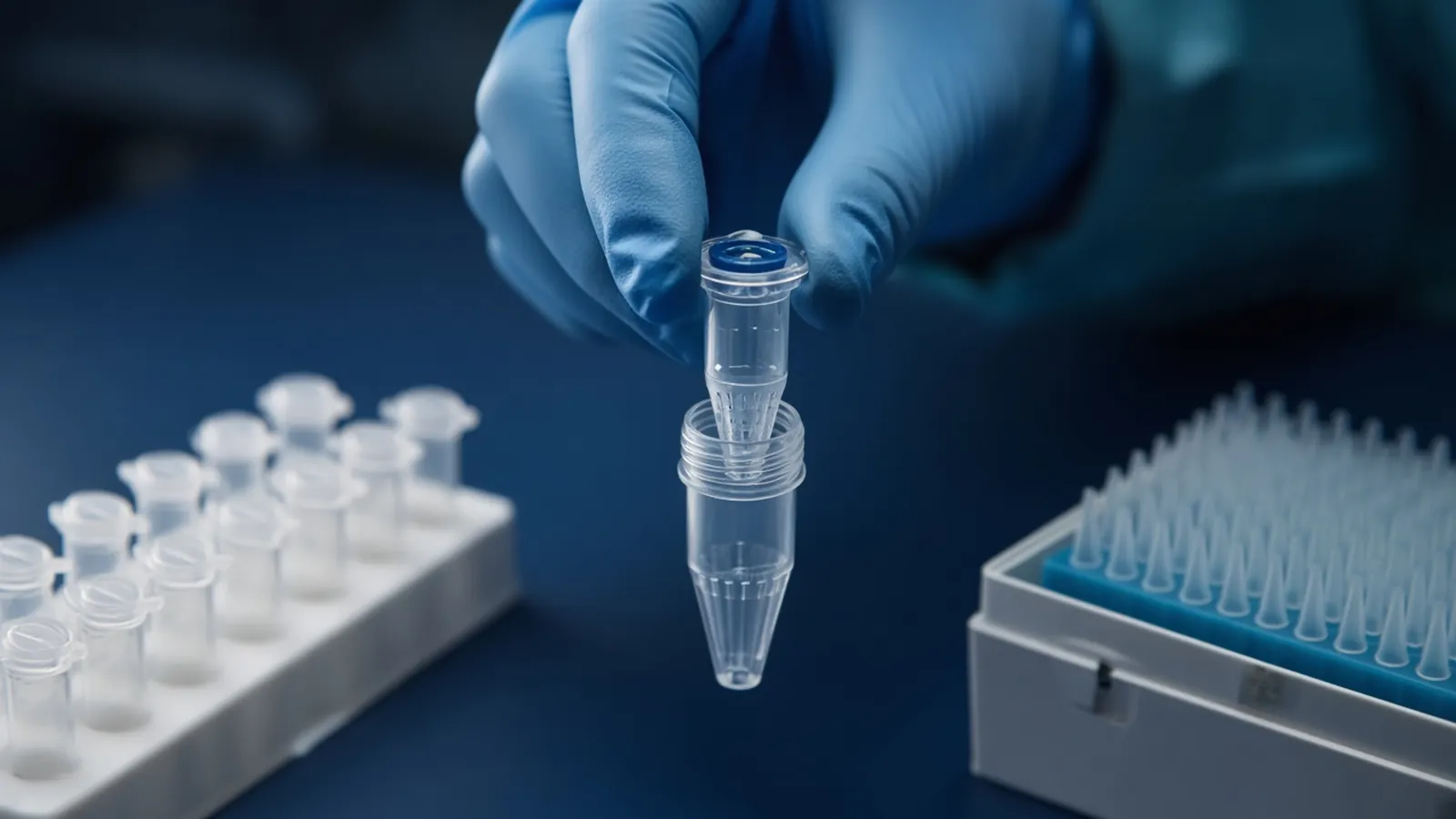
Questions for a nucleic acid prep enquiry are the difference between a reply you can use and a catalogue page that might be the wrong class. Ask the sample type, whether you need DNA, RNA, or both, the downstream method, the inhibitor risk, the throughput, whether you need a column or a bead, and what documentation must come back with the materials. This selection guide is for research sourcing. It does not list a commercial offer, and it does not say that a preparation service is running.
How to shape any laboratory enquiry, including acceptance checks, is in how to write a laboratory sourcing enquiry. Which extraction class those answers point toward is in how DNA extraction methods differ.
Sample type
Name the specimen in the words the lysis will care about. Cultured mammalian cells, whole blood, a gram-scale tissue, a plant leaf, a bacterial pellet, a plasmid culture, a formalin-fixed piece, and an environmental swab do not open the same way. Sample lysis is the first place an under-specified enquiry fails. Add the input you actually have: cell number, volume, or mass, and how many such samples. A method that fits ten milligrams can be the wrong class at one gram.
Say what the specimen is not, when that avoids a mismatch. A plasmid prep is not a genomic prep. A cell-free DNA question is not a whole-blood genomic question. If the matrix is infectious or otherwise regulated, say that a biosafety decision already exists at your institution, without asking the enquiry to make one.
DNA, RNA, or both
State the molecule. DNA and RNA share some silica habits and diverge at lysis, at the washes, and at storage. "Nucleic acid" in an enquiry is incomplete unless the assay truly accepts either. If you need both from one specimen, say co-purification and say which molecule is allowed to be the compromise. RNA integrity requirements do not belong in a DNA-only note, and a DNA ratio target does not describe an RNA prep.
If the downstream step is reverse transcription, write RNA. If it is a restriction digest or a plasmid clone, write DNA. If you are unsure, write the assay and let the molecule follow from that, rather than guessing a kit family.
Downstream method
The assay chooses yield, length, and inhibitor tolerance. Endpoint PCR can accept sheared DNA and still fail on ethanol. A long-read library can accept a lower mass and still fail if fragments were broken. A ligation cares about double-stranded mass and about leftovers that quiet the enzyme. A Sanger reaction cares about a clean template in a stated range. Put the assay in the first lines of the enquiry so nobody optimises for a concentration you will never use.
Add the minimum mass or the volume you must deliver, if you know it from the assay note. Add the elution buffer the assay accepts. Tris-EDTA and water are a common fork. Leave that fork unnamed and the reply may assume the wrong one.
Inhibitor risk
Name the inhibitor you already know. Heme from blood, polyphenols and polysaccharides from plants, humic material from soil, formalin crosslinks, and ethanol or chaotrope from an earlier attempt are different problems. "The sample is dirty" does not tell a method class what to remove. If a previous eluate showed a low A260/A230 or killed a spiked PCR, include that observation as a fact. Do not convert it into a demand for a magical purity number.
If you have not seen inhibition yet, say the matrix and stop. Inventing a contaminant list does not make the enquiry more precise.
Throughput, and column versus bead
Throughput is how many preps, how often, and whether they arrive as a batch. One tube today is a spin column. A plate every week may be a bead method because a magnet and a multichannel pipette scale differently from a rack of columns. Say the number. Say who will do the handling. Automation is a separate claim. Do not write automated unless you have an instrument and a plastic format in mind.
Column versus bead is a chemistry-and-format choice, not a brand choice. Ask for a silica column when you want a short manual prep and a small elution. Ask for beads when you want the same bind-wash-elute idea with a magnet, or a size-selective bead chemistry you can describe. If you do not yet know, state the throughput and the fragment-length need and ask which class fits. Do not paste a catalogue code from another supplier in place of that sentence.
| Question | A useful answer | Too thin to send |
|---|---|---|
| Sample type | Blood, 200 microlitres, 24 per week | Biological sample |
| Molecule | DNA for a restriction digest | Nucleic acid |
| Downstream | Ligation, water elution, stated mass | Downstream analysis |
| Inhibitor | Plant polyphenols suspected | Dirty |
| Throughput | Eight columns, manual | High throughput |
| Format | Spin column, not a plate | Standard kit |
| Documents | Insert, lot on delivery, ratios as local hints | Good quality |
Documentation you will actually file
Ask for the documents your notebook needs: the protocol insert, the input window, hazard information, and lot identity when a shipment arrives. If your group records A260/A280 and A260/A230, say those are measurements you will make as cleanliness hints, not acceptance certificates the material can carry in advance. A blank extraction is your control, not a number a catalogue owes you.
Say how the eluate must be labelled if someone else will finish the work: identity, date, method, buffer, operator. An enquiry that forgets documentation often receives a bottle with no insert in the local language of the bench, meaning the PDF nobody filed.
The general shape of performance, documents, and an acceptance check is the sourcing article linked above. Use it so this prep enquiry matches the way your group already writes other requests.
Thin enquiries and what they cost you
A message that says only "DNA kit for lab" will be answered with a question, or with a class that fits a common case and not yours. The delay is the missing specimen and the missing assay. Sending a photograph of a box is not a specification. A note that asks for materials without naming the molecule, the input, and the assay is not a scientific requirement, and this page will not coach that kind of message. If RNA will be shipped onward, add the cold-chain handoff you already know you need so the reply does not assume the elution ends on the bench where it was made.
If the work might later be cited, write the enquiry so the method class can be named in the methods section: matrix, molecule, and elution buffer. You can still change your mind after the reply. You cannot reconstruct an unstated inhibitor from a packing list.
Safety stays at your institution
An enquiry can mention that the specimen is covered by an existing biosafety decision. It should not ask a supplier to assign a containment level or to approve clinical use. The WHO laboratory biosafety manual is background for the institutional conversation. Research extraction materials remain research materials.
Heat, handoff, and the written need
If eluates or specimens will move across a warm city, say so. A specification that ignores a cold-chain handoff for RNA will read as if a room-temperature column were the whole story. Humidity does not change the questions above. It does change storage and dry-spin habits after the materials arrive, which belong in your local method, not as a slogan in the enquiry. Write the elution buffer and the documentation you need. Those two lines travel better than a request for something described only as pure.
Where to send the questions
Use the nucleic acid isolation enquiry reference as the place those questions can be framed. It is an enquiry reference. It is not a statement that EVRINTH runs the assay, holds a particular material, or stands in any distribution relationship. The sample preparation catalogue and the sample preparation pathway show the surrounding classes. Send the seven answers with the quote request, and ask whether a quotation is possible.
Questions from the bench
Is the specimen name enough to start an enquiry?
A name such as blood or leaf is the start, not the specification. Add whether you need DNA, RNA, or both, what assay will consume the eluate, and which inhibitor you already know is in that matrix. Two blood tubes with different downstream methods are different requests.
Should I name a catalogue number I saw elsewhere?
Only if you are asking whether an equivalent class exists, and you say so. A part code from another catalogue is not a complete scientific need, and it may describe a column sized for a different input. Prefer the specimen, the throughput, and the performance you will check. Do not send a code as a substitute for sample lysis and the assay.
What documentation should I ask to receive?
Ask for the insert or specification that names input window, elution buffer, and any safety notes you must file. Ask to record lot identity when materials arrive. A260/A280 targets, if you mention them, are cleanliness hints you will measure, not a certificate the supplier can promise for your specimen.
Can this enquiry authorise a diagnostic test?
No. A sourcing enquiry for research extraction does not validate a clinical or forensic assay and does not set a biosafety level. Say if the work is research so the reply stays in that frame. Institutional approvals stay at your institution.
References
Manufacturer names identify published method classes. Trademarks remain with their owners. Catalogue records on this site are independent references for enquiry. They are not a statement of inventory, distribution rights or a supply commitment. This page is educational. It is not medical advice, a diagnostic protocol or a biosafety approval.
Catalogue
Related products and categories
These links follow the subject of the article into published manufacturer references. A listing is a reference for an enquiry, not a statement of stock or distribution rights.
Continue in this cluster
Related reading
How DNA extraction methods differHow silica columns, beads, precipitation and organic extraction change DNA yield, length and inhibitors, and which class fits the assay you actually plan toA glossary of purification termsDefine chaotrope, bind-wash-elute, yield, purity ratios and RIN, then walk a purification so those words describe one real workflow.Blood saliva and tissue as starting materialExplain how EDTA blood, heparin blood, saliva and solid tissue behave as extraction inputs, and why a serum tube is not whole blood.