
comparison
Recombinant versus polyclonal reagents
Polyclonal, hybridoma monoclonal and recombinant antibodies differ in epitope count and lot definition. Choose the class in the specification, not by slogan.
- Author
- EVRINTH Editorial Team
- Published
- 8 October 2026
- Updated
- 8 October 2026
- Reading time
- 9 min
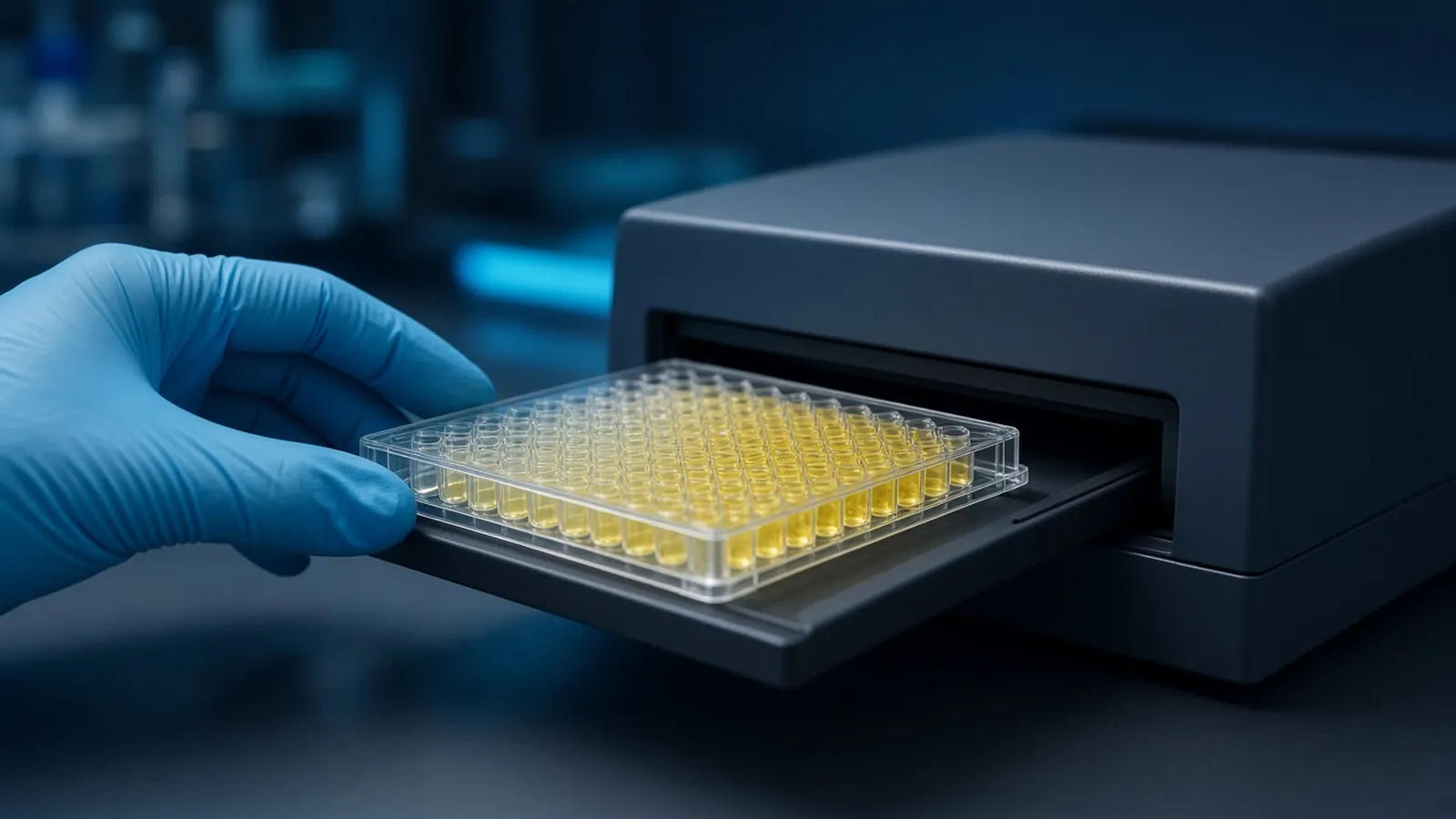
Recombinant versus polyclonal reagents is a comparison of three classes, not a ranking with a winner. Polyclonal serum recognises several epitopes on the immunogen. A monoclonal antibody from a hybridoma recognises one epitope and can drift if the clone is unstable. A recombinant antibody is a monoclonal whose binding sequence is defined and, when the supplier actually maintains that sequence, is easier to compare across lots. The purchasing decision is which of those properties your experiment uses. ELISA format, blocking and the standard curve that will reveal a bad lot are in ELISA formats, controls and readout. Local checks after the vial arrives are in choosing and checking a primary antibody. This is not a price comparison. A higher epitope count is not a higher quality score.
Who is writing the specification
If you are setting up a sandwich that must last for a project, you care about a pair of reagents that bind at once and about a lot definition you can write down. If you are doing a first blot on a poorly characterised protein, a polyclonal that sees several surfaces can give you a band while a single unlucky epitope sees nothing. If you are comparing sites or building an assay that must not change when a rabbit is no longer immunised, a recombinant clone is a way to name the reagent without naming an animal. Write that purpose in the first paragraph of the enquiry. A method can be discussed against it. A slogan on a page cannot choose for you.
What a polyclonal preparation actually contains
A polyclonal reagent is the antibody fraction, or sometimes the whole serum, from an animal immunised with the antigen. Many B-cell clones responded. The vial therefore contains a mixture of binding sites, plus whatever else the purification did not remove. Several epitopes give a practical robustness: if one surface is masked by a binding partner or a modification, another antibody in the mix may still hold. On a blot, that mixture can light more than one band. On an ELISA, it can raise the chance that capture and detection still find the analyte when a single clone would miss it. The cost is specificity work. Irrelevant antibodies contribute to nonspecific binding. Blocking, dilution and a real negative sample have to earn the quiet blank.
Lots are biological. A new animal, or a later bleed of the same animal, is a new mixture. Bridging with a control sample on the same plate is part of using polyclonals, not an optional audit. If your specification says polyclonal, also say that you require a lot number and that you will bridge lots. Do not write polyclonal when you mean any antibody. The word is the mixture.
The immunogen still decides the mixture. A peptide conjugate raises antibodies against that peptide and against the carrier. Carrier reactivity is a classic surprise. Ask what the immunogen was, and look up the residue range on UniProt or NCBI Protein so you know whether your isoform contains it.
Hybridoma monoclonals and drift
A hybridoma monoclonal is one binding site, produced by a fused cell line. One epitope is a sharp tool. It is also a single point of failure. If that epitope is absent, denatured, or blocked by another protein, the signal goes away completely rather than weakening. For a sandwich you need a second clone that binds elsewhere. State non-overlapping epitopes in the specification. Two vials from the same clone cannot sandwich a monomeric target.
Drift is the lot problem. Hybridoma cultures can lose the locus, become overgrown by a non-producing population, or be replaced by a misidentified line. ICLAC documents how often cell lines are not what the label says. An antibody produced from a drifted or swapped line is not the reagent you validated. Ask how the producer banks and checks the clone. You still verify the lot on your assay, because a culture can change between their test and your plate.
Purification adds another layer. Ascites, culture supernatant and protein A fractions are different materials even from one clone. The specification should name the preparation class if it matters to your background. A supernatant dumped onto a plate at high volume carries medium proteins that a blocker must handle.
Recombinant reagents, when the sequence is real
Recombinant antibodies are produced from a defined nucleic acid sequence, typically in a cell system chosen for expression, and they are monoclonal in the sense that one binding site is encoded. The advantage for a specification is naming. You can ask for the clone identity, the isotype, the host framework and, where it is available, a sequence or a sequence accession. Lots can still differ in aggregation, concentration and glycosylation if the producing cell glycosylates. Sequence identity does not mean tube identity. A control sample still bridges lot A to lot B.
The advantage appears only if the supplier keeps the sequence and ties the vial to it. A recombinant label without a documented sequence is a production method, not a definition. Ask what document travels with the lot. If the answer is a photograph and no clone identity, you do not yet have the recombinant benefit. You have a monoclonal with a different manufacturing story.
Recombinant does not mean free of nonspecific binding. A sticky framework or a poor formulation will paint plastic. Blocking and the blank still decide. It does not mean the epitope survives your method. A sequence-defined antibody against a folded epitope still fails on a reduced blot. Application evidence remains mandatory. The class does not replace the check in the antibody article.
Sandwich pairs, host and the standard curve
A sandwich needs two binding events. With polyclonals, the mixture may supply both, sometimes in one serum used cleverly, more often as a capture fraction and a detection fraction. The blank has to prove that the mixture is not simply sticking to itself. With monoclonals, you select two clones and you test them as a pair, not as two independent blot stars. Recombinant clones make that pair easier to reorder later, which is the commercial point of the class for a long study: the reorder can name the same sequences. It still cannot skip a curve on the new lot.
Host species decides the secondary, if you use one. A recombinant antibody is often built on a human, mouse or rabbit framework. The framework is the host for detection purposes. Write it down. A polyclonal goat and a recombinant rabbit are not interchangeable in a protocol that says anti-goat.
The standard curve is how you notice that a new lot of any class has shifted. Keep the calibrator constant when you compare antibody lots, or you will confound a calibrator change with an antibody change. Precision across those bridging plates is the evidence that the class you chose can be lived with. A brochure does not contain your curve.
| Class | Epitopes | How a lot is defined | Where it fails | Pairing in a sandwich |
|---|---|---|---|---|
| Polyclonal serum or purified polyclonal | Several, from the immunised animal | Animal and bleed, not a single sequence | Cross-reactivity, carrier antibodies, bleed-to-bleed shift | Possible, with a heavier blank burden |
| Hybridoma monoclonal | One | Clone identity, if the line is stable | Epitope loss, hybridoma drift, misidentified line | Needs a second, non-overlapping clone |
| Recombinant antibody | One, sequence-defined when documents exist | Sequence or clone record plus production lot | Sticky frameworks, application mismatch, undocumented sequence | Easier to reorder as a named pair, still needs a pair test |
When robustness and definition pull apart
Choose the polyclonal mixture when you have evidence, or a clear reason to expect, that a single epitope will be hidden, and when you can tolerate the specificity work. Choose a hybridoma monoclonal when you already know the epitope is present in your method and you can secure the clone's identity. Choose a recombinant when you need that monoclonal property plus a sequence or clone record you can cite in a report and reorder against. If a study is halfway through on a polyclonal lot, do not switch class because a recombinant is fashionable. Bridge, or start a new baseline and say so.
Failure looks different. A polyclonal lot change often shifts background and the apparent level together. A monoclonal failure often looks like no signal, suddenly, because the one epitope is gone or the clone stopped producing. A recombinant lot with the correct sequence can still arrive aggregated and raise the blank. Your troubleshooting should follow the class. Do not apply a single dilution from the old serum to the new clone and call them the same primary.
protocols.io examples that name clone identifiers next to dilutions are the documentation standard to copy. A protocol that says the antibody, with no class and no lot, cannot be repeated by the next student.
Safety and research use
All three classes can contain preservatives, and all three are research reagents unless a specific diagnostic claim exists under the rules that apply to you. This comparison does not create that claim. Animals used to raise polyclonals are an ethical and institutional matter outside this page. Recombinant production does not remove the need to handle the protein as a reagent with a safety sheet. Specimens you probe follow biosafety rules. Do not describe a class as inert because it is monoclonal.
Writing the class into a procurement note
In a shared purchasing file, the class is a line of its own: polyclonal, hybridoma monoclonal, or recombinant, plus host, application, and whether a pair is required. Add the lot-bridging plan, because that is what makes the class usable next year. In a hot receiving area, storage still follows the sheet for that formulation. A recombinant vial is not more tolerant of a warm dock than a serum is. Specify arrival conditions for whichever class you selected. If a committee asks for one preferred class, give the experimental reason from this page rather than a superlative. The reason is epitope count, lot definition, pair design, or host match.
What the enquiry should request
Name the target and species, the application, the class you want or the classes you will consider, the host you can detect, and whether you need two non-overlapping binders. Ask the reply to state clone or serum identity, how the lot is defined, and whether a sequence record exists for a recombinant. The reagents and chemicals catalogue is a way to see reagent classes. The molecular biology pathway places the assay among other methods. Send the specification with the quote request and ask whether a quotation is possible. A method can be discussed from the class and the pair requirement. Ask for documents that tie the vial to a lot. Do not ask which class is universally best. The answer depends on the epitope problem you wrote down.
Questions from the bench
Is a recombinant antibody always the better buy?
No. A recombinant reagent is a sequence-defined monoclonal, which helps when you need one epitope and a lot you can describe. A polyclonal can be the better tool when the target is partly masked and several epitopes keep a signal. The specification should say which of those problems you have.
Can I pair two polyclonal sera in a sandwich?
Sometimes, if capture and detection can bind at once and the blank stays quiet. Sera also contain irrelevant immunoglobulin that raises nonspecific binding, so the blocking and the dilution have more work to do. A pair of non-overlapping monoclonal clones is easier to explain. It is not the only design that can work.
What does sequence-defined actually promise?
It promises that the binding site can be tied to a stated sequence if the supplier truly keeps and documents that sequence. It does not promise that every production run was purified the same way, or that the antibody will recognise your matrix. Ask how the lot is defined and what bridging control they expect you to run.
Our hybridoma supernatant changed after a new culture. Is that normal?
It is a known risk. Hybridoma lines can drift, and a culture mishandled over passages can change what the supernatant contains. A recombinant production system is one way laboratories try to escape that drift. It still needs a lot check on your plate, because expression and purification can change the vial even when the sequence is constant.
References
Manufacturer names identify published method classes. Trademarks remain with their owners. Catalogue records on this site are independent references for enquiry. They are not a statement of inventory, distribution rights or a supply commitment. This page is educational. It is not medical advice, a diagnostic protocol or a biosafety approval.
Catalogue
Related products and categories
These links follow the subject of the article into published manufacturer references. A listing is a reference for an enquiry, not a statement of stock or distribution rights.
Continue in this cluster
Related reading
ELISA formats controls and readoutELISA formats, controls and readout: how direct, sandwich and competitive assays turn a binding event into a number that stays inside the curve. Choosing and checking a primary antibodyHow to choose and check a primary antibody: host, clonality, application claims, and controls that show the signal is the intended target.Questions before an antibody enquiryTarget, species, application, immunogen, host, conjugate and storage on arrival. Each question stops a different wrong reagent from being quoted.