
protocol overview
Reducing agents and disulfide bonds
DTT, beta-mercaptoethanol and TCEP break disulfides in different ways. Reducing and non-reducing gels ask whether oligomers are covalently linked.
- Author
- EVRINTH Editorial Team
- Published
- 8 October 2026
- Updated
- 8 October 2026
- Reading time
- 8 min
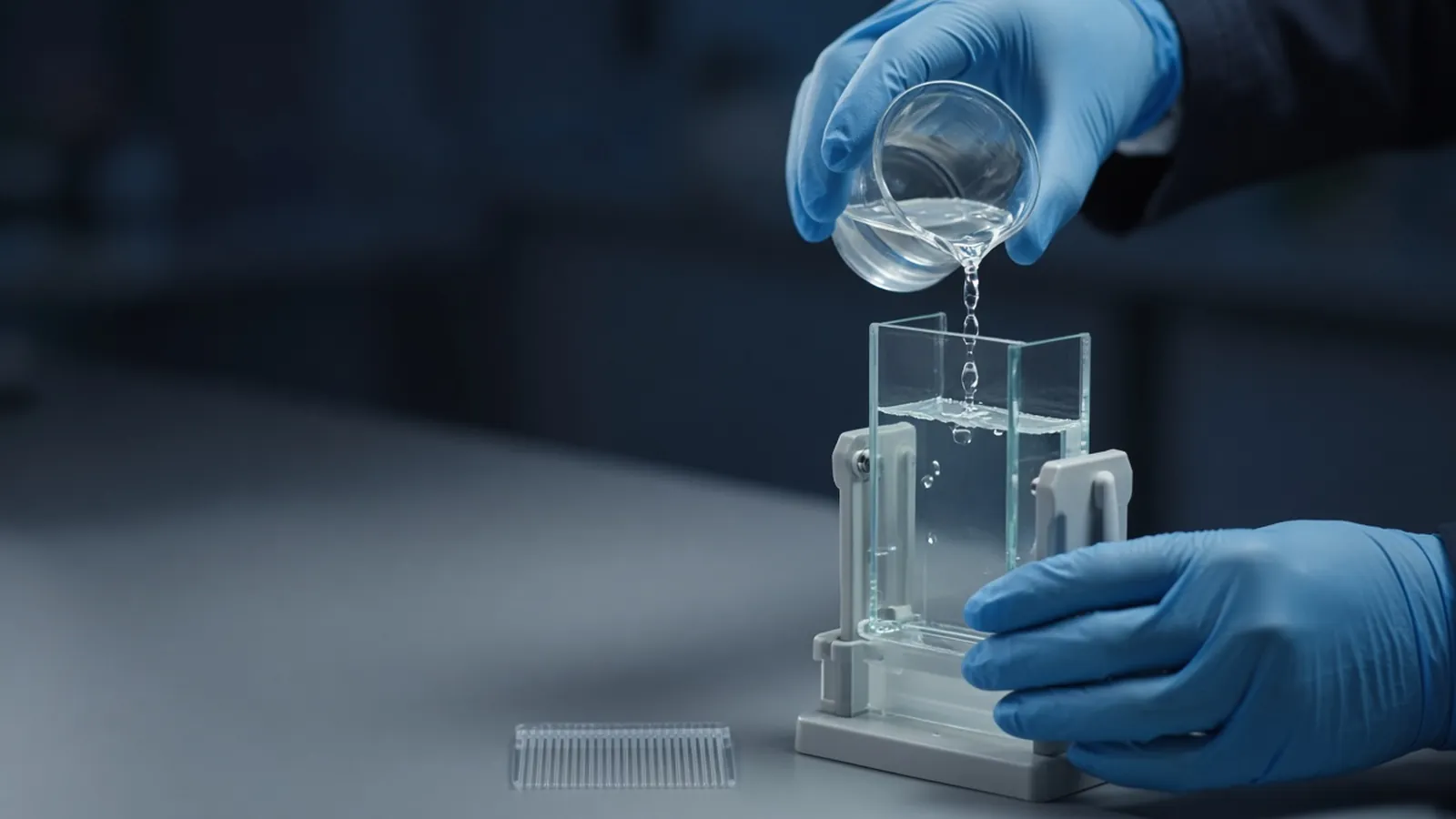
A disulfide is a covalent bridge between cysteines. Whether you break it before a gel decides which oligomers you are allowed to see. Reducing agents are not a garnish on sample buffer. Dithiothreitol and beta-mercaptoethanol are thiols that shuffle and break those bridges. Tris(2-carboxyethyl)phosphine is a different chemical class that can do the reduction without itself being a thiol. This overview is for someone loading an SDS gel, planning a maleimide label, or wondering why an elution fell apart into two bands. How to interpret the lanes is continued in reading a protein gel. If the gel is only the start of a blot, the transfer story is in western blot from gel to membrane.
What the reductant is doing
In a folded protein, two cysteines can form a disulfide within one chain or between chains. SDS on its own coats the polypeptide and pulls non-covalent assemblies apart. It does not reliably cut a disulfide. A thiol reductant attacks the bridge and leaves free cysteines, often protected in the reduced state by excess reagent. Heat and SDS together open buried bridges so the reductant can reach them. If you omit the reductant and still heat in SDS, you are running a non-reducing denaturing gel. Oligomers held only by disulfides stay large. Oligomers held by salt bridges and hydrophobic contacts generally fall to monomers anyway.
That distinction is the whole point of the paired lanes. An antibody is the classic picture: under reducing conditions the heavy and light chains separate, and under non-reducing conditions the covalent assembly stays high on the gel. A cytokine or a receptor fragment that is a disulfide-linked dimer behaves the same way. A protein that is a dimer only through its surface, with no interchain disulfide, looks monomeric in both lanes once SDS is present. If your question was "is the native protein a dimer in buffer", neither lane has answered it. You need a method that does not denature.
Typical concentrations in Laemmli-style sample buffers are often on the order of tens of millimolar DTT, sometimes near 50 to 100 millimolar, or a small volume percent of beta-mercaptoethanol, often discussed around a few percent. TCEP is often used at a lower millimolar level because protocols differ. These are ranges you will see in methods, not a recipe. Follow the protocol for the sample buffer you are using. Old DTT that has oxidised in a warm bottle is a common reason a "reducing" lane still shows the high band.
Thiol versus phosphine, and what comes later
DTT is the usual thiol in modern sample buffers. Beta-mercaptoethanol is older, more volatile and more odorous, and it still appears in published recipes. Both can reduce the disulfide and both can interfere downstream. TCEP is chosen when a protocol wants a reductant that is stable as an aqueous stock or when a thiol would compete with a later cysteine-directed reagent. Compatibility is not universal. Some immobilised-metal resins tolerate a low level of one reductant and strip or lose capacity with another. The resin note wins over folklore.
Maleimide chemistry is the sharp example. A maleimide couples to a free thiol on the protein. Leftover DTT or beta-mercaptoethanol is also a free thiol, and it will consume the maleimide. You can finish the reaction with little or no label on the protein and a gel that still looks fine. Quench or remove the reductant before labelling, using the labelling protocol's own guidance. TCEP is sometimes more compatible with maleimides than DTT is, and sometimes it is not, depending on pH and concentration. Read the note. Do not assume the class difference is a free pass.
Copper protein assays are the other collision. Reducing agents reduce copper and create colour in a BCA-type well. The quantification page on Bradford, BCA and absorbance at 280 nm is the place to choose an assay after a reducing gel sample. Do not quantify the SDS sample buffer by BCA and call it the protein concentration of the experiment.
A workflow that can fail in either lane
Prepare two aliquots from the same tube when the disulfide itself is the question. One receives reductant. One does not. Both receive SDS and the same heat treatment so the only planned difference is the bridge. Load them side by side with a marker. If both lanes look identical and you expected a collapse, the reductant may be exhausted, the disulfide may be unusually stubborn, or there was no interchain bridge. Increase the reductant only inside the protocol's limits, use a fresh stock, and confirm the sample actually mixed. Boiling some proteins, especially membrane proteins, produces a smear or a band stuck in the well. If the reducing lane vanishes into the well while a cooler incubation looks clean, follow a lower temperature the method allows rather than repeating a harsher boil.
If the non-reducing lane smears and the reducing lane is sharp, you may be looking at a family of disulfide intermediates. That pattern is data. It is not a spoiled gel until the controls say so. A no-protein lane of sample buffer checks dye fronts and reagent junk. A known disulfide-linked control, when you have one, shows that this batch of reductant can work.
| Reagent | Class | What a gel uses it for | Where leftover reagent hurts |
|---|---|---|---|
| DTT | Thiol | Routine reducing SDS-PAGE | Maleimide labels, many copper assays, some resins |
| Beta-mercaptoethanol | Thiol | Older reducing sample buffers | Same thiol collisions, plus odour and volatility |
| TCEP | Phosphine | Reduction when a thiol stock is a poor fit | Protocol-specific: some labels and some metals |
| None | Non-reducing | Keeps disulfide-linked oligomers intact | Tells you nothing about non-covalent assemblies |
Failure modes that look like biology
A high band that survives fresh reductant and full SDS denaturation may be a covalent cross-link that is not a disulfide, or a very stable bridge that needs the protocol's stronger conditions. Do not call it a novel subunit until the chemistry is checked. A band that appears only when reductant is omitted can also be an air-oxidised artefact created while a cysteine-rich protein sat without protectant. Compare a freshly prepared sample with one left on the bench. Speed of appearance matters.
Incomplete mixing is dull and common. Reductant sitting as a droplet on the lid does not reduce the protein at the bottom of the tube. Spin down, mix, and heat again before you rewrite the oligomer model. Prestained markers are approximate, so a "shift" of a few kilodaltons needs the paired lanes, not a comparison with last week's photo.
Safety and the building
Beta-mercaptoethanol is volatile and unpleasant, and thiols are chemical hazards. Use them in the conditions your laboratory requires. Acrylamide gels add their own hazard. This article is not a clinical protocol and not an approval to handle infectious material. Institutional biosafety rules cover the sample.
Thiol stocks die faster in a warm room. A bottle of DTT left by a sunny window is a different reagent by the afternoon. Make small aqueous thiol stocks, keep them cold as the source specifies, and write the date. Humidity does not neutralise the chemistry, but it does punish poorly closed hygroscopic solids. After a power cut, a heated block that restarted mid-cycle is not a completed denaturation. Repeat the heat step with a known control rather than trusting a half-boiled lane.
Reagents to name in an enquiry
State whether you need a thiol or a phosphine, the downstream step that forbids one of them, and whether the gel must be paired reducing and non-reducing. Reagents and chemicals is where buffer components and common reductant classes sit as catalogue categories. Send the constraints with a quote. If the disulfide question is part of a larger expression construct, the custom protein expression and purification page is only an enquiry reference. A method can be discussed there. It does not say that expression or purification is being operated as a service from this article.
Choose a reducing condition that matches the question
- 01Decide what the disulfide is doing in the experimentIf you need subunit mass, plan a reducing lane. If you need to know whether chains are covalently paired, plan a matched non-reducing lane from the same sample.
- 02Pick a reductant class, not a habitDTT and beta-mercaptoethanol are thiols. TCEP is a phosphine. Use the class the downstream step allows, in a typical range from the protocol you are following, and prepare thiols fresh.
- 03Denature with SDS and heat as that protocol statesHeat drives SDS binding and helps the reductant reach buried disulfides. Some proteins aggregate if boiled. Stay inside the time and temperature window the method gives, often a few minutes in the 70 to 95 Celsius range.
- 04Remove or account for leftover reductantDo not carry a reducing sample buffer into a maleimide labelling reaction or into a copper protein assay. Exchange the buffer or quench according to the labelling protocol before you claim a free thiol was modified.
Questions from the bench
Are DTT and beta-mercaptoethanol the same reagent?
They are both thiol reductants, and both can break protein disulfides in an SDS sample buffer. They differ in smell, stability and the concentration a given protocol asks for. Substituting one for the other without checking that protocol is how a non-reducing control gets accidentally reduced, or a reduction stays incomplete.
Why is TCEP described as a different class?
TCEP is a phosphine, not a thiol. It reduces disulfides and is often more stable in water than DTT. It still has its own interference list. Some resins, some maleimide workflows and some metal-affinity steps treat TCEP differently from DTT. Follow the note for the resin or the label you are using.
What does a non-reducing gel prove?
A band that falls to the subunit mass only after reduction is consistent with a disulfide-linked oligomer. A band that stays put may be a monomer, a non-covalent oligomer that SDS already separated, or a disulfide the reductant never reached. The gel shows covalent linkage. It does not, by itself, prove a native quaternary structure.
Can leftover DTT ruin a later assay?
Yes. Maleimides label thiols, so leftover reductant consumes the reagent and can label nothing on the protein. DTT and beta-mercaptoethanol also create false colour in many BCA-type assays. Remove them or choose an assay they do not break.
References
Manufacturer names identify published method classes. Trademarks remain with their owners. Catalogue records on this site are independent references for enquiry. They are not a statement of inventory, distribution rights or a supply commitment. This page is educational. It is not medical advice, a diagnostic protocol or a biosafety approval.
Catalogue
Related products and categories
These links follow the subject of the article into published manufacturer references. A listing is a reference for an enquiry, not a statement of stock or distribution rights.
Continue in this cluster
Related reading
Reading a protein gelHow to read a protein gel: what SDS-PAGE bands, smears, ladders and loading differences can support, and what they cannot identify.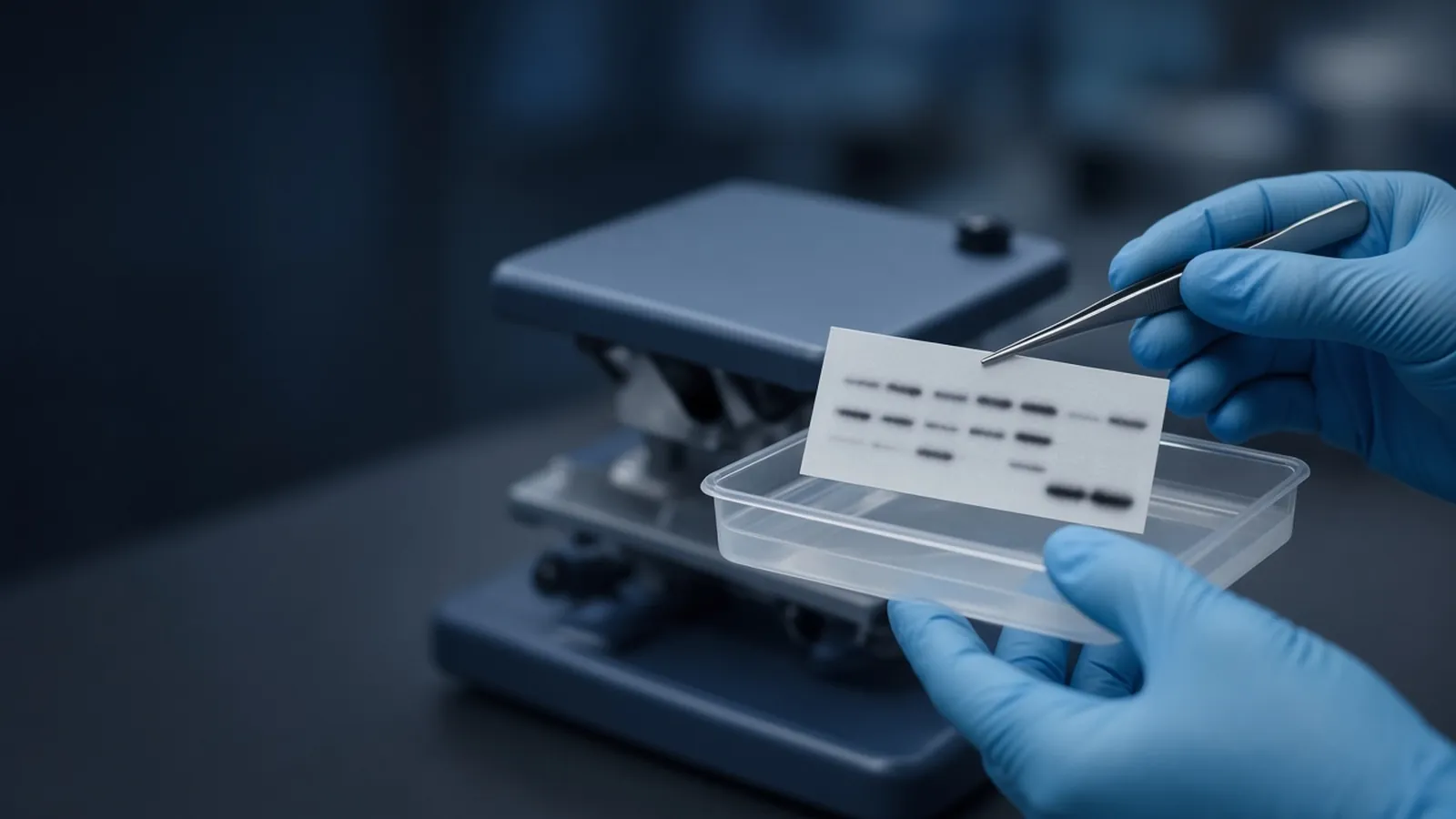 Western blot from gel to membraneHow a protein moves from an SDS gel onto a membrane, how antibodies create a band, and which controls separate transfer failure from a real signal.Bradford BCA and absorbance at 280 nmBradford, BCA and absorbance at 280 nm report different chemistries. Pick the assay your buffer allows and name the standard beside the number.