
guide
Reduction alkylation and trypsin
Why proteins are reduced and alkylated before trypsin in bottom-up proteomics, and how incomplete cysteine chemistry changes which peptides a search can name.
- Author
- EVRINTH Editorial Team
- Published
- 8 October 2026
- Updated
- 8 October 2026
- Reading time
- 11 min
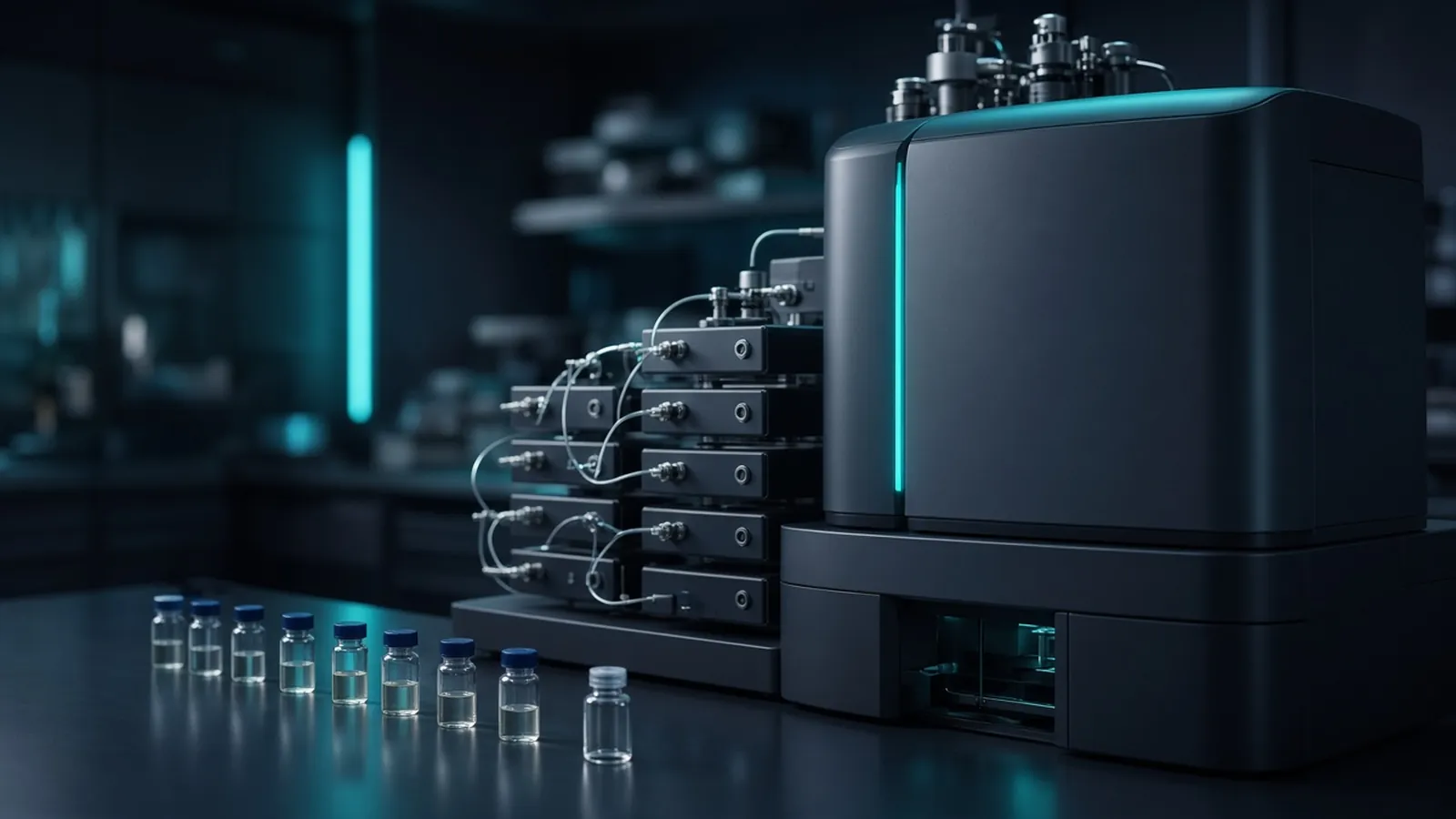
Reduction, alkylation and trypsin are the three chemical decisions that turn a folded protein into peptides a bottom-up mass spectrometer can fragment. The order is not a tradition. Disulphide bonds hold cysteines together. A reductant opens those bonds. An alkylating agent caps the free thiols so the bonds do not quietly reform while the tube sits. Trypsin then cuts on the carboxyl side of lysine and arginine, provided those residues are still recognisable. If any of those steps is incomplete, the search engine is asked to name peptides that were never made, or to ignore peptides that were made with an unexpected mass. Read bottom-up proteomics in plain language for the identification logic, and preparing peptides for mass spectrometry for the cleanup that follows the digest. This page is the cysteine and cleavage step itself.
Who this chemistry is for
Use this guide when a research sample will be searched as a standard tryptic proteome: cell lysate, tissue homogenate, pulled-down protein, or a purified protein you want identified. It is the wrong guide when you are mapping native disulphides, because alkylation is designed to erase them. It is also the wrong mental model for a protease with a different specificity. Chymotrypsin, Lys-C, Asp-N and Glu-C answer different sequence questions. Name the enzyme in the search parameters so the false discovery rate is calculated against the cuts you actually allowed.
The decision this page supports is practical. Before you thaw the reductant, write whether the experiment needs capped cysteines, which denaturant the proteins can tolerate, and how you will know the digest worked. A later chromatogram cannot repair a cysteine that reoxidised in the tube.
What the three reactions do
A cysteine side chain ends in a thiol. Two thiols can oxidise to a disulphide. In a folded protein many of those bonds are structural. In a lysate they also form by accident, between proteins that never met in the cell, especially if the extract sat warm and alkaline. Reduction puts those sulphurs back in the thiol form. Common reductant classes are dithiothreitol, tris(2-carboxyethyl)phosphine and related phosphines. They are not interchangeable in every buffer. TCEP is often chosen when a downstream step dislikes thiols that linger, and DTT is widely described in urea or guanidine protocols. The concentration, the pH and the minutes belong to the protocol you are following, not to a number copied from a different kit.
Alkylation follows reduction because a free thiol is reactive. Iodoacetamide is the classical reagent: it attaches a carbamidomethyl group, and most search engines treat carbamidomethyl-cysteine as a fixed modification. Chloroacetamide is discussed when a laboratory wants less off-target alkylation of other residues. Acrylamide from an old gel can alkylate cysteines too, which is one reason a gel plug and an in-solution digest should not be searched with a cysteine rule copied from each other without checking. Alkylation is commonly done in the dark because some of these reagents are light-sensitive. The manufacturer's note is the authority for that detail.
Trypsin is a serine protease. Sequencing-grade material is treated so that the cuts that are not at lysine or arginine are reduced, but it is not a theoretical enzyme. It still misses sites, especially when a acidic residue sits next to the lysine or arginine, when the site was chemically modified, or when the protein never unfolded. Autolysis peptides from the trypsin itself appear if the enzyme was not protected or was added far too generously. Those peptides are a useful confession that the enzyme was present. They are not a measure of how many sample proteins were digested.
Reagent classes, not a copied insert
Think in classes and then lock the class to a protocol.
Denaturant or detergent comes first if the proteins are not already unfolded. Urea, guanidinium salts and selected surfactants each keep proteins soluble and each leave a different problem for the mass spectrometer. Urea that has been warm can form isocyanate and carbamylate lysines and protein N-termini. That side reaction both blocks trypsin and adds a mass the search must be told about. Many laboratories therefore keep urea-containing steps cool and do not store urea solutions for a long time. Follow the protocol's temperature, and do not assume a room in a hot building is the room the protocol imagined.
The reductant should be fresh enough that you trust it. Thiol reductants oxidise in air. A stock that has been opened repeatedly may look fine and still under-reduce. Alkylator stocks have the same honesty problem. Weigh or pipette the amount the protocol states, and record the lot.
Trypsin belongs in a class labelled for proteomics, not in a crude pancreatic preparation meant for cell dissociation. The enzyme-to-protein ratio is a decision. Too little enzyme, and missed cleavages rise. Too much, and you pay in autolysis and in non-specific nicks. Ratios around 1:50 to 1:100 by mass are widely cited as a starting window for in-solution work. Treat that window as a typical range. The sheet that came with the enzyme is the instruction.
Acid stops the digest. Many workflows acidify with trifluoroacetic acid or formic acid to a clearly acidic pH before desalting. If you forget, trypsin keeps working in the autosampler vial and the peptide population drifts between the first injection and the last.
A workflow with branch points
Start from a known protein amount, or from a stated cell number if the amount is still an estimate. How laboratories estimate protein concentration is the upstream check. An assay that is blinded by detergent will make every later ratio fictional.
Solubilise and denature. If the solution is cloudy, reduction will be uneven and trypsin will prefer the protein that already dissolved. Change the detergent class or the physical disruption. Do not proceed and hope the search will average the problem away.
Reduce. If a later peptide list shows a large share of peptides still linked by intact disulphides, or cysteines in more than one chemical form, reduction or the alkylation that followed it was incomplete. Repeat the chemistry on a fresh aliquot rather than reinterpreting the file.
Alkylate. If the search reports a high rate of over-alkylation on peptide N-termini or on other residues, the alkylator was too concentrated, too slow to be quenched, or left too warm. Shorten or quench according to the protocol, and decide whether those extra modifications must be variable in the search. Adding every possible side reaction as a variable modification will also inflate the search space and can hurt the false discovery rate. That trade is a search decision, described in the identification pages, not a reason to skip the quench.
Digest. Cool the tube if the protocol uses urea during the digest, because trypsin is less happy in strong denaturant and urea chemistry continues. Some workflows dilute the denaturant before the enzyme is added. That dilution is part of the method.
Stop, desalt and dry or inject. A digest that is still salty or still full of detergent will suppress ionisation even when the cleavage was perfect. Cleanup failure looks like a bad enzyme. It is not.
What to record so the search stays honest
The search can only explain masses you allow. If cysteines were carbamidomethylated, say so as a fixed modification and do not also leave cysteine unmodified unless you have a reason and you understand the cost to the false discovery rate. If you suspect over-alkylation, a small pilot search can test that variable modification. Do not turn a pilot into the production search without looking at how many new matches are decoys.
Missed cleavages are usually allowed once or twice in a standard search because real digests are imperfect. A file in which most peptides carry two missed sites is not a reason to allow three missed sites and move on. It is a reason to look at reduction, denaturation and the enzyme ratio.
| Observation after the digest | Chemistry it suggests | What it does not prove |
|---|---|---|
| Many missed cleavages at ordinary K and R sites | Under-digestion, poor unfolding, or enzyme that lost activity | That the instrument was poorly tuned |
| Peptides with several cysteine chemistries | Incomplete reduction or incomplete alkylation | That the protein is biologically disulphide-bonded |
| Unexpected mass on lysine or the N-terminus | Over-alkylation, carbamylation, or another side reaction | Which side reaction it is, until the mass is checked |
| Strong trypsin autolysis, little sample signal | Enzyme was present, sample peptides were lost or suppressed | That the protein amount was zero |
Failure modes
A digest can look successful on a spectrophotometer and still be a poor peptide mixture. Absorbance after cleanup estimates peptide amount. It does not estimate cleavage specificity. The honest checks are chromatographic: a UV or total-ion trace that is not a single unresolved hump, and a search summary with a believable missed-cleavage distribution.
Incomplete reduction is common when the protein was a membrane protein or a disulphide-rich extracellular protein and the denaturant never reached the core. Harsher denaturation, a different protease pair such as Lys-C before trypsin, or a method written for that protein class is the branch. Do not simply double the trypsin and call the disulphides handled.
Over-alkylation is common when iodoacetamide is added at a high concentration and the tube is left at incubation temperature for a long time. The typical corrective path is a shorter alkylation, a quench with a thiol, or a change to a milder alkylator class if the protocol allows it. Confirm the change still matches the fixed modification in the search.
Carbamylation masquerades as mysterious extra modifications after a urea digest that ran warm. Cool the urea steps, use fresh urea, and decide explicitly whether carbamylation is in the search. Ignoring it splits the signal for those peptides across an unexplained mass.
Safety and research limits
Urea, guanidine, iodoacetamide and the acids used to stop a digest are ordinary chemical hazards. Iodoacetamide is an alkylating agent and deserves the caution the safety data sheet gives it. Trifluoroacetic acid and formic acid are corrosive. The mass spectrometer is not the place to discover that a tube still contains a strong acid above the concentration the instrument method allows.
This chemistry is a research sample-preparation method. It does not identify a disease, and it does not assign a function to a protein. A named peptide sequence is evidence about composition under a stated false discovery rate. Function is a different experiment.
Heat, time and overnight steps
An overnight 37 Celsius digest assumes the incubator or the block holds that temperature and that the building keeps power. In a laboratory where power drops, an unattended digest can cool for hours and then warm again, which changes both cleavage and chemical side reactions. A heated block with a known recovery, or a digest timed to the working day, is easier to defend than a tube whose temperature history is a guess. High ambient heat also shortens the honest life of urea solutions and of some reductant stocks. Make them when you need them, and do not store them in a warm drawer because the freezer is full.
Humidity matters after the digest, when peptides are dried in a centrifugal evaporator. A tube that never quite dries can be stoppered and left, and the residual acid or solvent changes the peptides before they are injected. Dry to the endpoint the cleanup protocol describes, then freeze or inject. Do not leave semi-dry peptides on a bench overnight.
What to put in an enquiry
A useful sourcing question names the matrix, the approximate protein amount per sample, the denaturant already present, the cysteine chemistry you intend to search, and whether the same peptides must remain compatible with a later modification enrichment. Ask which reductant, alkylator and sequencing-grade trypsin classes fit that constraint, and ask how the supplier describes quenching.
The shotgun discovery proteomics page, the protein identification by LC-MS/MS page and the differential abundance page are enquiry references for the study around this chemistry. They are a way to discuss scope. They are not a statement that a digest is already being run. Send the scientific requirement with the quote request, including the number of samples and the modification rules you need the search to respect.
Cap cysteines before a trypsin digest
- 01State whether cysteines must be cappedWrite down whether the study needs alkylated cysteines for a standard search, or free cysteines for a disulphide or modification experiment. The two goals do not share one recipe.
- 02Reduce under the denaturing conditions the protocol namesUse a reductant class the digestion protocol specifies, on a fully solubilised protein, for the time and temperature that protocol gives. A protein that is still folded hides cysteines.
- 03Alkylate, then remove leftover alkylatorAdd the alkylating agent after reduction, protect it from light when the protocol says so, and quench or dilute leftover reagent before trypsin sees it. Excess alkylator modifies residues trypsin needs.
- 04Digest and stop with a recorded enzyme-to-protein ratioAdd sequencing-grade trypsin at the ratio and duration the protocol specifies, then acidify or otherwise stop the digest before cleanup. Record the ratio so a later missed-cleavage rate has a cause.
Questions from the bench
Does every proteomics sample need iodoacetamide?
No. Alkylation is there to stop cysteines from re-forming disulphides and to give the search a defined cysteine mass. Some modification studies leave cysteines free on purpose. Follow the method that matches the claim, and say which cysteine chemistry the search assumed.
Why does leftover iodoacetamide hurt a trypsin digest?
Iodoacetamide can alkylate residues other than cysteine if it is left too long, too warm, or in excess. Lysine modification near a cleavage site changes the peptide trypsin would have made. Quenching or a prompt buffer exchange is how laboratories keep that side reaction small.
Is overnight trypsin always better than a short digest?
A longer digest can cut more sites and can also create more non-specific nicks and more chemical damage. Many protocols use an overnight incubation near 37 Celsius, and others use a shorter time with a higher enzyme ratio. Use the window the enzyme supplier describes, then judge the result by missed cleavages rather than by the clock.
What should a cysteine-chemistry enquiry include?
Name the sample matrix, the protein amount range, whether the proteins are already in detergent or urea, and whether phosphopeptides or other modifications must survive. Ask for the reductant and alkylator classes that fit that matrix. The quotation should state the chemistry, not only a kit family name.
References
Manufacturer names identify published method classes. Trademarks remain with their owners. Catalogue records on this site are independent references for enquiry. They are not a statement of inventory, distribution rights or a supply commitment. This page is educational. It is not medical advice, a diagnostic protocol or a biosafety approval.
Catalogue
Related products and categories
These links follow the subject of the article into published manufacturer references. A listing is a reference for an enquiry, not a statement of stock or distribution rights.
Continue in this cluster
Related reading
Bottom-up proteomics in plain languageBottom-up proteomics in plain language: proteins are digested to peptides, a mass spectrometer fragments them, and a database search names candidates.Preparing peptides for mass spectrometryHow laboratories prepare peptides for mass spectrometry: reduction, alkylation, digestion, cleanup, and the clues that a digest failed.A glossary of proteomics termsA working glossary of proteomics terms, from precursor and PSM to razor peptide, FDR and batch effect, and how each term changes a pull-down or abundance claim.