
glossary
RNA extraction on a clean bench
Define RNase, RNase-free plastic, DEPC, ice and dedicated tubes, then see how a shared bench fails an RNA extraction before lysis starts.
- Author
- EVRINTH Editorial Team
- Published
- 8 October 2026
- Updated
- 8 October 2026
- Reading time
- 9 min
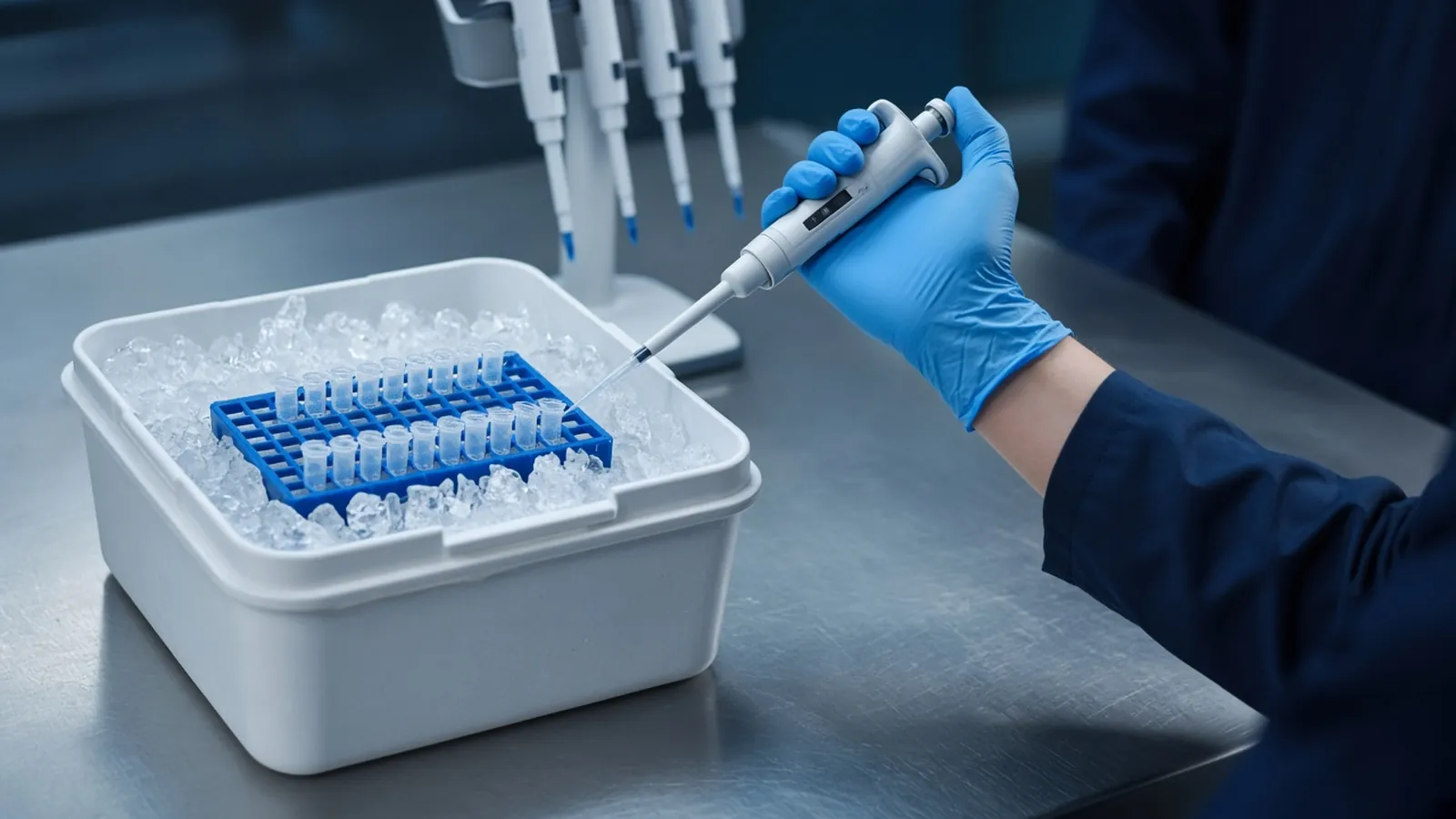
A clean bench for RNA is a short list of objects that have not recently touched RNase, plus a habit of not walking those objects to the rest of the laboratory. The words on the bottles are easy to mix up, and the mix-up is how a shared bench ruins a prep before sample lysis even starts. This glossary defines the words and then uses them on that failure. The chemistry that has to inactivate RNases at the moment of lysis is already described in protecting RNA during extraction. Extraction classes in general are in how DNA extraction methods differ.
The photograph is a gloved hand pipetting into microtubes on ice, on a stainless workstation set aside for the job. The steel is not the protection. The dedication is.
The words, in the sense a bench scientist needs
RNase is a ribonuclease, an enzyme that cuts RNA. Cells are full of them. Skin is a reliable source. Many laboratory enzymes, including the RNase A still used in some plasmid preparations, are purified RNases on purpose. Some of these proteins survive heat and drying that would finish a typical microbe. A bench can look wiped and still be an RNase bench if a plasmid prep, a bacterial pellet, or an uncovered enzyme tube lived there in the same hour.
RNase-free is a manufacturing and handling claim, not a visual one. Plastic or water sold as nuclease-free has been produced and tested so that a stated nuclease activity is absent, and it stays that way until you open it and touch it with a contaminated glove or pour it into a washed bottle. "Clean" and "autoclaved" and "the good tip box" are not synonyms. Once the box is open on a shared bench, the claim is only as good as what happens next.
DEPC is diethyl pyrocarbonate, a chemical used historically to inactivate RNases in water. It modifies the enzyme. Residual DEPC then has to be destroyed, classically by autoclaving, because leftover reagent will also modify RNA and will react with amine groups. That is why DEPC treatment of Tris and other amine buffers is the wrong tool: the buffer is consumed and you do not get a trustworthy solution. DEPC is hazardous in its own right and belongs in a chemical risk assessment if a legacy method still calls for it. For almost every current RNA bench, buying certified nuclease-free water is the calmer definition of "water". Do not revive DEPC to make a shared wash bottle feel serious.
Ice is a temperature aid. It slows many reactions, including some nuclease reactions, which is why several protocols park cells, enzymes or finished RNA on it. It is not a kill step. A chaotropic or phenol lysis often runs at room temperature because the chemistry, not the cold, denatures RNases. Ice that has melted is water of unknown cleanliness sitting under your tubes. An ice bucket that also holds a genomic digest from the shared bench is a ferry for whatever was on those other fingers.
Dedicated plastics are tips, tubes, racks and marker pens that stay on the RNA bench. They are not a special polymer. They are a closed set. The moment a tip box visits a gel tray, a plasmid miniprep, or a teaching bench, it is no longer dedicated, whatever the bag once said. Filter tips reduce the chance that a pipette barrel becomes the shared surface. They do not forgive a glove that just closed a door.
A260/A280 near 2 is a protein hint about the liquid you measured. Nucleic acid extraction can produce that number from RNA that a shared bench has already shortened. The glossary would be incomplete if "good ratio" were allowed to mean "clean bench".
| Term | What it means on this bench | What people wrongly hear |
|---|---|---|
| RNase | An enzyme that cuts RNA, common on skin and in some preps | A rare contaminant found only in old buffers |
| RNase-free | A tested, closed lot of plastic or water | Any tube that looks new or has been autoclaved |
| DEPC | A historical water treatment that must be destroyed afterwards | A rinse that makes Tris and benches safe |
| Ice | A slow-down used only where the protocol says so | Proof the RNA is protected |
| Dedicated plastics | A set that does not travel to DNA or culture work | Expensive tips used for every job that day |
| Clean bench | A reserved surface with reserved gloves and reagents | A stainless bench wiped with a shared cloth |
How a shared bench fails the prep
The usual morning: the only free bench is the one where plasmid minipreps were neutralised an hour ago. RNase A was in that kit. The same tip box is open. The same gloves turn a fridge handle, annotate a gel, and then open the RNA tubes. None of those steps looks dramatic. Each one is enough.
Failure starts before lysis when the tissue or the cell pellet waits on that bench for a buffer that someone has to fetch from a different room. Endogenous RNases work while you walk. The clean-bench version of the same pause is short because the buffer, the labelled tubes and the ice, if ice is required, are already there. Sample lysis then happens into a denaturing buffer on plastics that have not visited the plasmid tray. That sequence is the whole method. A beautiful elution cannot stitch RNA cut during the wait.
The same pattern repeats with water and ice. Someone treats Tris with DEPC, or refills a certified bottle from the general purifier. Meltwater from a communal ice bucket wicks into tube rims. An unfiltered pipette barrel that aspirated an RNase reaction last week still belongs to every sample today.
You notice the failure on the trace, not in the glossary. Ribosomal bands are weak or gone across the whole batch, including a fresh cell pellet that should have worked. A single degraded sample among good ones points at that specimen's delay. A whole batch degraded, with a clean control included, points at the bench, the water, or the plastic. A260/A280 will often look acceptable throughout. Do not let it adjudicate.
A working definition you can audit on a Tuesday
Reserve the surface. Stage certified tubes and a tip box that will be thrown away or closed when you leave, not lent. Put on gloves after you have finished touching fridges and phones, and change them when you leave the bench. Keep a bottle of nuclease-free water for this work. Do not top it up from the general tap of the water system. Leave DEPC in the chemical cupboard unless the SOP still names it.
Set ice only if this protocol wants ice, in a tray you can clean, and do not park unrelated tubes in it. Thaw the sample into denaturing lysis promptly. Then follow the RNA method you already chose. When you finish, the plastics do not migrate to the DNA gel. That last sentence is the audit. If you cannot say where the tip box slept, you do not have dedicated plastics. You have a wish.
Include one known-good pellet in the batch when the bench is new or shared. If it degrades with the samples, stop and retire the open water and the open tips. If it survives and the samples do not, the bench did its job and the specimens did not.
Safety and what the vocabulary does not permit
RNase is not the only hazard. Phenol and chaotropes in the lysis kit, and the biological specimen, dominate the risk assessment. A clean bench can still be the wrong containment for an infectious sample. Institutional biosafety rules decide the cabinet. The WHO laboratory biosafety manual is background, not permission to work on an open stainless bench because the photograph looks calm. This glossary is not a clinical collection protocol.
DEPC, if a legacy SOP insists, is handled as a chemical hazard with its own data sheet, not as a hygiene sprinkle. Do not heat it casually or pour it down a shared sink because it is "for RNA".
Heat, condensate, and a bench beside a corridor
In a hot, humid room a stainless surface next to a busy corridor collects condensate and a film of whatever people carry past. The film is not RNase-free because the metal is shiny. Wipe with what your RNA SOP allows, then stage dedicated plastics after the wipe has dried, not while a shared detergent cloth is still travelling from the bacterial bench to this one. Ice trays fail faster in the same heat: plan the cold steps as a short block of work so the tubes are not standing in meltwater while you label a dozen caps. A window left open for comfort is an air path onto the open tip box. Close the box between samples. None of this replaces denaturing lysis. It stops the bench from undoing that lysis.
What to ask for
Ask for certified nuclease-free tubes, filter tips and water, and for an RNA lysis class matched to the tissue. State that you want those plastics as a dedicated set, not as general laboratory tips. Say if a legacy method still names DEPC, so the chemical hazard is explicit and can be questioned. Name the tissue, because pancreas and blood are not a cultured cell pellet.
The sample preparation catalogue is where those plastic and lysis classes are browsed, and the sample preparation pathway is the route onward to the assay. Send the bench constraint with the quote request. The nucleic acid isolation enquiry reference is a place to describe the specimen and the integrity you need. It is an enquiry reference. It does not mean the extraction is performed for you. Ask whether a quotation is possible. The acceptance check is a surviving control pellet and a trace, not a shiny bench and a flattering ratio.
Questions from the bench
Does autoclaving make tips RNase-free?
No. Autoclaving kills organisms. It does not reliably destroy RNases that were already dried on the plastic, and the tray you load into the autoclave may not be clean in the RNase sense. RNase-free means the manufacturer tested that lot for nuclease activity and packaged it to stay that way. Open it on the RNA bench and do not tip those tips out into a jar that also holds PCR tubes.
Should I treat my Tris with DEPC?
No. Diethyl pyrocarbonate reacts with amine buffers such as Tris, so the buffer is damaged and the treatment is not doing the job you wanted. DEPC is a historical way to inactivate RNases in plain water, and the residual chemical has to be destroyed before the water touches RNA. Certified nuclease-free water is the ordinary choice now. Keep DEPC off the bench unless a named SOP still requires it and the safety data are in force.
If the tubes are on ice, is the bench clean enough?
Ice slows many enzymes. It does not define a clean bench, and it does not inactivate RNase. Meltwater running into a cap is a contamination path. Use ice only on the steps the protocol puts on ice, with a container that is not also holding a restriction digest. A denaturing sample lysis still has to be the step that actually stops RNases.
A260/A280 is near 2.0. Did the shared bench do no harm?
The ratio is a protein hint, not an integrity result. Shared-bench damage shows up as a lost ribosomal trace, a failed reverse transcription, or a no-RT control that is not the question this ratio can answer. Nucleic acid extraction can look spectrophotometrically calm after RNases have already cut the RNA. Read a gel or a trace before you trust the morning.
References
Manufacturer names identify published method classes. Trademarks remain with their owners. Catalogue records on this site are independent references for enquiry. They are not a statement of inventory, distribution rights or a supply commitment. This page is educational. It is not medical advice, a diagnostic protocol or a biosafety approval.
Catalogue
Related products and categories
These links follow the subject of the article into published manufacturer references. A listing is a reference for an enquiry, not a statement of stock or distribution rights.
Continue in this cluster
Related reading
 How DNA extraction methods differHow silica columns, beads, precipitation and organic extraction change DNA yield, length and inhibitors, and which class fits the assay you actually plan toA glossary of purification termsDefine chaotrope, bind-wash-elute, yield, purity ratios and RIN, then walk a purification so those words describe one real workflow.Blood saliva and tissue as starting materialExplain how EDTA blood, heparin blood, saliva and solid tissue behave as extraction inputs, and why a serum tube is not whole blood.