
glossary
RNase contamination on shared benches
Skin, dust, old racks and recycled tubes seed RNase on a shared bench. Separate contamination from inhibition, and know when a wipe is not enough.
- Author
- EVRINTH Editorial Team
- Published
- 8 October 2026
- Updated
- 8 October 2026
- Reading time
- 7 min
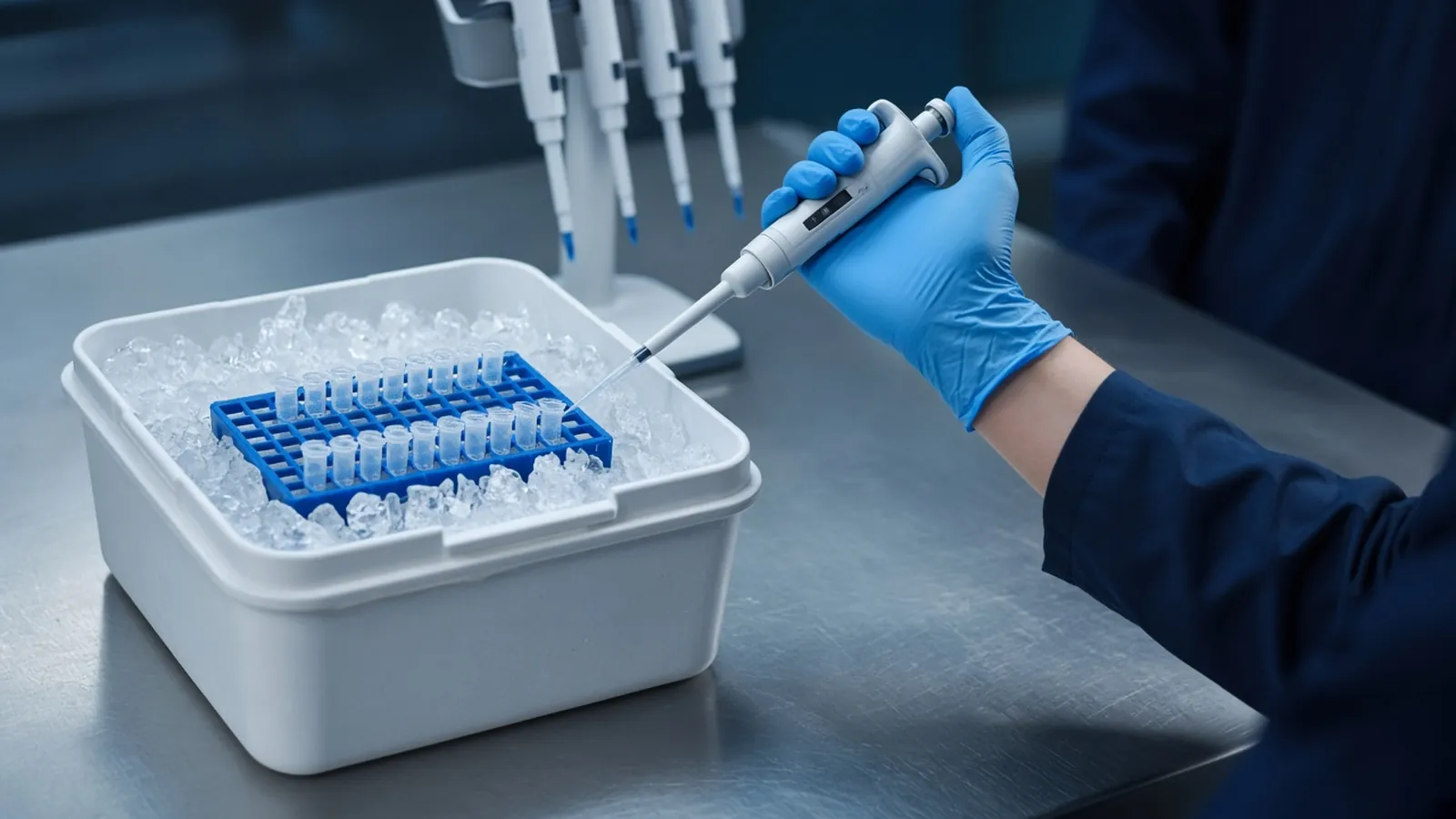
RNase contamination on shared benches is how an RNA prep dies before the silica column has done any work. Skin, dust, old racks, and recycled tubes carry ribonuclease into a space that also hosts plasmids, DNA extractions, and ordinary traffic. This glossary separates contamination from inhibition and says what a wipe does and does not prove. It is research language for a shared room. It is not a validated cleaning protocol and not a clinical method.
The extraction steps that assume you have already limited RNase are in protecting RNA during extraction. How that prep compares with DNA methods is in how DNA extraction methods differ.
RNase
An RNase is an enzyme that cuts RNA. Several common ones are unusually stable. They can survive drying, and they do not need the cofactors a casual disinfectant story assumes. They come from cells you lysed yesterday and from skin on a bare hand today. Sample lysis that was meant to denature them only works inside the tube, after the sample is in the chaotrope or the other inactivating condition the method uses. On the bench, before that moment, the enzyme is simply present.
Calling every RNA failure "RNase" hides two different events. Use the narrower word when you mean this enzyme or the fragments it leaves.
Contamination
Contamination, here, means RNase or already-fragmented RNA introduced from outside the specimen's own biology. Sources on a shared bench are ordinary. Skin is one. Ungloved hands, or gloves that touched a face and then a tube rim, move RNase onto plastic. Dust is another. An open tube collects whatever the room is circulating, including material from dried spills. Old racks are a third. A rack that held lysates, even if it looks empty, keeps residue in the wells. Recycled tubes are a fourth. A washed microtube is not a certified nuclease-free tube. Washing removes what the wash removes. It does not reissue the certificate the original bag had.
A contaminated prep shows cut RNA: a smear, a lost ribosomal pattern, a collapsed integrity score, a blank that is also degraded if the source was the water or the tube. The specimen may have been intact at collection.
Inhibition
Inhibition means a substance in the tube stops a later enzyme. Ethanol from a wash, leftover chaotrope, phenol, and excess salt can block reverse transcriptase or a polymerase. The RNA may still be long. The assay still fails. Contamination and inhibition can both be true. They are not synonyms, and the next action differs. A cleanup or a dry spin addresses some inhibitors. Neither rejoins RNA that an RNase already cut. A new extraction from a better-handled specimen addresses contamination that happened on the bench. It does not fix an inhibitor you immediately reintroduce with the same wash habit.
| Word | What you should mean | What a shared bench adds |
|---|---|---|
| RNase | An enzyme that cleaves RNA | Skin, dried lysate, dusty plastic |
| Contamination | That enzyme or cut RNA entered the work | Racks, recycled tubes, open aliquots |
| Inhibition | A leftover stopped a later enzyme | Wash alcohol, chaotrope, dirty eluate |
| Wipe | Soil removed, if the cloth was clean | Not a proof the surface is nuclease-free |
| Water aliquot | The small volume you actually pipetted | Discard when it was open or touched |
A wipe is not a validated decontamination
Wiping a bench with a general cloth and a solvent makes it look ready. Dust moves. Some residue thins. Many RNases remain active after a brief ethanol wipe. A validated decontamination is a named agent, a contact time, and a check your SOP already accepted. If you do not have that SOP, do not describe the wipe as having made the bench RNase-free. Say you wiped it. Then keep RNA work on a defined area, with dedicated racks and tips, so the claim you need is smaller than "the whole room is clean."
Bleach and commercial RNase-inactivating sprays are method classes with their own contact times and metal-corrosion notes. Follow the product you opened and the institutional chemical rules. This page will not invent a dilution or a minute. After a chemical treatment, rinse as that note requires so the decontaminant does not become an inhibitor in the next nucleic acid extraction.
When to discard the water aliquot
Nuclease-free water stops being a safe reagent when the aliquot, not the factory bottle, has been exposed. Discard the working aliquot if it stood open on the shared bench, if a pipette barrel or a finger touched the stock, if you refilled it from an unknown tube, or if the blank RNA from that session is degraded while a fresh aliquot performs better. Do not return the suspect water to the reserve bottle. The reserve stays closed and is opened into a new small tube for the next session.
Ice buckets from the shared freezer are part of the same decision. An old ice tray that held random tubes is closer to a rack than to clean plastic. Use a clean container for the RNA set.
How to work the next session
Give the RNA set a defined square of bench, a rack that has not held crude lysates, and tubes from a closed bag. Gloves go on before the bag opens, and they change when they touch a door, a face, or the plasmid rack. Keep the sample cold as the extraction article describes. Put a reagent blank of your water through the same plastics. If that blank's RNA assay shows degradation, discard the aliquot and the open tips and do not interpret the samples.
If the integrity trace is intact and the enzyme still fails, switch vocabulary to inhibition and look at the wash and the elution. Staying on an RNase story will send you to clean a bench that is not the cause.
Safety
RNase-inactivating chemicals are hazards in their own right. Follow the safety data and what your institution allows on a stainless surface. Specimens remain under the biosafety decision already in force. The WHO laboratory biosafety manual and the WHO biosafety health topic are background, not a permit to run infectious material on an open shared bench. Nothing here authorises a diagnostic RNA assay.
Dust in an open room
A bench beside a busy corridor or an open window collects dust faster than a closed bay. That is a reason to cap tubes and to keep water aliquots small, not a reason to invent a particle count. If the only available space is shared, the glossary still applies: dedicated rack, fresh tubes, discard the open aliquot, and do not call a wipe a validation. Nucleic acid extraction for RNA can share a building with DNA work. It should not share a tip box.
What to ask for
If you are sourcing tubes, water, or a column class for RNA, say that the plastics must be suitable for RNA work and that the bench is shared. Ask for the documentation that states the nuclease claim the manufacturer actually makes, and file it. Do not assume a clear bag is a claim. Use the sample preparation catalogue and the sample preparation pathway, and send the notes with the quote request. The nucleic acid isolation enquiry reference is an enquiry reference. Ask whether a quotation is possible.
Questions from the bench
Is a failed RNA assay always RNase contamination?
No. Contamination means RNase or already-cut RNA entered the work and the molecules were cleaved. Inhibition means a leftover such as ethanol or chaotrope stopped a later enzyme without necessarily cutting the RNA. A dead reverse transcription can be either. An integrity trace that collapsed points toward cleavage. A trace that is intact and still will not amplify points toward inhibition or the assay mix.
Does wiping the bench with ethanol make it RNase-free?
A wipe removes dust and some soil. Ethanol is a poor destruction method for many RNases, which are stable proteins. Unless the agent, the contact time, and a check are the ones your SOP names, the wipe is not a validated decontamination. Treat a shiny bench as cleaner, not as proven.
When should I throw away a water aliquot?
Discard the working aliquot when it sat open on a shared bench, when a tip may have touched a stock, or when a blank from that set shows degraded RNA. Do not pour it back into the stock bottle. Open a fresh aliquot for the repeat. Keep the unopened reserve closed.
Can I extract RNA on the same rack I use for plasmids?
You can, and you will share whatever dried lysate and skin contact that rack has collected. Old racks are a source. Give RNA its own rack and its own tubes, or accept that a shared rack is a contamination risk you have chosen. A silica column does not protect RNA before lysis is complete.
References
Manufacturer names identify published method classes. Trademarks remain with their owners. Catalogue records on this site are independent references for enquiry. They are not a statement of inventory, distribution rights or a supply commitment. This page is educational. It is not medical advice, a diagnostic protocol or a biosafety approval.
Catalogue
Related products and categories
These links follow the subject of the article into published manufacturer references. A listing is a reference for an enquiry, not a statement of stock or distribution rights.
Continue in this cluster
Related reading
 How DNA extraction methods differHow silica columns, beads, precipitation and organic extraction change DNA yield, length and inhibitors, and which class fits the assay you actually plan toA glossary of purification termsDefine chaotrope, bind-wash-elute, yield, purity ratios and RIN, then walk a purification so those words describe one real workflow.Blood saliva and tissue as starting materialExplain how EDTA blood, heparin blood, saliva and solid tissue behave as extraction inputs, and why a serum tube is not whole blood.