
guide
Silica columns versus magnetic beads
Choose a silica column or magnetic beads from debris load, plate throughput and fragment length, since both often share the same bind-wash-elute chemistry.
- Author
- EVRINTH Editorial Team
- Published
- 8 October 2026
- Updated
- 8 October 2026
- Reading time
- 9 min
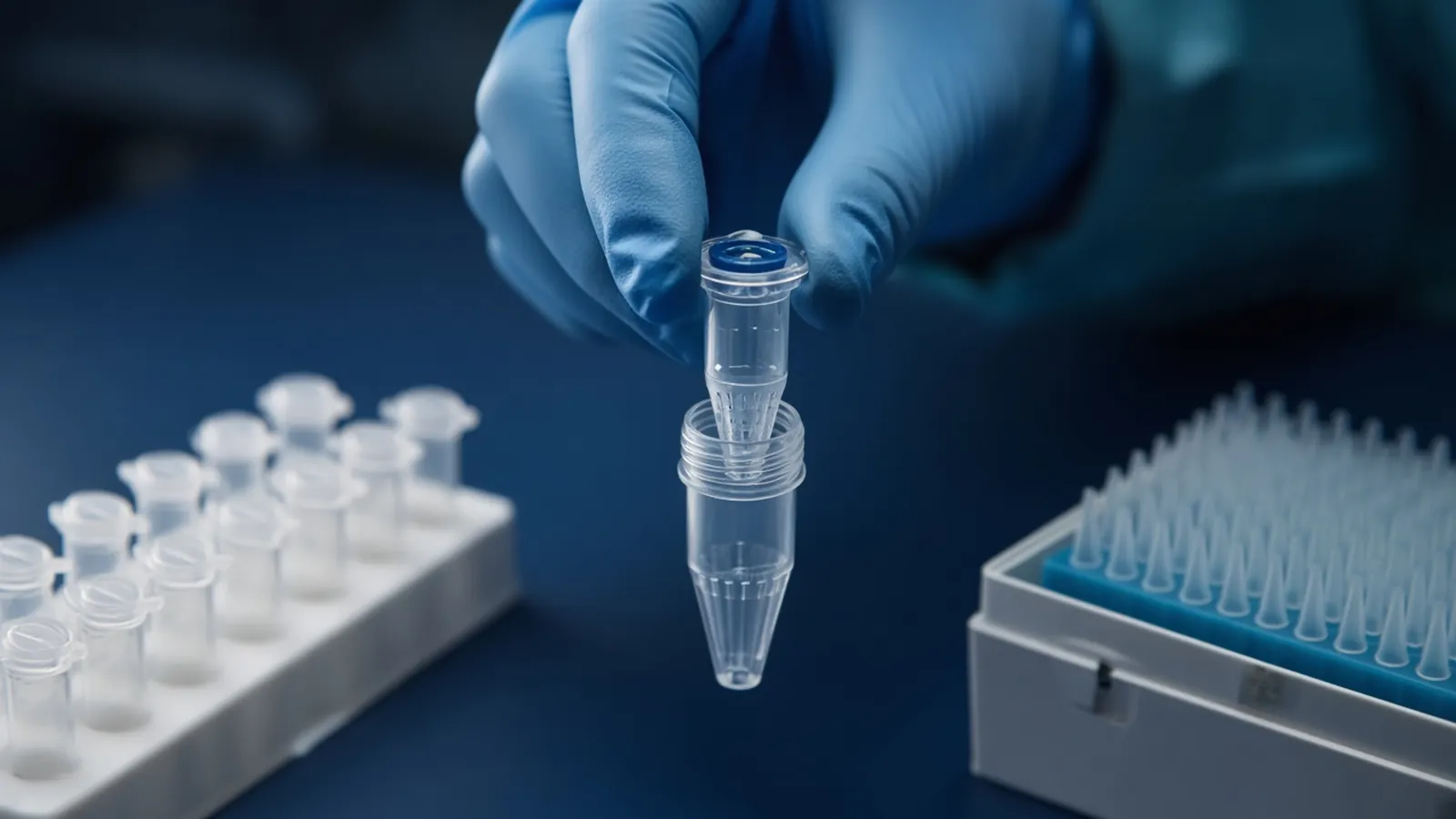
Silica columns and magnetic beads are a handling choice inside one family of separations, not two rival sciences. The photograph on this page is a gloved hand seating a silica column in a collection tube. Beads never appear in that frame. You still have to decide whether that column is the right object for the lysate in front of you, or whether a magnet and a plate would waste less of the sample. The wider map of extraction classes is in how DNA extraction methods differ. This guide stays on the column-versus-bead decision.
Choose by three facts you can see: how much debris is in the lysate, how many samples you will process together, and how long the nucleic acid must remain. A slogan on a box does not answer those. A260/A280 after either method is only a later hint about protein, not the reason to pick the format.
The bind, wash and elute that both formats often share
In high chaotropic salt, water is pulled away from nucleic acids and they adsorb to a silica surface. Guanidinium salts are the usual chaotrope class. A wash that still contains alcohol keeps the nucleic acid on the silica while proteins, dyes and much of the salt leave. Elution in low-salt buffer or water lets it rehydrate and come off. A column membrane and a silica shell on a paramagnetic particle are two geometries for that surface. The particle is pulled to a magnet so you can remove the liquid without a frit. Sample lysis still has to happen first. Neither format opens an unlysed pellet. Follow the bottle you opened for temperatures and hold times.
There is a second bead chemistry that should not be folded into the slogan. Carboxyl-coated paramagnetic beads, used with a crowding agent such as polyethylene glycol and a salt, bind nucleic acids in a size-biased way. More crowding agent pulls in shorter fragments. That is useful when you want primers gone and harmful when you wanted those short pieces, or when you wanted every length equally. Those beads can also be gentle on long DNA if you mix them without violent shearing. They are not a silica column that learned to float.
What the hardware changes
A column has a fixed bed and a finite capacity. Load more nucleic acid than the membrane can hold and the excess flows through while the elution looks mysteriously poor. The frit also acts as a sieve. Fine debris, mucin, starch, paraffin crumbs and half-lysed tissue sit on top and stop the spin. The tube then looks full after centrifugation, which is a clog, not a successful bind. Forcing a second spin at a higher speed can shoot the debris through or shear long DNA against the membrane. It is a poor rescue.
Beads trade the frit for a mixing problem. The particles have to meet the nucleic acid, then meet the magnet. Incomplete mixing leaves yield in the supernatant. A magnet that does not match the plate leaves a brown ring of beads where the elution tip will collect them. Beads that travel into the eluate are a real contaminant. They scatter light, so an absorbance reader may flatter the concentration, and they can inhibit sensitive enzyme steps. Hold the tube or the plate on the magnet while you transfer. If the protocol offers a second transfer of the eluate, that step exists because carry-over is ordinary, not because the user was careless once.
Fragment length is the third decider. Pushing a viscous, high-molecular-weight lysate through a frit shears it. Energetic pipetting to resuspend a bead pellet shears it too. If you only need a genotyping amplicon of a few hundred bases, modest shear is acceptable and a clogged column is the larger nuisance. If you need clones of long inserts, or reads that depend on long molecules, neither format may be as kind as a gentle precipitation, and the format you do use has to be mixed with wide-bore tips and patience. Judge length on a gel or a fragment trace. Do not infer it from which logo you bought.
RNA can travel the same silica chemistry, on a column or on beads, when the lysis buffer was the denaturing class the RNA protocol requires. RNA integrity still comes from how the specimen was kept and how fast RNases were stopped, which is the subject of protecting RNA during extraction. Swapping a column for beads does not restore a degraded trace.
A procedure you can apply to the next batch
Start from the assay, then the lysate, then the count of samples.
If the lysate is gritty, plant-fibrous, clotted, or full of soil, do not make a column your default. Either clear it until a column can accept it, or bind on beads that are not asked to filter. If the lysate is viscous and will not pipette, you are looking at long DNA or unfinished digestion, not at a format failure. That problem is solved in the lysis, before bind chemistry starts.
If you have fewer samples than a centrifuge rotor holds, and the lysate is clear, a column is a direct tool. The dry spin that removes ethanol is easy to see and easy to forget. If you have a plate, or you will have a plate next month, choose beads whose working volume fits the well, and buy or borrow the magnet that those wells were designed against. A magnet bought for a different plate geometry is how beads sneak into the eluate.
If fragment length matters, write the maximum mixing you will allow, use tips that do not shear, and check a gel before you congratulate the yield. If a crowding-agent bead is in use, write the cutoff you intended. A cleanup that was meant to keep only long fragments will look like a low yield when the sample was mostly short. Take a blank through the same washes. A260/A280 only hints that protein is not dominating the spectrum.
| What you can observe | Silica column | Silica magnetic beads | Crowding-agent beads |
|---|---|---|---|
| Debris in the lysate | Frit clogs, spin fails | No frit, clumps still possible | No frit, clumps still possible |
| Dozens of samples | Awkward rotors and lids | Plates and a matching magnet | Plates and a matching magnet |
| Need for long fragments | Frit and hard spins shear | Gentle mixing can spare length | Size bias depends on crowding |
| Need to remove short primers | Weak, unless the kit cutoff says so | Similar to a silica column | This is the usual job |
| Likely carry-over | Ethanol if the membrane stays wet | Beads in the eluate, plus ethanol | Beads in the eluate, plus PEG and salt |
When the result disagrees with the advertisement
A low yield from a rich sample is overload, incomplete sample lysis, or a clog that you called a bind. Split the lysate, clear one half, and bind both halves the same way. The half that suddenly yields was the capacity or the debris. The half that stays empty was the lysis. A short smear, when you needed long DNA, means the shear already happened. Wider tips and no vortex on genomic DNA belong earlier than a brand change. If every blank produces the same unexpected band, retire the open set.
Hazards, containment, and what this page does not approve
Chaotropic salts are harmful to skin and eyes. Ethanol washes are flammable. The specimen may be infectious even after you call the product nucleic acid. Aerosols from a column that is overloaded, and from a bead mix that is pipetted too fast, are part of the method. Your institutional biosafety rules decide the cabinet, the waste, and who may run the prep. The WHO laboratory biosafety manual is a public background document for that local decision. It is not permission, and this page is not a clinical or forensic protocol.
Wet air, rotors, and a magnet that needs no spin
In humid air a membrane that looks dry can still hold ethanol, and the next polymerase stalls. Give the dry spin the time the protocol states. A crusted bead pellet, dried too long on the magnet, has the opposite fault and elutes poorly. A power cut stops a column mid-separation. Liquid left above the frit is neither eluate nor waste until you know which step the rotor was in. A magnet does not care that the rotor stopped, which is why some laboratories keep a bead path for days the centrifuge cannot finish. That is not a reason to skip the wash.
What to send when you ask for either format
State the specimen, how dirty or fibrous it is, the number of samples in a typical run, whether you need plates, and the fragment length the downstream assay requires. Say DNA or RNA. Say whether a crowding-agent size cutoff is wanted or would throw away the target. Those facts let someone match a column, a silica bead, or a size-selective bead without pretending the three are one product.
Use the sample preparation catalogue for the plastic, bead and column classes, and the sample preparation pathway if this prep sits inside a longer workflow. Send the requirement with the quote request. The nucleic acid isolation enquiry reference is a place to frame the scientific question. It is an enquiry reference. It does not mean an extraction is carried out for you. Ask whether a quotation is possible, and keep the acceptance check as a blank, a length check, and the assay you named.
Choose a column or beads from the lysate you actually have
- 01Name the fragment length the assay can live withWrite whether the next step is a short PCR, a clone, or a long-read library. That length decides how hard you may spin, pipette, or mix.
- 02Look at debris and viscosity before you pick a formatA lysate full of grit will sit on a column frit. A lysate that will not enter a tip is already telling you the DNA is long, or that sample lysis is unfinished.
- 03Match the format to the number of tubesA handful of samples can live on a microcentrifuge and a silica column. A plate of samples needs a magnet and beads whose plastic actually fits that magnet.
- 04Define a check that is not a brand sentencePlan a blank taken through the same bind and wash, a gel or trace for length, and the assay itself. Treat A260/A280 as a protein hint after either format.
Questions from the bench
Do magnetic beads use different chemistry from a silica column?
Often they do not. Silica-coated beads bind nucleic acid in chaotropic salt, stay bound through an alcohol wash, and release it in low salt, which is the same idea as a membrane. A separate bead class uses a crowding agent and salt to bind by size, and that class is not a column in disguise. Read which chemistry is in the bottle before you compare yields.
Why does a column stop spinning while beads from the same lysate still work?
The frit is a filter. Cell debris, plant grit, clots, or a viscous genomic lysate pack on it and the liquid never reaches the collection tube. Beads have no frit, so the same grit may still bind or clump, but it does not block a membrane. Pellet obvious debris before a column, or move that sample to beads, and record which change you made.
Can beads in the eluate be ignored if the concentration looks high?
No. A bead that leaves with the liquid adds turbidity, can inflate an absorbance reading, and can disturb a later enzyme or a sequencer loading. The magnet step is finished only when the eluate is taken while the beads are still held. If the liquid is brown or speckled, put it back on the magnet and move the clear portion.
Which format is better for RNA integrity?
Neither format repairs RNA that was already cut. Integrity is the trace or the gel, not the logo on the tube. What does differ is handling time and contamination of the plastics. A slow, cluttered column batch can sit as long as a slow bead batch. Use the format your bench can run cleanly, and judge the RNA afterwards.
References
Manufacturer names identify published method classes. Trademarks remain with their owners. Catalogue records on this site are independent references for enquiry. They are not a statement of inventory, distribution rights or a supply commitment. This page is educational. It is not medical advice, a diagnostic protocol or a biosafety approval.
Catalogue
Related products and categories
These links follow the subject of the article into published manufacturer references. A listing is a reference for an enquiry, not a statement of stock or distribution rights.
Continue in this cluster
Related reading
How DNA extraction methods differHow silica columns, beads, precipitation and organic extraction change DNA yield, length and inhibitors, and which class fits the assay you actually plan toA glossary of purification termsDefine chaotrope, bind-wash-elute, yield, purity ratios and RIN, then walk a purification so those words describe one real workflow.Blood saliva and tissue as starting materialExplain how EDTA blood, heparin blood, saliva and solid tissue behave as extraction inputs, and why a serum tube is not whole blood.