
troubleshooting
Sodium azide and downstream live-cell work
Sodium azide preserves many antibody stocks, inhibits peroxidase, and poisons cells. Check the vial before an HRP plate or a live culture.
- Author
- EVRINTH Editorial Team
- Published
- 8 October 2026
- Updated
- 8 October 2026
- Reading time
- 9 min
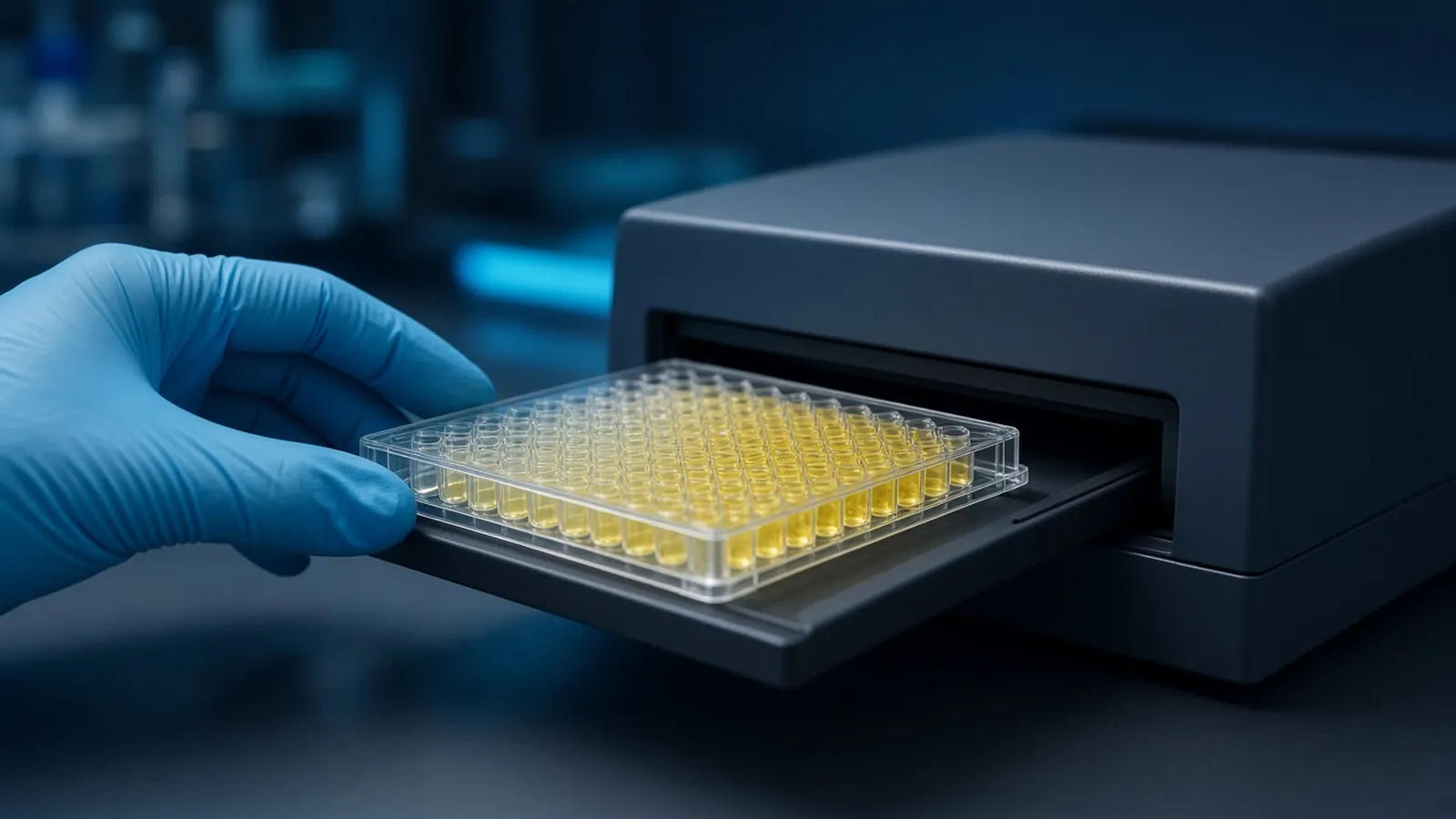
Sodium azide and downstream live-cell work collide because the same small molecule is asked to do two incompatible jobs. In the antibody vial it is a preservative, there to discourage microbial growth in a protein solution. In a horseradish peroxidase ELISA it is an inhibitor, and the plate stays pale. In a live culture it is a poison of cellular respiration, because it inhibits cytochrome oxidase, and it is a chemical hazard for the person pipetting it. Troubleshooting starts at the label, not at the biology you hoped to measure. Plate controls and enzyme readouts are described in ELISA formats, controls and readout. The culture context, if cells are the downstream system, is in mammalian cell culture for research labs. Bench biosafety habits are in biosafety basics for research benches. This page does not give a dose. It does not tell you a concentration that is safe for cells or for people. The safety sheet and the protocol you are authorised to run are the only quantitative sources.
What the preservative is doing in the vial
Antibody solutions are nutritious. A preservative is one way manufacturers slow bacteria and fungi in a vial that will be opened more than once. Sodium azide is widely used for that purpose. Other preservatives exist. The troubleshooting error is to remember the word antibody and forget the rest of the ingredients list. Before you dilute a primary or a secondary into an assay, read the vial, the datasheet and the diluent recipe you are about to make. A home-made diluent copied from a blot protocol can add azide even when the antibody stock was free of it. Then every well shares the inhibitor and the standard curve never rises.
Azide is not a blocker, and it is not part of the standard curve. Blocking proteins and calibrators have their own formulations. If you borrowed a blocking buffer from a slide protocol, check it too. A biotin-free, azide-free, peroxidase-compatible diluent is a specification sentence. Write it before you mix.
An HRP plate that went quiet after a new bottle
Horseradish peroxidase uses a haem chemistry that azide shuts down. If a sandwich that previously produced a curve is blank after you change secondary antibody, and the capture, the standard and the substrate bottle did not change, azide on the new secondary is a first-line suspect. Confirm it from the label. A tube test helps: mix a drop of the suspect conjugate with substrate, away from the plate, under the safety notes. If that tube stays colourless and a known azide-free peroxidase control turns colour, you have separated a dead substrate from an inhibited enzyme. If both stay colourless, the substrate or the reader is back in play. Promega protocols are an example of how enzyme sheets describe compatible buffers. Follow the sheet for the enzyme you are actually using.
Alkaline phosphatase is a different enzyme. Do not assume it shares peroxidase's exact intolerance, and do not assume it is indifferent either. Read its sheet. Switching enzymes to escape azide is a new assay, with a new substrate and a new wavelength, not a drop-in rescue.
A standard curve that is flat at the baseline is not a low sample. Do not fit it. Do not subtract a blank and report zeros as biological absence. Replace the inhibited detection step and rerun the calibrators. Samples on the inhibited plate are unmeasured.
Live cells are not a blot
A preparation washed into a live culture can change the biology and can kill the cells. Azide blocks cytochrome oxidase, so respiration fails. The cells may round up, detach, or die on a timeline you then attribute to the treatment, the cytokine, or the gene you were studying. The antibody stain is the confounder. Even a short stain followed by an incomplete wash can leave enough preservative to matter. Because this page refuses a dose, the operational rule is qualitative and strict: if the downstream work is live, use a formulation the protocol states is suitable for live cells, or remove the preservative by the class of method the protocol names, and confirm the culture's behaviour with a vehicle that matches the handling.
ATCC culture guides describe how living stocks are handled and authenticated. They are not an azide detoxification method. They are a reminder that a dead culture has ordinary causes, contamination and harsh reagents among them, and that you record what entered the flask. Put the antibody lot and the preservative line in that record.
Washing is not a ritual. A rinse that leaves the monolayer sitting in the stain buffer is not a removal step. If the protocol specifies a number of washes and a medium change, do those, and still do not claim the cells are azide-free unless the protocol says the procedure achieves that. If the experiment is metabolic, respiration, or viability, an azide-exposed well cannot sit in the treatment group as a clean control.
Operators are part of the system. Azide is acutely hazardous. Do not sniff a vial to identify it. Do not allow acid to meet azide waste, because acidified azide can release toxic hydrazoic acid. That incompatibility is why azide waste is a chemical decision, not a sink decision. Follow the safety sheet and the institutional waste stream. The WHO Laboratory Biosafety Manual supports the institutional side of biological safety. It does not replace the chemical safety sheet for sodium azide.
Where a blot often differs
On a western blot the primary antibody may be diluted in a buffer that contains azide, and the membrane is not alive. Detection is often a later enzyme step. If that enzyme is peroxidase, the blot protocol usually washes before substrate so the inhibitor is not left in the substrate incubation. People then conclude azide is harmless. It was harmless to that order of operations. Put the same dilution onto an ELISA detection antibody that stays in the well with peroxidase, or onto live cells, and the conclusion expires.
| Downstream use | What azide often does | What you check when the result looks wrong |
|---|---|---|
| HRP ELISA or HRP blot substrate still in contact with the preservative | Inhibits the enzyme and the colour or light fails | Vial, diluent, and a tube test against an azide-free enzyme control |
| Live cells, including a stain before a functional readout | Toxic to respiration and a chemical hazard | Preservative line, wash, and a vehicle well that saw the same buffer |
| A denaturing blot with washes before an enzyme step | Often tolerated, which is not a general clearance | Do not export that tolerance to the plate or the culture |
| Alkaline phosphatase or a non-enzyme readout | Not the peroxidase story; read that sheet | Enzyme name on the conjugate, not the word secondary |
Removal only when the use requires it
Dialysis and desalting columns are classes of method that can separate a small molecule from an immunoglobulin, when a protocol tells you to do that and when you can afford the protein loss. They are not a default. Each handling risks contamination, dilution you forget to record, and a tube that is no longer the lot you received. If you remove azide, label the tube as azide-depleted by a named method and date, and do not return it to the preserved stock. Follow the safety sheet for the waste you create. Do not acidify it. Do not dry it down on a hotplate.
If the supplier offers a preservative-free formulation for the same clone, specifying that formulation is cleaner than rescuing a preserved vial. Ask for it in the enquiry when the downstream work is live cells or peroxidase detection that will remain in contact with the antibody. A method can be discussed on that point. Do not assume two pack sizes of the same name share a preservative.
Fixed-cell stains are not live-cell work. They still have a waste stream, and they still have an enzyme if you detect with peroxidase. Sort the experiment into the table before you reuse a buffer recipe from the neighbouring bench. Notes on protocols.io sometimes state azide-free conditions in the reagents list. The absence of that line in your own protocol is a gap, not evidence that azide is absent.
Research limits, not medical advice
Nothing here is medical advice, antidote guidance, or a statement about human exposure management. If someone is exposed, follow the safety sheet and your institution's emergency process. Research cultures that die after a stain are an experimental confounder and a chemical event. They are not a model you invent after the fact. Do not interpret viability data from azide-exposed wells as a treatment effect. Do not use this chemistry near acids in the same waste container.
Heat does not make the hazard go away
A warm laboratory does not evaporate the problem into harmlessness. Warming a preserved stock may damage the antibody and still leave the azide in the liquid. A power cut that thaws a vial is a storage excursion and a spill risk if the tube bursts. Quarantine the protein question as you would any thawed stock, and keep the chemical controls. Do not leave azide solutions in open beakers to air them out. Do not store them beside acids. In a humid season, labels fall off cold tubes. Write the preservative on the lid as well as the side, so a sweating tube in a shared ice bucket is still identifiable when the side label slides.
What to say when you ask for the reagent
State whether the next step is an HRP immunoassay, an alkaline phosphatase assay, a blot, or live cells. Ask the reply to name the preservative. Browse reagent classes in the reagents and chemicals catalogue and the assay context on the molecular biology pathway. Use the quote request to ask whether a quotation is possible. A method can be discussed when you include the downstream constraint. Ask for a preservative-free option if the cells or the peroxidase require it. Do not ask for a concentration that makes azide safe. That number is not something a catalogue conversation should invent.
Questions from the bench
The new secondary killed an HRP ELISA that worked last month. What should I check first?
Read the secondary vial and the diluent for sodium azide. Azide inhibits horseradish peroxidase, so a preserved detection antibody can leave an otherwise correct sandwich colourless. Compare with an aliquot you know is free of azide, or with the previous lot, before you recoated the whole study.
Cells died after a surface stain that used a catalogue antibody. Is the antibody the toxin?
The immunoglobulin may be fine and the preservative may not be. Many stocks include azide, which is toxic to cells and inhibits cytochrome oxidase. A wash that was assumed to dilute it away may not have reached the level your culture tolerates. Treat this as a chemical exposure of the culture and as a safety incident for the operator, not as a mysterious biological death.
We use the same azide-preserved primary on western blots without trouble. Why the alarm?
A blot is usually a lysate on a membrane, not a living cell, and the detection enzyme may be added in a later step that is free of azide. Azide is often tolerated in that setting. The same vial is a different reagent when it meets peroxidase during the binding step or when it meets live cells.
Should I dialyse every antibody before every plate?
No. Remove azide only when the downstream use requires it, by a method the protocol names, such as a dialysis or desalting class, and only under the safety sheet. A blot or an assay that is designed around an azide-compatible enzyme does not need that handling. Extra steps lose protein and can contaminate the bench.
References
Manufacturer names identify published method classes. Trademarks remain with their owners. Catalogue records on this site are independent references for enquiry. They are not a statement of inventory, distribution rights or a supply commitment. This page is educational. It is not medical advice, a diagnostic protocol or a biosafety approval.
Catalogue
Related products and categories
These links follow the subject of the article into published manufacturer references. A listing is a reference for an enquiry, not a statement of stock or distribution rights.
Continue in this cluster
Related reading
ELISA formats controls and readoutELISA formats, controls and readout: how direct, sandwich and competitive assays turn a binding event into a number that stays inside the curve. Mammalian cell culture for research labsHow research labs keep mammalian cell culture workable: medium, aseptic technique, confluence, passage records and contamination checks.
 Biosafety basics for research benchesResearch-bench biosafety is a stack of barriers chosen by a risk assessment. This page explains the stack. It does not approve the work.