
explainer
Volumetric preparation versus top-up habits
A volumetric flask is calibrated at a stated temperature, often 20 °C. Dissolving below the mark and topping a beaker by eye are different kinds of promise.
- Author
- EVRINTH Editorial Team
- Published
- 8 October 2026
- Updated
- 8 October 2026
- Reading time
- 8 min
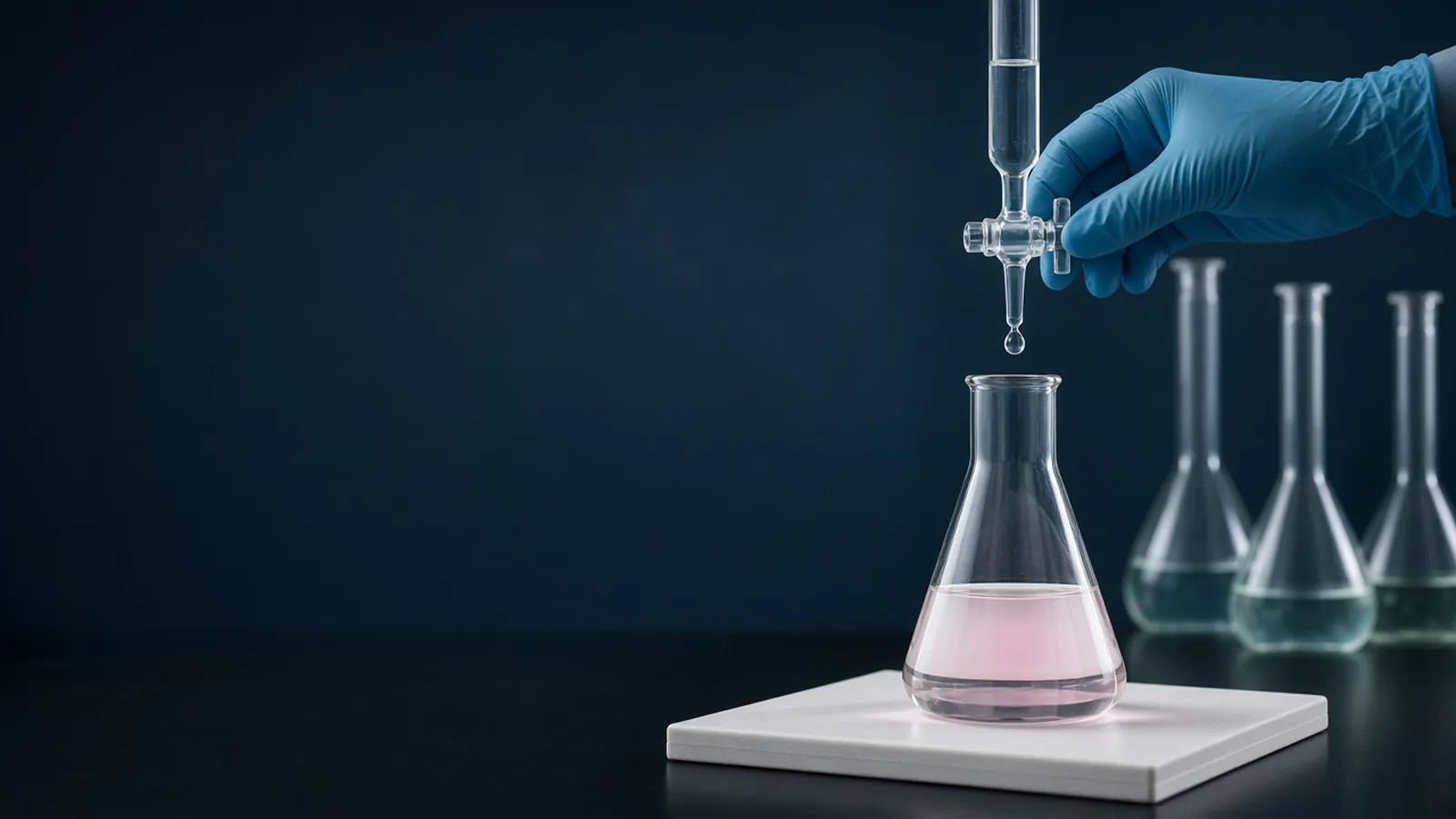
A line etched on a volumetric flask and a pour that looks like a litre in a beaker both end with a full vessel. They promise different things about concentration. The flask's line is a calibration at a stated temperature, commonly 20 °C. The beaker's mark is a rough guide, and an unmarked top-up by eye is coarser still. This explainer is why the order is dissolve, adjust pH, then make up, and why warm water does not sit on that line the way cold water does. Choosing the glass in the first place is discussed in choosing laboratory glassware. The pH half of the order is preparing a buffer and checking pH. The solvent grade is laboratory water types and where they fail.
Salts come from the reagents and chemicals catalogue. The beaker you dissolve in, and the flask you finish in, are specified with beakers and flasks. If the volume is the thing you are buying glassware to defend, say so on the quotation request.
Two operations that look alike
Volumetric preparation means a known amount of substance is contained in a known volume at the conditions of the calibration. For a flask marked to contain, the meniscus on the line is that volume at the temperature inscribed on the glass, when the flask is clean and you read the meniscus as the flask expects, usually at eye level. The concentration you compute from the mass and that volume is then an honest number, within the tolerance class of the flask.
Top-up habits are the other operation. You dissolve in a beaker, you pour until the graduation you can see, or until the beaker "looks like" the volume in the recipe, and you start the assay. That is legitimate for a wash whose concentration is not interpreted, for a rinse, or for a teaching demonstration that says approximate. It is a different record. Writing "500.0 mL" after a beaker top-up invents a precision the vessel did not have.
The decision this page supports is which operation the method required, and whether the notebook matches it.
What the calibration temperature is doing
Liquid water expands as temperature rises through the range laboratories actually use. Density falls from the calibration region around 20 °C toward a warmer bench. A solution brought to the mark while warm therefore contains less mass of solution than the nominal volume suggests when you later think of that volume at the calibration temperature. When the flask cools, the meniscus sits below the line. The direction is the useful fact: warmer fill, less mass per nominal litre, lower concentration once you compare at one temperature. Glass expands too, and the solution's expansion may differ slightly from pure water. Those are smaller or recipe-dependent corrections. This page does not invent a percent error for a particular building. Read the temperature on the flask, avoid making critical volumes on a sun-warmed sill, and let a warm solution equilibrate if the concentration will be interpreted tightly.
A flask used far below its calibration temperature errs in the opposite direction: the liquid is denser, the mark captures more mass, and on warming the meniscus climbs. Again, state the direction and let a real calibration budget live in the metrology procedure if you need a number. NIST's laboratory metrology pages are the public door to that kind of documentary standard. They are not a substitute for the inscription on the flask in your hand.
Dissolve below the mark, then adjust, then make up
Solids change the volume when they dissolve. Acid and base added to set pH change the volume again. If you fill to the line first and then titrate, every drop of titrant dilutes the concentration you calculated, and a clumsy overshoot that you reverse with a second reagent dilutes it further and adds salt. The workable order is the one the buffer method already uses. Dissolve in a beaker at something like four-fifths of the final volume. Confirm the solid is gone. Bring the solution to the temperature at which you will report pH. Calibrate the electrode with fresh buffers that bracket the target, and stop if the slope is a failed control. Adjust. Transfer into the volumetric flask, rinse the beaker into the flask with the same water, and only then bring the meniscus to the mark. Mix by inversion. The rinses are part of the quantitative transfer. A rinse you throw away is a loss of solute.
pH paper or a single uncalibrated reading is not the adjust step for a buffer someone else will treat as pH 7.40. Conductivity after making up can show a gross salt mistake. It cannot repair a meniscus that was set in a hurry above the line.
Where a beaker is the honest tool
Use the beaker for dissolving, for rough media where the recipe says "about," and for waste collection. Graduations on beakers are there to keep you from overfilling, not to certify a molarity. A top-up by eye, with no graduation used at all, is the coarse end of that family. If you choose it, label the bottle "approximate" or record the method's actual wording. The next person is then allowed to make a volumetric batch when the assay tightens, instead of inheriting a fake precision.
Mixing cylinders sit between the two. They are better than a beaker and they are not automatically the flask's calibration. Read what the cylinder claims and which temperature it claims it at. If you do not know, do not record it as class A.
| Habit | What you may claim | What goes wrong if you over-claim |
|---|---|---|
| Volumetric flask at its marked temperature, meniscus on the line | A concentration tied to a calibrated volume | A warm fill you still record as the 20 °C volume |
| Dissolve, pH, then make up | The titrant volume is inside the final volume | Adjusting after the mark and keeping the old molarity |
| Beaker graduation | An approximate volume for a coarse method | Writing three significant figures the beaker never had |
| Top-up by eye | A clearly rough preparation | Promoting that bottle to a standard curve |
| Warm solution cooled after the mark | The direction of the volume change is known | Inventing a lab-specific percent without a calibration |
Failure modes
The classic quantitative failure is a standard curve that will not repeat after a new operator "made it the same way" in a beaker. Compare the vessels before you compare the analytes. The classic buffer failure is a pH adjusted in the volumetric flask after the mark, followed by a concentration that no longer matches the enzyme paper. Remake the batch if the overshoot was large. The classic thermal failure is a flask filled at the end of a hot afternoon and used as a reference the next cool morning, with no temperature written down. You will not know which direction to suspect until the temperature is in the note. Once it is, the direction above tells you which way the concentration moved. It still does not give you a homemade percent to "correct" the assay by.
A dirty flask, especially one with detergent residue, changes the meniscus and can inhibit an enzyme. Rinse volumetric glass as the glassware method requires. A chip on the neck that makes the line hard to see is a reason to retire the flask from quantitative work. Parafilm as a mixing lid that leaks during inversion loses solution that you then top up, which is a second dilution. Invert as the flask allows, with a stopper that fits.
Safety and research limits
Acids and bases used in the adjust step are the hazard, not the calibration line. Eye protection, and acid added to water when you dilute a concentrate, are the standing rules. A volumetric preparation of a buffer is not a sterile preparation unless you ran a sterilising step afterward, and autoclaving can shift both volume and pH. Recheck if the method says the number matters. This explainer is not a diagnostic method and not a biosafety approval. Institutional rules cover infectious material. Glassware choice does not.
Warm benches
In a laboratory that spends the afternoon well above 20 °C, let critical solutions cool toward the flask's temperature before you set the meniscus, or accept a coarser method and say so. Do not invent a correction factor for "our building." Humidity does not move the meniscus. It does move hygroscopic masses before they ever reach the flask, which is a weighing problem feeding a volumetric one. Power cuts matter if they stop the stirrer mid-dissolution and someone makes up a suspension. Finish dissolving first.
What to ask for
When glassware is the purchase, ask for the nominal volume, whether the vessel is volumetric and to contain or to deliver, the calibration temperature, and the class if you need a known tolerance. When the purchase is a ready solution, ask for concentration and for how the volume was defined, plus pH and temperature. A certificate that says "prepared in a beaker" is allowed to be coarse. A certificate that implies a standard concentration should be traceable to a volumetric step you can recognise. Check the flask inscription on receipt the way you check a reagent label: the temperature and the volume are the specification.
Questions from the bench
Why does the flask say 20 °C?
The calibration line is true for the temperature printed on the flask, commonly 20 °C, for a stated operation such as to contain. Water and the solution expand as they warm above that region. Filling to the mark on a hot bench captures less mass than the same mark at the calibration temperature.
Is topping a beaker up to the graduation ever acceptable?
Yes, when the method only needs a coarse concentration and you say so. Beaker marks are approximate guides. They are a different promise from a volumetric flask's calibration line. Do not record a beaker top-up as if it were a class A volume.
When do I adjust pH relative to the mark?
Dissolve below the mark, equilibrate, set the pH, and only then bring the solution to the line. Acid or base added after the mark changes the concentration. The electrode work is the same discipline as any other buffer: fresh standards, a slope inside the laboratory window, and the temperature written down.
References
Manufacturer names identify published method classes. Trademarks remain with their owners. Catalogue records on this site are independent references for enquiry. They are not a statement of inventory, distribution rights or a supply commitment. This page is educational. It is not medical advice, a diagnostic protocol or a biosafety approval.
Catalogue
Related products and categories
These links follow the subject of the article into published manufacturer references. A listing is a reference for an enquiry, not a statement of stock or distribution rights.
Continue in this cluster
Related reading
 Laboratory water types and where they failResistivity, organic carbon and endotoxin answer different questions. A water grade fails when the assay cares about a contaminant the meter cannot see.
 Preparing a buffer and checking pHPrepare a buffer at a stated pH and temperature, record the salt form, and treat a drifting electrode or a bad slope as a failed control.A glossary of solution termsDecide which number a recipe means before you weigh a salt: molarity or molality, which percent, normality, buffer capacity, osmolality, or hydrogen-ion