
comparison
When to repeat an extraction
Compare repeating the extraction, diluting and retrying the assay, and cleaning the same eluate. Use blanks, labels, yield and debris to choose.
- Author
- EVRINTH Editorial Team
- Published
- 8 October 2026
- Updated
- 8 October 2026
- Reading time
- 7 min
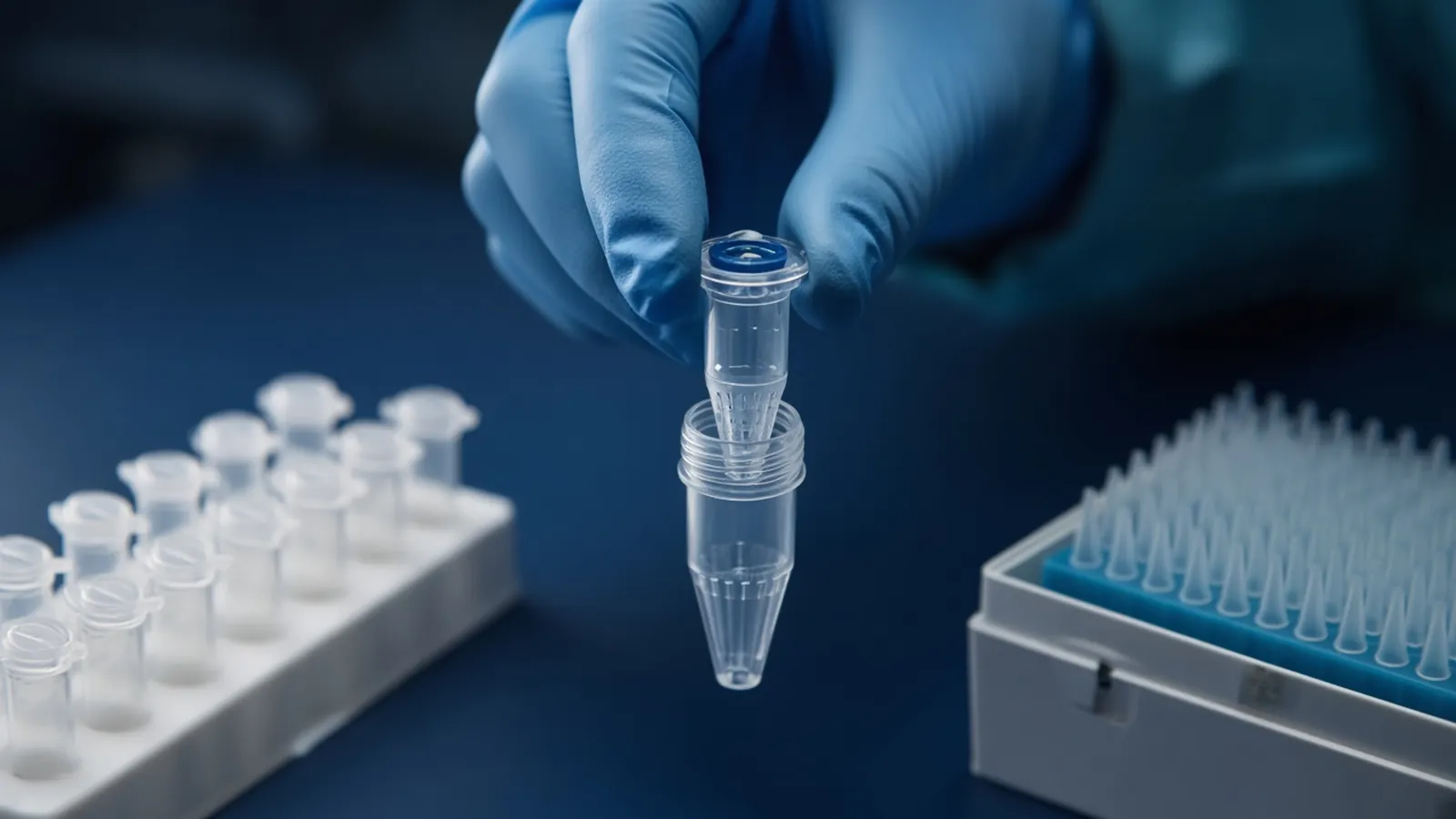
When to repeat an extraction is a comparison among three next actions. You can go back to the specimen and extract again. You can dilute the eluate and retry the assay. You can send the same eluate through a cleanup. They spend different things: specimen, time, or a column. The right one depends on the failure in front of you, not on a habit of starting over. This is a research comparison. It does not promise that a repeat will hit a yield, and it is not a clinical retest rule.
The extraction you might repeat is one of the classes in how DNA extraction methods differ. If the assay is PCR, dilution and spikes are also part of PCR controls and contamination control.
Repeat the extraction
Repeating means a new lysis on retained specimen, or on a backup aliquot that is still identified, using a method you can name. It is the right spend when the nucleic acid you need is probably not in the current tube, or the tube is not allowed to be used.
Choose it when the reagent blank was contaminated. The samples from that batch are not interpretable. Cleaning them does not unmix contaminant DNA from sample DNA. Diluting them dilutes both. A repeat must also change the suspected cause: a new reagent lot, a cleaner rack, or a handling step you can describe. Repeating on the same contaminated wash is how you buy the same blank twice.
Choose it when labels are in doubt. A swapped cap or a faded code means you do not know which specimen you would be cleaning. Dilution and cleanup preserve the confusion. Go back to a container whose identity is still on the sheet.
Choose it when visible debris shows the lysate never became a solution. A cleanup column will clog on the same debris. Dilution does not finish sample lysis. Clarify, or repeat from a piece you can actually open.
Choose it when RNA integrity is already poor and the assay needs long RNA. Cleanup removes some contaminants. It does not rejoin cut molecules. A new extraction from better-preserved material is the remaining path. If nothing better-preserved exists, say so and stop, rather than repeating a doomed lysis for a number.
Dilute and retry the assay
Dilution keeps the same eluate and asks the assay to tolerate it. It is cheap, and it is informative. A tenfold dilution that suddenly amplifies, or that lets a spiked control work, means inhibitors or too much template were the problem. You do not need a new extraction to learn that.
Dilution is the wrong spend when the assay has a minimum input and you are already below it. You will learn that the reaction can run, and you will still not have enough template. It is also the wrong spend on a failed blank. You would be diluting a contaminated set and perhaps dropping the contaminant under the detection line while leaving the interpretation dishonest.
Use dilution before cleanup when you can afford a few microlitres and the question is inhibition. Use it after a cleanup only to check that the cleanup worked. Do not stack dilutions until a band appears and then report that band as the original sample.
Clean the same eluate
A cleanup is a second bind-wash-elute, or a bead wash, on the nucleic acid you already have. It spends a column and loses some mass, and it can leave you in a smaller volume. It is the right spend when A260/A280 or A260/A230 says leftovers remain, the mass is still above what the next method needs, and the blank from the original prep was clean.
It is the wrong spend when the yield is already below the next method and cleanup losses would sink it further, unless the cleanup's smaller elution is a concentration step you have planned on purpose. It does not fix labels. It does not fix a contaminated blank. It does not fix inhibition that survives that chemistry. If you clean and a spike into the cleaned eluate still dies, the inhibitor is not what that cleanup removes, or the enzyme reaction is broken for another reason. Repeating the extraction with a method aimed at the matrix is then the honest next action, provided specimen remains.
| Failure in front of you | Repeat extraction | Dilute and retry | Cleanup of this eluate |
|---|---|---|---|
| Contaminated blank | Yes, after the cause changes | No | No |
| Labels in doubt | Only from a still-identified specimen | No | No |
| Yield below the next method | Yes, if input or lysis can improve | No, it lowers mass further | Only if it concentrates enough |
| Visible debris | Yes, or clarify first | No | No, the column clogs |
| Inhibition a cleanup does not fix | Yes, if specimen remains | Already the test that showed inhibition | Already tried |
A short order of tests
Look at the blank and the labels before you touch the chemistry. Either one can forbid both dilution and cleanup.
If those are sound, and the assay failed, dilute once and include a spike of a trusted template in a sister tube. Rescue of the spike means the eluate was inhibitory or the original load was too high. Then decide between using the dilution, if the mass still suffices, and a cleanup, if you need the contaminants gone rather than diluted.
If the spike works and the sample still fails, you are looking at missing target or a lysis that did not release it. Repeat only if specimen remains and the answer is worth the specimen.
If yield is the complaint rather than a dead assay, compare the mass with what the next method needs. Below that need, dilution is theatre. Cleanup helps only as a concentrator. Otherwise repeat from more input or a completed lysis, and do not write down an expected yield in advance.
When a little specimen can be spared, split it before you commit. One portion repeats the extraction with a single change, such as a finished lysis. Another portion of the existing eluate is either diluted or cleaned, not both. The comparison is then real: same specimen, three different spends, one recorded winner. If you cannot spare the split, pick the action the table allows and write why the other two were refused. A later reader should see that dilution was rejected because of a failed blank, not because the group prefers starting over.
If debris is visible, stop and clear or repeat. Do not discover the clog halfway through a cleanup you cannot finish.
When none of the three is honest
If no specimen remains, the label is gone, and the eluate is inhibitory after cleanup, there is no scientific next action that produces the missing result. Record the stop. Repeating imaginary material, or reporting a diluted contaminant, is worse than a gap.
A courier-warmed backup is not automatically the repeat specimen. If the backup left the cold chain, treat RNA in particular as a new integrity question before you extract it as if it were the fresh aliquot. DNA may still be the better molecule to attempt. Write the excursion on the sheet either way.
Safety
A repeat handles the specimen again. The biosafety decision does not relax because the first prep failed. Follow institutional rules for both the new lysis and the discarded eluate. The WHO biosafety health topic is background, not approval. Do not treat a repeated research extraction as a diagnostic confirmation.
What to say if you need a different method
If the repeat is really a change of method class, say why: debris, inhibitors the cleanup did not remove, or an input above the column you have. Name the specimen and the assay. Use the sample preparation catalogue and the sample preparation pathway, and send that with the quote request. The nucleic acid isolation enquiry reference is an enquiry reference. Ask whether a quotation is possible.
Questions from the bench
Should I always repeat when PCR fails?
No. A failed assay can be inhibition, too much DNA, or a bad master mix. Diluting the eluate and retrying separates those from a prep that never captured the target. Repeat the extraction when the blank failed, the label is untrustworthy, or a cleanup and a dilution still leave the assay dead and you still have specimen.
When is a cleanup enough?
A cleanup is enough when the nucleic acid is already in the tube and the problem is a leftover the cleanup chemistry removes, such as salt, chaotrope, or alcohol. It is not enough when the yield is below what the next method needs and the cleanup cannot concentrate you into range, or when the blank showed contamination. Cleaning a contaminated batch cleans the contaminant too if it is nucleic acid.
What if dilution fixes the spike but the sample stays negative?
The tube can support the enzyme, so inhibition is no longer the best explanation. The sample may lack the target, or the target may have been lost in sample lysis. Repeating the extraction is reasonable if a retained specimen exists and the result matters. Diluting further will not create template.
Does a poor A260/A280 by itself force a new extraction?
The ratio is a cleanliness hint. A cleanup is the direct response when the mass is already enough and the assay cares about that leftover. Repeat only if the ratio is bad and the mass is also too low to be worth cleaning, or if debris shows the lysate never cleared. RNA integrity, if it is poor, is a reason to repeat from better-preserved material rather than to clean the fragments you have.
References
Manufacturer names identify published method classes. Trademarks remain with their owners. Catalogue records on this site are independent references for enquiry. They are not a statement of inventory, distribution rights or a supply commitment. This page is educational. It is not medical advice, a diagnostic protocol or a biosafety approval.
Continue in this cluster
Related reading
How DNA extraction methods differHow silica columns, beads, precipitation and organic extraction change DNA yield, length and inhibitors, and which class fits the assay you actually plan to run.A glossary of purification termsDefine chaotrope, bind-wash-elute, yield, purity ratios and RIN, then walk a purification so those words describe one real workflow.Blood saliva and tissue as starting materialExplain how EDTA blood, heparin blood, saliva and solid tissue behave as extraction inputs, and why a serum tube is not whole blood.