
protocol overview
Autoclaving a buffer can shift pH
Autoclave a buffer only when the composition allows it, then recheck pH at the recipe temperature, because Tris, sugars, and bicarbonate do not come back
- Author
- EVRINTH Editorial Team
- Published
- 8 October 2026
- Updated
- 8 October 2026
- Reading time
- 9 min
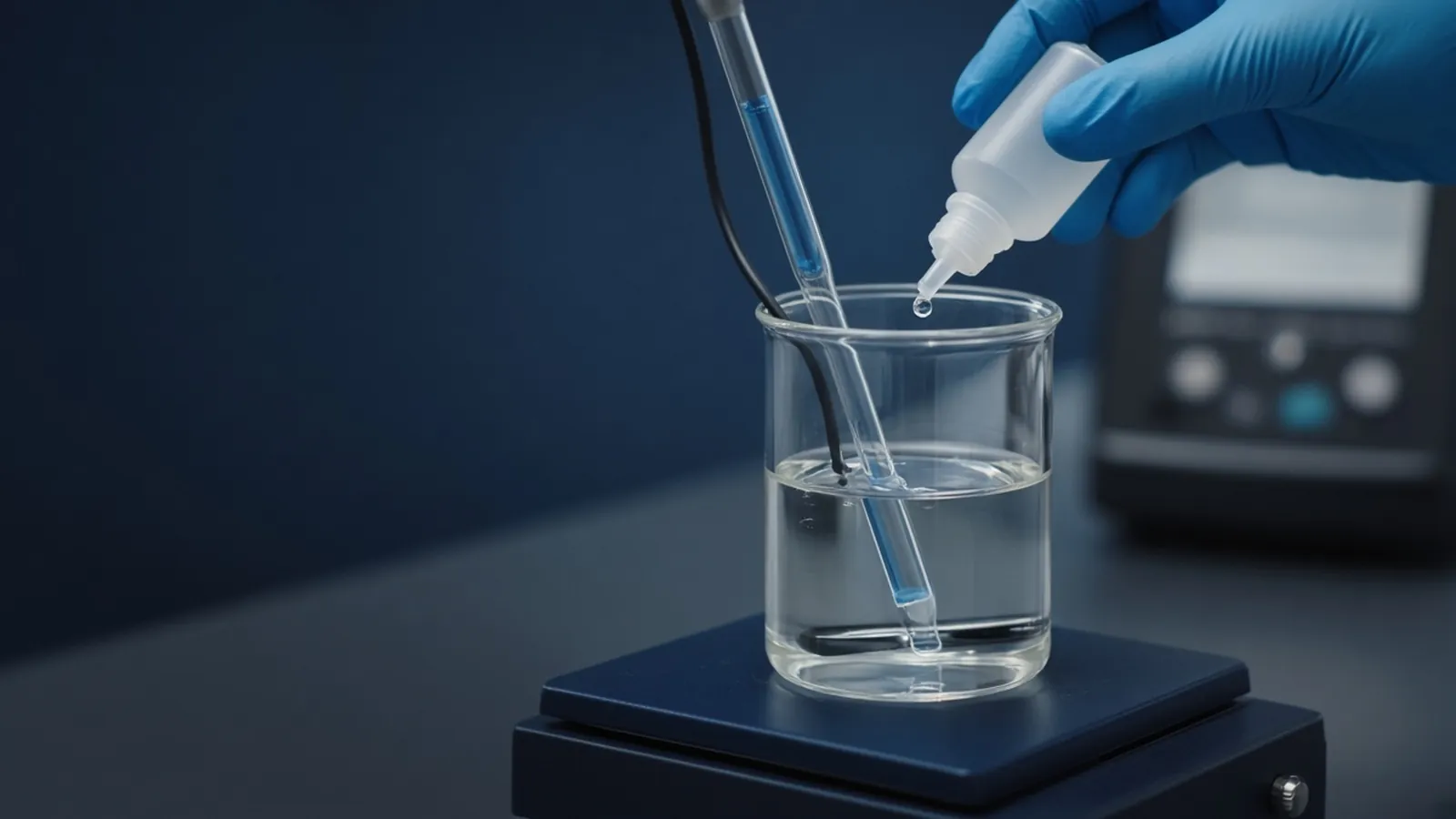
Steam will make a buffer hot enough to move its chemistry and then leave you with a cooled bottle whose pH is a new measurement, not a memory of the number you set. This protocol overview is the decision path for a research buffer: which compositions may go in, how to load them without inventing a universal hold time, and when the pH is allowed to be written on the label.
The meter work after the cycle is the same discipline as preparing a buffer and checking pH. What an autoclave does not wash, and does not prove with a piece of tape, is in autoclaves and what sterilisation does not do. Water that entered the buffer is still a water problem, covered in laboratory water types and where they fail. Salts and any heat-stable components are specified from the reagents and chemicals catalogue. Rated bottles live with beakers and flasks. If you are buying vessels for this cycle, say so on the quotation request.
Which bottles belong in the autoclave
Tris buffers are commonly autoclaved. The molecule is robust enough that laboratories do it every week, and the pH still commonly moves relative to the number you set on the bench. Part of that move is the temperature coefficient: Tris pH falls as the solution warms, by a few hundredths of a unit per degree, and rises again as it cools. A reading at 80 degrees is not a reading at 25 degrees or at 20 degrees. Another part can be physical. A vented cap lets some water leave, so the cooled buffer is slightly more concentrated, and dissolved carbon dioxide can shift during the cycle. You do not need to guess the size of the shift. You need to measure it when the bottle is back at the temperature written in the recipe.
Phosphate buffers are the quieter comparison. Their pH changes less across the same temperature span. They still do not like calcium or magnesium, which precipitate, and a sealed full bottle is still a pressure hazard. Quieter is not the same as "do not recheck".
Sugars caramelise. Glucose or sucrose left in a salt buffer will yellow or brown, and the degradation products are a new recipe. If the method can stand it, autoclave the salts and add the sugar afterwards through a 0.22 micrometre filter into the cooled sterile base. If the method demands that the sugar see steam, follow that sheet and expect colour to be a reject criterion.
Bicarbonate decomposes. Heating drives off carbon dioxide and pushes the solution toward carbonate, so both the buffer identity and the pH move. A bicarbonate medium is a filtration candidate, not an autoclave candidate. Do not try to "put the CO2 back" by shaking the cooled bottle in room air and hoping the pH returns to the pre-cycle value. The stoichiometry has changed.
Detergents foam, some are not heat-stable, and a boiling detergent solution can lift out of its vessel. Leave them out unless the method sheet and the safety data sheet both put them in. Antibiotics and many vitamins are the classic filter-afterwards additives. The pattern is consistent: heat the part that survives, filter the part that does not, and write which is which.
Vessel and load, without a magic minute count
Use glass the manufacturer rates for autoclaving, typically a borosilicate laboratory bottle, or a plastic the vessel maker rates for steam. Leave headspace so the liquid can expand. Loosen a screw cap or use the vented cap the bottle was sold with. A tightly closed full bottle is how glass fails in a cycle. The same rule is in the autoclave page, and it is not optional because the contents are "only buffer".
The hold time is the time the load spends at temperature, not the time you typed into a controller if the controller is counting from a chamber sensor that gets hot before a two-litre bottle does. A 100 millilitre bottle and a two-litre bottle in the same basket do not finish together. Follow the autoclave manufacturer's liquid-cycle instructions and the vessel instruction. Copying "the number we always use" from a neighbour's small bottle onto a large one under-processes the large one and over-processes nothing you can defend.
Pack so steam can circulate. A basket of bottles nested against the wall, caps down, or bottles buried under a sack of tips, is a different cycle from the one the manual validated the settings for. Liquids want a slow exhaust so they do not boil over when the pressure falls. A fast exhaust designed for dry glassware is the wrong programme. If you do not know which programme the machine is in, you do not start the buffer.
The recheck is the control
Let the bottle return to the temperature named in the recipe. In a hot laboratory that temperature may be 30 degrees rather than the 20 or 25 the textbook assumed. Measure the actual temperature. Do not wave the bottle and call it cool. Calibrate the electrode if the gap since the last slope check requires it, with standards that bracket the target, and stop if the slope fails. NIST's calibration material is the public reminder that the standards are part of the result.
Read the pH. If it sits inside the window the method allows, label the bottle with the measured pH, the temperature, the date, and the fact that it was autoclaved. If it sits outside the window and the solution is colourless, unprecipitated, and free of the sugar or bicarbonate problems above, the branch is small: adjust with the acid or base the recipe already names, accept that the adjustment changes the concentration slightly, and record the addition. If the solution has browned, clouded, or lost a component you know is heat-labile, do not titrate it back into a false sense of correctness. Prepare it again and change the split between steam and filtration.
Do not adjust a still-hot buffer to the recipe pH. You would be titrating a different temperature's equilibrium, and the cooled bottle would miss in the other direction.
| Composition | Steam | What you recheck or withhold |
|---|---|---|
| Tris, simple salts | Commonly yes | pH after return to the recipe temperature |
| Phosphate, no divalent metals | Often yes | pH at the recipe temperature; any precipitate |
| Sugars | Prefer to add later by filtration | Discard if the salts-plus-sugar bottle browned |
| Bicarbonate | No | Do not try to restore pH by aeration |
| Antibiotics, many vitamins | Add later by filtration | Potency is not a pH question |
| Detergents | Only if the sheet says so | Foam-over and heat stability |
Failures that are not a pH problem
A bottle that cracked, boiled dry, or came out with the cap still tight and the contents up the neck is a load failure. Discard the contents even if a surviving aliquot reads the right pH. You do not know what left and what concentrated.
A cycle interrupted by a power cut is an unfinished cycle. The laboratory's autoclave procedure says whether that load is reheated from the start or discarded. It is not a finished sterile buffer with a slightly adventurous pH. Treat sterility and pH as separate failed controls.
Tape that changed colour, on a bottle whose centre never got there because the load was packed badly, is the failure mode the autoclave page is written to prevent. Combine that scepticism with a pH recheck and you still have not proved sterility. You have only stopped yourself from mis-labelling the pH.
Precipitation after cooling often means a salt that was soluble at autoclave temperature and is not soluble at the recipe temperature, or a divalent metal you did not mean to include. Warming it back to dissolve, then cooling it into the assay, just hides the precipitate until it forms in the well. Remake without the incompatible pair.
Safety
Autoclaves burn people with steam, with hot bottles, and with liquids that boil over when a cap has been left too tight. Use the machine training your laboratory requires. Heat-resistant gloves and eye protection are part of unloading, not an optional extra for large bottles. Judge colour on the bench after the bottle is safe to handle.
This overview is research handling guidance. It is not an occupational approval, and it is not a sterilisation validation for waste or for an infectious load. If the buffer has already been used with a culture, BMBL and the WHO laboratory biosafety manual frame the biosafety decision your institution has to make. A pH shift does not change that decision.
Heat in the room after the cycle
A bottle that feels merely warm in a 32 degree room may still be far above the 25 degree recipe. Write the thermometer value. Humidity does not change the Tris coefficient, but a slow weigh before the cycle still leaves you rechecking the pH of the wrong molarity. Fix the weigh next time. If power cuts abort cycles, log the unfinished load and follow the autoclave rule for it.
What to specify
If the enquiry is for bottles, ask for autoclave-rated vessels and the venting method the maker intends. If the enquiry is for buffer salts, name the salt form and ask for nothing that pretends a supplier autoclave replaced your pH measurement. Your laboratory still rechecks at the recipe temperature. Put the vessel rating and the chemical identity on the quotation request, and keep the cycle time in the autoclave log rather than in a purchasing adjective.
Autoclave a buffer and accept the pH only after it has cooled
- 01Decide whether this composition may see steamKeep bicarbonate and sugars out of the autoclave unless the method sheet explicitly puts them there. Tris and many simple salt buffers are commonly autoclaved, then rechecked. If a component is only stable by filtration, sterilise the salt base and add that component afterwards through a membrane.
- 02Load the vessel the way its maker and the autoclave instruction describeUse a rated borosilicate or a rated plastic, leave headspace, and vent the cap as the vessel instruction says. Do not copy a minute count from a small bottle onto a large one. The load, the volume, and the autoclave cycle determine how long the liquid centre is at temperature.
- 03Cool to the recipe temperature, then measure the pHA reading taken in a hot bottle is not the pH the recipe named. When the solution is back at that temperature, calibrate if the meter needs it, read the pH, and record it. If the shift is outside the laboratory window, adjust only with the acid or base the recipe allows, or prepare the buffer again.
Questions from the bench
Why does Tris move when phosphate looks quieter?
Tris has a large temperature coefficient, on the order of a few hundredths of a pH unit per degree, so a hot reading and a cooled reading are far apart even when the chemistry survived. Phosphate moves much less with temperature. You still recheck both at the recipe temperature, because evaporation and a lost cap can concentrate either one.
Can I autoclave a bicarbonate medium if I am in a hurry?
No. Bicarbonate decomposes on strong heating and loses carbon dioxide, so the alkalinity you get back is not the alkalinity you prepared. Cell-culture media that rely on bicarbonate are filter-sterilised for that reason, among others. Hurry is not a special case that changes the chemistry.
The bottle browned. Can I still use it if the pH is close?
No. Browning is caramelisation of sugar, or another heat reaction you did not plan. The pH of a browned solution can look almost acceptable while the composition has changed. Discard it. Next time, autoclave the salt base and add the sugar by filtration if the method allows.
Is a colour-change tape evidence that the pH is still right?
No. Tape reports that an indicator saw heat. It does not report the pH of your buffer, and it does not prove the liquid centre reached the cycle the autoclave was set for. Those limits are discussed with steam sterilisation more broadly elsewhere. Recheck the pH with a meter at the recipe temperature.
References
Manufacturer names identify published method classes. Trademarks remain with their owners. Catalogue records on this site are independent references for enquiry. They are not a statement of inventory, distribution rights or a supply commitment. This page is educational. It is not medical advice, a diagnostic protocol or a biosafety approval.
Catalogue
Related products and categories
These links follow the subject of the article into published manufacturer references. A listing is a reference for an enquiry, not a statement of stock or distribution rights.
Continue in this cluster
Related reading
 Laboratory water types and where they failResistivity, organic carbon and endotoxin answer different questions. A water grade fails when the assay cares about a contaminant the meter cannot see.Preparing a buffer and checking pHPrepare a buffer at a stated pH and temperature, record the salt form, and treat a drifting electrode or a bad slope as a failed control.
 Autoclaves and what sterilisation does not doSteam sterilisation holds a cleaned load at temperature. It does not wash, remove endotoxin, or prove sterility because the tape changed colour.