
selection guide
Biosafety cabinets are not fume hoods
Choose a Class II cabinet, a chemical fume hood, or a laminar clean bench by what each airflow protects. HEPA filtration does not capture vapours.
- Author
- EVRINTH Editorial Team
- Published
- 8 October 2026
- Updated
- 8 October 2026
- Reading time
- 9 min
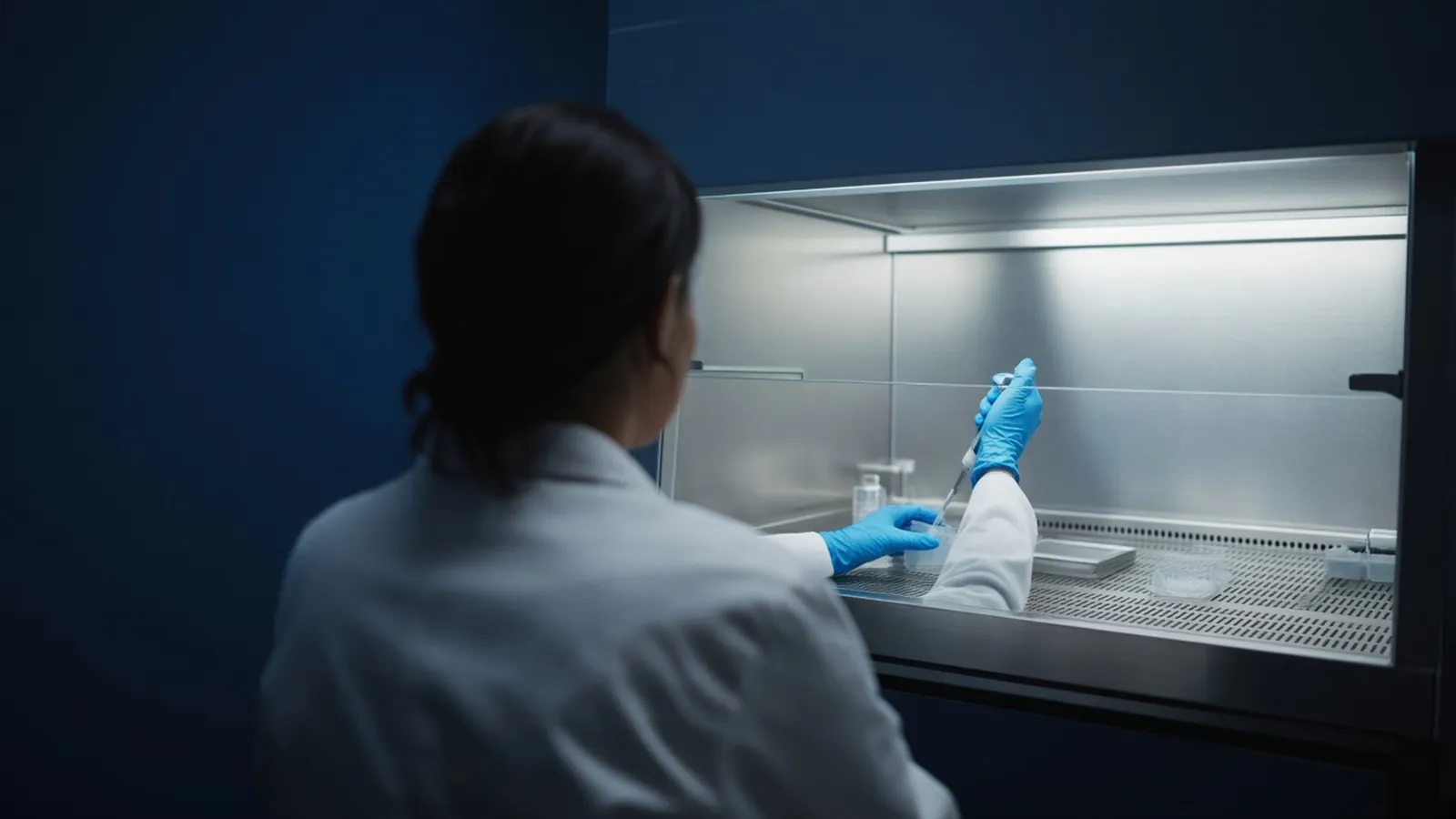
Three pieces of equipment get called the hood. A Class II biosafety cabinet, a chemical fume hood, and a laminar clean bench move air for different reasons. Putting one name on all three is how a volatile solvent ends up behind a HEPA filter that cannot catch it, or how a culture ends up on a bench that blows air toward the person. Selection starts from what must be protected: the work, the user, the room, or the people breathing a vapour.
Once a Class II cabinet is the tool the assessment named, the habits that keep it honest are in working inside a biosafety cabinet. The wider barrier stack is in biosafety basics for research benches. Consumables that belong inside the cabinet, rather than the cabinet itself, are in laboratory consumables. A laboratory writing a specification can discuss the choice through academic research and a quotation request. This is a selection guide for people preparing that specification. It is not permission to start the work.
What each airflow is for
A Class II biosafety cabinet, when it is certified and used as a Class II cabinet, draws air in at the front opening to protect the user, sends HEPA-filtered air down onto the work to protect the product, and sends HEPA-filtered exhaust out to protect the environment. That is the three-way protection people mean. The CDC BMBL and the WHO laboratory biosafety manual describe cabinets in that role: containment equipment for procedures that can generate aerosols, inside an assessment, not as a general chemical hood.
HEPA filtration is a particle technology. Droplets and aerosols of microbes are particles. Solvent vapour is not a particle in that sense. It rides through a HEPA filter with the air. If the cabinet recirculates most of its air into the room, the vapour comes back into the room. That is why a recirculating Class II cabinet is the wrong place for volatile chemicals. Some Class II designs are hard-ducted and are built so a portion of the air, or all of it, leaves the building. Those designs are a chemical question as well as a biological one. The cabinet specification, the chemical hygiene officer, and the biosafety officer have to agree before anyone calls it suitable for a named solvent. "It is a cabinet" is not that agreement.
A chemical fume hood exists to capture and exhaust vapours, and the sash is both a shield and part of the airflow. The working words for hoods are in fume hoods and volatile chemicals. A fume hood does not give you the product-protecting, HEPA-filtered downflow of a Class II cabinet. Using a fume hood for an infectious culture because "the air goes away" can protect the user from a smell and still fail the containment and product requirements the biological assessment was written around. Where the OSHA laboratory standard applies, the hood is an engineering control for hazardous chemicals. It is not a biosafety cabinet by another name.
A laminar clean bench, sometimes sold as a laminar flow hood, sends filtered air across the work so dust does not settle on a clean product. On a horizontal bench that air travels toward the user. A vertical clean bench can look similar to a cabinet in a photograph and still lack the inflow that protects the person. The hero image on some laboratory pages, including pages about hoods, often shows culture flasks in this kind of enclosure. Look at the airflow diagram on the actual machine, not at the flask. If air meets your face, you are not in a Class II cabinet.
Class I cabinets protect the user and the environment and do not protect the product. Class III cabinets are gas-tight glove boxes for work an institution has placed at a very high level of containment. Naming them is enough. This page is not an operating procedure for either, and it is not an invitation to use them.
Criteria that actually choose
Write four lines before you compare brochures.
What must not reach the user? An aerosol of a culture is a cabinet question. A vapour is a fume-hood question. Both at once is a specialised, ducted arrangement that has to be accepted in the assessment, not a compromise you make on the day.
What must not be contaminated by the room? Sterile media and a clean assembly want product protection. A Class II cabinet or a clean bench can provide that, and only the Class II cabinet also protects the user. If the product is harmless and the user must not be exposed, do not "upgrade" to a clean bench. You would be reversing the airflow's duty.
Where does the air go? Recirculated into the room, exhausted outdoors, or blown at the operator. Ask the manufacturer to state this in a sentence you can file. A diagram with arrows is the document. A word like "hood" is not.
What is the proof it still works? A biosafety cabinet is used while it is certified on the schedule the institution and the standard require. A fume hood is used while its test sticker and alarm say the airflow is acceptable. A clean bench has its own filter and airflow checks if you are relying on it for product protection. A running fan with an expired sticker is a decoration.
Then add the substances. List every volatile, every acid, and every disinfectant you intend to use in the same enclosure. Disinfectant vapours and ethanol belong in that list. A cabinet SOP may allow a surface disinfectant and still forbid a solvent extraction. Read the line. Do not generalise from "we wipe it with alcohol."
The branch when the chemical shows up late
The common failure is a biological method that later gains a solvent step. You set up a certified Class II cabinet for a culture, then the lysis recipe contains a volatile organic chemical, or someone wants to stain inside the cabinet with a solvent-based dye. Stop. Ask whether that chemical may be in that cabinet. If the answer is no, move the chemical step to a fume hood, or change the chemistry, under the assessment. Do not crack the sash wider and hope dilution will do.
A second branch is a spill. A small biological spill inside a working cabinet is handled the way the cabinet spill SOP says, with the fan still doing its job and the disinfectant the plan named. A solvent spill inside a recirculating cabinet is a vapour in a box that will share it with the room. That is a different emergency, and the plan should already have separated the two. If it has not, you are not ready to put the bottle in the cabinet. Waste that leaves either enclosure follows the stream in risk assessment is a local document. Some biological waste is an autoclave candidate. Solvent waste is not a surprise you add to a biohazard bag. See autoclaves and what sterilisation does not do.
| Tool | Airflow duty | Protects | Does not do |
|---|---|---|---|
| Class II biosafety cabinet | Inflow, HEPA downflow, HEPA exhaust | User, product, and environment when certified and used as such | Capture solvent vapour. A recirculating unit returns vapour to the room |
| Ducted Class II variant | Some or all air exhausted outdoors | Depends on the design and the assessment | Become a fume hood just because a duct exists |
| Chemical fume hood | Captures and exhausts vapour | User from vapours, sash as a shield | Provide HEPA product protection or biological containment by default |
| Laminar clean bench | Filtered air over the work, often toward the user | The product from dust | Protect the user. It can expose the user |
| Open bench | None | Nothing airborne | Any of the duties above |
Certification, power, and a sticker
Select the cabinet that can be certified and maintained where you work. A cabinet that cannot be tested locally is a future open bench with a motor. Ask who certifies, how the result is labelled, and what you do when the label expires. The same question applies to the fume hood's test sticker. Follow that sticker. This page will not invent a face velocity for you.
A power cut is a selection issue as well as an operating issue. If the fan stops, the air path you specified has stopped. The SOP should say to stop work, to cover or secure what the cabinet manufacturer and the biosafety officer require, and not to resume the moment the lights return. The purge time, if one is required before you start again, is the time in the SOP, not a number guessed from memory. Write the power-cut branch into the assessment before you rely on the enclosure. In a building where supply interruptions are part of ordinary life, that branch is not theoretical.
What this guide does not grant
Choosing the right enclosure does not authorise the organism, the volume, or the people. Risk assessment and authorisation sit with the institution. This page is not a biosafety approval, not a medical instruction, and not permission to proceed. It does not assign a biosafety level. Higher-containment ventilation is a facility project for people who already operate those facilities. Nothing here is a build guide.
What to put in the enquiry
State which of the three duties you need: particle containment with product protection, vapour exhaust, or dust-free product protection only. Ask the seller to confirm class, recirculation versus ducting, and what a HEPA filter does not capture. Say which chemicals would be present, in general terms the institution allows. Ask what certification the manufacturer expects after installation. Send the specification with a quotation request. Keep consumables, such as surface disinfectants compatible with the work surface, on a separate line so a wipe is not mistaken for the airflow. Do not ask anyone outside the institution to declare the room suitable for your agent.
Questions from the bench
Does a HEPA filter make a biosafety cabinet safe for volatile chemicals?
No. A HEPA filter captures airborne particles. Solvent vapours and gases pass through it. A recirculating Class II cabinet that sends air back into the room is the wrong tool for volatile work. A few ducted cabinet designs can exhaust some chemical vapour, and only the assessment, the chemical hygiene officer, and the cabinet's own specification can say whether yours is one of them.
Is a laminar clean bench a biosafety cabinet?
No. A laminar clean bench is built to keep dust off the work. Horizontal benches blow filtered air toward the person. That protects a clean product and exposes the user to whatever is on the bench. It is the wrong tool for an infectious culture or any material you do not want aimed at your face.
What should a quotation for a cabinet specify?
Specify the class, whether the air is recirculated or ducted, the certification expectation, and the work the institution has already assessed. Include the chemicals, if any, that would share the cabinet. Ask for the manufacturer's statement of what the airflow protects. Do not ask a seller to assign a biosafety level to your organism.
Where do spills and the autoclave fit?
A spill inside a cabinet is still a spill, and the local plan names the disinfectant and who may clean it. Waste leaving the cabinet follows the waste stream in the assessment. An autoclave can be the destination for some biological waste and is the wrong destination for solvents and for many mixed loads. Those limits are in the autoclave article.
References
Manufacturer names identify published method classes. Trademarks remain with their owners. Catalogue records on this site are independent references for enquiry. They are not a statement of inventory, distribution rights or a supply commitment. This page is educational. It is not medical advice, a diagnostic protocol or a biosafety approval.
Catalogue
Related products and categories
These links follow the subject of the article into published manufacturer references. A listing is a reference for an enquiry, not a statement of stock or distribution rights.
Continue in this cluster
Related reading
 Biosafety basics for research benchesResearch-bench biosafety is a stack of barriers chosen by a risk assessment. This page explains the stack. It does not approve the work.Working inside a biosafety cabinetHow a Class II biosafety cabinet moves air, how that differs from a chemical fume hood, and which habits keep cultures and workers protected.A glossary of biosafety termsPairs that share a bench still do different jobs. Use this comparison to choose the right word for a cabinet, a chemical, a level, or a control.