
application
DNase treatment and its limits
Decide when DNase should remove genomic DNA from an RNA prep, and where the enzyme can nick RNA or remain active into reverse transcription.
- Author
- EVRINTH Editorial Team
- Published
- 8 October 2026
- Updated
- 8 October 2026
- Reading time
- 9 min
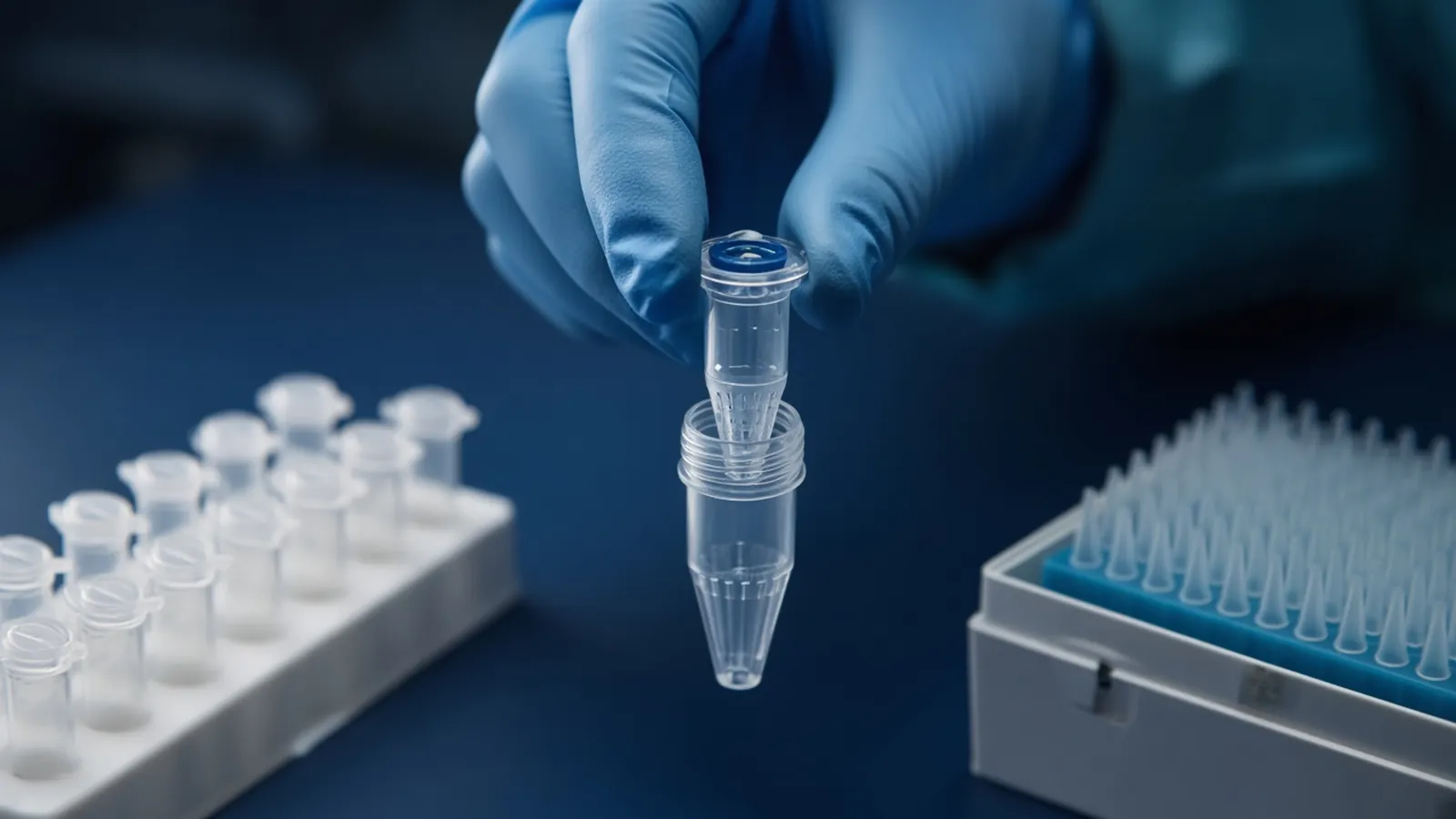
DNase treatment is the decision to destroy DNA on purpose so an RNA measurement is not secretly a DNA measurement. Use it when genomic DNA would inflate an absorbance, or would amplify in a reverse-transcription assay whose primers can bind that DNA. Stop when you still need the DNA, when the primers already cannot copy the genomic sequence and the no-RT control is clean, or when the RNA is so scarce that another incubation and another cleanup will spend the sample for a problem you have not shown you have. Those are the edges of the application. Inside them, the enzyme has limits that a vendor adjective will not mention.
Nucleic acid extraction and sample lysis decide how much DNA is in the RNA tube to begin with. A harsher lysis or a larger input often brings more DNA, which is why a DNase step appears in so many kits. The extraction classes are compared in how DNA extraction methods differ. How a no-RT well sits inside a relative-expression plate is described in RT-qPCR for relative expression. This page is when to add the enzyme, and when the enzyme itself becomes the artefact.
What the enzyme does, and what it is assumed to do
Deoxyribonuclease cuts DNA. The common research enzyme, DNase I and its close relatives, needs divalent cations such as magnesium and calcium to work. RNA is not the intended substrate. In practice RNA is nicked often enough that a trace taken after a casual digest can look worse than the trace taken before it. Two mechanisms show up on real benches. The enzyme preparation can contain a trace of RNase. And heat used to kill the DNase, while magnesium is still present, can cleave RNA even after the DNase itself is dying. Many cards therefore tell you to add an EDTA-class chelator before heat, or to skip heat and remove the enzyme on a silica column or with beads. Follow the card in your hand. Heat alone is not a universal off switch.
If active DNase survives into the reverse-transcription tube, it can attack the cDNA as it is made and can damage DNA primers in that reaction. The RNA may have been fine, the genomic DNA may have been gone, and the assay still collapses. Removal or inactivation is part of the treatment, not an optional polish. A silica column cleanup after an in-solution digest is one class of removal. An inactivation the manufacturer validated is another. Leaving the enzyme there because the tube is already small is how the limit appears in the data.
None of this purifies the RNA. Phenol, ethanol, guanidine, heparin and degraded ends are untouched by a nuclease that targets DNA. Calling the tube pure because a DNase incubation finished is the claim this application does not support.
When to choose it, and when to stop
Choose DNase when the downstream readout cannot tell DNA from RNA. A primer pair that sits inside one exon will amplify genomic DNA happily. An A260 quantification of "RNA" will count DNA as if it were RNA. Some library methods state that residual DNA becomes library molecules. In those cases the enzyme is doing a job the assay cannot do for itself.
Stop, or do not start, when the biological question needs genomic DNA from the same cells. Stop when your primers span a large intron, the genomic product is either absent or a different size, and a no-RT control in this matrix is repeatedly blank. The enzyme is then a risk of nicking RNA without a corresponding benefit. Stop when a pilot shows that the digest plus cleanup loses more RNA than the DNA contamination was worth, and switch the effort to primer design or to a smaller DNA input at lysis. Stop when you cannot remove the DNase afterwards. An enzyme you cannot inactivate is not a treatment you should add to a scarce eluate.
On-column digestion suits a silica workflow you are already inside. It can under-digest when the membrane is overloaded with DNA, which is another way sample lysis and input show up later as a positive no-RT. In-solution digestion gives the enzyme a better chance at stubborn DNA and a better chance to nick RNA if you handle the metals casually. Pick one class and finish its removal step. Do not do both on the same precious tube "to be sure" unless a pilot on spare RNA says the yield survives.
The no-RT control is the evidence
A no-reverse-transcription control contains the RNA and the amplification reagents without the reverse transcriptase. If it produces product, something DNA-like is being copied. That something may be genomic DNA the DNase missed, plasmid contamination, or a primer artefact. The control does not measure purity, integrity, or the accuracy of a fold change. It answers one question: does this signal require reverse transcription?
If the no-RT well is blank and the RT well is positive, you may treat the signal as dependent on reverse transcription, within the limits of that assay. You may not write that the RNA is pure or intact. If the no-RT well is positive, you do not have an RNA-only result. Repeating the DNase with a less overloaded input, removing the enzyme properly, or redesigning primers are the scientific responses. Subtracting "a little genomic background" without a stated, reviewed rule is how DNA becomes a gene-expression paper.
Run the no-RT on the treated RNA, not on a different sample you wish were equivalent. A water no-template control answers contamination of the mix. It does not answer whether this RNA tube still contains DNA. You need both controls when the claim is a transcript measurement.
| Situation | DNase is justified | Evidence you still need |
|---|---|---|
| Exon-only primers, expression claim | Yes, unless a redesign is coming first | Blank no-RT on the treated RNA |
| Primers already span a large intron and no-RT is blank | Usually no | Keep the no-RT; do not add enzyme for comfort |
| A260 will be reported as RNA mass | Yes, if DNA would move the number | A dye or a trace, not the ratio alone |
| Same sample must also yield genomic DNA | No | Split the specimen before the digest |
| Library protocol demands DNA removal | Yes, as that protocol states | Enzyme removed so it cannot nick the library |
| RNA already scarce and DNA contribution unknown | Pilot on a spare aliquot first | Yield after removal, plus no-RT |
Failure paths that look like biology
A no-RT band that appears only in the richest samples is often overload of an on-column digest. Reduce input at sample lysis, or move that sample to an in-solution digest the protocol allows, and repeat the control. Do not average it into the low-input samples that were actually clean.
A no-RT band in every well, including water, is contamination of the assay, not failure of DNase. Change the mix and the tips before you re-digest the archive.
An RNA trace that collapses only in the DNase-treated half of a split sample is the enzyme step. Check that EDTA was present before heat if the card demands it, that the temperature matched the card, and that the enzyme lot has not been abused. A known-good standard RNA treated beside it confirms the lot. If the standard survives and the sample does not, the sample was fragile already and the digest was the last insult, not the only one.
A reverse transcription that yields nothing only when DNase was used, with a fine trace before the digest, fits active enzyme carried forward, or EDTA carried forward into an RT mix that needed that magnesium. Those two failures look alike and have opposite fixes. Read the card: either you failed to chelate before heat, or you failed to remove the chelator before RT. Guessing with extra magnesium until a signal appears will also transcribe damaged or contaminated templates.
Absorbance that drops after DNase can be DNA leaving, which is the point, or RNA being lost, which is the cost. A dye selective for RNA, or a trace, tells those apart. A260/A280 will not.
Safety and the claim you are allowed to make
DNase is a protein reagent. The serious hazards in the same workflow are usually the lysis chemicals and the specimen, not the nuclease aliquot. Follow the safety data for the lysis kit and the institutional rules for the organism or the human sample. The WHO laboratory biosafety manual is background for that local decision. It does not approve the work.
A blank no-RT control is not a diagnostic viral result and not a statement that genomic DNA is absent below every possible assay. It is evidence about this primer pair and this tube. Write it that narrowly.
Enzyme aliquots and a freezer that warmed
DNase is easy to kill with a bad cold chain and easy to contaminate with a bad bench. Aliquots that thawed during a power cut may under-digest, so the no-RT control turns positive on a method that worked last month. The RNA was not suddenly full of extra genomes. The enzyme was tired. Mark tubes that warmed, and do not pool them with a new lot. An aliquot that lived on a plasmid bench can arrive with RNase on the outside of the tube. Dedicated handling still applies. Record which lot touched which samples so a nicked trace can be traced to a bottle rather than to a biological story.
What to say when you ask for the enzyme or the kit
State whether the digest must be on-column or in solution, what the RNA will be used for, and whether you can run a no-RT control afterwards. Say if the same specimen must also provide DNA, so nobody includes a DNase step in a kit you cannot split. Name the inactivation class you can actually perform. If you cannot heat-inactivate safely, ask for a removal step on a silica column or beads.
Browse enzyme and column classes in the sample preparation catalogue and the route to the assay on the sample preparation pathway. Send the constraint with the quote request. The nucleic acid isolation enquiry reference is a place to describe the specimen and the readout. It is an enquiry reference. It does not mean a DNase treatment is performed for you. Ask whether a quotation is possible. The acceptance check is a blank no-RT well and an RNA trace that still matches the assay, not a claim that the RNA became pure.
Questions from the bench
Does DNase make the RNA pure?
No. DNase hydrolyses DNA. Protein, phenol, ethanol, chaotrope, polysaccharide and already-degraded RNA can all remain. A260/A280 may shift a little because DNA no longer contributes to the absorbance, and that shift is still only a hint. Purity for an enzyme is a cleanup question. DNase is a DNA-removal question. Keep the two words apart in the notebook.
What does a positive no-RT control mean after I used DNase?
The assay is still reading DNA, or the reagents are contaminated with something the primers can copy. It does not mean the reverse transcription worked. Do not subtract a small signal and publish the rest unless you have a documented reason the contribution is negligible. Repeat a more complete removal, or redesign the primers so genomic DNA is not a template, as a relative-expression workflow already requires.
Why would the RNA trace look worse after DNase?
The enzyme step can nick RNA. Heat inactivation in the presence of divalent metals is a known way to cleave RNA, and some DNase preparations carry a trace of RNase. A parallel aliquot of a known-good RNA, treated in the same tube, separates a bad enzyme lot from a sample that was already damaged during sample lysis. Follow the inactivation or the removal the enzyme card specifies.
On a silica column or in solution?
On-column digestion is convenient and can be incomplete when the DNA load is high or the contact is short. In-solution digestion is often more thorough and exposes the RNA to the incubation and to the metals the enzyme needs. Either class is legitimate if you then remove or inactivate the DNase so it does not enter reverse transcription. The card, not a habit from a different kit, chooses the class.
References
Manufacturer names identify published method classes. Trademarks remain with their owners. Catalogue records on this site are independent references for enquiry. They are not a statement of inventory, distribution rights or a supply commitment. This page is educational. It is not medical advice, a diagnostic protocol or a biosafety approval.
Catalogue
Related products and categories
These links follow the subject of the article into published manufacturer references. A listing is a reference for an enquiry, not a statement of stock or distribution rights.
Continue in this cluster
Related reading
How DNA extraction methods differHow silica columns, beads, precipitation and organic extraction change DNA yield, length and inhibitors, and which class fits the assay you actually plan toA glossary of purification termsDefine chaotrope, bind-wash-elute, yield, purity ratios and RIN, then walk a purification so those words describe one real workflow.Blood saliva and tissue as starting materialExplain how EDTA blood, heparin blood, saliva and solid tissue behave as extraction inputs, and why a serum tube is not whole blood.