
comparison
Eye protection and a face shield
Compare safety glasses, sealed goggles, and a face shield by the splash they actually stop. A shield does not retire the need for goggles.
- Author
- EVRINTH Editorial Team
- Published
- 8 October 2026
- Updated
- 8 October 2026
- Reading time
- 9 min
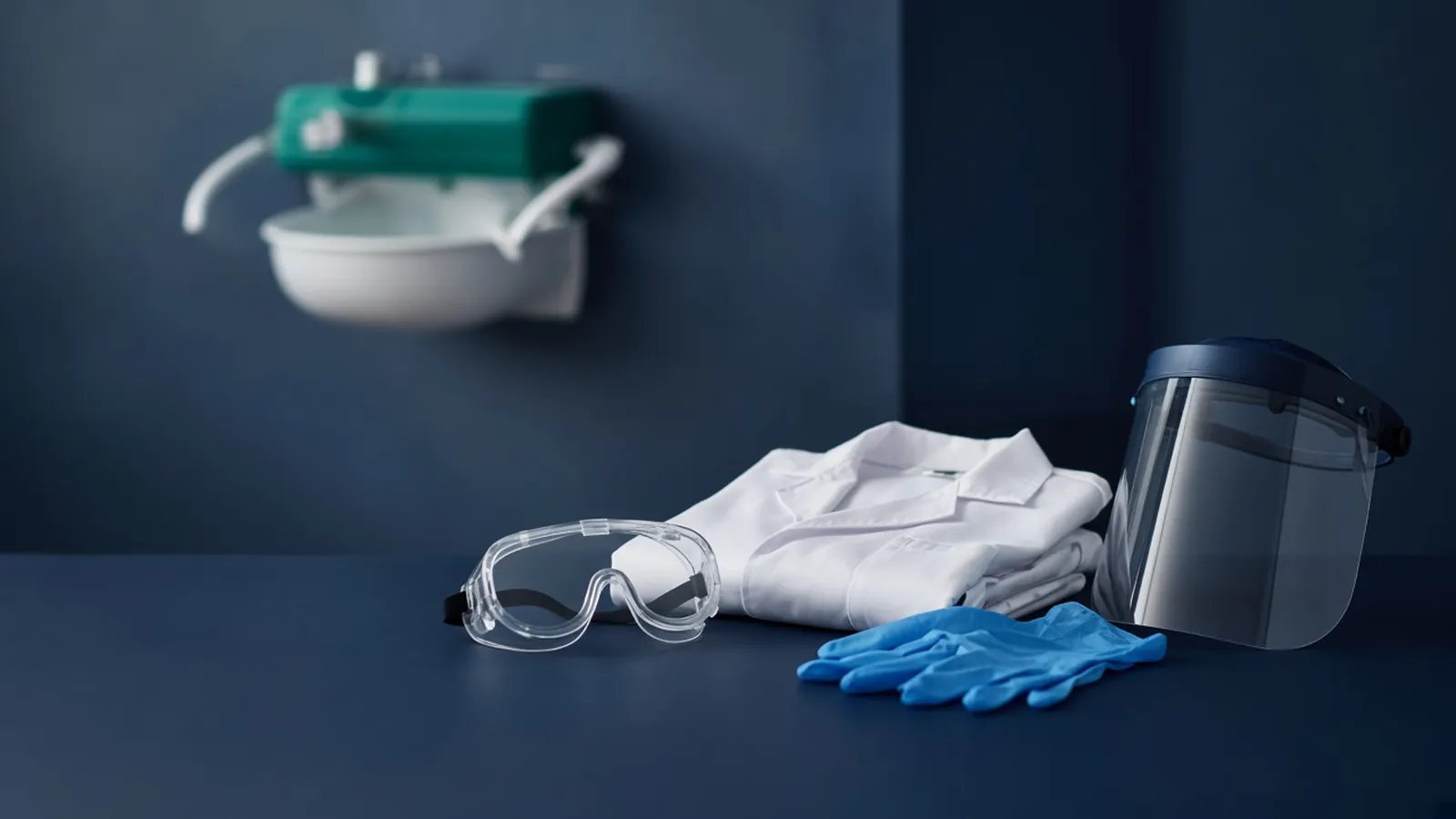
A face shield and a pair of goggles answer different shapes of splash. The shield is a wide visor on the front of the face. Liquid can still travel under it and around the sides. Goggles are built to meet the face so those paths do not reach the eye. Safety glasses, with or without side shields, are a third geometry: useful for some impact and for small, direct splashes, and open everywhere the frame does not sit. Choosing among them is a specification decision. It belongs in the risk assessment, next to the step that could actually throw liquid.
The place of eyewear in the wider barrier stack is in biosafety basics for research benches. How it shares a task with coats and gloves is in PPE that matches the task. Product classes are in laboratory consumables. A teaching laboratory comparing what to specify can use academic research and a quotation request. Commercial intent here means you are about to write a specification. It does not mean a shield is a purchase that settles the hazard.
Two geometries, plus the glasses people already wear
Picture a beaker at chest height. A splash travels outward and upward. A shield in front of the face catches a share of that sheet of liquid. The same splash, hitting the bench and bouncing, or running off the lower edge of the shield, can still reach the eye from below. A tube opened at eye level, or a stopper that pops, sends droplets along a shorter path that a loose shield may not seal.
Goggles change the problem from "did the visor intercept the droplet" to "is there a gap at the skin." Non-vented goggles and indirectly vented goggles are the classes people specify when a chemical splash is credible, because a direct vent is a hole a liquid can use. The exact vent style should be the one your assessment and the eyewear standard you specify have agreed. Do not assume every item sold as a goggle is sealed.
Safety glasses stay on more easily over a long day, and they are what many laboratories require as a minimum when any liquid work is underway. They are a weak answer to a concentrated acid, a hot autoclaved bottle, or a cryogen. Side shields close one path and leave the gap above and below the lens. If your ordinary prescription glasses are the only eyewear in reach, they are not safety glasses unless they were built and marked as such. A visitor's reading glasses are a particularly poor control.
The WHO laboratory biosafety manual and the CDC BMBL expect eye protection when a splash to the eye is part of the procedure. They do not treat a shield and goggles as interchangeable words. Chemical work sits under your chemical hygiene arrangements as well. Where the OSHA laboratory standard applies, protective equipment is chosen for the hazard, after engineering controls, and the safety data sheet is part of that reading.
What you are specifying
When you compare products, separate four features.
Coverage is the area of skin and which gaps remain. A shield covers forehead, much of the face, and sometimes the throat, and it leaves a gap at the chin and the ears. Goggles cover the eye socket. Glasses cover a window in front of each eye.
Seal is whether liquid has to defeat a gasket or only miss a lens. Seal is the reason goggles remain in the specification for many chemical tasks even after a shield is added.
Impact and optical quality are a different hazard. Flying glass from a dropped bottle or a failing rotor lid is not the same event as a slow pour. Specify the impact claim you need by asking which standard the eyewear was tested to. Do not invent a certificate, and do not treat "laboratory grade" on a listing as a standard.
Compatibility with the rest of the task includes prescription inserts, anti-fog performance, and whether the shield fits over the goggles you already require. A shield that cannot be worn with the goggles will be worn instead of them. That is how a comparison on paper becomes a gap at the bench.
Cryogenic work and autoclave unloading add temperature. A cryogen splash is both a cold burn and a splash to the eye. Hot media from an autoclave is a boiling splash. The autoclave article explains what steam does to a load. It does not choose your visor. The autoclave SOP does. Often the honest specification is goggles plus a shield, because the volume is large and the face is close to the door. Confirm that locally rather than copying this sentence into a protocol as if it were your rule.
The eyewash is part of the comparison
Every option above can fail. The eyewash is the control that remains. Before you open the bottle, you should know which station serves this bench, that the path is unobstructed, and that the station is in the condition your laboratory's inspection schedule requires. A station behind a stored freezer is not a control.
If material reaches the eye, go to the eyewash and follow the card posted there and the institutional emergency plan. Call the person that plan names. This article does not give a treatment duration, a neutraliser, or a medical instruction. Do not delay the eyewash to read a blog. Do not put an unauthorised chemical into an eye because a neighbour suggests a neutraliser.
The same knowledge belongs in the risk assessment. A line that says "wear goggles" and does not mention the eyewash has specified only half of the eye. How local that document has to be is the subject of risk assessment is a local document.
Choosing for one task, then fogging
Write the step, the liquid, and the height of the work relative to your face. A micropipette into a tube at the bench, with an aqueous buffer and no pressure, is often the case where safety glasses match the assessment. A pour of concentrated acid from a bottle, a vacuum flask that can bump, or a cryogenic vial that can vent is the case where goggles, often with a shield, are the specification people are trying to meet. A biosafety cabinet's sash is a partial shield for work inside the cabinet. It is not eyewear, and it is not a reason to abandon the eyewear the assessment named for that cabinet procedure.
The branch when fogging starts is the one that defeats good specifications. People lift goggles onto the forehead "for a moment" and leave them there. Treat fogging as a failed control, not as a comfort issue to solve with bare eyes. Stop the pour. Clean or replace the eyewear. Specify an anti-fog class if humidity is the cause. If the goggles fog because they are the wrong seal for a steamy autoclave door, change the timing: let the load stand as the SOP requires before you open the door, with the eyewear still on. Do not open the door early and squint.
| Feature | Safety glasses | Sealed or splash goggles | Face shield |
|---|---|---|---|
| Typical path blocked | Direct splash through the lens area | Splash that would enter around the eye | A broad sheet from the front |
| Gaps that remain | Above, below, and often at the sides | Vents, if they are the wrong type | Under the chin, at the sides, behind the visor |
| Honest task | Small splash, many routine bench steps, when the assessment agrees | Chemical splash, hot liquid, many pours | Large volume, cryogen, autoclave door, often with goggles underneath |
| Failure mode | Relied on for a full-face chemical splash | Lifted because they fog | Worn alone and treated as goggles |
| What to write in an enquiry | Side shields, fit over prescription glasses, standard tested | Vent type, seal, anti-fog, standard tested | Fit over the goggles, coverage, standard tested |
When both are worn
Some tasks justify goggles and a shield together: a large volume, a pressurised or bumping flask, a cryogenic transfer, an autoclave unload. The goggles close the eye. The shield takes the sheet that would soak the face and run down onto the coat and the bench. Specifying both is not "more PPE for its own sake." It is two geometries. If the person cannot see the meniscus through both layers, the specification has failed in a different way. Look at anti-fog, at visor clarity, and at whether the volume can be reduced or the transfer done behind a sash. Do not solve poor visibility by lifting the goggles and trusting the shield.
A shield is also a poor substitute for a fume hood. It does not capture vapour. If the safety data sheet is worried about inhalation, the engineering control comes first, and the eyewear answers only the splash that remains.
Limits of this comparison
This page helps you write a specification and read an assessment. It does not approve the work, assign a biosafety level, or treat an eye injury. Authorisation sits with the institution. If a splash has already happened, the emergency plan and the posted eyewash instruction are the documents that matter. See occupational health as that plan directs. Nothing here is a diagnosis.
Humidity and a borrowed pair
Goggles fog when you move between a hot corridor and a cooled room, and they fog in a laboratory that is simply humid. People then work with the eyewear on their forehead and call it compliance. Specify anti-fog performance in the enquiry, keep a cleaning method that does not scratch the lens, and treat a fogged lens as a stop. A borrowed pair with a perished seal or a cracked visor is not the item you specified. Take it out of service. A yellowed shield that you cannot see through will be lifted, which deletes the control.
What to put on the quotation
Separate the lines: safety glasses, splash goggles, face shield. For each, ask which standard it was tested to, the vent or seal type, whether it fits over prescription eyewear, and whether an anti-fog option exists. Say the tasks in plain language: routine buffer work, chemical pour, cryogen, autoclave unloading. Ask whether the shield is sized to wear over the goggles, not instead of them. Send that with a quotation request. Ask for the manufacturer's description. Do not ask the seller to decide that the shield is enough for your acid.
Questions from the bench
Can a face shield replace goggles when I pour a chemical?
For many chemical pours, no. A shield covers the face from the front and still leaves paths under the chin and around the sides. Sealed goggles are there to close the path to the eye. Some assessments want both, for a large splash plus a sealed eye. The shield alone is the wrong comfort.
What is the difference between safety glasses and goggles?
Safety glasses are spectacles, sometimes with side shields. They interrupt a straight-on impact or a limited splash and do not seal to the face. Goggles seal, or they vent in a way that is meant to block a liquid splash. The task's splash geometry picks which one the assessment is talking about.
Where does the eyewash fit in the choice?
Eyewear reduces the chance a splash reaches the eye. The eyewash is the control for the splash that got there anyway. You should be able to reach it without hunting, and you follow the instruction posted on it and the institutional emergency plan. This page does not prescribe treatment.
Do I need eye protection to unload an autoclave?
Hot liquid and steam are a splash and a burn hazard even when the load is a media bottle. The autoclave SOP and the assessment name the eye and face protection for unloading. A coat alone does not cover the face. Steam sterilisation limits are a separate question, covered in the autoclave article.
References
Manufacturer names identify published method classes. Trademarks remain with their owners. Catalogue records on this site are independent references for enquiry. They are not a statement of inventory, distribution rights or a supply commitment. This page is educational. It is not medical advice, a diagnostic protocol or a biosafety approval.
Catalogue
Related products and categories
These links follow the subject of the article into published manufacturer references. A listing is a reference for an enquiry, not a statement of stock or distribution rights.
Continue in this cluster
Related reading
Biosafety basics for research benchesResearch-bench biosafety is a stack of barriers chosen by a risk assessment. This page explains the stack. It does not approve the work. Autoclaves and what sterilisation does not doSteam sterilisation holds a cleaned load at temperature. It does not wash, remove endotoxin, or prove sterility because the tape changed colour.A glossary of biosafety termsPairs that share a bench still do different jobs. Use this comparison to choose the right word for a cabinet, a chemical, a level, or a control.