
guide
Spill cleanup starts with the substance identity
Name the spilled material before you reach for a cloth. Biological, acid, solvent, and cryogen spills do not share one cleanup method.
- Author
- EVRINTH Editorial Team
- Published
- 8 October 2026
- Updated
- 8 October 2026
- Reading time
- 10 min
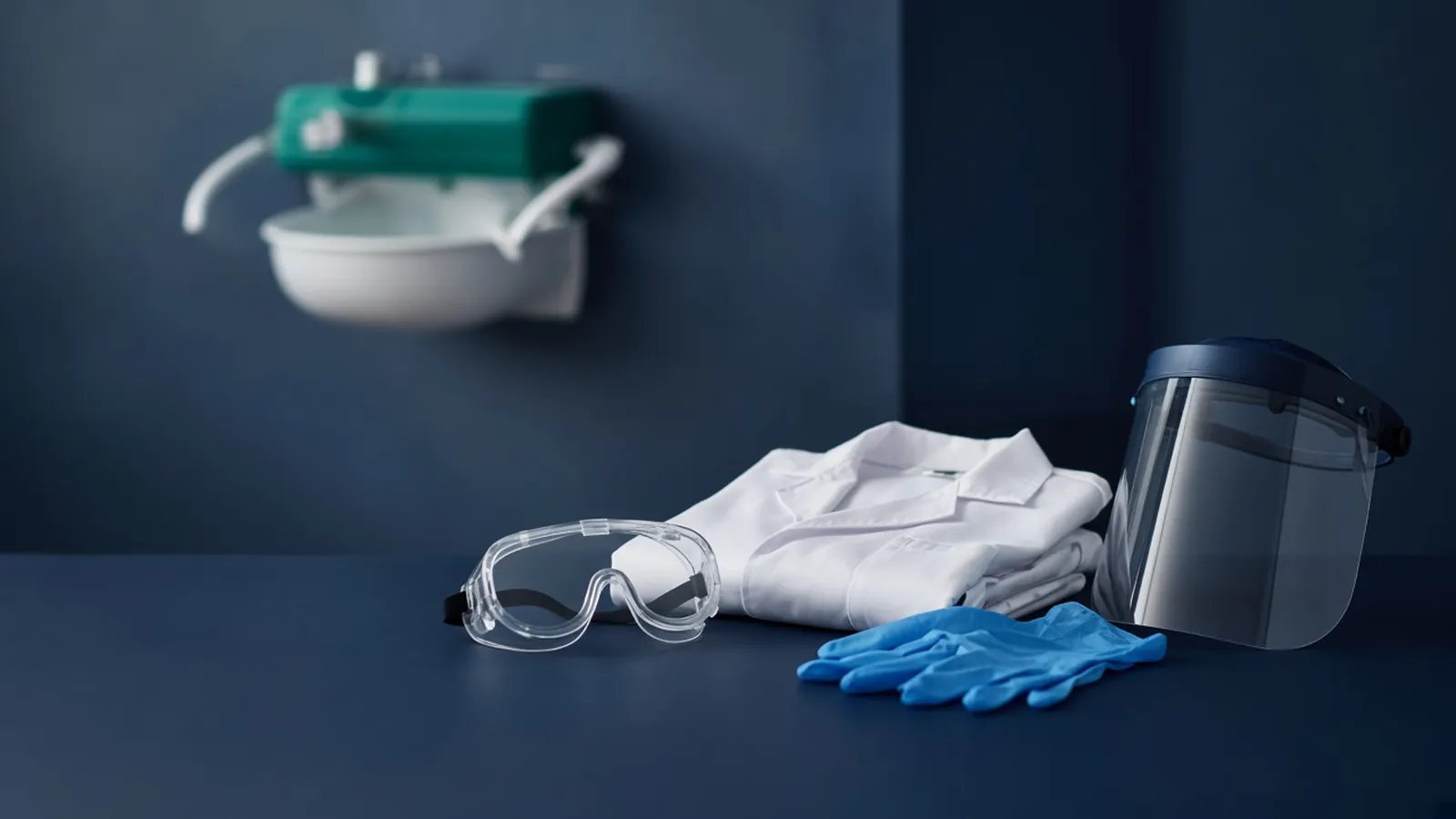
The cloth is the wrong first move. A spill has a name, a volume, a place, and a person who may already have some of it on a glove or a shoe. Biological material, acid, organic solvent, and cryogenic liquid do not share a cleanup. Starting from the cloth erases the only question that chooses the response: what is it? This guide stops at that decision. The safety data sheet and the local plan govern the actions that follow. Nothing below is a universal recipe, and nothing below is permission to clean a spill your plan tells you to leave for someone else.
The barrier stack around this moment is in biosafety basics for research benches. Why the written plan has to mention this room and this substance is in risk assessment is a local document. Absorbent pads, gloves, and eyewear are classes in laboratory consumables. A teaching laboratory building a real plan can use academic research and a quotation request for the materials the plan already named.
Identity, then family
Read the bottle that broke, or the tube whose label you can still see. If the container is destroyed, use the method in front of you: you were pouring glacial acetic acid, or you dropped a culture flask, or the nitrogen Dewar vented. "Clear liquid" is not an identity. Two clear liquids in the same laboratory can be buffer and solvent.
Put the identity into a family, because plans are written by family.
Biological material includes cultures, blood and tissue handled as biological, and recombinant material the assessment covers. The WHO laboratory biosafety manual and the CDC BMBL discuss spill response as part of practice: who may clean a small spill, what happens with aerosols, and how waste is treated. Your institution turns that into a local page with a named disinfectant, a contact time, and a threshold above which you leave the room and call. This article will not invent those parameters. If the plan says to let aerosols settle before anyone re-enters, the wait is the plan's wait.
Corrosive acids and bases are a chemical family. Concentration and volume decide whether the plan calls the spill small enough for trained staff or large enough to evacuate. Neutralisation is not a hobby. Adding a base to a concentrated acid can boil and throw the mixture. The safety data sheet is the chemical-specific document. Where the OSHA laboratory standard applies, that sheet and the chemical hygiene plan are the system you are inside. A biological disinfectant is not an acid neutraliser.
Organic solvents bring vapour and fire. The questions are ignition sources, whether the hood is the place of the spill, and whether the volume is already past the plan's threshold for leaving. A wipe that is reasonable for a few drops of ethanol on a bench is not a method for a litre of a flammable solvent. The fume hood words that matter if the spill is inside a hood are in fume hoods and volatile chemicals. If the fan is off, you do not have that capture.
Cryogens, including liquid nitrogen and dry ice, are a fourth family. Liquid nitrogen expands to a large volume of gas and can displace oxygen. It also freezes tissue on contact. Dry ice is a carbon dioxide hazard in a small room, and a cold burn if you hold it. The response is ventilation and the emergency plan's rule about entering a room that may be oxygen-deficient. It is not a mop, and it is not water poured on a pool of cryogen because water is what you use for some other spills. Skin contact is a cold injury. Follow the emergency plan. This page does not give first aid steps.
Mixed spills are common and worse. A culture lysed in phenol is biological and chemical. A broken thermometer in a solvent is its own historical mess, and you should not have mercury thermometers if the laboratory has already replaced them. When two families apply, the plan's instruction for mixed waste wins. If you have no mixed instruction, stop and call. Do not pick the family you know how to wipe.
People, place, and protective equipment
While you are still identifying the spill, keep uninvolved people out. Tell the supervisor the plan names. Look at yourself. If material is on your glove, that may be a glove change and a wash, for a tiny splash the plan treats as personal contamination rather than a room spill. If it is in your eye, the eyewash and the posted instruction come before any cleanup of the floor. The comparison of eyewear does not matter in that minute. The station does. See eye protection and a face shield for why you should already have known the path.
The protective equipment for cleanup can differ from the equipment you were wearing to pipet. The plan names it. A face shield and a different glove material are sometimes specified for a corrosive cleanup and would have been excessive for the original micropipetting. Do not stay in thin nitrile for a solvent that the glove chart says will defeat it. Do not invent a breakthrough time. If the chart and the plan do not give you a glove you trust, you are not the person who cleans that spill.
The place includes drains, paper on the floor, and the path to the corridor. Stop a flow toward a drain if the plan tells you to and if you can do it without wading into the spill. A drain is not a treatment plant. Ventilation that has failed is part of the place. A solvent spill in a closed room with a dead fan is an evacuation problem in most plans, not a mopping problem.
The branch when the label is gone
You return from the centrifuge and find a puddle under a bench where three people had bottles. Nobody can say which bottle. This is the branch. You do not sniff it as analysis. You do not dab it with bleach to "see what happens," because bleach mixed with the wrong chemical, including acids, can release a toxic gas. You close the area as the emergency plan describes, and you call. Curiosity is not identification.
A second branch is a spill you can name, inside a cabinet or a hood, with the fan running, and within the size the plan calls small. Then the plan's own steps apply, including the disinfectant or the absorbent it names. Follow them. Do not upgrade them with a second chemical because a poster in another building showed one. After the material is collected, the waste container is the one for that family. Biological waste may be an autoclave candidate. Solvent-soaked pads are chemical waste. Combining them in one bag is how the autoclave operator inherits a fire hazard. The limits of steam are in autoclaves and what sterilisation does not do.
| Family | First question | Why one shared recipe fails |
|---|---|---|
| Biological | Which agent, and does the plan say to wait for aerosols? | A disinfectant for the wrong organism, or no contact time, leaves the job undone |
| Acid or base | What concentration and volume, and what does the SDS say? | A random neutraliser can heat and splash |
| Organic solvent | Is there vapour and an ignition source, and is the fan running? | A biological wipe ignores fire and inhalation |
| Cryogen | Is oxygen displacement or a cold burn the hazard? | Water and a mop do not address asphyxiation |
| Unknown or mixed | Who does the plan say to call? | Guessing a family picks the wrong control, including a dangerous mix |
| Personal splash to the eye or skin | Where is the eyewash or the shower, and what does the card say? | Cleaning the floor first delays the person |
After the plan has been used
Write a short record: substance, approximate amount, where, who was exposed, which plan page you followed, and what was awkward. Awkwardness is data. If the absorbent was missing, if the eyewash was blocked, or if nobody knew the call list, the assessment is out of date. Update it. A spill that "turned out fine" without a record teaches the next person to improvise.
Thresholds for "small enough to clean ourselves" are local. Do not inherit another laboratory's litre limit. Your room's ventilation, your training, and your substances differ. If you are unsure which side of the threshold you are on, you are on the side that calls.
What this guide does not do
It does not authorise you to clean a spill. It does not assign a biosafety level. It does not treat an exposure or tell you that a substance is harmless because the volume looked small. Authorisation and emergency response sit with the institution. If someone is injured or contaminated, the emergency plan is the instruction. This page is educational. It is not medical care and not permission to proceed.
When the fan stops
A power cut during a solvent spill removes capture. The branch in a serious plan is to leave, not to wipe faster before the vapour builds. Write that branch down in buildings where power interruptions happen. Heat makes the same solvent evaporate faster, which tightens the time in which a "small" spill stays small. Neither fact gives you a recipe. Both facts belong in the plan you hope you will not need.
What to specify in an enquiry
Ask for the contents of a kit only after the plan has named them: absorbent compatible with the solvent family, gloves of a stated polymer, eyewear of a stated type, waste bags of a stated class. Say which families the room actually uses, so you do not receive a single "universal neutraliser." Send that with a quotation request. A kit without a plan is a purchase. The plan is the control, and it is written locally.
Identify the spill, then follow the plan for that family
- 01Stop and name the substanceRead the label, the safety data sheet, and what you were doing in the minute before the release. Write down the name, the concentration if you know it, and the approximate amount. A cloth is not the first step.
- 02If you cannot name it, do not improvise a treatmentAn unlabelled puddle is not a prompt to try a neutraliser or a disinfectant at random. Call the person the emergency plan names and keep other people out of the area the plan describes.
- 03Open the plan page for that familyBiological material, corrosive liquid, organic solvent, and cryogen have different plans. Use the page that matches the identity, including the protective equipment and the call-out threshold written there. Do not borrow the biological disinfectant for an acid.
- 04Record what happened so the assessment can changeAfter the plan's response, note the substance, the volume, the place, and whether the written plan was usable. A surprise solvent in a biological waste bag is a reason to edit the assessment, not a story that ends at the mop.
Questions from the bench
Is there a single spill kit that covers the whole laboratory?
A single bag can hold gloves, goggles, and absorbent pads. It cannot hold one procedure for every substance. The kit is useful only next to a plan that splits biological material, corrosives, solvents, and cryogens. Stocking the bag without that split is how people apply the wrong liquid to the wrong puddle.
Should I neutralise an acid spill with whatever base is on the shelf?
No. Mixing a concentrated acid with a random base can heat, splash, and still leave a hazardous residue. The safety data sheet and the local plan say whether neutralisation is even the response, and with what, and for which dilutions. If those documents are silent, you have not been given a method. Call the person they name.
A culture tube broke. Is ethanol from the wash bottle the cleanup?
Only if the biological spill plan names that alcohol, at that use, with a contact time you can actually achieve. Ethanol evaporates quickly and is a poor default for every organism. Many plans specify a different disinfectant and a wait for aerosols to settle. Follow the plan. This page does not supply a substitute recipe.
Does the autoclave finish a spill?
The autoclave is a destination for some collected biological waste, after the spill has been handled as the plan requires. It is the wrong destination for solvents and for many chemical absorbents. Steam also fails when the load is sealed or too dry, which the autoclave article explains. Do not carry an uncontained puddle to the machine.
References
Manufacturer names identify published method classes. Trademarks remain with their owners. Catalogue records on this site are independent references for enquiry. They are not a statement of inventory, distribution rights or a supply commitment. This page is educational. It is not medical advice, a diagnostic protocol or a biosafety approval.
Catalogue
Related products and categories
These links follow the subject of the article into published manufacturer references. A listing is a reference for an enquiry, not a statement of stock or distribution rights.
Continue in this cluster
Related reading
Biosafety basics for research benchesResearch-bench biosafety is a stack of barriers chosen by a risk assessment. This page explains the stack. It does not approve the work. Autoclaves and what sterilisation does not doSteam sterilisation holds a cleaned load at temperature. It does not wash, remove endotoxin, or prove sterility because the tape changed colour.A glossary of biosafety termsPairs that share a bench still do different jobs. Use this comparison to choose the right word for a cabinet, a chemical, a level, or a control.