
explainer
Storing eluted DNA and RNA
DNA is more forgiving than RNA once eluted. Choose TE or water, plan aliquots and freeze-thaw, and treat humidity and power cuts as storage risks.
- Author
- EVRINTH Editorial Team
- Published
- 8 October 2026
- Updated
- 8 October 2026
- Reading time
- 8 min
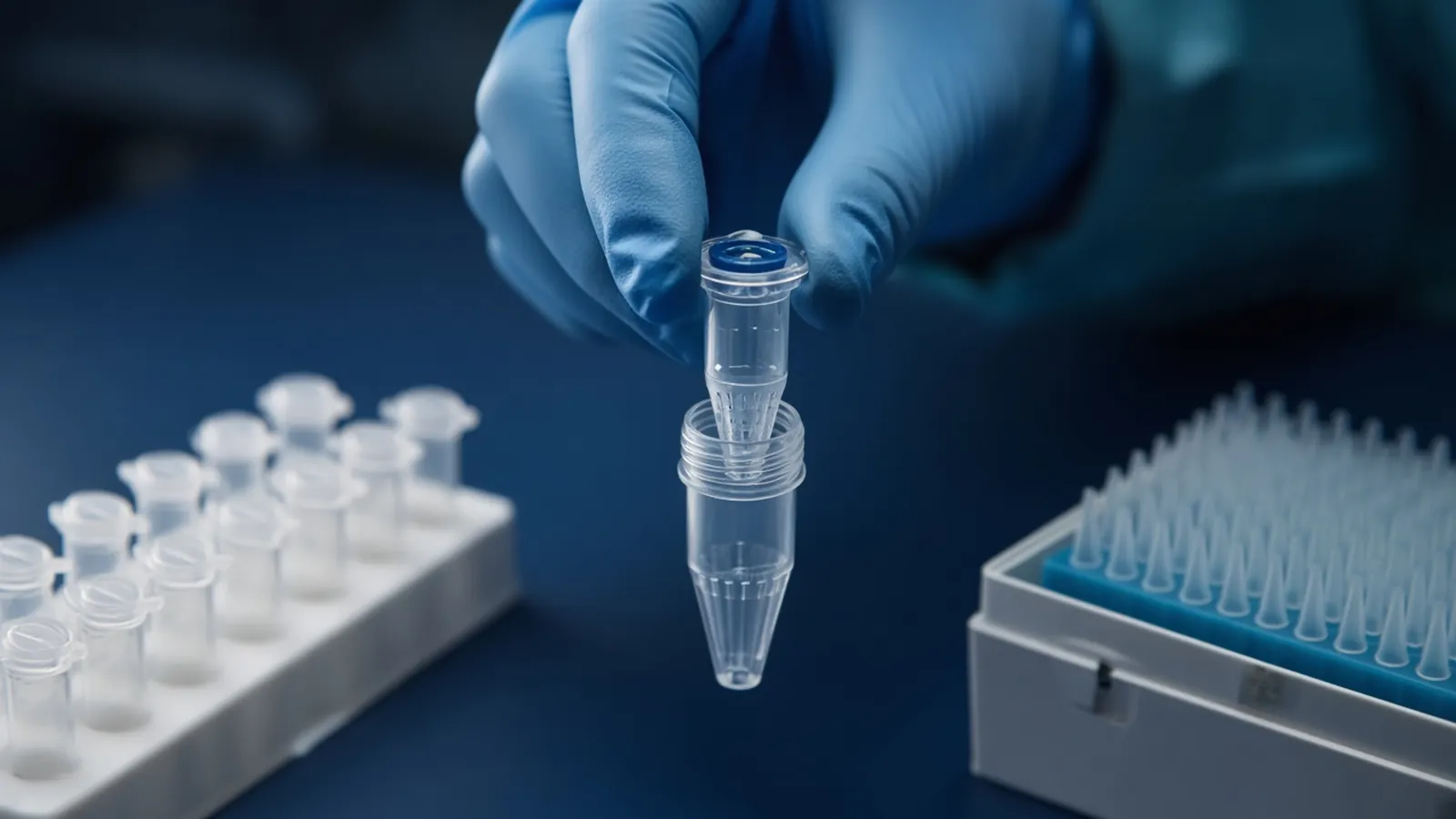
Storing eluted DNA and RNA starts from a chemical difference. DNA is more forgiving than RNA once it is in a clean buffer. RNA carries a 2-prime hydroxyl that makes the backbone easier to cut, and RNases are widespread, stable, and unimpressed by a quick chill. The same box, the same buffer, and the same thaw schedule are a weak plan for both molecules. This explainer is for research eluates from a silica column, a bead wash, or a precipitation. It is not a stability certificate and not a clinical storage protocol.
How the eluate was made still matters. Sample lysis and the extraction class decide how much nuclease and inhibitor came through. Those choices are in how DNA extraction methods differ. Keeping RNA intact up to the moment of elution is in protecting RNA during extraction. Freezer habits for specimens in general are in storing biological samples from fridge to freezer.
Why the two polymers part company
In water, DNA loses bases slowly when the pH drops, and it breaks when nucleases or harsh chemistry attack the backbone. In a mild buffer, cold, that process is slow enough that many laboratories treat a DNA working stock as a durable reagent. RNA does not earn the same assumption. A single nick removes a transcript from the intact pool a long-read or an integrity assay cares about. RNase does not need a cofactor in the way many DNases do, so a chelator that helps DNA is not a complete RNA strategy.
Storage therefore has two goals that you should name separately. One is chemical: hold pH, limit metals, limit enzyme activity, limit warmth. The other is practical: the tube you thaw next month must still be the tube you labelled today, with the buffer you think it has.
TE and water
TE, Tris plus EDTA, is the usual planning buffer for stored DNA. Tris resists the slow acidification that pure water can pick up from carbon dioxide. EDTA binds divalent metals that many nucleases use. Together they make a quieter tube than water for a DNA archive.
EDTA is also why TE annoys later enzymes. Polymerases, ligases, and restriction enzymes need magnesium. A few microlitres of TE in a large reaction are often tolerated, because the assay buffer contains extra magnesium. The same TE used as a large fraction of a small reaction can inhibit. Follow the enzyme card you actually have. Storage buffer and assay buffer are allowed to differ. Keep the archive in TE. Dilute into the reaction, or elute the aliquot you will use tomorrow into water or the buffer the assay names.
Water elutions are kinder to enzymes and harsher as archives. There is no EDTA to sequester metals, and the pH is less defended. They suit a prompt downstream step and a DNA you will not ask to wait for months. If you elute in water because the kit said so, and you then need to store the DNA, you can add a planned buffer afterwards. Do that deliberately and relabel. Do not discover at the ligation bench that half the tubes are water and half are TE.
RNA is often eluted in nuclease-free water because many RNA kits and many reverse transcription mixes are written that way. Some protocols use a specified RNA storage buffer. Follow the insert and the next assay. Do not add a DNA-style TE out of habit without checking whether that EDTA level is acceptable downstream. Whatever you choose, write it on the tube. An unlabelled RNA tube cannot be stored correctly because you no longer know the plan.
Aliquots and freeze-thaw
Freeze-thaw is a warm interval repeated on purpose. Crystals, a brief rise in temperature, and condensation on the lid all happen. For DNA the damage is often modest until nucleases are also present. For RNA the same cycle is a real way to lose integrity. Aliquots sized to one experiment mean you thaw once and discard or reserve the leftover under a new label if you keep it.
Avoid using the stock as the working tube. A single master elution split into a stock you rarely touch and several assay aliquots is the usual shape. Label each aliquot with buffer and date, not only with the sample code. A frost-free freezer that warms on a timer is a poorer home than a manual-defrost box if your laboratory can choose. The mechanism is the cycling, not the logo on the door.
Do not invent a maximum cycle number and treat it as a law. Record thaws when the molecule is RNA or the assay is sensitive. If an assay fails and the tube has a long thaw history, that history is a candidate cause alongside the extraction.
Minus 20 and minus 80 as planning habits
Many laboratories keep DNA working stocks at minus 20 Celsius and a backup colder when the sample is scarce or the project is long. RNA is commonly planned for minus 80 Celsius when it must last, with minus 20 only as a short hold if the protocol you follow allows it. These are habits for planning a freezer map. They are not a measured half-life for your eluate. Input from sample lysis, residual nuclease, and the buffer decide the real life of the tube.
A fridge is a short stop for a DNA you will use the same day, not an archive. RNA does not belong in a fridge as a storage plan except for the brief interval a method explicitly allows, on ice. Room temperature is for the minutes the protocol is in your hands.
| Habit | DNA | RNA |
|---|---|---|
| Common buffer | TE for archive, water if the assay demands it | Nuclease-free water or the buffer the insert names |
| Working cold | Often minus 20 Celsius | Prefer minus 80 Celsius for anything you must keep |
| Aliquots | Worth doing for scarce samples | The default, one use per thaw |
| Main later risk | EDTA inhibiting a small enzyme reaction | RNase and repeated thaw |
Humidity, frost, and power cuts
Humidity shows up as soon as a cold tube meets wet air. Condensate on the rim dilutes the next pipette and can carry nucleases if the rim was touched. Open briefly, spin down, and close. Frost inside a box hides tubes and scrapes labels. A tube you cannot read is not a stored sample. The labeling and freezer articles cover how to keep identity attached.
A power cut is a different event from ordinary storage. While the freezer is warm, both polymers leave the habit you planned, and RNA leaves it faster. Record the excursion: how long, how warm if you know, which boxes. Do not assume DNA and RNA survived equally, and do not assume either is fine because the compressor is running again. Quarantine scarce RNA until a small integrity check says it is still the molecule you needed. DNA often tolerates a short warming better. A long outage is a new piece of history on the sheet, not a continuation of the old plan. Dry ice packing and handover, if the tubes must move, belong to the cold-chain practice in the storage article, not to a hope that the box stayed cold in traffic.
Failures after storage
An assay that worked on day one and fails after a month has a short list: nuclease, the wrong buffer discovered late, evaporation that raised the salt, a label swap, or an integrity loss you can see on a gel. Measure again rather than reusing the old concentration forever. Evaporation concentrates DNA and also any inhibitor. A higher number is not automatically a healthier tube.
EDTA inhibition looks like a dead enzyme with plenty of DNA. Dilute the input or clean into water and retry a small reaction before you declare the clone or the amplicon gone.
Safety
Stored nucleic acid from an infectious specimen can still be regulated as that specimen's waste class. Follow institutional biosafety rules for freezers and for what may be moved. The WHO laboratory biosafety manual is background for that decision. Cold burns and broken tubes in a frosted box are ordinary physical hazards. This page does not approve diagnostic archiving.
What an enquiry should include
State DNA or RNA, the elution buffer you must end in, the hold time you are planning, and whether the next enzyme is sensitive to EDTA. That is the storage half of a purification request. Use the sample preparation catalogue and the sample preparation pathway, and send it with the quote request. The nucleic acid isolation enquiry reference is an enquiry reference for the prep that produces the eluate. Ask whether a quotation is possible.
Questions from the bench
Should every eluate go into TE?
TE is a sound default for DNA you will store, because Tris holds pH and EDTA reduces metal-dependent nuclease activity. It is a poor default when the next reaction is small and the DNA volume is a large share of it, since EDTA can chelate the magnesium the enzyme needs. Elute a working aliquot in the buffer the assay accepts, or dilute the TE so the carry-over is small.
Why is RNA planned colder than DNA?
RNA is cleaved more readily, and RNases are common and stable. Laboratories commonly keep DNA working stocks at minus 20 Celsius and plan longer RNA storage at minus 80. Those are habits, not a guarantee for your buffer and your nuclease load. A silica column elution does not change that chemistry.
How many freeze-thaw cycles are allowed?
There is no universal count that fits every tube. Each thaw gives nucleases a warm interval and, for RNA, accumulates breaks. Aliquot to the volume of one use so a single thaw does not spend the whole prep. If a tube has already been through several thaws and the assay is failing, treat that history as a real variable.
Can I leave eluted DNA on the bench overnight?
A clean DNA in TE often tolerates a short time at ordinary room temperature better than RNA does, and a hot bench is harsher than a cool one. Overnight on an open rack is still a risk from dust, nucleases, and evaporation. Return DNA to the freezer your plan names, and do not leave RNA out while you image a gel.
References
Manufacturer names identify published method classes. Trademarks remain with their owners. Catalogue records on this site are independent references for enquiry. They are not a statement of inventory, distribution rights or a supply commitment. This page is educational. It is not medical advice, a diagnostic protocol or a biosafety approval.
Catalogue
Related products and categories
These links follow the subject of the article into published manufacturer references. A listing is a reference for an enquiry, not a statement of stock or distribution rights.
Continue in this cluster
Related reading
How DNA extraction methods differHow silica columns, beads, precipitation and organic extraction change DNA yield, length and inhibitors, and which class fits the assay you actually plan toA glossary of purification termsDefine chaotrope, bind-wash-elute, yield, purity ratios and RIN, then walk a purification so those words describe one real workflow.Blood saliva and tissue as starting materialExplain how EDTA blood, heparin blood, saliva and solid tissue behave as extraction inputs, and why a serum tube is not whole blood.