
selection guide
A glossary of protein-prep terms
Fourteen protein-prep words, from lysate to glycerol stock, each tied to the mistake it stops before a purification is misread.
- Author
- EVRINTH Editorial Team
- Published
- 8 October 2026
- Updated
- 8 October 2026
- Reading time
- 9 min
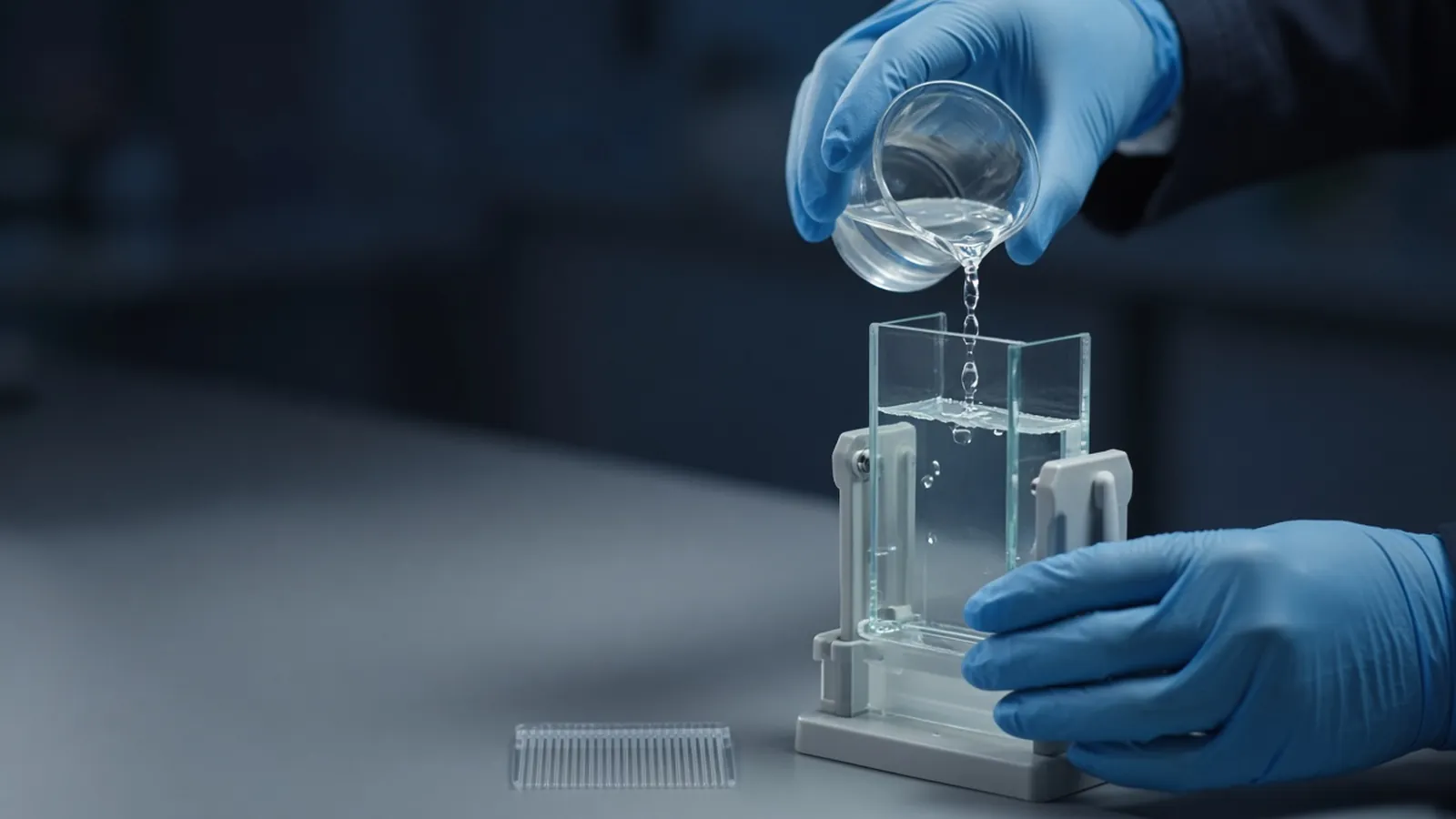
Protein work fails in conversation before it fails at the centrifuge, when two people use the same word for different liquids. Lysate, elution and pellet sound obvious inside one laboratory and become ambiguous the moment a tube is handed on. This glossary fixes fourteen terms to the mistake each one prevents. It is a selection aid for research records, not a purification protocol and not a clinical specification.
Bands and ladders are interpreted in reading a protein gel. Column families sit in affinity and ion-exchange protein purification. How a buffer is written, including the temperature of the pH reading, is in preparing a buffer and checking pH.
Where the protein actually is
A lysate is the mixture after cells or tissue have been broken. It contains soluble protein, insoluble debris, nucleic acids, metabolites and whatever detergent or inhibitor you added. Calling a lysate "the protein" hides the fact that the target may be a minor band. The mistake it prevents is loading a purification or an assay as if the tube were already a single species.
A supernatant is the liquid above a pellet after centrifugation. It is soluble only relative to that spin: speed, time and buffer decide what stayed up. A gentle clarifying spin leaves membranes and aggregates in suspension. An ultracentrifuge spin can pellet complexes a microcentrifuge would call soluble. The mistake it prevents is treating every supernatant as the native, monomeric protein.
A pellet is the material that sedimented. It may be unbroken cells, cell walls, organelles or aggregated protein. Washing a pellet and calling it waste is rational only when you have checked that the target is in the supernatant. The mistake it prevents is throwing away the fraction that holds the protein of interest.
An inclusion body is a dense aggregate of recombinant polypeptide, common in bacterial expression when folding does not keep up with synthesis. It is not a contaminant from the medium, and it is not evidence that the sequence is wrong. Washed inclusion bodies can look impressively pure on a gel and still be inactive. The mistake it prevents is either discarding the pellet as junk or shipping the pellet as if it were folded enzyme. Host context for that choice is in expression hosts in outline.
What the column did
IMAC means immobilised metal-affinity chromatography. A metal ion, often nickel or cobalt, is held on a resin and binds a histidine-rich tag. IMAC is a capture step. It is not a synonym for pure protein. Host proteins with surface histidines, and any protein that sticks nonspecifically, can share the elution. The mistake it prevents is equating "it came off the nickel column" with a single band, or with a correct fold.
An elution is the liquid in which bound material was released, by imidazole, salt, pH or a competing ligand, depending on the resin. An elution is a set of fractions, not one tube, until you pool on purpose. The mistake it prevents is combining every UV-positive fraction, including the shoulders that are mostly contaminants, and then describing the pool as the peak.
Flow-through is whatever did not bind. It is the control that tells you the column was actually working. A target that appears in the flow-through never saw the elution buffer as its home. The mistake it prevents is discarding that liquid before a gel or an activity assay has looked at it. Early fractions and flow-through deserve the same labelling discipline as the peak.
Three numbers that get reused too casually
MWCO is the molecular-weight cut-off printed on a dialysis membrane or a centrifugal concentrator. It is a nominal rating, not a sharp sieve. A protein near the cut-off leaks, and a protein far above it can still stick to the membrane. The mistake it prevents is choosing a cut-off close to the protein mass and then explaining a low yield as "the column was poor". Concentrating choices are set out in concentrating a dilute protein.
pI is the isoelectric point, the pH at which the protein's net charge is zero. Solubility is often worst near that pH, and ion-exchange binding depends on the charge on either side of it. A calculated pI from a sequence is a planning figure. Tags, modifications and the buffer ions move the practical window. The mistake it prevents is buffering the sample at the calculated pI and reading the resulting cloudiness as degradation.
Specific activity is activity divided by the amount of protein, in whatever units the assay and the quantification method define. It rises when inactive protein is removed and falls when the catalyst is damaged. Total activity and specific activity answer different questions: how much work the tube can do, and how enriched the catalyst is. The mistake it prevents is reporting a brighter Bradford number as if it were a purer enzyme. Quantification methods are compared in how laboratories estimate protein concentration.
Reagents and archives that are not the protein
Reducing sample buffer is the gel-loading mixture that contains SDS plus a reductant such as DTT or beta-mercaptoethanol. It is for electrophoresis. It is the wrong liquid in which to store an enzyme you still want active, and a reduced lane is a different experiment from a non-reduced lane. The mistake it prevents is comparing those lanes as if the protein had been treated the same way, or quenching an activity assay with gel buffer.
A protease inhibitor is a set of chemicals meant to slow unwanted cleavage. Cocktails differ. Some inhibit the serine proteases, some the metalloproteases, and some will also inhibit the enzyme you intended to measure. They slow proteolysis. They do not rewind a sample that sat warm for an afternoon. The mistake it prevents is writing "plus inhibitors" as if the band pattern were frozen in time.
Endotoxin, in this context, is lipopolysaccharide from Gram-negative bacteria. It is a contaminant class, not a Coomassie band. The mistake it prevents is reading a clean gel as an endotoxin result. The separation between those claims is in endotoxin is a separate question from purity.
A glycerol stock is a frozen suspension of a clonal culture, typically in a final glycerol concentration the laboratory's own method sets, often discussed around 15 to 25 percent. It is an archive of cells, not an archive of purified protein. The mistake it prevents is thawing the master stock as a convenience, or assuming the stock's antibiotic marker proves the plasmid map. Practice points are in glycerol stocks of an expression clone and in storing biological samples from fridge to freezer.
A handoff that uses the words on purpose
Write the fraction name at the moment you create the tube, not at the end of the day. Branch as soon as a word and a gel disagree. If the notebook says elution and the gel looks like the lysate, you pooled too widely or you mislabelled. If the notebook says supernatant and the protein is known to form inclusion bodies, run the pellet on the same gel before you conclude the expression failed. If the notebook says IMAC-pure, ask whether flow-through and elution were both loaded, and whether a second method, such as ion exchange, was even part of the plan.
When a control fails, change the word rather than the hope. A cloudy "soluble fraction" is a suspension. A "pure" lane with three bands is an enriched fraction. Specific activity that collapses after a buffer exchange means the assay and the protein disagreed with the new buffer, which preparing a buffer and checking pH is meant to make explicit.
| Term | Mistake it prevents |
|---|---|
| Lysate | Treating a broken-cell mixture as one protein |
| Supernatant | Assuming solubility without stating the spin |
| Pellet | Discarding the fraction that holds the target |
| Inclusion body | Calling an insoluble recombinant aggregate either junk or native enzyme |
| IMAC | Equating a histidine capture with purity |
| Elution | Pooling every UV peak into one unnamed tube |
| Flow-through | Throwing away unbound target |
| MWCO | Picking a membrane cut-off too close to the protein mass |
| pI | Buffering at the least soluble pH by accident |
| Specific activity | Using a mass assay as a purity assay |
| Reducing sample buffer | Mixing a gel reagent into a functional experiment |
| Protease inhibitor | Believing cleavage has been abolished |
| Endotoxin | Reading a gel as a lipopolysaccharide measurement |
| Glycerol stock | Thawing the master, or trusting a marker in place of a map |
When the vocabulary is used and the experiment is still wrong
Correct nouns do not repair a swapped tube. Two elutions from neighbouring columns, both labelled elution, are how samples trade identities. Add the construct name, the date and the fraction number. A glossary is a constraint on language, not a tracking system by itself.
Calculated pI and nominal MWCO are model numbers. If the protein precipitates a full pH unit away from the predicted pI, believe the tube. If a 50 kDa protein vanishes through a membrane rated far below that mass, suspect a damaged device or a cleaved protein, and check on a gel before you rewrite the definition of cut-off.
Research use, not a regulated vocabulary
These definitions support research notes and enquiry text. They are not a pharmacopoeia, a biosafety classification, or a diagnostic claim. Whether a lysate is infectious, whether an inclusion-body prep needs a cabinet, and whether endotoxin data may be shown to a collaborator are decisions for the institution's own rules. Chemical inhibitors and acrylamide belong in that assessment too.
Writing the same words in a specification
Laboratories that share samples across cities lose time when "pure" and "eluted" mean different things on each side. A short specification can list the fraction name, the buffer with pH and the temperature of that measurement, the resin class, and which assay produced the concentration. Heat and delayed transit do not change the definitions. They do make an unlabelled pellet unrecoverable as knowledge, even if the protein is still in the ice.
What the enquiry should say
Name the construct, the fraction you want (soluble supernatant, washed inclusion body, IMAC elution, or a later polish), the buffer the downstream assay requires, and the evidence you will accept on a gel. Reagent classes for buffers, inhibitors and resins are in the reagents and chemicals catalogue. Scope for expression and purification can be discussed through the custom protein expression enquiry reference. Put the fraction words in the quote request so the reply addresses the tube you actually need.
Questions from the bench
Is a clarified lysate the same thing as a purified protein?
A clarified lysate is a supernatant after cells were broken and debris was spun down. Thousands of proteins can still be in that liquid. Purification starts when a later step, such as a column, separates the one you mean from that mixture.
Should the flow-through always be discarded?
Only after a gel or an activity check shows the target bound. A flow-through that still contains the band is the sample, and the elution may be mostly contaminants that stuck instead. Keep the flow-through cold and labelled until that check exists.
Does specific activity replace a gel?
Specific activity reports catalytic work per unit of protein mass. It can rise as contaminants leave, and it can also fall if the enzyme is damaged while the gel still looks full of protein. The two measurements answer different questions, so a record usually carries both.
Which words belong on a tube that leaves the building?
Write lysate, supernatant, elution or whatever fraction it actually is, plus buffer, date and owner. Add inclusion body or endotoxin only when those claims were tested. A pet name from the notebook does not travel.
References
Manufacturer names identify published method classes. Trademarks remain with their owners. Catalogue records on this site are independent references for enquiry. They are not a statement of inventory, distribution rights or a supply commitment. This page is educational. It is not medical advice, a diagnostic protocol or a biosafety approval.
Catalogue
Related products and categories
These links follow the subject of the article into published manufacturer references. A listing is a reference for an enquiry, not a statement of stock or distribution rights.
Continue in this cluster
Related reading
Reading a protein gelHow to read a protein gel: what SDS-PAGE bands, smears, ladders and loading differences can support, and what they cannot identify. Affinity and ion-exchange protein purificationHow affinity capture and ion exchange pull a protein from a lysate, and why each collected fraction still needs an identity check.
 Preparing a buffer and checking pHPrepare a buffer at a stated pH and temperature, record the salt form, and treat a drifting electrode or a bad slope as a failed control.