
explainer
Disinfectants and contact time
Contact time, concentration, and organic load decide whether a disinfectant can work. Ethanol and bleach both fail in predictable ways.
- Author
- EVRINTH Editorial Team
- Published
- 8 October 2026
- Updated
- 8 October 2026
- Reading time
- 9 min
A disinfectant fails quietly when the surface looks wiped and the liquid has already gone. The active chemical needs a concentration and a wet contact time on a surface that is not buried under agar, blood, or soil. Evaporation, organic load, and an incompatible material are the usual reasons a bottle from the shelf does not do what a general label suggested. This page explains those constraints. It does not publish a kill claim, a universal dilution, or a contact time you can copy into a protocol.
Where disinfectants sit among the other barriers is in biosafety basics for research benches. Why the choice belongs in a document about this agent and this room is in risk assessment is a local document. Chemical classes are in laboratory consumables and, for the reagents catalogue, reagents and chemicals. A teaching specification can go through academic research and a quotation request.
Wet time is the mechanism you can see
Disinfection is chemistry at a surface. The active molecule has to meet the organism for long enough, at a high enough concentration, in a form the organism cannot hide from. When the liquid films out and dries, the meeting stops. A wipe that flashes to dryness in a warm room was a brief rinse. The policy's contact time is the time the surface must stay visibly wet, or otherwise as the policy defines "wet," not the time you spent moving your hand.
That is why the technique and the chemical are one decision. Flooding a bench and walking away can keep it wet, and it can also run into drawers and damage equipment. Wiping to a just-damp film can look tidy and miss the time. The institutional disinfectant policy is the compromise that was actually accepted: which product, which dilution, which surfaces, which time, and which follow-up wipe if the residue itself is a problem. Your variation is not a second policy.
Organic load sits in front of the chemistry. Protein, blood, soil, and spent agar consume oxidative disinfectants, chlorine especially, and they shield organisms from contact. The practical consequence is the sequence many policies already use: remove the gross soil, then apply the disinfectant for the full time. Cleaning and disinfecting are different verbs. A towel that smears a colony across a dry bench and is then spritzed with alcohol has spread the material and then dried it.
Ethanol and bleach, as limits rather than recipes
Ethanol is the disinfectant people trust because it is already on the bench. Aqueous ethanol around seventy percent by volume is the preparation laboratories usually mean, because higher concentrations evaporate even faster and can coagulate surface protein in a way that interferes with penetration. That sentence is a reason to respect the preparation your policy names. It is not a claim that seventy percent ethanol kills a named organism in a named number of minutes. Alcohol evaporates. In a warm laboratory it evaporates sooner. Spores and some non-enveloped viruses are the textbook cases where alcohol is the wrong class of product. If your agent is in that situation, the policy will have named something else. Do not promote ethanol to a universal wipe because the wash bottle is closer.
Sodium hypochlorite, the active agent in bleach, is a different class. Available chlorine does the oxidative work, and organic matter spends it. Working dilutions lose strength with time, with light, and with heat, so policies tell you to prepare them fresh and to date the bottle. The concentration on the stock bottle is part of the arithmetic. Two "bleach" bottles with different labelled hypochlorite contents are different reagents. This page will not tell you to use a one-to-ten dilution of whatever is under the sink. Use the dilution the policy calculated for the bottle you actually have.
Bleach corrodes stainless steel, including the work surface of a biosafety cabinet. Policies that allow bleach on that surface usually require a follow-up wipe, after the contact time, so the residue does not stay and pit the metal. The cabinet SOP and working inside a biosafety cabinet are the local version of that sentence. Bleach plus acid releases chlorine gas. Bleach plus ammonia releases chloramines. Those are reasons to keep hypochlorite away from other bottles, not reasons to memorise a homemade blend.
Other classes exist: quaternary ammonium compounds, hydrogen peroxide and peracetic acid preparations, phenolics, and alcohols other than ethanol. Each has a spectrum, a material compatibility, and a residue. The manufacturer's instructions and the institutional policy choose among them for a stated purpose. A product marketed for floors is not automatically a product for a cabinet. A product accepted for a virus is not automatically the one accepted for spores. Read the purpose the policy wrote. Do not generalise from the word "disinfectant" on the front of the bottle.
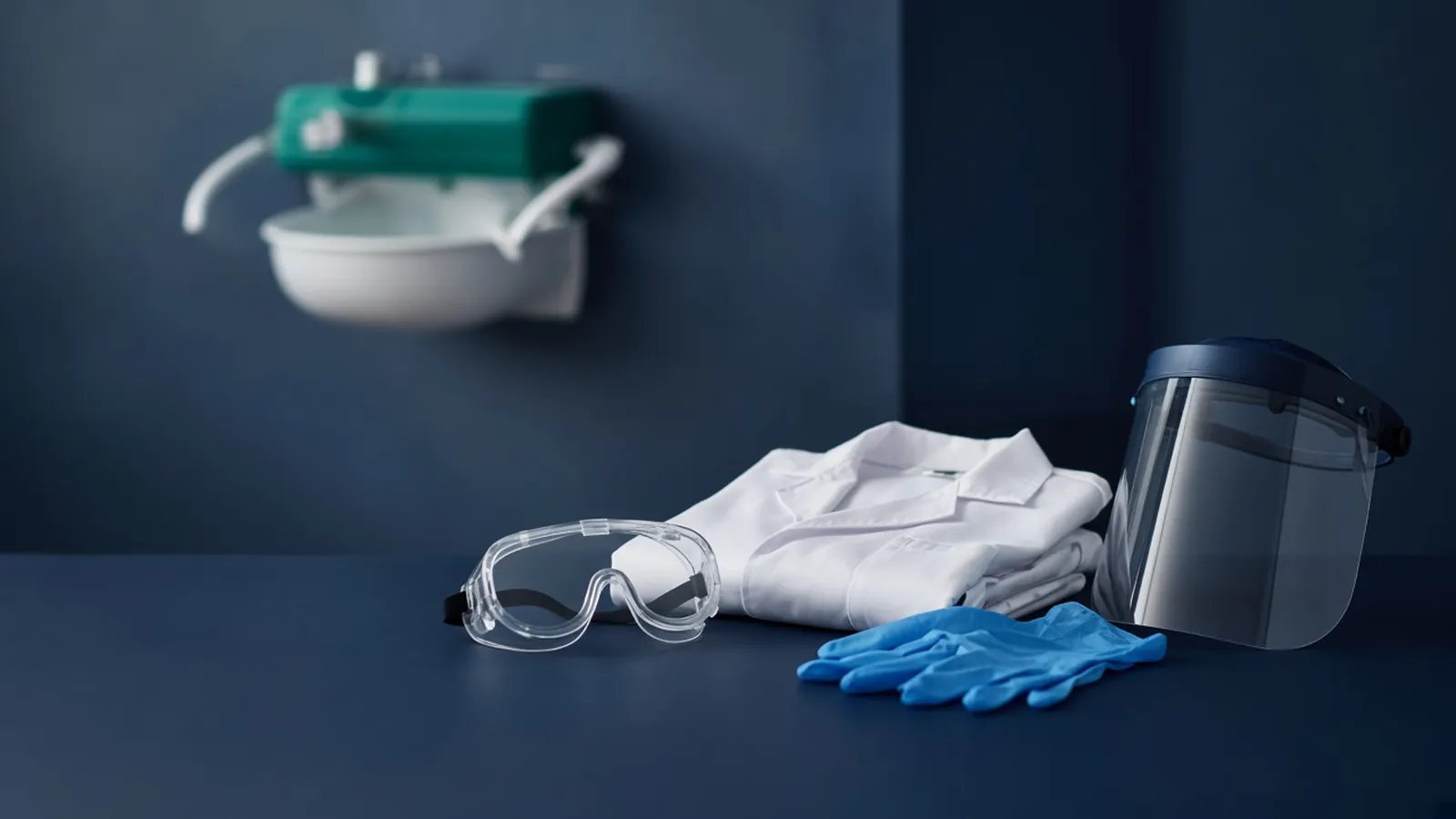
The WHO laboratory biosafety manual and the CDC BMBL treat disinfection as a practice under the assessment, with the agent and the organic load in view. They are not a licence to publish your own kill table. Chemical hazards of the disinfectant itself fall under the safety data sheet and, where it applies, the OSHA laboratory standard. The disinfectant is a chemical you can be hurt by. Gloves and eye protection match that chemical, which is the argument of PPE that matches the task. Ethanol is flammable. Bleach is irritating. The PPE for "just a wipe" is still the PPE for that bottle.
What disinfection does not finish
Disinfection is not sterilisation. A surface disinfectant does not make a load of waste sterile, and it does not replace a validated steam cycle for the loads your waste SOP sends to the autoclave. The limits of that cycle, including dirty loads and loads steam cannot penetrate, are in autoclaves and what sterilisation does not do. The mirror error is to autoclave a chemical disinfectant as if steam improved it. Follow the waste category. Many disinfectants are not autoclave loads.
A wipe also does not finish a spill by itself. Spill response starts with identity. The disinfectant the biological plan names is for that plan, at that contact time, after any wait the plan requires for aerosols. It is not the response to a solvent or an acid. That split is spill cleanup starts with the substance identity.
The branch when the surface dries early
You apply the policy's product and, before the contact time has passed, the bench is dry. The branch is to apply again so the surface stays wet for the full time, if the policy allows repeated application, or to change the method to one the policy says will hold a film. Do not record the time from a clock you started while watching a dry surface. In a hot room, prefer the preparation and the volume the policy allows you to use so dryness is less likely. Do not switch to a higher percentage of ethanol on the theory that "stronger is better." You may only have made it flash off faster.
A second branch is visible soil. If agar or blood is still on the surface, you are not in the disinfectant step yet. Remove the soil the way the policy says, with the waste stream that soil belongs to, then start the contact time. A third branch is the wrong surface. Bleach on a cabinet, ethanol on a particular plastic, a phenolic on skin: compatibility is in the policy and the safety data sheet. Skin is not a bench. Disinfectants are not hand soap, and they are not wound care. Handwashing after glove removal is a different control, described in gloves are not a substitute for handwashing.
| Factor | What it changes | What to read |
|---|---|---|
| Contact time | Whether the chemical and the organism actually met | The institutional policy, not a neighbour's habit |
| Concentration | The preparation you think you are using | The labelled active content and the policy's dilution |
| Organic load | Chlorine and other oxidants are consumed. Soil shields organisms | Clean first when the policy says to clean first |
| Evaporation | Alcohol films disappear, faster in a warm room | Whether the surface stayed wet for the whole time |
| Material | Bleach corrodes metal. Some products attack plastics | Cabinet SOP and the safety data sheet |
| Spectrum | Alcohol is a poor default for spores and some viruses | The policy's match to your agent. No invented kill claim |
| Mixing | Incompatible mixes can release gas | One product at a time, as written |
Authority
The policy that names the product is an institutional document. This explainer does not approve a disinfectant for your organism, does not set a biosafety level, and does not tell you a surface is safe to touch. Authorisation sits with the institution. Disinfectants are not medicines and not a treatment for a splash on a person. An exposure follows the emergency plan and the safety data sheet.
Heat, storage, and a working dilution
Warm storage and warm benches shorten both the wet time of alcohols and the useful life of a hypochlorite dilution. Date the working bottle. Discard it on the schedule the policy gives you, sooner if it has been held in the heat or has been fed with dirty pipettes. Specify, when you buy, the labelled concentration and the container material. A vague request for "bleach" will be answered with whatever concentration the seller assumes, and your dilution arithmetic will be wrong before the first wipe. Keep the stock capped. Do not top up a working bottle with a new strength and keep the old date.
What to put in an enquiry
Name the active class, the labelled concentration you need, the surfaces it must be compatible with, and the pack size your policy's expiry can live with. Ask for the safety data sheet and the manufacturer's stated uses. Say if the product must be suitable for a stainless cabinet surface, or if it is only for floors. Send that with a quotation request. Do not ask a supplier to guarantee that the product kills your organism, and do not accept a kill slogan in place of the policy's contact time.
Questions from the bench
Why is wiping with ethanol not enough for every organism?
Ethanol evaporates quickly, so the surface often dries before a meaningful contact time. Its spectrum is also not universal. Bacterial spores and some non-enveloped viruses are the usual teaching examples of organisms for which alcohol is a poor choice. The institutional policy matches the agent. This page does not claim a kill percentage.
Does a stronger bleach solution always work better?
Concentration is one variable, and it is set by the policy from the labelled sodium hypochlorite content. Too weak, and you are not using the preparation the policy validated in its own terms. Stronger than the policy is not a free improvement: bleach corrodes metal, irritates skin and eyes, and still fails when organic matter consumes the chlorine. Follow the dilution and the contact time you were given.
Is disinfection the same as sterilisation?
No. Disinfection is a reduction of relevant organisms under stated conditions, and it often does not include a claim about bacterial spores. Sterilisation is a validated process intended to kill microorganisms, including spores, when the load is prepared so the agent can reach them. An autoclave is one sterilisation tool, with the limits in the autoclave article. A wet bench wipe is not that process.
Can I mix bleach with a cleaner to save a step?
Do not mix bleach with acids, ammonia, or cleaners you have not been told are compatible. Acid and hypochlorite can release chlorine gas. The policy names one product at a time, at one concentration, for one contact time. If the surface is soiled, the usual pattern is to clean, then disinfect, not to invent a blend.
References
Manufacturer names identify published method classes. Trademarks remain with their owners. Catalogue records on this site are independent references for enquiry. They are not a statement of inventory, distribution rights or a supply commitment. This page is educational. It is not medical advice, a diagnostic protocol or a biosafety approval.
Catalogue
Related products and categories
These links follow the subject of the article into published manufacturer references. A listing is a reference for an enquiry, not a statement of stock or distribution rights.
Continue in this cluster
Related reading
Biosafety basics for research benchesResearch-bench biosafety is a stack of barriers chosen by a risk assessment. This page explains the stack. It does not approve the work. Autoclaves and what sterilisation does not doSteam sterilisation holds a cleaned load at temperature. It does not wash, remove endotoxin, or prove sterility because the tape changed colour.A glossary of biosafety termsPairs that share a bench still do different jobs. Use this comparison to choose the right word for a cabinet, a chemical, a level, or a control.